

Web server penetration testing is a very important cybersecurity activity through which a systemized test of a web server is conducted to identify security defences and weaknesses. Organisations are increasingly using web-based applications and services, and this reason makes web server penetration testing a necessary tool in maintaining a strong security posture and preserving their sensitive data against cyber threats.
In the current world of digital technological applications, web servers are the backbone of online activities; they provide the hosting of corporate websites, as well as complex web applications. Nevertheless, cyber criminals continuously risk attacking these servers with the intent of finding vulnerabilities to gain unauthorized access, steal data, or compromise any part of the service offered. By conducting extensive web server penetration testing, companies can realize and accommodate all security loopholes before ill-minded entities exploit them.
The guide examines the core techniques, tools, and methodologies that are applied in web server security testing, offering details on common defects and best practice tips to secure the web server environment.
Understanding Web Server Penetration Testing Fundamentals
Web server penetration testing is an ordered procedure of testing the security of Web servers by replicating the real-life conditions of an attack on the servers. The steps given here involve duly authorised ethical hackers, who seek to discover, exploit, and report about vulnerabilities which may be used by evil doers.
The main aim of web server vulnerability assessment is to enable organisations to have clear knowledge of their security position. This is because this methodology of testing is more than just the use of automated scanning tools, since the method also includes manual testing methods that could detect more complex vulnerabilities than scanning tools could.
Explore: How to Perform penetration testing on web applications?
Key Components of Web Server Testing
The components of web server security testing include several essential elements that combine synergistically to deliver a comprehensive security assessment:
- Reconnaissance and information gathering: Scanning publicly available information on the web about the target web server in terms of software and operating systems used on the server, and the network setups.
- Vulnerability Identification: Methodical scanning and examination of the web server to determine known security weaknesses and misconfigurations
- Exploitation Testing: Trying to figure out how bad the vulnerability is by trying to exploit it to see what damage it may do and what benefits could be compromised.
- Post-Exploitation Analysis: To assess the level of possible damage and access that might be attained after a successful exploitation has been conducted
A methodology organizes the process of web server penetration testing, guaranteeing that the depth of coverage is ethically neutral and does not cause more disruption than necessary to the production systems.
Secure Your Web Server Today — Get a Comprehensive Testing a real sample Report from Our Experts.

Essential Techniques for Web Server Security Assessment
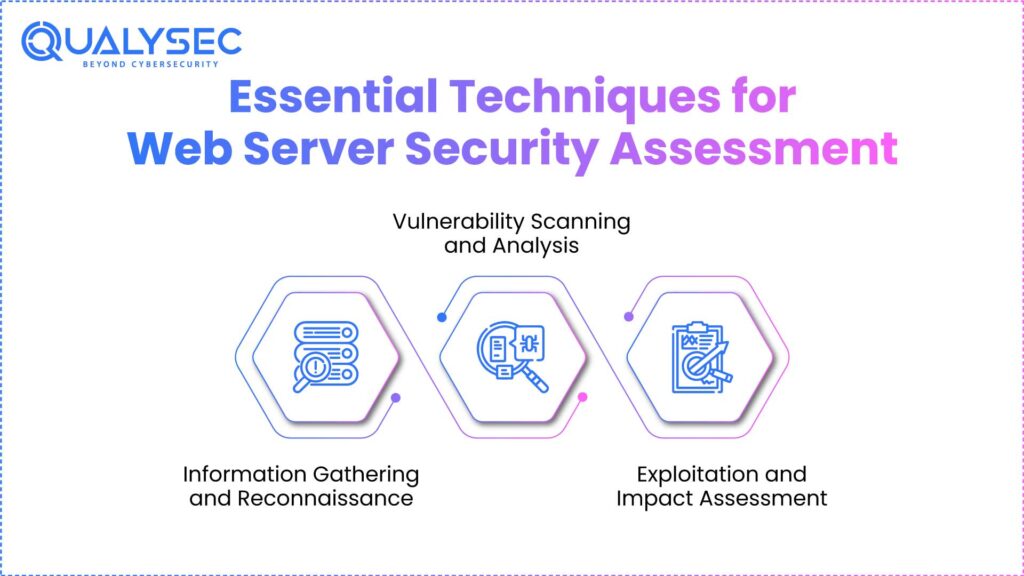
Web server penetration testing must include both automated and manual testing methods. These approaches are combinational and thus ensure their effectiveness in thoroughly covering potential attack routes and insecurities.
Information Gathering and Reconnaissance
The first stage of web server security testing will be information gathering of the target system. This reconnaissance step is very important in this attack surface knowledge and the ways of entry.
At this stage, the security practitioners use different methods to gather data on the web server’s infrastructure. DNS enumeration assists in recognising subdomains and the corresponding IP addresses, whereas banner grabbing provides the version and configuration of the server software. Techniques of Google hacking might expose sensitive information that might have been exposed by accident during indexing by search engines.
Vulnerability Scanning and Analysis
Web server vulnerability assessment offers a wide range of utilities in automated and manual determination of vulnerabilities. Automated vulnerability scanners are able to discover vulnerabilities and misconfigurations rapidly by looking at large server infrastructures, considering the known vulnerabilities.
Nevertheless, it is imperative to have manual analysis to find complex vulnerabilities that would be overlooked by automated tools. This will involve an analysis of custom setups, improper logic checks, and the security of the custom applications installed on the web server.
- Port Scanning: Port ID and open services that are connected to the target web server
- Service Enumeration: The process of determining specific versions and configurations of the identified services
- Configuration Analysis: Analysing server setups to spot insecurities and misconfigurations
- Custom Application Assessment: Appraising Web applications at the server side about application programming vulnerability
Exploitation and Impact Assessment
In the exploitation step of web server penetration testing, testers make an effort to exploit the discovered vulnerabilities to see how attackers can actually use them. They must think through this step well to avoid harming production systems and to illustrate the possible impact of security vulnerabilities.
Controlled exploitation methods are utilised by security experts to confirm vulnerable issues and ascertain the degree to which the security posture of the organisation will be affected. This can involve trying privilege escalation, lateral movement, or data access to show exactly how compromised the environment could be.
Read Also: What is Web Application Scanning & What are its Types?
Common Web Server Vulnerabilities and Attack Vectors
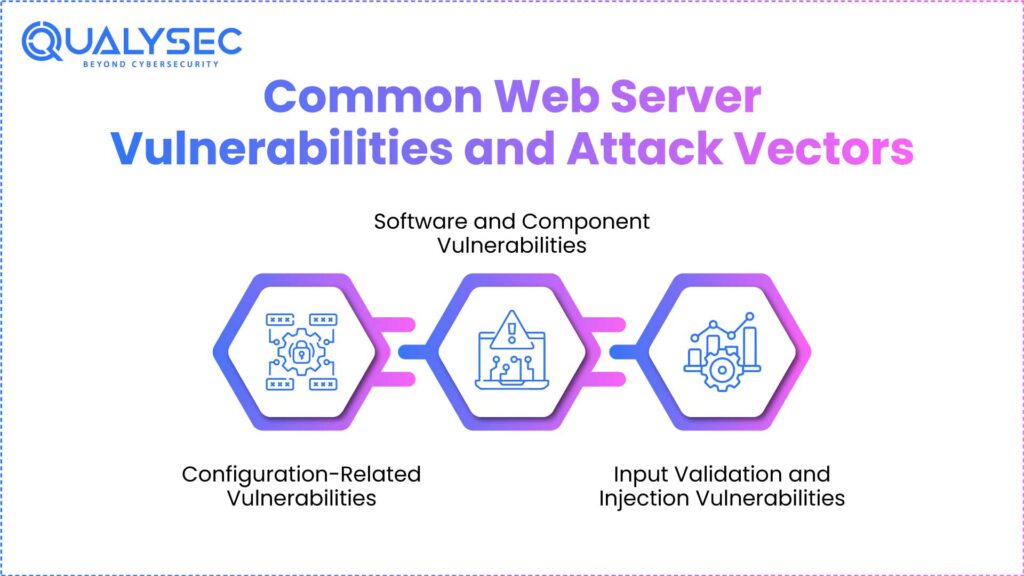
To ensure proper security testing and protection, organizations need to know about common web server vulnerabilities. Malicious actors most commonly observe such weaknesses as security vulnerabilities in the arena of web servers.
Configuration-Related Vulnerabilities
Most common web server vulnerabilities are misconfigurations or a lack of implementation of security best practices. The default settings would normally revolve around practicality instead of security, making the systems prone to intrusion.
Examples of server misconfigurations include using the default credentials, unwanted server services, incorrect file permissions, and weak access controls. Such problems are especially hazardous as they frequently give access to attackers with an easy or even effortless entry to systems.
Directory listing vulnerabilities enable attackers to look through directories on the server, and they might find sensitive files. On the same note, inadequate error handling may expose sensitive data regarding server settings and file configurations to possible attackers.
Software and Component Vulnerabilities
The most common web server vulnerabilities entail obsolete software and software patches. The web servers usually use several programming features such as the basic server program, addons, modules, and libraries:
- Unpatched Server Software: Windows web servers) whose software is more than a year old and has security holes
- Vulnerable Plugins and Modules: Third-party extensions that can harbour vulnerabilities
- Obsolete Supporting Libraries: Software libraries that have been exploited due to an exploitable vulnerability
- Insecure Default Configurations: Default configurations over functionality-oriented security.
Explore: Top 10 Web Application Security Risks And How To Mitigate Them
Input Validation and Injection Vulnerabilities
A particularly significant list of common web server vulnerabilities is the failure of input validation. The circumstances under which the web servers fail to sanitise, encode, or verify entry by the user reveal the vulnerabilities, allowing an attacker to execute malicious code or commands during an attack.
SQL injection weaknesses enable cybercriminals to alter queries on the affected databases and, therefore, they may expose stolen data or unauthorised access. The weakness could be termed as command injection, which grants the attacker an opportunity to be able to execute any command on the server and potentially lead to the compromise of the entire system.
Examples of such vulnerabilities are cross-site scripting (XSS), whereby the attacker may have access to insert malicious scripts in web pages that may cause unauthorised access to other users or even the theft of some useful information. These exploits are the limit to the area of proper input validation, including output encoding in the protection of web servers.
Identify and Eliminate Web Server Vulnerabilities Before Hackers Exploit Them. Start Your Security Test Now- Contact Us!

Essential Tools for Web Server Penetration Testing
Modern web server penetration testing consists of using an eclectic array of specialised software, which identifies, analyses, and exploits vulnerabilities. They would comprise manual test frameworks to automatic scanners, which are oriented towards various influences of the testing procedure.
Network Scanning and Enumeration Tools
Web server security testing on the network requires the use of network scanning tools that offer vital reconnaissance services. The use of these tools can aid a security professional to gain insights about the network topology and, hence, detect possible attack vectors.
Arguably, the most multipurpose network scanning program, Nmap can perform port scanning, service identification, and operating system fingerprinting. It has a scripting engine to enable custom vulnerability scanning and auto-testing use cases.
Masscan has high-speed port scanning capabilities, is thus perfect for a large-scale web server vulnerability assessment project. It is useful during preliminary survey stages, as it can check thousands of hosts in a very short amount of time.
Web Application Testing Frameworks
Specifically designed web application testing tools for web server security testing and web application vulnerability testing. The tools include complete test functionality for current web situations.
Burp Suite is a combined web application security testing environment with proxy and vulnerability scanning capabilities and a tool to aid manual testing. It has an extensible architecture that enables security professionals to tailor the testing methodologies to fit a specific situation.
OWASP ZAP has a freely available alternative that contains extensive scanning capabilities and an active community of developers. It also has automated scanning capabilities with manual testing capabilities that make it useful in performing comprehensive web server penetration testing.
- Nikto: Scanning tool that finds typical vulnerabilities and misconfigurations using a specialised scanner meant to run against web servers.
- Dirb/Gobuster: Directory and file brute-forcing tools that find hidden resources and content
- SQLMap: SQL injection Vulnerability tester tool that automates testing of databases.
- Metasploit: An elaborate penetration testing framework with numerous exploit modules.
Vulnerability Assessment Platforms
The latest vulnerability assessment platforms give an automated ability to scan, along with well-rounded reporting and control systems. These platforms simplify the process of auditing web server vulnerability assessment and simultaneously give one nuts and bolts information on security postures.
They usually combine several scanning engines and deliver a single console to manage security vulnerabilities in extensive networks. They normally have options to schedule routine scans, monitor remedial activity, and produce compliance reports.
Got the Right Tools to Secure Your Web Server? Explore the Top Pen Test Tools Now.
Why Qualysec Stands Out in Web Server Penetration Testing?
Qualysec has emerged as one of the critical performers in the market of cybersecurity services that offer solutions for web server penetration testing in a comprehensive way. The innovative business model used by the company is a blend of advanced technology and experience to provide a superior security assessment service that offers more than testing algorithms.
In assessing the security of web servers, the approach used by Qualysec combines both automatic and manual web server security testing to cover all the areas that an attacker can exploit. The team of certified security professionals at the company affords the company a wealth of experience in discovering and exploiting security holes that are complex to detect using automated tools.
The real difference that Qualysec has, though, is that they always aim to give actionable data and insights as opposed to merely pointing out vulnerabilities. In their thoroughly reported work, they give particular remediation instructions, prioritise risks, and make tactical suggestions on enhancing the security postures overall. This practice would provide maximum returns on web server vulnerability assessment investments by the clients.
Industry Standards Combined with Real-World Expertise
The company adheres to strict industry-standard frameworks in its testing process but retains techniques based on real experience gained over the years. The security experts at Qualysec keep abreast of newer threats and new means of attack, which makes their testing methodologies up-to-date and would be able to counter contemporary cyber threats.
Qualysec also offers full post-testing services, such as remediation validation and long-term security consulting services. The willingness to ensure the success of the clients goes beyond the initial testing period, as organisations can also keep good security postures in the long term.
Ready to strengthen your web server security? Schedule a consultation with Qualysec’s experts today to discuss your specific security needs and develop a comprehensive testing strategy.

Advanced Testing Methodologies and Best Practices
Web server penetration testing should not be merely an automated process with results reviewed. More developed techniques also involve threat modelling, risk analysis, and monitoring techniques to deliver an end-to-end security assessment.
Threat Modelling and Risk Assessment
The introduction to modern web server security testing starts by modelling the threats thoroughly to determine the possible attack vector and prioritise the testing procedure. The method makes testing efforts aimed at the most severe issues and subjects at risk.
Threat modelling requires studying the web server structure, assets, and data flows, and calculating the possible lines of attack. Such an analysis assists security experts in knowing the possible ways that an attacker can target the system and where to direct defensive strategies.
Risk assessment is a combination of vulnerability identification and analysis of impact to the business to prioritise a work order of remediation. This will make sure that organisations handle the most severe security concerns initially and take the greatest possible benefit of scarce assets to improve security.
Continuous Testing and Monitoring
Web server vulnerability assessment should not be a one-off process but an evolving process that evolves with the changing threat environment and systems architecture. Incremental testing strategies assist companies to have good security positions in the long run.
The use of regular testing schedules holds them in good stead since they are able to discover the new vulnerabilities promptly as the systems evolve and new threats appear. Automated monitoring tools can address frequent monitoring that helps monitor the security posture between formal testing cycles.
- Scheduled Vulnerability Scans: Scans often detect new vulnerabilities and configurations.
- Configuration Monitoring: Constantly check the configurations of the servers to identify modifications made without the authorization of the servers.
- Security Metrics Tracking: Continuous measures of security gains and the progress made in handling security vulnerabilities
- Incident Response Integration: Inclusion of results of the testing in the incident response preparation and planning
Transform your cybersecurity posture with Qualysec’s advanced penetration testing services. Contact our team to learn how we can help protect your organisation.
Conclusion
Web server penetration testing represents a critical component of modern cybersecurity strategies, providing organisations with essential insights into their security postures and potential vulnerabilities. Through comprehensive testing methodologies that combine automated scanning with manual analysis, malicious actors can exploit security weaknesses before organisations identify and address them.
The evolving threat landscape requires organisations to adopt proactive approaches to web server security testing, incorporating regular assessments, continuous monitoring, and comprehensive remediation strategies. Understanding common web server vulnerabilities and implementing appropriate testing methodologies helps organisations maintain robust security postures in increasingly complex digital environments.
Success in web server vulnerability assessment depends on combining the right tools, methodologies, and expertise to provide comprehensive security evaluations. Organisations that conduct regular penetration testing and continuously monitor security are better positioned to defend against cyber threats and protect sensitive data.
By implementing the techniques, tools, and best practices outlined in this guide, organisations can significantly improve their web server security postures and reduce their exposure to cyber threats. The key lies in adopting a comprehensive approach that addresses both technical vulnerabilities and procedural weaknesses while maintaining focus on continuous improvement.
Take the first step toward stronger web server security. Connect with Qualysec today for a comprehensive security assessment tailored to your organisation’s specific needs.
Frequently Asked Questions
1. What is web server penetration testing?
Web server penetration testing is a systematic security assessment process that involves authorized ethical hackers attempting to identify, exploit, and document vulnerabilities in web server environments. This testing simulates real-world attack scenarios to help organisations understand their security weaknesses and implement appropriate remediation measures.
2. Why is web server penetration testing important for cybersecurity?
Web server security testing is crucial because web servers are prime targets for cybercriminals seeking to access sensitive data or disrupt services. Regular penetration testing helps organizations identify vulnerabilities before malicious actors can exploit them, ensuring compliance with security standards and protecting valuable digital assets from cyber threats.
3. What are the common vulnerabilities found in web servers?
Common web server vulnerabilities include configuration errors, unpatched software components, input validation failures, weak authentication mechanisms, and improper access controls. These vulnerabilities can lead to unauthorized access, data breaches, and service disruption if not properly addressed through regular security assessments.
4. What tools are commonly used to assess web server weaknesses?
Popular tools for web server vulnerability assessment include Nmap for network scanning, Burp Suite for web application testing, OWASP ZAP for automated scanning, Nikto for web server-specific vulnerabilities, and Metasploit for exploitation testing. These tools work together to provide comprehensive coverage of potential security weaknesses in web server environments.