What Is the NIS2 Directive Requirements? A Complete Guide for Europe Businesses
Discover the NIS2 Directive requirements that strengthen cybersecurity across the EU and help organizations achieve compliance with the latest regulatory standards.
The EU NIS2 directive (Directive (EU) 2022/2555) is now enforceable in every European Union Member State as of 18th of October 2024. This is a major change in the EU’s cybersecurity law, which can be compared to GDPR in terms of its significance. Thus, the NIS2 Directive, which is still in force, has set up new requirements that compel organizations to deploy network protection, incident management, and supplier control. While the initial NIS2 Directive requirements (2016) applied only to operators with a critical function, NIS2 has now broadened its scope.
What is the NIS2 Directive?
The Network and Information Security (NIS2) Directive is a regulatory framework established by the European Union to enhance the cybersecurity of critical infrastructure and digital service providers. In December 2022 (the first NIS Directive was issued in 2016), the European Parliament and the Council passed the NIS2, which legally came into effect on 16 January 2023. It required national transposition by Member States by 17 October 2024.
During its 39th Plenary Meeting in Cyprus on 26 May 2026, the NIS2 Cooperation Group accepted standard incident reporting templates to provide a clear and consistent format for reporting cybersecurity occurrences. This simplification aims to lighten the administrative load on businesses and guarantee more consistency in incident reporting across the EU. The new templates also correspond with more general EU projects like the suggested single entry point for incident reporting under the Digital Omnibus.
What Is The Purpose of the NIS2 Directive?
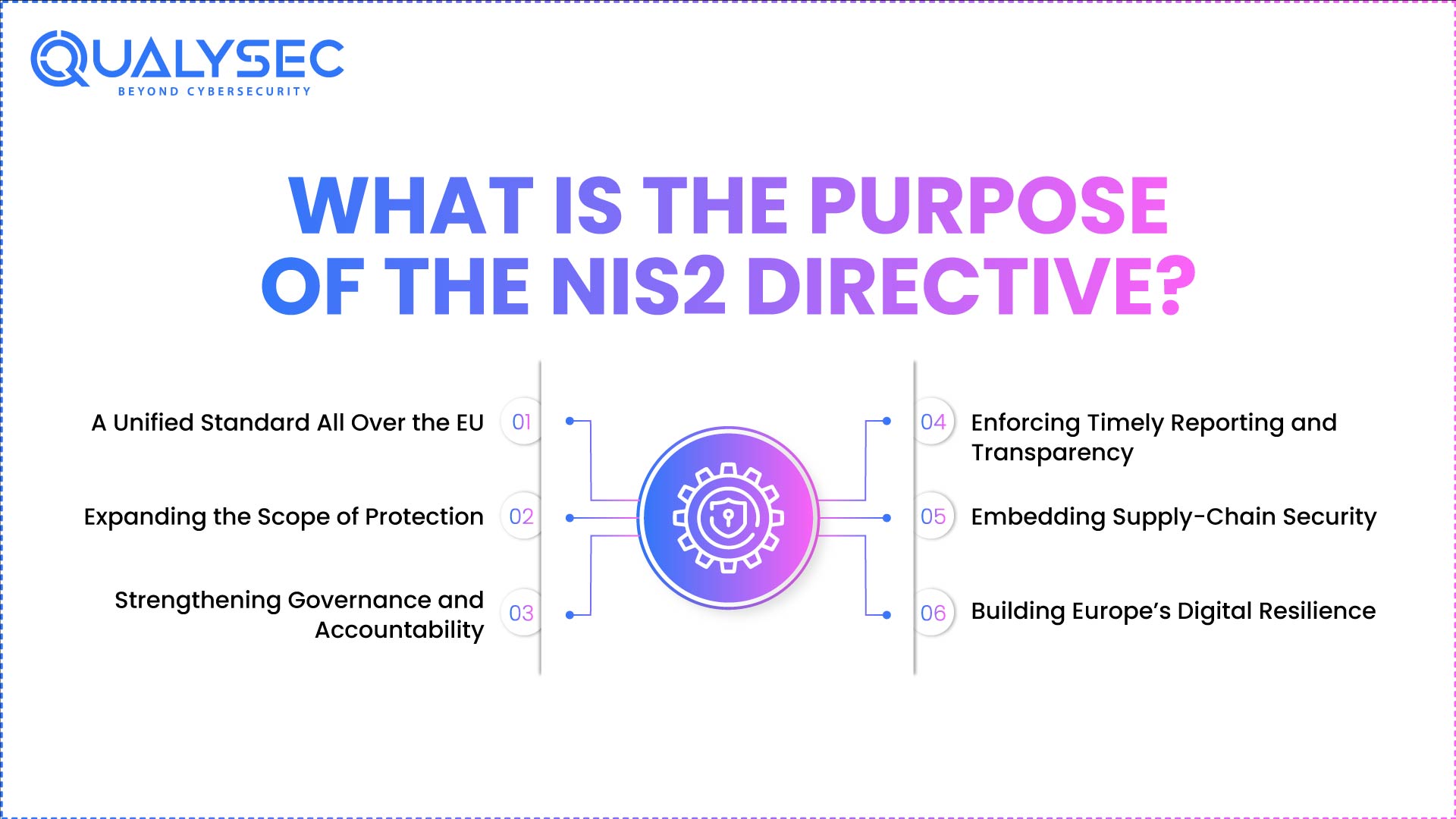
Several factors can be mentioned in favor of the EU NIS2 directive. These are:
1. A Unified Standard All Over the EU
The NIS2 framework is regarded as a consistent minimum requirement for cybersecurity compliance throughout Member States. NIS1, on the other hand, only resulted in variations in the nature of implementation by countries, leading to further fragmented obligations and consequently, uneven protection. NIS2, however, does away with that fragmentation through the definition of common rules, procedures for reporting, and mechanisms for enforcement.
2. Expanding the Scope of Protection
The Directive now covers 18 critical and important sectors, ranging from energy, banking, and healthcare to postal services, public administration, and digital providers like cloud platforms or DNS services. It recognises that digital supply chains are interconnected and a breach in one service can ripple across borders.
3. Strengthening Governance and Accountability
The NIS2 directive framework elevated accountability to a higher level. The top management and the boards of directors have now assumed direct responsibility for the establishment, testing, and documentation of the cybersecurity measures. Non-compliance is no longer solely an IT failure; it can lead to legal and financial implications for the executives personally as well.
4. Enforcing Timely Reporting and Transparency
The Directive’s primary objective is to enhance incident reporting throughout the EU. Authorities must be notified as soon as possible so that the national Computer Security Incident Response Teams (CSIRTs) can carry out more effective coordination and mitigation of the threats.
5. Embedding Supply-Chain Security
Modern cyber threats frequently exploit third-party vendor vulnerabilities. The NIS2 Directive mandates explicit obligations regarding risk assessments and security audits for suppliers and service providers, a statutory first in EU cybersecurity law.
6. Building Europe’s Digital Resilience
Ultimately, NIS2 aims to establish a robust collective defense posture. Rather than attempting to eliminate all breaches, it focuses on minimizing impact, ensuring rapid business continuity, and positioning cybersecurity as a strategic governance priority. Similarly, DORA reinforces this approach for the financial sector by emphasizing digital operational resilience, risk management, incident response, and business continuity.
Who Must Comply with the NIS2 Directive?
NIS2 is relevant for Public and Private organizations that offer essential or important services in the EU market. It is broken down into the following two main sections:
Entity Classification
Covered Sectors
Criteria & Thresholds
Essential Entities (EE)(High Criticality)
Energy, transport, banking, financial market infrastructures, health, drinking water, wastewater, digital infrastructure, ICT service management (B2B), public administration, space.
Medium & Large enterprises (≥50 staff OR >€10 million turnover/balance sheet).
Important Entities (IE)(Critical Sectors)
Postal & courier services, waste management, chemical manufacturing & distribution, food production & processing, manufacturing (medical devices, electronics, machinery), digital providers (marketplaces, search engines, social networks), research organisations.
Medium & Large enterprises (≥50 staff OR >€10 million turnover/balance sheet).
Note for Micro & Small Enterprises: Micro and small enterprises can also be designated when they are critical to national security, national or public safety, or to major economic activities.
Note for Non-EU Businesses: Non-EU businesses providing regulated services in the EU will also need to meet NIS2 requirements and appoint a legal person in an EU Member State.
You might also be like to reading about other EU compliance regulations such as GDPR and EU MDR.
NIS2 Directive Requirements in Europe
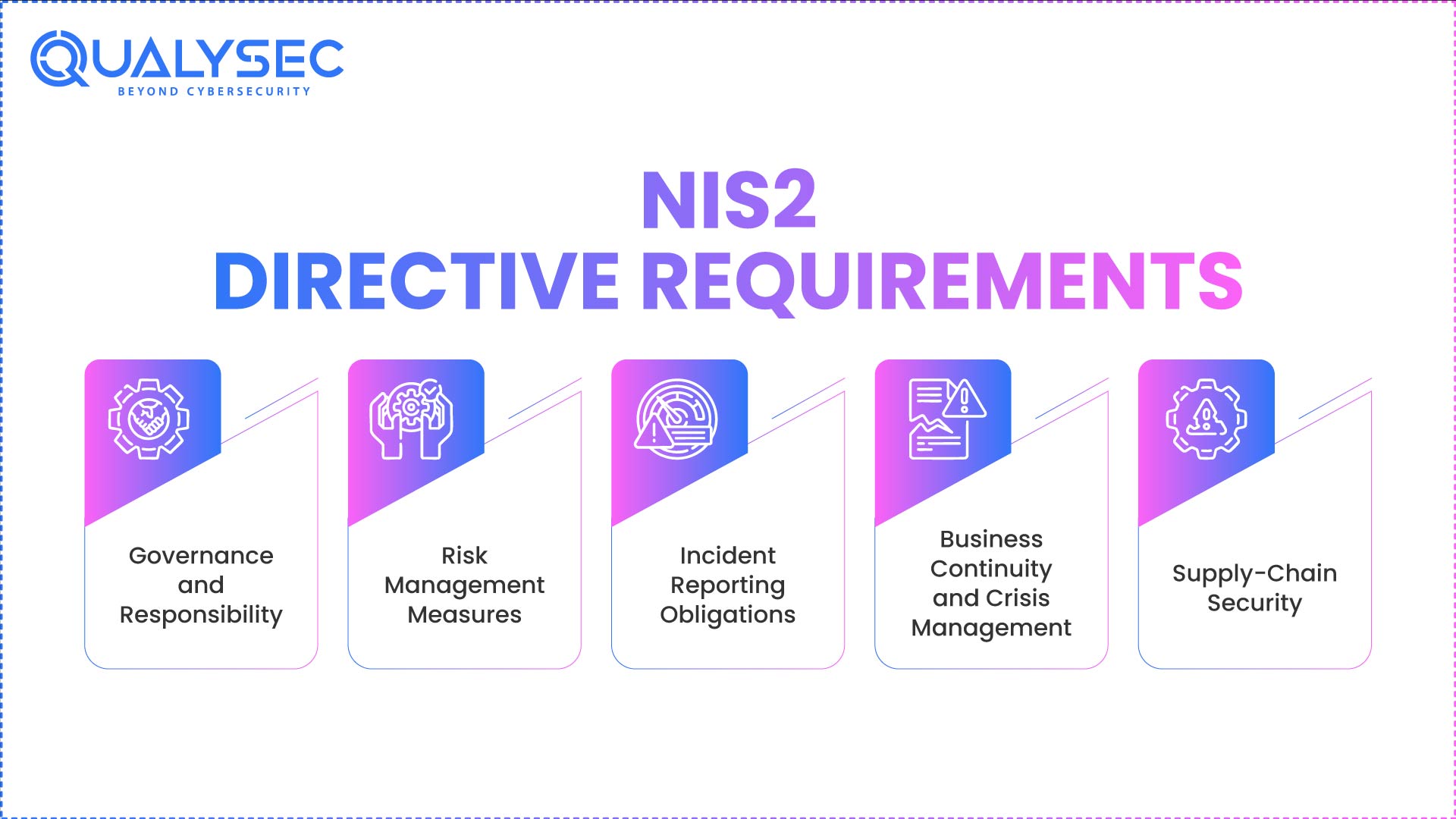
After an organisation identifies its classification, it must adhere to the fundamental security and governance requirements of the Directive, which Article 21 lists as core.
Board members will receive cybersecurity training and can be held personally liable for gross negligence in oversight.
Firms should establish responsibility in information security at the top leadership.
2. Risk Management Measures
To cope with cyber risks, companies have to make the relevant and corresponding technical, operational, and organisational decisions. These are:
Information system security policy and risk analysis.
Incident continuity/incident handling plans.
Policies on access control, authentication, and encryption.
Patches and disclosure of vulnerabilities.
Multi-factor authentication and secured communications.
All these measures should be recorded, analyzed regularly, and contain verifiable evidence in the form of the penetration testing results, risk register, or logs of incidents.
3. Incident Reporting Obligations
A three-tier reporting structure applies (Article 23):
Initial notification within 24 hours (“early warning”).
Detailed report within 72 hours of incident detection.
Final report within one month, or a progress update if still ongoing.
The national CSIRT or the competent authority in every Member State should receive the reports.
Relevant indicators of compromise (IoCs) are also supposed to be shared by organisations where necessary.
4. Business Continuity and Crisis Management
There should be tested backup systems, disaster recovery, and crisis response measures by companies.
Technical & Operational Cybersecurity Measures Under NIS2 Directive
NIS2 turns cybersecurity controls into mandatory governance evidence. Any NIS2 cybersecurity measure has to be recorded, experimented with, and auditable by the regulators.
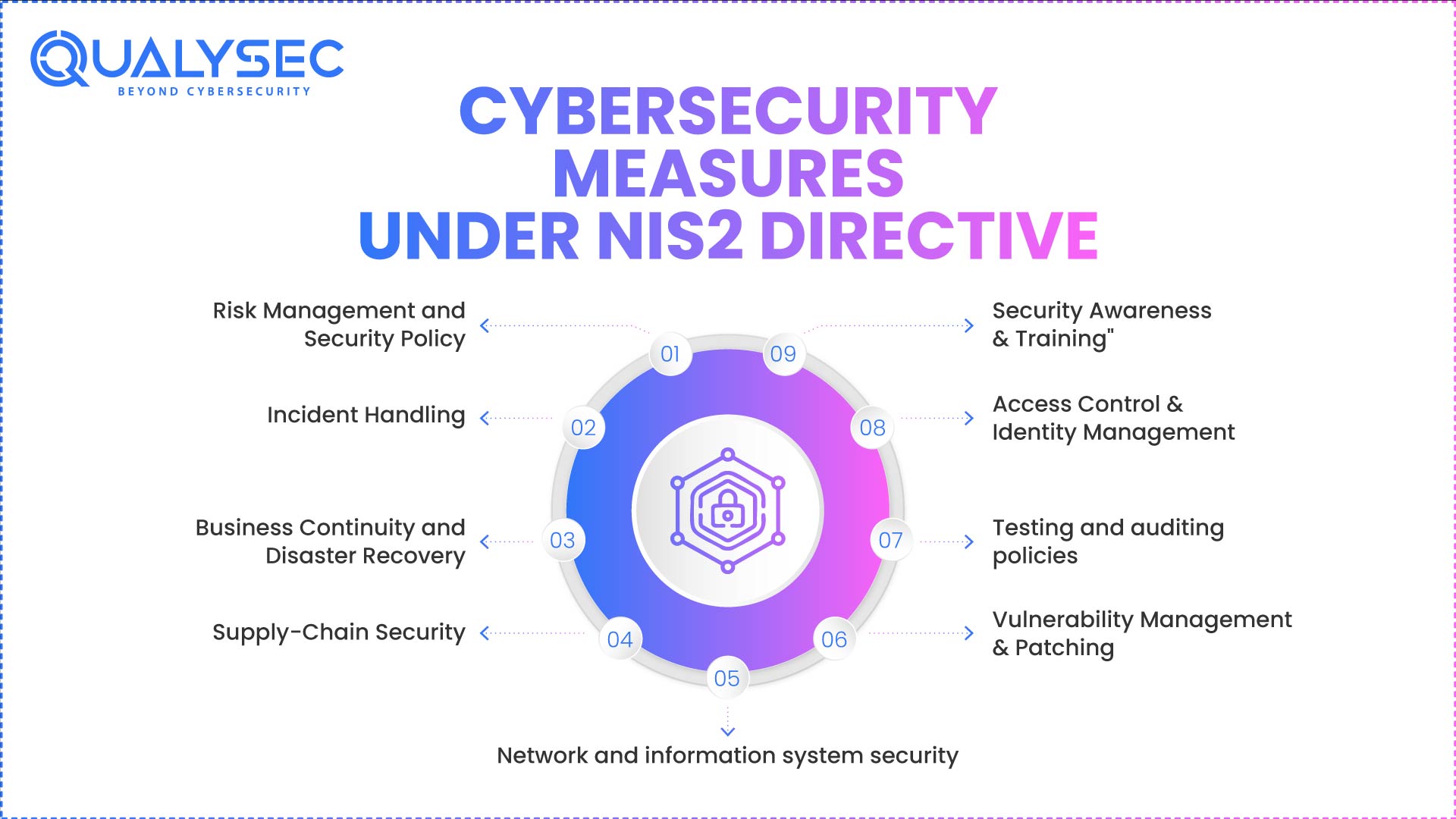
1. Risk Management and Security Policy
Have a written risk management model, which outlines threats, weak points, and countermeasures. The documents needed are the risk register, policy approval logs, and annual reviews.
2. Incident Handling
Have in place Incident detection, response, containment, recovery, and post-incident review processes. To this, we will require evidence such as incident response plans, playbooks, and test reports.
3. Business Continuity and Disaster Recovery
Have back-ups, redundant systems, and recovery procedures that tests have shown reduce service disruption. According to cybersecurity statistics, the evidence of this cybersecurity measure is provided by backup logs, DR test results, and continuity reports.
4. Supply-Chain Security
Evaluate and control the security position of the vendors, service providers, and contractors. Such evidence as supplier risk tests, signed SLAs, and security clauses is needed.
5. Network and information system security
Provide segmentation, encryption, and access control in order to prevent unauthorised access and lateral movement. Experts may present evidence in the form of network diagrams, configuration baselines, and access reviews.
6. Vulnerability Management & Patching
Find, monitor, and fix known system and software vulnerabilities. Evidence is required in the form of patch management logs and vulnerability scan reports, and pen-test results.
7. Testing and auditing policies
Test security controls through regular internal and external security audits. The evidence includes audit schedules, test reports, and remediation plans. Independent assessments by a CREST-accredited cybersecurity company add credibility to these audits and help demonstrate compliance with NIS2 requirements.
8. Access Control & Identity Management
Introduce strong authentication and least-privilege access to every system. Evidence such as IAM logs and proofs of MFA enforcement can be provided as a NIS2 cybersecurity measure.
9. Security Awareness & Training
Educate all employees, including management, about the cybersecurity approaches and the responsibility to report incidents. In this case, attendance logs, training records, and competency cybersecurity assessments are some of the evidence used.
Speak Directly With Qualysec’s Certified Security Experts
Discover vulnerabilities before attackers exploit them
The Directive establishes minimum thresholds in the EU for violating NIS2 compliance. The real punishment might differ depending on the national legislation, but cannot be less than these amounts of fines:
Essential Entities: Up to €10 million or 2 % of global annual turnover (whichever is higher).
Important Entities: Up to €7 million or 1.4 % of global annual turnover (whichever is higher).
Corrective measures can also be implemented. These include:
Carry out on-site checks or off-site checks.
Demand documentation of risk management measures, testing, and reporting measures.
Issue remediation measures based on the order (e.g., impose new controls, halt operations, or have independent security testing).
Introduce an interim disqualification of executives where there are instances of habitual negligence.
Other than loss of money, non-compliance may cause:
Public Naming & Shaming: Public disclosure of breaches by law enforcement agencies.
Contractual Penalties: Client-imposed penalties for suppliers failing NIS2 obligations.
License Revocation: Regulatory agencies can revoke operating licenses in fields like finance or healthcare.
Procurement Exclusion: Disqualification from public and enterprise procurement systems.
Conclusion
The NIS2 Directive requirements are not just another regulatory obstacle. It is a chance to enforce trust, governance, and operating financial capacity throughout the digital economy of the EU. In order to establish credibility for your business in the EU, it is relevant to collaborate with the correct pen testing firm.
Qualysec provides a detailed gap analysis in order to discover vulnerabilities. Firms receive a structured, prioritised remediation roadmap that aligns with the ENISA guidelines and regulatory requirements of the industry. Qualysec’s automated-plus-manual penetration testing delivers risk management measures that evidence can demonstrate.
Protect Your AI System Today!
Advanced protection for your AI applications & data.
Yes. The NIS2 Directive requirements have become legally binding to all EU Member States and to every organisation that falls into the classification of an Essential or Important entity.
2. Is NIS2 mandatory in the UK?
No. The United Kingdom left the EU earlier than when NIS2 became effective; thus, the Directive is not legally mandatory in the UK. Non-profit UK-based organisations that serve EU clients in the regulated sectors may, however, have to do it indirectly, provided they render their services in the EU or have subsidiaries there.
3. What is the difference between ISO 27001 and NIS2?
ISO 27001 is a global voluntary standard that provides the creation of an information security management system. NIS2, on the other hand, is a European law of the Europeans that mandates certain cybersecurity and incident-reporting requirements.
4. Is NIS2 a European directive?
Yes. NIS2 is an EU cybersecurity directive that the European Council and Parliament adopted.
5. Who is required to comply with NIS2?
Compliance is mandatory for all the Essential and Important Entities that are in the 18 critical sectors. It covers organisations in the energy, transport, healthcare, financial, digital infrastructure, government administration, and parts of the manufacturing and research industries.
6. Do EU directives still apply in the UK?
No. Directives issued by the EU, such as the NIS 2 Directive requirements, are no longer applicable to the UK post-Brexit. The UK has its own network and Information systems regime of cybersecurity in the Network and Information Systems Regulations 2018.
Regulatory References & Legal Citation Sources:
Directive (EU) 2022/2555 of the European Parliament and of the Council (NIS2 Directive).
NIS Cooperation Group 39th Plenary Meeting (May 2026): Standard Incident Reporting Templates.
UK Network and Information Systems Regulations 2018 (S.I. 2018/506).
About Chandan Sahoo
Chandan Kumar Sahoo is the Founder and Chief Executive Officer (CEO) at Qualysec. With over 8 years of experience in security testing and software quality assurance, he leads corporate strategy and expansion, helping organizations globally secure their web, mobile, and cloud environments.