






The EU General Data Protection Regulation defines EU GDPR compliance for any organization handling European residents’ personal data. However, the risks of non-compliance are clear—fines can reach up to €20 million or 4% of global turnover under EU law, and up to £17.5 million under UK law.
That is why maintaining full GDPR compliance in Europe is a critical issue for modern businesses. This comprehensive guide explores the regulation, who is subject to it, the technical requirements for GDPR penetration testing, and a practical checklist to ensure audit readiness.
This guide transforms information protection policies into actionable steps, proving that your team can demonstrate accountability and data security at the right time.
What does EU General Data Protection Regulation (GDPR) compliance mean?
The General Data Protection Regulations (GDPR) refer to the rulebook for dealing with personal data. It sets seven core principles for how you collect, use, keep, and protect data. GDPR requires comprehensive security with a process for regular GDPR penetration testing to determine how well those measures work. It also expects you to prove you comply, not just say you do.
Complying with the GDPR compliance regulation requires doing the right thing as per the seven core principles and keeping the evidence. It is important to maintain GDPR compliance Europe wide.
Who does GDPR apply to?
GDPR compliance applies based on where the data subject is and where or how processing happens, not just where your company sits. If you are established in the EU, GDPR applies to your processing. If you are outside the EU but you target or monitor people in the EU, GDPR still applies.
In the UK context, the UK GDPR applies to organisations acting as controllers or processors. EU GDPR may require that, at least, out-of-the-EU companies caught by the regulation may have to have an EU representative as the point of contact with regulators and individuals.
To ensure every requirement is met, follow a structured GDPR compliance checklist.
Is GDPR compliance important for your business?
Yes, EU GDPR compliance is significant to your business. Without considering this, one might face serious repercussions:
- Legal exposure: Legal penalties under UK GDPR for major infringements can reach £17.5 million or 4% of annual global turnover, whichever is higher. EU GDPR enforces a parallel ceiling of €20 million or 4% of global turnover.
- Operational reality: The regime demands accountability that you can demonstrate, not just good intent. The ICO’s Accountability Framework explains what evidence credible programmes keep across ten categories.
- Saves time and money: Good data protection improves trust, reduces waste, and eases procurement. The ICO notes that solid compliance saves time and money and signals that you respect people’s information, which strengthens your brand.
Get a GDPR-aligned testing plan from our experts and track compliance in real time with the Qualysec Vulnerability Dashboard.
7 Data Protection Principles of EU GDPR Compliance
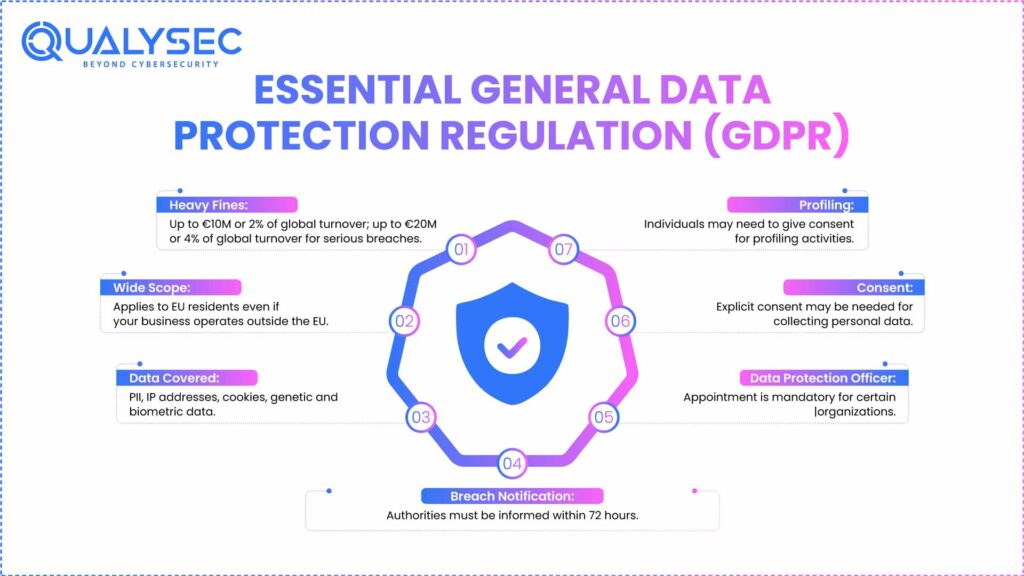
GDPR compliance requirements are built on seven principles in Article 5: lawfulness, fairness and transparency, purpose limitation, data minimization, accuracy, storage limitation, integrity and confidentiality, and accountability.
Here are the seven data protection principles of GDPR –
1. Lawfulness, fairness, transparency
You are required to be lawful in everything that you do, treat people equally, and make sense regarding what you do.
What to do: Spot all the reasons to process to a legal justification and post the correct privacy notice.
2. Purpose limitation
Collect data for specific, explicit, legitimate purposes and don’t repurpose it incompatibly.
What to do:Add the purpose of ROPA to a piece of paper and test compatibility briefly when you change the purposes before any new use.
3. Data minimisation
Only collect what you need.
What to do: Trim forms and logs to the minimum fields; block data you don’t need.
4. Accuracy
Keep data accurate and up to date; enable corrections.
What to do: Add correction paths in product and support; schedule periodic checks where accuracy is critical.
5. Storage limitation
Don’t keep data longer than necessary.
What to do: Set a retention schedule per data set; automate deletion or anonymisation jobs for non-production environments and gdpr test data.
6. Integrity and confidentiality
Ensure that data is secured with the help of proper technical and organisational controls and ensure that they are verified on a regular basis (Article 32).
4. Cluster Page: GDPR Compliance Requirement for SaaS Platforms
What to do: Run access control, encryption, patching, logging, backups, sanitization for gdpr test data, and a risk-based GDPR testing schedule.
7. Accountability
It is your duty to follow and should be capable of showing it – policies, processes, and evidence.
What to do: Plan evidence in opposition to the ICO Accountability Framework (categories) (eg, ROPA, lawful basis, contracts, DPIA, security, training, breaches).
GDPR Compliance Checklist for European Businesses
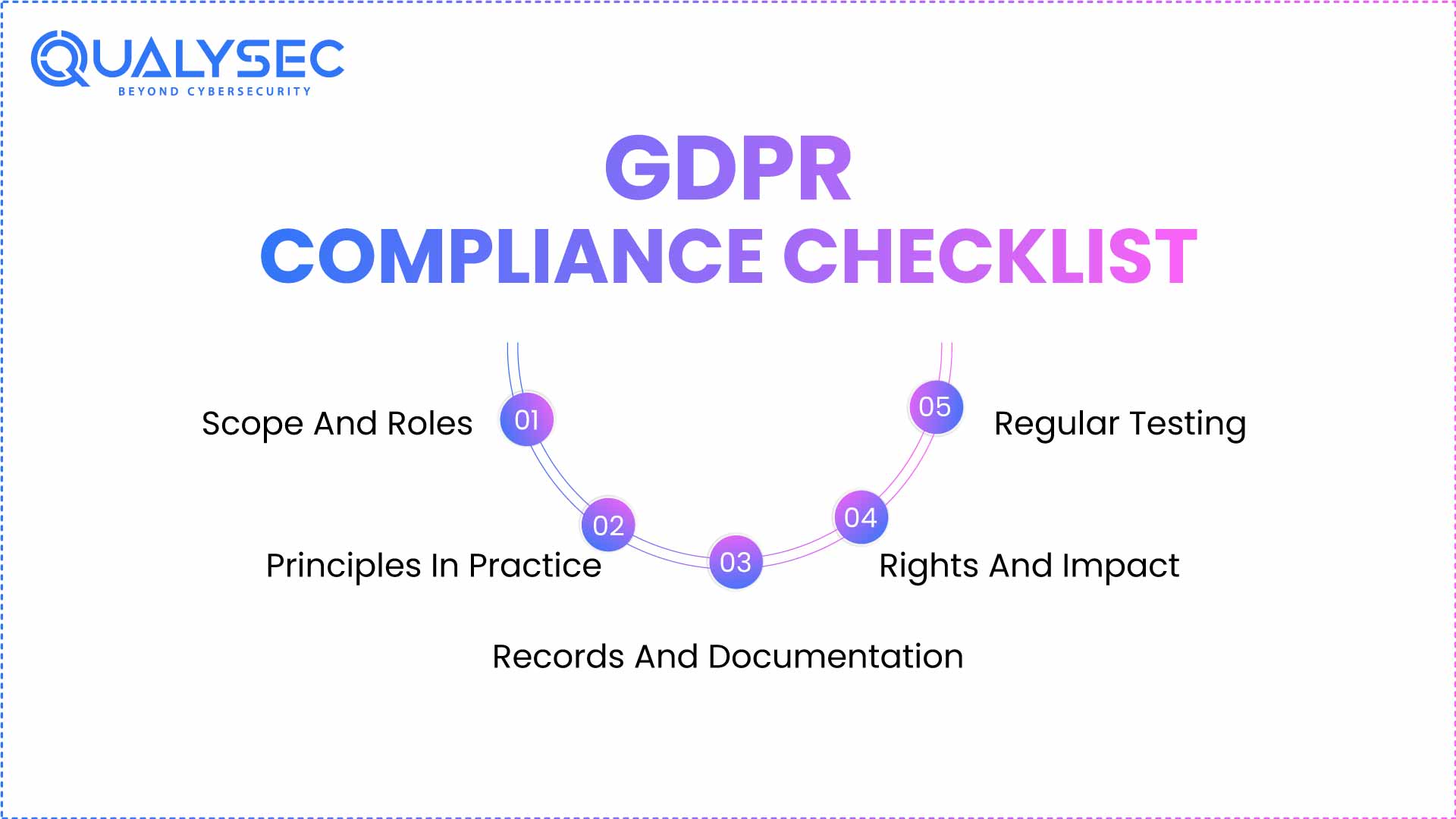
Take a look at this checklist for EU General Data Protection Regulation compliance. It aligns with the ICO’s accountability approach and common Article 32 expectations.
Scope and roles
- Establish whether the UK GDPR, EU GDPR, or both apply to every processing activity and record the determination.
- Determine the roles of controllers and processors and record them in ROPA. If necessary, select an EU or UK representative and post contact information.
Principles in practice
- Record lawful bases for each purpose and publish clear privacy notices.
- Apply data minimisation and purpose limitation, and capture this in ROPA and change tickets.
- Maintain accuracy and set retention periods with deletion or anonymisation on schedule.
Records and documentation
- Maintain a complete ROPA in electronic form and review it on a schedule. Use the ICO templates if helpful.
- Keep a breach register and a flow for 72-hour notifications.
- Store evidence of staff training and awareness across relevant teams.
Rights and impact
- Operate a Data Subject Access Request (DSAR) runbook that meets the one-month baseline and keeps an audit trail.
- Run DPIAs where high risk is likely and record risks, mitigations, and sign-off.
Regular testing
- Define a risk-based testing plan and keep the pack for each cycle. Scope, findings, fixes, and validation with dates and owners. Article 32 expects regular testing and evaluation of effectiveness.
Explore Real-World GDPR Success Stories- Download Our Case Studies Today

How Qualysec Delivers GDPR Penetration Testing & Compliance Services
At Qualysec, we help businesses comply with the EU General Data Protection Regulation. As a CREST-accredited company, we help you operate and prove the security measures GDPR expects under Article 32.
What do we actually do?
- Risk-based scoping across web, mobile, API, cloud, and network testing reflects where personal data is at risk.
- Hybrid penetration testing (manual plus automated) scheduled on a cadence that matches your risk and rate of change – the practical read of Article 32’s “regularly testing, assessing and evaluating.”
- Findings mapped to GDPR controls – we relate vulnerabilities to Article 32 measures and your internal policies, so fixes are tied to compliance outcomes instead of generic lists.
- Remediation validation – short, targeted retests that confirm fixes and reduce repeat issues, with a clear closure note.
- Audit-friendly evidence bundles – summary of audit scope, methods, findings, remediation tickets, screenshots, and change logs that you can drop directly into your accountability pack.
- SaaS-specific guidance – for multi-tenant platforms and API sprawl: encryption in transit/at rest, isolation patterns, logging for DSAR exports, and misconfiguration checks.
Achieve GDPR compliance with confidence. Talk with a compliance expert to discuss your specific needs.
Conclusion
GDPR is not just legal text. It is a working system of principles, rights, and security measures that you operate every day and can show on request. Article 32 controls match real risk and are tested on a schedule.
Treat compliance as a continuous loop. Map what you do, act on the risks you find, and keep proof that the action happened. For security, focus on access control, encryption, patching, logging, backups with restores tested, and a regular GDPR pentesting programme that you can defend.
At Qualysec, we focus on GDPR cyber security and provide risk-based testing with audit-friendly evidence. Our team scopes tests to real risk across web, mobile, API, cloud, and network, and validates fixes with short retests, providing top-notch gdpr compliance service.
FAQs
1. What is the EU’s General Data Protection Regulation?
The EU law of data protection is called the GDPR. It establishes guidelines on the way organisations gather, utilize, distribute, and safeguard personal data, and it applies to organisations that are founded in the European Union, as well as non-EU organisations that target or track individuals in the EU. It establishes responsibilities on controllers and processors, establishes enforceable rights for people, and provides large penalties that may be imposed in case of violation.
(Learn more about cross-border data processing and GDPR in India).
2. What are the 7 main principles of GDPR?
Article 5 sets seven principles that must guide all processing:
- Lawfulness, fairness, and transparency
- Purpose limitation
- Data minimisation
- Accuracy
- Storage limitation
- Integrity and confidentiality
- Accountability
Maintaining GDPR cybersecurity is of critical importance.
3. Is there a difference between the UK GDPR and the EU GDPR?
Yes, but they are quite aligned. The GDPR was incorporated into the domestic law of the UK as the UK GDPR, along with the Data Protection Act 2018. In case you are a UK organisation targeting or tracking individuals within the EU, the EU GDPR may apply alongside it, and in case you lack a base in the EU, you might be required to designate an EU representative.
4. What are the 4 rules of GDPR?
Strictly, GDPR is built on seven principles, not four. When people say “four rules,” they often mean the practical pillars most programmes focus on. A useful way to frame four core obligations is:
- Process lawfully, fairly, and transparently, and document your lawful basis.
- Uphold people’s rights such as access, erasure, restriction, portability, objection, and rights around automated decisions.
- Secure data using relevant technical and organisational means and make sure to test their efficiency at least once in a while, as Article 32 demands.
- Provide record-keeping such as ROPA, DPIAs, training logs, breach registers, and processor contracts.