

As modern networks grow more complicated, organisations are faced with a historic escalation in cyber threats, complicated malware attacks, and hackers. Traditional methods are not sufficient anymore for hunting, investigating, and mitigating complex digital threats. This is where AI in network security and cybersecurity unite to lay a new foundation for intelligent defence.
Artificial intelligence network security, machine learning in cybersecurity, and cybersecurity for artificial intelligence are changing how organisations protect their digital infrastructure and respond to cyber threats.
Growing Need for Intelligent Defence in Modern Networks
The exponential expansion of cloud networks, IoT devices, remote work systems, and edge computing has significantly expanded the attack surface area. Hackers have started using automation and artificial intelligence to launch better-targeted and longer-lasting threats.
Organisations need to have artificial intelligence cybersecurity systems capable of continuous learning, adaptability to new attack patterns, and identification of subtle differences that other tools may overlook due to the rapid changes in attack sequences.
Three main benefits of AI-powered protections are:
- Rapid recognition of abnormal network activities
- Automation of repetitive security duties
- Identifying predicted threats using historical and real-time data
The future of AI application security will greatly depend on this change from reactive to adaptive security.
Are you searching for penetration testing driven by artificial intelligence insights? For unmatched coverage, Qualysec combines expert manual testing with machine learning.
Role of AI in Enhancing Network Penetration Testing
Penetration testing is not just a manual, yearly exercise. Through the combination of AI network security with machine learning, testers can simulate more sophisticated attack situations, find deeper flaws, and lower human error—all of which is redefining how network penetration tests are performed and examined.
Artificial intelligence helps pentesting by means of:
-
- Automatically conducting reconnaissance and mapping of concealed assets
- Predicting which network elements are most vulnerable
- Finding incorrectly set up endpoints and weak authentication routes
- Faster than human testers, processing large logs
With the role of artificial intelligence in cyber security, pentesters can spend time on more sophisticated, strategic threat simulations while automation manages routine preparation.
How AI Improves Network Vulnerability Discovery
Regular vulnerability scanners sometimes return false positives or overlook developing defects. Using behavioural analysis, anomaly detection, and constant learning, artificial intelligence pinpoints vulnerabilities with accuracy. Major changes brought about by artificial intelligence:
- Finds zero-day flaws by analysing odd traffic patterns.
- Finds small misconfigurations and paths of privilege escalation.
- Based on exploit possibility and business impact, it gives top priority to flaws.
This knowledge lets companies be proactive in improving their security posture instead of only responding after harm happens.
AI-Powered Insights for Faster, Accurate Pentest Results
Select Qualysec for data-rich, artificial intelligence-enhanced pentest reports that spur actual security enhancements. AI-driven pentesting analysis improves the clarity and quality of penetration testing results. Below are the results testers can present:
- Trend-based vulnerability projections
- Automated severity scoring
- Path visualisations for attack
- AI risk assessment report
- Contextually rich remediation ideas
These ideas enable companies to grasp why something is vulnerable in addition to what it is and how to properly address it.
Moreover, AI speeds up pentest cycles without sacrificing accuracy by lowering the amount of time devoted to data correlation and manual log analysis.
Real-Time Threat Detection During Penetration Testing
Real-time security analysis during pentests—Qualysec’s AI-based systems immediately alert you to suspicious activity. All-time monitoring of systems during penetration testing is one of the main benefits of artificial intelligence for IT network security. Unlike typical pentests, which expose vulnerabilities at a moment in time, AI gives ongoing detection capability.
AI-enabled systems can:
- Flag abnormal network increases
- Find side motion efforts.
- Detect crude-force signatures.
- Identify early indicators of reconnaissance effort.
This gives companies the chance to improve their detection systems as the pentest proceeds, hence greatly increasing long-term defence capabilities.
You might like to know more about AI Threat Intelligence: Enhancing Penetration Testing Strategies
How Qualysec Uses AI to Strengthen Network Security Assessments
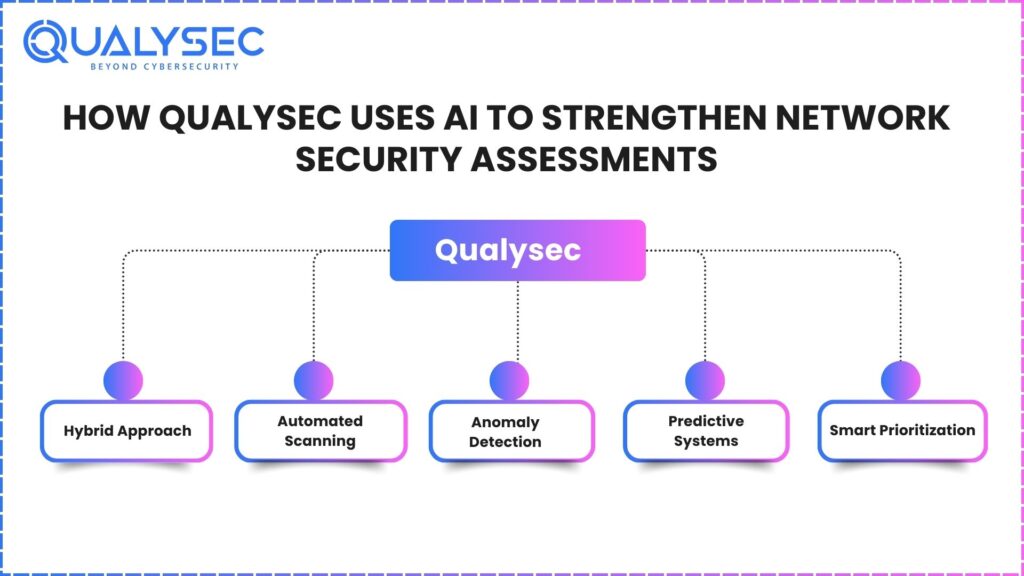
Qualysec provides very precise and actionable results by means of artificial intelligence built into many levels of its network penetration testing process. Our method guarantees maximum vulnerability coverage by combining automation with skilled manual testing.
Qualysec has artificial intelligence abilities, including:
- Automated scanning based on machine learning signature analysis
- AI-based identification of anomaly-driven flaws
- Predictive systems emphasising future attack potentials
- Smart prioritising depending on risk and exploitability
Delivering outstanding security testing results for companies across sectors, Qualysec is a leader in artificial intelligence and cybersecurity.
Benefits of Combining AI Tools with Expert Manual Pentesting
With Qualysec‘s hybrid pentesting method, get the best of both worlds: AI automation and human knowledge. Though strong, artificial intelligence cannot fully supplant human intuition, imagination, and grasp of sophisticated attack behaviour. The most successful security plan blends:
- AI automated data analytics and speed
- Human-led exploitation for actual attack simulation
They offer together:
- Less time spent on testing
- Exact recognition of latent logical faults
- Fewer false positives.
- Stronger compliance procedures
This hybrid approach guarantees that companies obtain dependable, thorough security evaluations.
Protect your network with Qualysec’s AI-driven assessment engine—smarter testing, greater coverage. Contact us!
AI for Continuous Network Monitoring After Pentests
Network security services have to be ongoing, not event-based. With its capacity for adaptive learning and anomaly detection, artificial intelligence suits post-pentest monitoring.
By means of artificial intelligence:
- Identifying long-term behavioural anomalies
- Warning teams of unusual data exfiltration or traffic spikes
- Checking the integrity of endpoints
- Recognising changing fingerprints
This guarantees networks remain secure as fresh threats develop, therefore underlining the importance of artificial intelligence in contemporary security plans.
Challenges of AI in Network Security and How Qualysec Solves Them
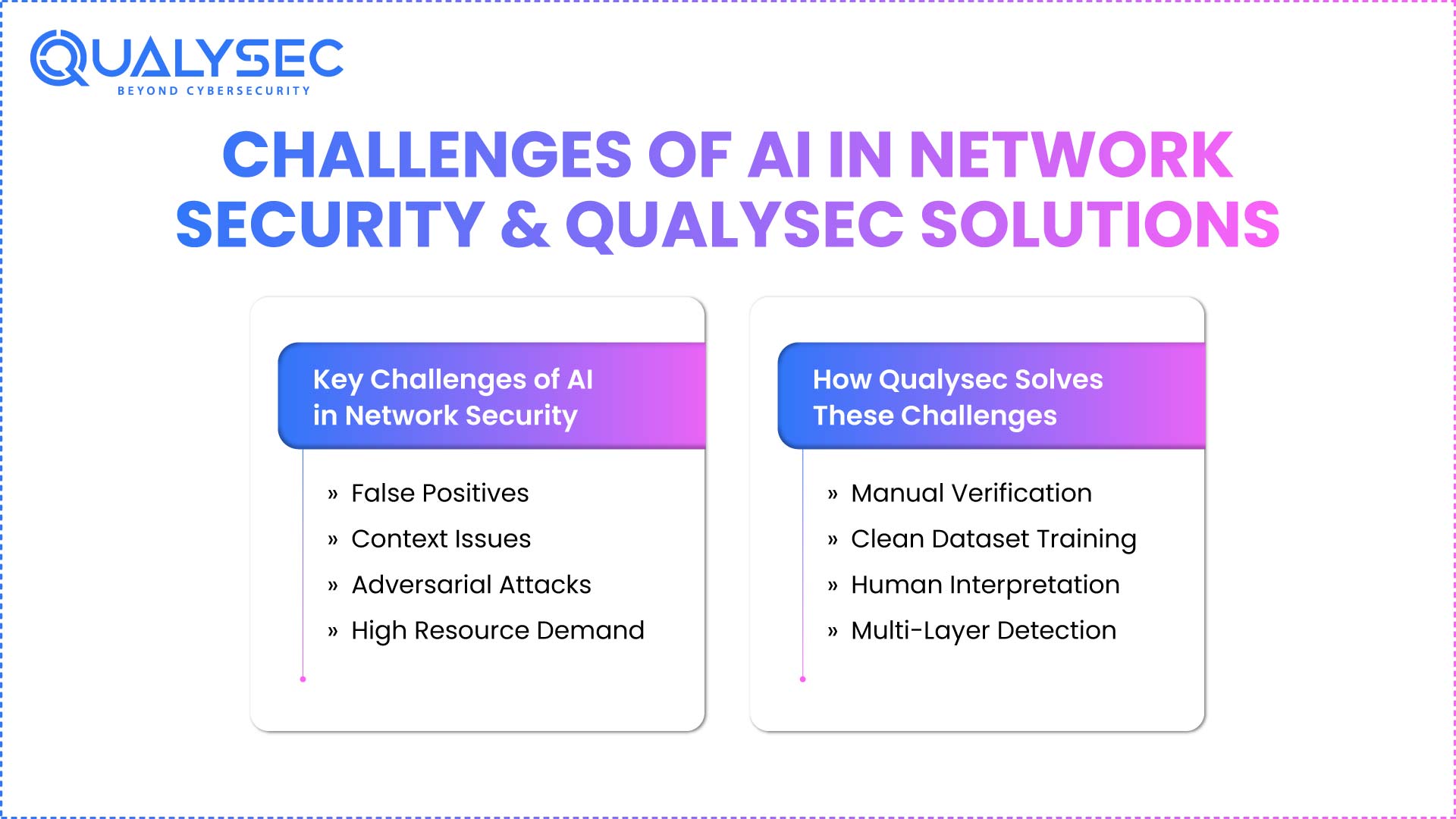
Though it has its advantages, adopting artificial intelligence in network security has problems, including:
- Incorrect positives resulting from models that are over-sensitive
- Troubles with context in sophisticated threat cases
- Risk of hackers contaminating artificial intelligence training data
- Substantial computational demands
Qualysec solves these by:
- Integrating artificial intelligence results with expert manual verification
- Educating artificial intelligence models on verified, clean datasets
- Interpreting sophisticated attack chains using human analysts
- Installing several layers of detection lowers spurious notifications.
This interaction guarantees clients get the most precise, reliable, and secure AI-enhanced network evaluations possible.
Stay protected year-round with Qualysec’s AI-driven monitoring. Schedule a meeting today!
Conclusion
Artificial intelligence is changing the landscape of network security using machine learning with faster detection of threats, intelligent analysis, and proactive response. AI helps businesses stay ahead of increasingly complex cyber threats by detecting anomalies in real time, monitoring post-testing, and automating penetration testing.
AI alone is not sufficient, though. The most efficient security strategy combines expert human knowledge with AI-driven automation—and Qualysec provides precisely that.
Qualysec establishes the standard for AI cybersecurity solutions and next-generation network protection due to its smart testing systems, predictive analytics, and expert-driven validation.
Need precise vulnerability detection? Using artificial intelligence models, Qualysec helps to more dependably and more quickly find faults.

FAQs
1. What is the role of AI in network security?
Automated detection, traffic pattern analysis, anomaly identification, and future threat predictions all improve network security thanks to artificial intelligence.
2. How will AI be used in cyber security?
AI powers automated incident response, AI driven threat detection, vulnerability discovery, behavioural analysis, malware detection, and vulnerability discovery.
3. How does AI improve network security monitoring?
AI always improves from network patterns, marks suspicious traffic, finds outliers, and cuts threat response time.
4. What are AI-powered next-generation firewalls?
Using artificial intelligence and machine learning, they are sophisticated firewalls that analyse traffic, stop unidentified threats, and adjust to changing attack patterns.
5. Can AI detect insider threats on networks?
Indeed. Unusual login attempts, odd data access, and behaviour changes pointing to inside abuse are all detected by AI.
6. How does AI analyse network traffic patterns?
AI finds hidden risks by assessing behavioural baselines, spotting anomalies, grouping like traffic, and linking events.
7. What is the role of AI in preventing DDoS attacks?
AI identifies bad packets, notes unexpected traffic surges, and automatically reduces threats before they overload the network.