An NBFC cybersecurity audit is a compliance requirement mandated by the Reserve Bank of India (hereinafter referred to as the RBI) to verify whether an NBFC’s IT systems, applications, data, and outsourced environments are securely governed and tested. Since Non-Banking Financial Companies operate at the centre of this risk landscape, manage data for millions of customers, including government data, and maintain financial records, the cybersecurity audit assesses the effectiveness of IT governance, cyber risk management, and security controls for NBFCs. If NBFCs skip cybersecurity audits or fail to meet current requirements, the RBI treats this as a serious governance and compliance failure. It can lead to regulatory warnings, mandated corrective action plans, or even restrictions on launching new digital products.
This guide helps NBFCs, compliance teams, and decision-making authorities understand what a cybersecurity audit entails, why it is mandatory, which RBI guidelines govern it, how often audits are conducted in practice, and what regulators examine during inspections.
What is an NBFC Cybersecurity Audit?
An NBFC cybersecurity audit refers to the Information System (hereinafter referred to as the IS) Audit that evaluates whether a Non-Banking Financial Company’s IT infrastructure, applications, networks, data, and third-party systems adequately protect against cyber threats and align with RBI’s current guidelines.
RBI’s Master Direction – Information Technology Framework for the NBFC Sector, 2017, dated 08.06.2017, originally governed cybersecurity audit for NBFCs. Under the current requirement – Master Direction on Information Technology Governance, Risk, Controls and Assurance Practices, including the 2017 Master Direction on the IT Framework for NBFCs, the main objective of the NBFC cybersecurity audit is to:
- Provide a detailed perception of the effectiveness of controls that are in place to ensure confidentiality and integrity.
- To assess, independently, whether the NBFC’s information systems, data, and digital operations are adequately protected.
- Assess the adequacy of the internal IT governance of the NBFCs
- To check whether NBFC meets applicable statutory and regulatory IT/cybersecurity obligations.
- To assess whether the organisations have effectively designed, documented, tested, and integrated their overall IT operations into their Business Continuity Plan (BCP) and Disaster Recovery (DR) Plans.
Cybersecurity Frameworks used in the NBFC Audits:
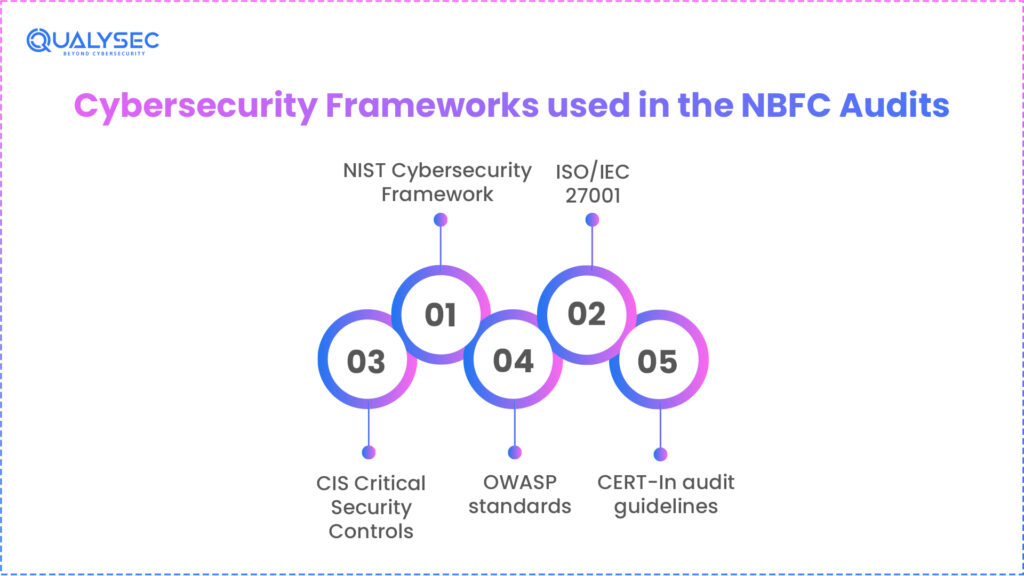
- NIST Cybersecurity Framework
- ISO/IEC 27001
- CIS Critical Security Controls
- OWASP standards
- CERT-In audit guidelines
Why is a Cybersecurity Audit Mandatory for NBFCs?
Cybersecurity audits are mandatory for NBFCs because they are an important part of India’s financial structure. Daily, they operate in a high-risk financial ecosystem. They handle:
- Personally identifiable customer data
- Financial and credit information
- Digital payment and lending transactions
- Integrated third-party fintech services
The mandates cybersecurity audits to ensure that:
- Confirm that organisations are actively identifying, managing, and documenting cyber risks.
- Independent parties test security controls instead of relying on self-certification.
- Boards exercise effective oversight over IT and cyber risk
- NBFCs maintain operational resilience during disruptions

Which RBI Guidelines Require Cybersecurity Audits for NBFCs?
Cybersecurity for NBFCs is paramount to the RBI. Therefore, there are multiple RBI regulations, namely – RBI Master Direction on IT Governance, Risk, Controls and Assurance Practices, 2023.
1. RBI Master Direction on IT Governance, Risk, Controls, and Assurance Practices, 2023
- In 2023, the RBI issued Master Direction to cover IT and cybersecurity governance for regulated entities, including NBFCs. It is effective from 01.04.2024. The new direction consolidates and repeals earlier separate circulars on cybersecurity, IS audit, BCP/DR, vendor risk, and IT outsourcing into a single unified framework.
- Under this direction, NBFCs are required to implement a cybersecurity framework that includes technical defences, governance, risk management, and independent assurance to protect their systems.
- The NBFCs are mandated to establish a formal IT and security governance team and framework aligned with the business’s objectives.
- NBFCs are mandated to establish controls aligned with global cybersecurity frameworks, such as ISO 27001, NIST, and GDPR. These controls should cover –
- Access control and identity management
- Network security and security operations
- Encryption and data protection
- Monitoring, logging, and alerting mechanisms
These controls support the objectives of cybersecurity audits.
It specifically requires independent assurance activities such as:
- Information security audit
- Security assessment services
- Vulnerability assessments
- Penetration testing (VA/PT)
It is pertinent to note that for critical systems, competent, independent experts should conduct vulnerability assessments at least every 6 months and penetration testing at least once every 12 months. Mandates require documenting the findings and remediating them from time to time.
- RBI mandates a cyber risk assessment periodically to identify threats, vulnerabilities, and impact across systems and operations.
- NBFCs are mandated to document cyber incident response procedures to cover:
- Incident detection, classification, and prioritisation
- Internal escalation processes
- Board, senior management, customers, regulators
- Coordination with CERT-IN and other relevant response centres
- The Master Direction requires NBFCs to plan and maintain effective BCP and DR arrangements to make sure that services stay in continuation or are restored on time if any incident is reported.
2. RBI Guidelines on Outsourcing of IT Services
RBI’s regulation on outsourcing IT services is now codified into a separate guideline that requires NBFCs to manage and control cybersecurity risks associated with outsourced services.
It is mandatory for NBFCs to:
- Conduct due diligence and ongoing security assessments of vendors, particularly those hosting critical systems, customer data, or cloud infrastructure.
- Regularly assess vendor controls through audits and technical testing aligned with their risk exposure.
- Integrate the logs, events, and alerting from outsourced environments into their SOC and monitoring mechanisms and audit, which forms an essential part of the NBFC’s overall security assessment services.
How often should NBFCs conduct a Cybersecurity Audit?
RBI does not publish a single fixed-frequency table that says “do X every Y months”. The frequency of a cybersecurity audit depends on the regulatory requirement, size and complexity of the organisation, nature of the IT system, volume and sensitivity of customer data. A brief table will give an overview of the cybersecurity audit:
| Audit or Assessment Type | Frequency |
| ISA or the Cybersecurity Audit | Once every financial year. |
| Cyber Risk Assessment | Once every financial year. |
| Vulnerability Assessment | Once every financial year. |
| Penetration Testing | Once every financial year. |
| Network Security Audit | Annually. |
| Application Security Testing | Annually. |
| Data Security Audit | Annually. |
| Third-Party and Vendor Security Assessment | NBFCs assess the cybersecurity posture of critical third-party service providers once every year. |
| Business Continuity and Disaster Recovery Review | Once every financial year. |
| Cyber Incident Response Testing | At least once every financial year. |