
From February 2026, the old CSA Cyber Trust Mark under Cyber Trust (2022) stopped being valid entirely. If your organisation is still working off the old framework, you’re preparing against a standard the Cyber Security Agency of Singapore no longer recognises. CSA publishes the current version, Cyber Trust (2025), as Singapore Standard SS 712:2025. It’s a meaningfully different exercise than the one many businesses still think they’re signing up for.
There’s also a sharper reason to move now than there was a year ago. At the 2026 Committee of Supply Debates, CSA announced new requirements. Licensed cybersecurity service providers, the firms delivering penetration testing and managed SOC monitoring, will need Cyber Trust Mark Level 3 by the end of 2026. Critical Information Infrastructure Owners must hit Level 5 by the end of 2027. This isn’t a marketing badge anymore for a growing slice of the market. For some organisations, it’s becoming a condition of operating.
This guide walks through what actually changed under SS 712 and why the CSA Cyber Trust Mark matters strategically. It also covers the real steps to get there: tier selection, self-assessment, audit, without the parts most guides skip past.
What is the CSA Cyber Trust Mark?
The Cyber Trust Mark—which Singapore businesses are now navigating—is the country’s national cybersecurity certification for organisations with substantial digital operations and elevated cyber risk. CSA developed it under the SG Cyber Safe Programme. It sits above Cyber Essentials, which covers baseline hygiene for smaller, less digitally exposed businesses. Cyber Trust instead uses a risk-based model: you assess your own risk profile first, then implement controls that actually match it.
That distinction matters more than it sounds, and it’s easy to miss on a first read. Cyber Essentials is a desktop review of a fixed set of nine domains. Cyber Trust scales with your organisation. It spans up to 22 domains across governance, people, process, and technology, depending on which of five preparedness tiers your risk profile actually calls for. A logistics company running a handful of internet-facing systems and a bank running core payment infrastructure don’t face the same bar. CSA built the framework specifically to reflect that difference.
Cyber Essentials is not a formal prerequisite for Cyber Trust. CSA recommends organisations with good existing cyber hygiene progress toward Cyber Trust, but a mature organisation can apply directly.
Navigating SS 712: What’s New in the Enhanced Cyber Trust Framework?
SS 712:2025 replaced the 2022 version for a reason. The digital footprint most Singapore organisations now carry looks nothing like it did when CSA wrote the original framework. Three changes stand out.
Four pillars beyond classical cybersecurity: Core IT security, governance, risk management, asset management, access control, and incident response now sit alongside secure cloud adoption, data protection, and shared-responsibility-model compliance. CSA assesses all of these as named areas, not as implied extensions of general controls.
Cyber Trust Mark vs ISO 27001, officially mapped: CSA now publishes a direct mapping between Cyber Trust (2025) requirements and ISO/IEC 27001:2022. Organisations already running an ISMS get a documented path to reuse that work, rather than starting a parallel compliance exercise from zero.
Five Cyber Trust Mark tiers instead of a flat checklist: Your organisation completes a guided self-assessment that identifies your risk profile first, then recommends the tier and domain count that actually fit. Tier 1 covers basic preparedness for limited digital exposure. Each tier up adds governance depth. Coverage then expands to supply chain and business continuity, up to advanced, proactive threat management at the top tier for organisations with the highest digital exposure.
| Cyber Trust Tier | Typical Profile | Scope Emphasis |
|---|---|---|
| Tier 1 | Limited digital exposure | Minimum baseline controls |
| Tier 2 | Moderate digital operations | Added governance and risk management |
| Tier 3 | Significant digital infrastructure | Supply chain and business continuity |
| Tier 4 | Extensive, higher-risk operations | Deeper technical and process controls |
| Tier 5 | Critical, highest-risk operations | Advanced, proactive threat management |

Strategic Benefits: Why Your Organisation Needs the Cyber Trust Certificate
For a CSA Cyber Trust Mark holder, the most immediate benefit is one most guides underplay: recognition outside Singapore. CSA states clearly that organisations beyond Singapore’s borders recognise Cyber Essentials and Cyber Trust. That means even a business headquartered elsewhere can use certification to demonstrate the same rigour CSA expects of a Singapore-based operation.
Beyond that, the practical drivers are straightforward. CSA cyber trust mark certification lists certified organisations in its public Directory of Certified Organisations, giving procurement teams and partners an independently verifiable reference rather than a vendor’s own claim. SMEs that certify also qualify for the SME Cybersecurity Excellence award, which the Association of Trade & Commerce runs jointly with CSA. The 2026 mandate now applies to CII owners, CII auditors, and licensed cybersecurity service providers. Because of that, certification is shifting from reputational advantage to contractual necessity for an expanding set of sectors.
CSA also provides funding support. This ranges from SGD 1,375 to SGD 2,250 for classical cybersecurity, depending on endpoint count. Additional pillars such as cloud, OT, or AI security add SGD 225 to 450 each. CSA deducts this funding directly from your chosen certification body’s fees.
Step-by-Step Application & Certification Process
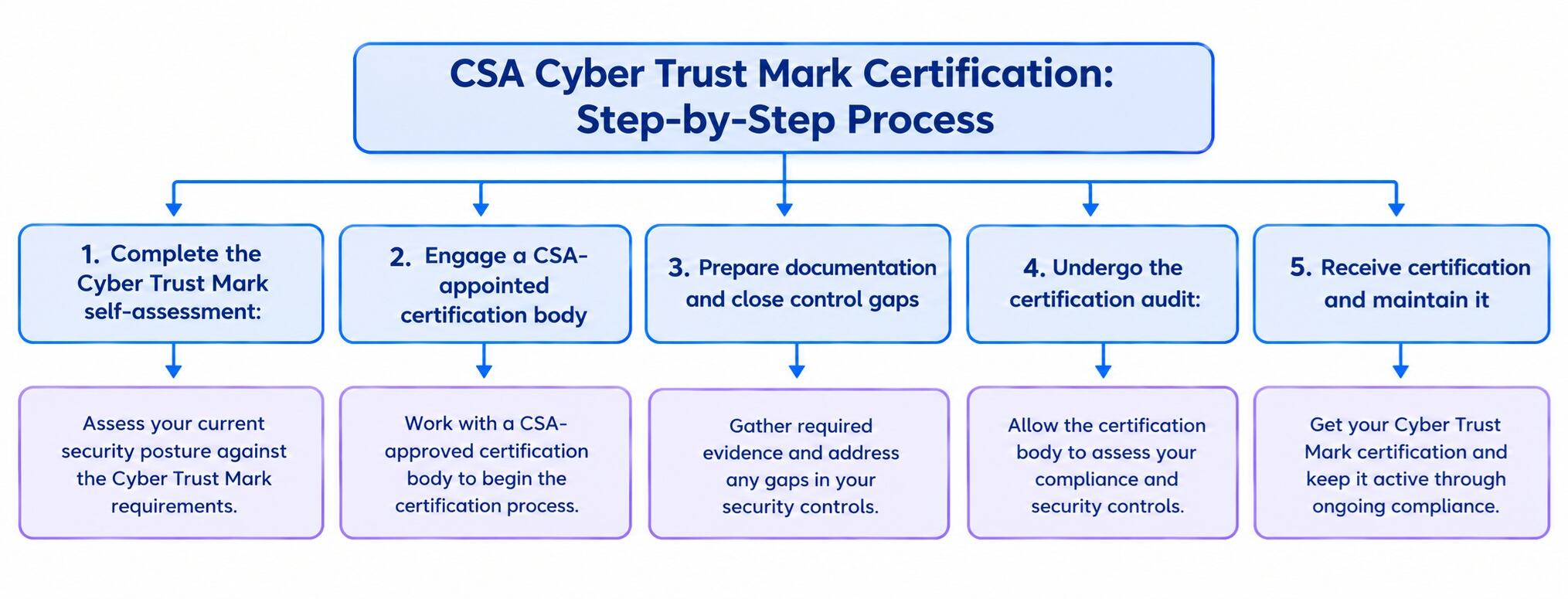
- Complete the Cyber Trust Mark self-assessment: CSA’s guided two-part template first helps you understand your organisation’s cybersecurity risk profile. It then identifies which preparedness tier and domain set actually apply. This step alone often reveals that an organisation’s assumed tier and its actual risk profile don’t match. That mismatch isn’t unusual, even among businesses that consider themselves cyber-mature.
- Engage a CSA-appointed certification body: Certification bodies such as TÜV SÜD, SGS, and TCSPL conduct the independent audit. CSA does not certify organisations directly, and certification fees and timelines vary between bodies, so it’s worth comparing before committing.
- Prepare documentation and close control gaps: Once you confirm your tier, work through a Cyber Trust Mark checklist covering the policies, procedures, and technical evidence your assessment domain requires. This is typically where gaps surface: controls that exist on paper, but that nobody has actually tested against a real attempt to break them.
- Undergo the certification audit: The assessment runs in two stages. Stage one is a documentation review, confirming policies and governance are in place. Stage two verifies implementation and effectiveness, confirming the controls actually work, not just that they’re written down. The audit mode is hybrid, combining remote and on-site verification. An independent assessor from your chosen certification body carries out both stages.
- Receive certification and maintain it: Successful audits result in a Cyber Trust Mark valid for three years, with a mandatory annual audit to keep it active. CSA then adds your organisation to its Directory of Certified Organisations.
Qualysec: Your Trusted Compliance & Penetration Testing Partner
CSA’s own audit methodology draws a hard line between two things: verifying that a control exists, and verifying that it actually works under pressure. Higher tiers in particular expect implementation and effectiveness evidence, not just a documented policy. Independent technical testing exists to close exactly that gap.
Qualysec supports Singapore organisations preparing for Cyber Trust certification with:
- Gap assessment against your identified tier – mapping current controls to the specific domains your self-assessment flagged, before you engage a certification body
- CREST-accredited penetration testing – across web, API, cloud, and network environments, producing the kind of implementation-effectiveness evidence that satisfies Stage 2 audits
- Documentation that aligns to CSA’s ISO/IEC 27001:2022 mapping – useful specifically for organisations already running an ISMS and looking to avoid duplicating compliance work
- Remediation and retesting support – closing the gaps we identify and confirming fixes hold before the formal audit, not after
It’s worth being direct about scope here: Qualysec isn’t a CSA-appointed certification body. Bodies such as TÜV SÜD or SGS conduct the audit themselves. But the readiness work and technical evidence you produce beforehand often determine whether that formal audit goes smoothly or surfaces gaps mid-process.
Conclusion
The Cyber Trust Mark under SS 712:2025 asks a harder question than most compliance frameworks. It’s not whether you have a policy. It’s whether your controls actually hold up when someone checks. That distinction is only getting more consequential. CSA is extending mandatory certification to CII owners, CII auditors, and licensed cybersecurity service providers through 2026 and 2027. Organisations that treat the self-assessment and gap-closing work seriously, before the formal audit begins, get through Stage 2 verification without last-minute surprises.
FAQ
How do I determine my certifiable cybersecurity preparedness tier?
CSA’s guided self-assessment template does this in two parts. It first establishes your organisation’s cybersecurity risk profile, then recommends the preparedness tier and domain set that match it. You must complete the self-assessment before you engage a certification body, since it determines the scope of everything that follows.
Must I be certified with the CSA Cyber Essentials mark before applying for the Trust mark?
No. Cyber Essentials is not a formal prerequisite. CSA recommends that organisations with existing good cyber hygiene, or an existing Cyber Essentials certification, progress toward Cyber Trust. Even so, a mature organisation can apply for Cyber Trust directly.
What risk scenarios are evaluated during the mandatory self-assessment?
The self-assessment evaluates your organisation’s digital exposure and operational risk profile. It looks at factors like the extent of cloud adoption, data sensitivity, business continuity dependencies, and the scale of your digital infrastructure. CSA uses these factors to determine which of the five preparedness tiers, and up to 22 assessment domains, actually apply to your operations.
What happens after completing the self-assessment profile?
Once you identify your tier, you prepare the relevant documentation and technical evidence for it. You then engage a CSA-appointed certification body to carry out the formal audit. The self-assessment output effectively scopes everything the certification body will check.
What is the mode of audit, and how long does the verification take?
CSA-appointed bodies conduct the assessment in hybrid mode, combining remote and on-site verification that covers both documentation review and implementation-effectiveness testing. Based on typical certification body timelines, the audit stages generally run a few weeks. Exact durations vary depending on organisational scope, tier, and certification body.
What is the validity of the certificate?
The Cyber Trust Mark is valid for three years from successful certification. You must pass a mandatory annual audit to maintain that validity throughout the period.
How much does it cost to certify through an appointed body like Qualysec?
Qualysec is not a CSA-appointed certification body and does not issue the Cyber Trust Mark itself. Appointed bodies such as TÜV SÜD, SGS, and TCSPL set certification fees, and these vary by scope and tier. CSA provides funding support of SGD 1,375 to 2,250 for classical cybersecurity based on endpoint count, plus SGD 225 to 450 per additional pillar. CSA deducts this funding directly from the certification body’s fees. Qualysec prices its readiness and penetration testing services separately, and these support the technical evidence your chosen certification body will assess.
What structural items must be prepared prior to official application submission?
Before engaging a certification body, complete the guided self-assessment to confirm your tier. Then assemble governance documentation, including policies, risk assessments, and incident response procedures. Add technical evidence of the controls you’ve implemented. For higher tiers, include proof that you’ve actually tested those controls.