
Finding a reliable cybersecurity company in Malaysia has become a high-stakes challenge for local engineering and compliance teams. It is no longer just about passing a routine vulnerability scan. Between defending against automated ransomware scripts and trying to satisfy Bank Negara Malaysia’s stringent BNM RMiT and PDPA mandates, technology leaders need security partners who can actively uncover hidden business logic flaws before malicious actors do.
To help you bypass the generic, ad-heavy directories, the offensive security researchers at Qualysec analysed the leading cybersecurity firms operating across Kuala Lumpur, Cyberjaya, and Penang. Instead of ranking providers by headcount or marketing budgets, we evaluated them on the metrics that actually impact your risk profile: verified CREST certifications, localised regulatory engineering, and a strict emphasis on deep, manual penetration testing over basic automated scripts.
Top 10 Cybersecurity Companies in Malaysia (Leaders & Major Players)
Cybersecurity is a critical aspect of the digital age, and Malaysia is no exception to the growing need for robust cybersecurity solutions. In this blog, we’ll explore the top 10 cybersecurity companies in Malaysia, shedding light on their innovative approaches to securing digital landscapes.
1. Qualysec

Qualysec Technologies is a CREST-accredited cybersecurity firm specialising in vulnerability assessment and penetration testing (VAPT). We serve Fortune 500 clients worldwide and enterprise organisations in Malaysia, Southeast Asia, North America, and Europe.
Qualysec utilises a hybrid testing approach that pairs AI-powered automated scanning with manual penetration testing conducted by security engineers. It tests across Web applications, mobile applications, APIs, cloud applications, IoT devices and AI/ML models.
Evaluations are conducted to meet compliance standards such as ISO 27001, SOC 2, and local compliance standards in Malaysia:
- Bank Negara Malaysia (BNM) RMiT: Security controls for financial and banking technology.
- Cyber Security Act 2024 (Act 854) & NACSA Guidelines: Compliance mandates for critical national information infrastructure (CNII).
- Personal Data Protection Act (PDPA): Technical safeguards for personal data privacy.
We provide vulnerability findings, remediation advice, and post-assessment re-testing to ensure fixes are implemented.

2. Wizlynx AG
Wizlynx AG is a trusted advisor to international clients in the cybersecurity industry and a service provider safeguarding corporate assets and driving digital transformations. The company specialises in providing offensive security evaluations, security architecture reviews, and threat management for multinational environments.
Malaysian Operations: Kuala Lumpur
Core Services: Penetration Testing (Web, Mobile, Network, Wireless), Information Security Assessments, Vulnerability Management, Secure Code Review, Managed Security Services (MSS), and Cyber Incident Response.
Certifications & Compliance: CREST Accredited, ISO 27001 Certified, ISO 9001 Certified, PCI DSS Qualified Security Assessor (QSA) support and compliance with GDPR and local Data Protection frameworks.
3. IBM Malaysia

IBM Security is the cyber defense arm of the global technology giant, offering enterprise security hardware, AI-powered platforms and global threat intelligence. The Malaysian division implements a large-scale enterprise security infrastructure, automated threat hunting and data security governance for assets in the banking, telecommunications and public sectors.
Malaysian Operations: Petaling Jaya, Selangor
Core Services: Security Information and Event Management (SIEM via IBM QRadar), Data Security & Encryption (IBM Guardium), Identity and Access Management (IAM), Cloud Security Architecture, and Managed Threat Response (IBM X-Force).
Certifications & Compliance: ISO/IEC 27001, ISO/IEC 27017, ISO/IEC 27018, SOC 1 / SOC 2 / SOC 3 reports, PCI DSS compliance and Bank Negara Malaysia (BNM) RMiT alignment support.
4. Cisco Systems Malaysia

This is a global leader in networking and digital security architecture. Cisco offers fully integrated security hardware, cloud-native defence platforms, and network perimeter protection solutions to safeguard complex hybrid work environments, enterprise data centres, and critical infrastructure networks in Malaysia.
Malaysian Operations: Kuala Lumpur
Core Services: Network Security & Next-Gen Firewalls (Cisco Secure Firewall), Identity & Access Control (Cisco ISE), Zero Trust Access (Duo Security), Endpoint Security, Cloud App Security (Cisco Umbrella), and XDR.
Certifications & Compliances: ISO/IEC 27001, FedRAMP Authorized, Common Criteria (CC) Certification, PCI DSS enablement and SOC 2 Type II.
5. LGMS Berhad
LGMS Berhad is a Malaysia-based pure-play publicly listed cyber security consultancy company. The company has a very strict “vendor neutral” approach, which means that it does not sell third-party software or hardware in order not to create an operational conflict of interest in the audit process.
Malaysian Operations: Subang Jaya, Selangor, Malaysia
Core Services: Penetration Testing, Vulnerability Assessments, Digital Forensics & Incident Response (DFIR), Computer Security Incident Response Team (CSIRT) Setup, ISO 27001 Implementation Audits, Technical Risk Advisory.
Certifications & Compliances: Bursa Malaysia Listed (ACE Market), Licensed by National Cyber Security Agency (NACSA) under the Cyber Security Act of Malaysia, PCI Approved Scanning Vendor (ASV), PCI QSA, ISO/IEC 17025 Accredited Laboratory and ISO 27001 Certified.
6. Securemetric Berhad
Securemetric Berhad is a regional digital security technology vendor where the company engineers its own proprietary hardware and software IP. The company has its own Research and Development (R&D) center and concentrates on digital identity verification, cryptographic key protection and Public Key Infrastructure (PKI) implementation in Southeast Asia.
Malaysian Operations: Kuala Lumpur, Malaysia
Core Services: Public Key Infrastructure (PKI) Solutions, High-Assurance Hardware Security Modules (HSM), Multi-Factor Authentication (MFA), FIDO Authentication Tokens, Digital Signature Solutions, and Software License Protection.
Certifications & Compliances: Bursa Malaysia Listed (ACE Market), FIDO Alliance Certified, ISO 9001:2015 Certified, Common Criteria (CC) Security Evaluations, and support for compliance with the Electronic Signature Acts and BNM e-KYC guidelines in the region.
7. Capgemini Malaysia

Capgemini Malaysia functions as the regional delivery arm of the global technology consulting powerhouse. It is a cybersecurity company that integrates security features into enterprise IT transformations, SAP implementations and multi-cloud modernisation projects for multi-national companies and large businesses.
Malaysian Operations: Kuala Lumpur
Core Services: Cyber Security Strategy & Governance, Security Architecture & Engineering, DevSecOps Integration, Identity Governance & Administration (IGA), Managed Detection & Response (MDR) and Cloud Security Services.
Certifications & Compliances: ISO/IEC 27001, ISO 9001, SOC 1 & SOC 2 Audited, NIS2 Directive advisory support, GDPR compliance frameworks, and global CMMI Level 5 operational standards.
8. PwC Malaysia

PwC Malaysia’s Cyber & Digital Trust practice delivers executive-level cybersecurity advisory, risk assurance, and enterprise resilience services. The team implements and integrates complex corporate IT infrastructure with local and international financial regulations, corporate governance and data protection laws.
Malaysian Operations: Kuala Lumpur
Core Services: Cyber Risk Advisory & Governance, Regulatory Compliance Auditing, Third-Party Risk Management (TPRM), Incident Response Planning & Breach Simulation, IT Infrastructure Controls Review, and Privacy Advisory.
Certifications & Compliances: ISO/IEC 27001 Advisory, Bank Negara Malaysia (BNM) Risk Management in Technology (RMiT) Assessment, Personal Data Protection Act (PDPA) Audit, SOC 1 / SOC 2 / SOC 3 Attestations and ISAE 3402 Compliance.
9. Deloitte Malaysia

Deloitte Malaysia’s Cyber Risk Advisory practice handles complex technical resilience, offensive security testing, and active breach remediation. The firm assists critical infrastructure operators and large enterprises to maintain continuous business operation while anticipating, handling, and recovering from severe cyber incidents.
Malaysian Operations: Kuala Lumpur
Core Services: Managed Extended Detection and Response (MXDR), Attack Surface Management, Operational Technology (OT/SCADA) Security, Cyber Threat Intelligence, Enterprise Ransomware Readiness and Crisis Management.
Certifications & Compliances: ISO/IEC 27001, ISO 22301 (Business Continuity), BNM RMiT Compliance Auditing, SOC 2 Type II, NIST Cybersecurity Framework (CSF) Alignment, and PDPA Compliance Services.
10. Trend Micro Malaysia

Trend Micro Malaysia is the enterprise sales, technical support, and threat intelligence division of the global endpoint and cloud security software vendor. The local team concentrates on securing enterprise perimeters, virtualized servers & containers, and user endpoints on distributed corporate environments.
Malaysian Operations: Kuala Lumpur
Core Services: Endpoint Protection (Trend Vision One), Extended Detection and Response (XDR), Cloud Workload Security, Virtual Patching & Network Inspection, Email & Collaboration Security, and Automated Threat Hunting.
Certifications & Compliance: ISO/IEC 27001, ISO/IEC 27017, SOC 2 Type II, FedRAMP Moderate Authorised, Common Criteria Certified, and compliance enablement for PCI DSS & HIPAA data standards.
Cybersecurity Landscape in Malaysia
A. Statistics and Insights on Cyber Threats in Malaysia
Before delving into the role of cybersecurity companies in Malaysia, it’s essential to understand the cybersecurity landscape in the country. Malaysia, like many other nations, faces a growing number of cyber threats and security challenges. The statistics and insights on these threats provide a compelling backdrop for the crucial role played by cybersecurity companies in the region.
- Rising Cyberattacks: Malaysia has witnessed a steady rise in cyberattacks in recent years. These attacks vary from distributed denial-of-service (DDoS) attacks to malware infections and data breaches. According to recent reports, Malaysia experienced a significant increase in cyberattacks, highlighting the escalating threat environment.
- Financial Sector Vulnerabilities: The financial sector in Malaysia is particularly vulnerable to cyber threats due to the sensitive financial information it handles. Cybersecurity incidents can lead to major financial losses and erode public trust. Financial institutions increasingly rely on cybersecurity companies in Malaysia to secure their networks and systems.
- Government and Critical Infrastructure Protection: Government agencies and critical infrastructure are prime targets for cyberattacks. Ensuring the security of these entities is essential to maintaining national stability. Cybersecurity companies in Malaysia work closely with government bodies to strengthen defenses and respond to evolving threats.
B. The Need for Robust Cybersecurity Solutions in Malaysia
The increasing cyber threats in Malaysia highlight the need for robust cybersecurity solutions. As digital transformation accelerates across industries, businesses face greater security risks than ever before. Protecting sensitive data, intellectual property, and business continuity has become essential. This is where cybersecurity companies in Malaysia provide expertise, technology, and strategies to reduce these risks.
- Protecting Data Privacy: Malaysia has implemented personal data protection laws, making it critical for businesses to secure customer information. Violating these laws can result in fines and legal consequences. Cybersecurity companies help organizations maintain compliance and protect sensitive data.
- Preventing Disruption: Cyberattacks can disrupt networks and systems, causing downtime and financial losses. Businesses rely on cybersecurity experts to implement measures that reduce disruption and maintain operational continuity.
- Staying Ahead of Cyber Threats: The threat landscape constantly evolves, with attackers using more advanced tactics. Cybersecurity companies in Malaysia stay updated with the latest threat intelligence and technologies to help organizations detect and respond effectively.
In conclusion, the need for robust cybersecurity solutions in Malaysia has never been more important. With the growing prevalence of cyber threats and the risk of severe financial and reputational damage, cybersecurity companies play a vital role in protecting the nation’s digital infrastructure.
Emerging Trends in Malaysian Cybersecurity
A. Current Challenges
As the threat landscape evolves, cybersecurity companies in Malaysia face increasingly complex challenges that require constant adaptation and innovation.
- Sophisticated Cyber Threats: Cybercriminals now use advanced malware, ransomware, and zero-day vulnerabilities. This demands a higher level of cybersecurity expertise from organizations.
- Skills Shortage: The demand for cybersecurity professionals exceeds the available talent pool in Malaysia. Companies often invest heavily in training and development to maintain skilled teams.
- Regulatory Compliance: Businesses must continuously adapt to evolving cybersecurity and data protection regulations. Non-compliance can lead to substantial penalties and reputational damage.
B. Innovations and Technologies
To address these challenges, cybersecurity companies in Malaysia are adopting innovative technologies and advanced security strategies.
- Artificial Intelligence (AI) and Machine Learning: AI and machine learning help analyze large amounts of data in real time, enabling faster threat detection and response.
- Zero Trust Security: Zero trust security models continuously verify users and devices instead of assuming trust, significantly improving overall security.
- Cloud Security: As cloud adoption grows, cybersecurity companies are increasingly focused on securing cloud environments and protecting data privacy.
C. Government Initiatives
The Malaysian government recognizes the importance of strong cybersecurity infrastructure and has introduced several initiatives to improve national cyber resilience.
- National Cyber Security Policy (NCSP): The NCSP outlines strategies to strengthen Malaysia’s cybersecurity posture and encourages collaboration between public and private sectors.
- CyberSecurity Malaysia: This agency under the Ministry of Communications and Multimedia coordinates and strengthens national cybersecurity efforts while partnering with private cybersecurity firms.
- Cybersecurity Legislation: Malaysia has introduced regulations such as the Personal Data Protection Act (PDPA) and cybersecurity-related laws to improve digital security governance.
Malaysia’s cybersecurity landscape presents both challenges and opportunities. As threats become more sophisticated, cybersecurity companies remain essential in protecting digital assets and improving national cyber resilience.
Importance of Cybersecurity for Businesses
Cybersecurity companies in Malaysia play a crucial role in helping businesses understand and mitigate cyber risks.
- Data Breaches: Data breaches can expose sensitive customer information, resulting in financial losses and long-term trust issues.
- Operational Disruption: Cyberattacks can interrupt business operations, causing downtime, productivity loss, and reduced customer satisfaction.
- Reputation Damage: Security breaches can severely impact a company’s reputation and weaken customer confidence.
Below are some key reasons why cybersecurity is essential for businesses in Malaysia.
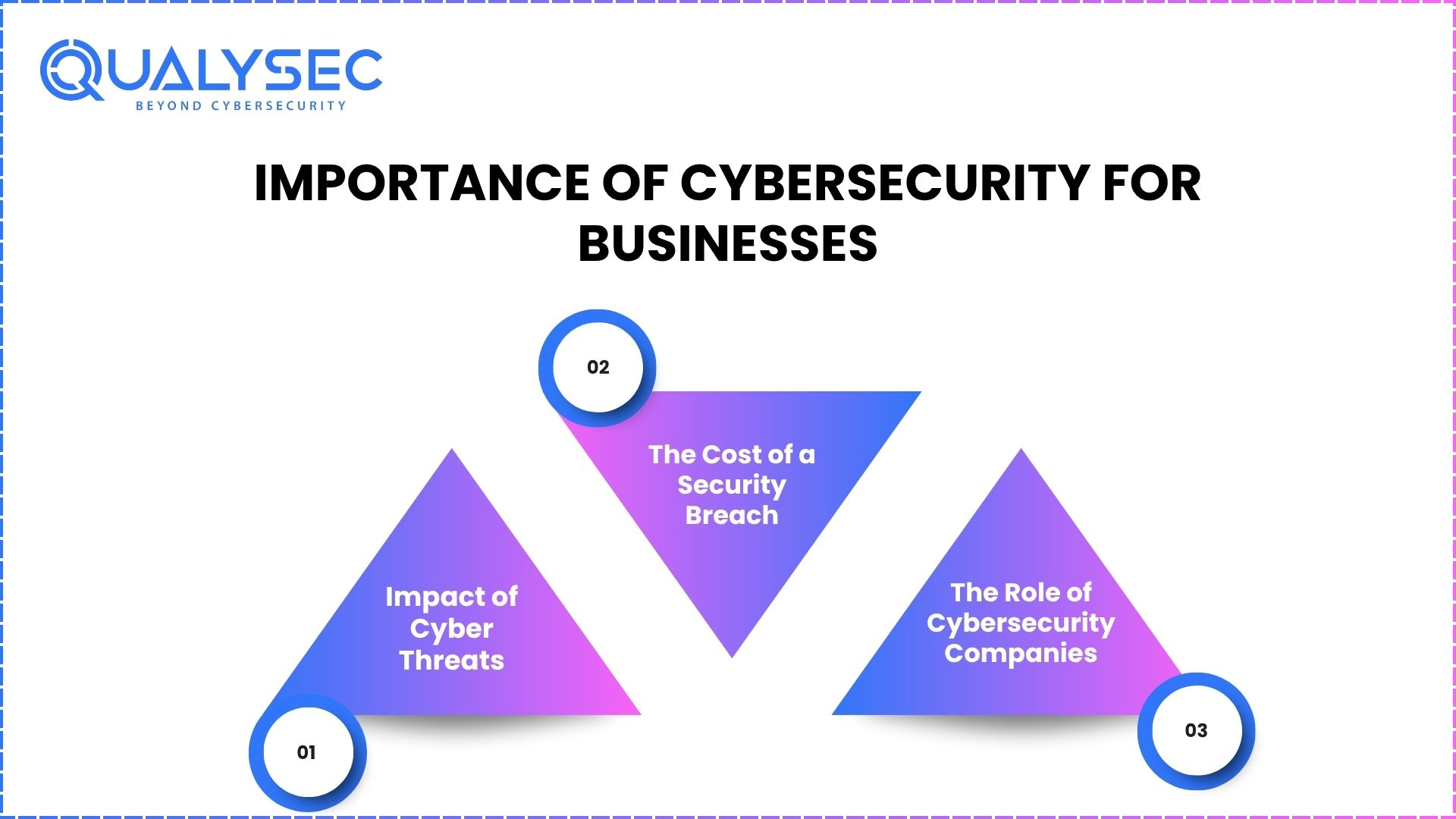
A. Impact of Cyber Threats
The significance of cybersecurity for businesses cannot be overstated. Digital assets, sensitive data, and business operations depend heavily on secure systems. Cybersecurity companies in Malaysia help organizations identify and reduce cyber risks effectively.
- Data Breaches: Data breaches can result in severe financial losses and damage customer trust for years.
- Operational Disruption: Cyberattacks can interrupt workflows, reduce productivity, and negatively impact customer service.
- Reputation Damage: Security incidents can damage a company’s public image and weaken long-term business relationships.
B. The Cost of a Security Breach
The financial impact of a security breach can be devastating for businesses. Cybersecurity companies in Malaysia help organizations reduce these risks through proactive security measures.
- Financial Losses: Security breaches can result in investigation costs, customer notifications, legal expenses, and recovery efforts.
- Regulatory Fines: Businesses that fail to comply with cybersecurity regulations may face significant fines and penalties.
- Loss of Market Value: Major security breaches can negatively impact investor confidence and reduce company valuation.
C. The Role of Cybersecurity Companies
Cybersecurity companies in Malaysia play a critical role in helping businesses minimize cyber risks and strengthen digital security.
- Risk Assessment: Cybersecurity firms conduct assessments to identify vulnerabilities and improve defense strategies.
- Security Solutions: These companies provide services such as firewalls, intrusion detection systems, endpoint protection, and threat monitoring.
- Incident Response: In the event of a cyberattack, cybersecurity experts provide rapid response services to minimize damage and restore operations quickly.
- Compliance Guidance: Cybersecurity companies help businesses comply with cybersecurity regulations and data protection requirements.
Cybersecurity is no longer optional for businesses. Strong security measures are essential for preventing financial losses, operational disruption, and reputational damage.
Conclusion
A. Recap of Top Cybersecurity Companies in Malaysia
Below are some leading cybersecurity companies contributing to Malaysia’s digital security ecosystem:
- Qualysec: Provides penetration testing, vulnerability assessments, and compliance security audits.
- Wizlynx AG: Offers cybersecurity consulting, risk management, and compliance solutions.
- IBM: Provides enterprise cybersecurity technologies and advanced threat intelligence solutions.
- Cisco: Offers networking and cybersecurity solutions for businesses and enterprises.
- LGMS: Provides VAPT, digital forensics, incident response, and technical risk advisory services.
B. Final Thoughts on Cybersecurity in Malaysia
As Malaysia continues its digital transformation journey, cybersecurity companies remain critical in protecting businesses and government institutions from evolving cyber threats.
- Evolving Threat Landscape: Cyber threats will continue to grow in sophistication, requiring proactive defense strategies.
- Collaboration: Public-private collaboration and information sharing are essential for improving cybersecurity resilience.
- Innovation: Technologies such as AI, machine learning, and zero trust security will play a major role in future cybersecurity strategies.
- Regulatory Compliance: Businesses must work closely with cybersecurity experts to meet evolving cybersecurity regulations.
Cybersecurity companies in Malaysia are instrumental in helping organizations operate securely in an increasingly digital world.
FAQ’s
1. What is cybersecurity?
Answer: Cybersecurity refers to the practice of protecting computer systems, networks, and digital data from unauthorized access, theft, damage, or disruption.
2. Why is cybersecurity important?
Answer: Cybersecurity helps prevent cyberattacks, data breaches, and unauthorized access to sensitive information while protecting business continuity and user privacy.
3. What are common cyber threats?
Answer: Common cyber threats include malware, ransomware, phishing attacks, DDoS attacks, insider threats, and social engineering attacks.
4. How can individuals protect themselves from cyber threats?
Answer: Individuals can improve cybersecurity by using strong passwords, enabling two-factor authentication, updating software regularly, and avoiding suspicious links or emails.
5. What should businesses consider when choosing a cybersecurity company?
Answer: Businesses should evaluate a cybersecurity company’s experience, reputation, service offerings, incident response capabilities, and compliance expertise before making a decision.