

New York is the priciest cyber target in the U.S. In 2025, the state was the top victim of cybercrime, with over $3.2 billion lost by businesses, primarily through ransomware attacks, business email compromise, and attacks on financial services, law firms, healthcare networks, and SaaS platforms. Every business in NYC is a target, because Wall Street, Madison Avenue and Midtown combine to process trillions of dollars in transactions, and to own the world’s most valuable customer data.
As a result, regulation has tightened. Every financial services firm in New York; banks, insurers, mortgage brokers, money transmitters, and licensed institutions is subject to the NYDFS Cybersecurity Regulation (23 NYCRR Part 500), and is subject to fines of up to a million dollars if they fail to comply. CISOs must submit compliance certifications on an annual basis, and the timeframe for notifying of a breach has been reduced to 72 hours. Include SEC cyber disclosure requirements, PCI DSS, HIPAA and the NY SHIELD Act, and the audit timeline moves to one of the top items on a CISO’s checklist.
This guide is designed for this reality. It details the top cyber security companies in New York for 2026, the methodology behind the ranking, and what each cybersecurity firm excels at, their weaknesses, and the expected pricing. So, whether you’re a Wall Street bank, a Midtown law firm, a Brooklyn-based SaaS startup, or a Bronx healthcare network, the aim is to help you narrow in on New York City cybersecurity companies without any fear.
Why Cybersecurity Matters More Than Ever in New York
Now, a breach is not just a technical issue; it is one of dollars, a legal issue, and a reputation issue that has ripple effects that extend for quarters. The stakes are high in New York, where financial services, law firms, healthcare, and media converge. There are four areas of impact that are most important:
1 Financial Losses
In 2026, the average cost of a data breach in the United States was $10.22 million, which is the highest cost of data breaches in the world, and New York companies generally pay more, given the complexity and regulatory requirements of the state and customers’ sensitivity to data. These are direct costs like forensic investigation, AG notices, ransom payments, customer credit monitoring, and class-action settlements. The direct impact is typically dwarfed by the indirect impact lost contracts, customer losses, etc., and increased cyber-insurance premiums. 60% of small businesses will close their doors within 6 months of a significant cyber attack.
2 Reputational Damage
Before entering into a contract, New York enterprise buyers particularly banks, insurers, law firms and healthcare networks conduct vendor security questionnaires. A public breach may take two to three quarters to stall a sales cycle and require renegotiation of master service agreements. An undisclosed incident discovered during the due diligence process has become a deal-breaker; private equity firms in Manhattan regularly hire cyber specialists to do an audit.
3 Legal & Compliance Exposure
New York has one of the most difficult compliance environments in the U.S. for businesses. These include the NYDFS Cybersecurity Regulation (23 NYCRR 500), the NY SHIELD Act for all businesses that collect or store private information of NY residents, the SEC’s cyber-incident disclosure rules (Form 8-K Item 1.05), the HIPAA (for the healthcare industry), the PCI DSS (for payment processing firms), and the GDPR (for companies that do business with EU residents). In particular, NYDFS has been leading the charge of fines that have reached seven figures and are still to come, and certifications in CISO have been required.
4 Business Disruption
The average ransomware event for mid-sized US companies comes with a price tag of 5 to 14 days of downtime. That downtime can cost a SaaS business half a quarter’s worth of revenue, and also result in penalty clauses being breached on customer contracts in the hospital with EHR applications or a Wall Street trading desk. Today’s attacks are also extortion-based and involve data theft, so that even a well-managed firm with good backups can be exposed at the leak location.
Bottom line: cyber security companies in New York have ceased to be a cost centre and are now becoming a growth, compliance, and trust enabler. The right partner ensures protected revenue, accelerated enterprise sales cycles and regulators aren’t in your boardroom.
Why New York Is America’s Financial Cybersecurity Capital
New York is rightfully taking its place in the United States as the hub of financial cyber defence. Five factors account for the clustering of New York cybersecurity companies:
- Financial-sector concentration: In the United States, the highest concentration of cyber spend is found within Wall Street, Park Avenue and the World Trade Centre area, where the major US insurers, Mastercard, Citigroup, BlackRock, JPMorgan, Goldman Sachs and Morgan Stanley, are headquartered.
- NYDFS regulatory gravity: 23 NYCRR Part 500 has transformed New York into the most regulated market in the US for cyber, and the NYDFS is now the most active cyber regulator at the state level. This is responsible for the continued demand for MSSPs, vCISO vendors, and audit experts that meet compliance standards.
- Public-company cluster: Cloudflare and Mastercard have big NYC offices, BlueVoyant is NYC-HQ’d, Semgrep is NYC-HQ’d, and Trail of Bits are NYC-HQ’d cyber innovators, while Palo Alto Networks, CrowdStrike and Microsoft Security have significant NYC delivery presence.
- Big Four and law firm support: PwC, Deloitte, EY, and KPMG each have massive cyber consulting practices in NYC, and white-shoe law firms have leading cyber and privacy practices. This forms a thicket of advisory and incident-response assistance.
- Cyber insurance hub: New York is also the cyber insurance hub for the global market, with all major underwriters, as well as AIG, Marsh, and Chubb, being based here. That means that NYC cybersecurity companies are very conversant with what insurers wish to see from a security programme.
Types of Cybersecurity Services Offered by New York Companies
These cyber security service in New York serve startups, mid-sized businesses, financial institutions, legal firms, healthcare organizations and enterprises. The most often available ones are:
- Managed Security Services (MSS / MDR): 24×7 monitoring, threat hunting, EDR/XDR management and incident response typically on a retainer basis. The fastest-growing service category in 2026 will be.
- NYDFS Compliance Services: 23 NYCRR Part 500 readiness; CISO certification support; multi-factor authentication; encryption; and incident response planning required for all covered financial services companies.
- Vulnerability Assessment & Penetration Testing (VAPT): Manual and automated testing of Web Applications, Mobile Applications, APIs, Networks, and Cloud workloads to expose vulnerabilities and prevent attackers.
- Digital Forensics & Incident Response (DFIR): This aspect is relevant because of the 72-hour notification after the breach mandated by NYDFS, and includes post-breach investigation, evidence preservation, root cause analysis and breach-notification coordination.
- Identity & Access Management (IAM/PAM): Identity-first security, zero-trust roll-outs and privileged access management – right in line with the new attack trend in 2026: “attackers logging in, not breaking in.”
- Application Security: SAST, DAST, IAST, and secure code review, particularly in the NYC Fintech, SaaS, and crypto sectors.
- Compliance & Regulatory Services: SOC 2, HIPAA, PCI DSS v4.0, GLBA, ISO 27001 & NY SHIELD Act readiness assessments with documentation support.
- Cloud Security services: AWS/Azure/GCP configuration reviews, container security hardening, CSPM and CIEM.
- Red Team & Adversary Simulation: Multi-vector adversary simulation testing of people, process and technology.
- Cyber Insurance Readiness: Pre-underwriting Assessments, Evidence Packs and Security Control Validation are critical for NYC firms when negotiating Cyber renewals.
Top 10 Cyber Security Companies in New York (2026): Our Methodology
The list comes from a methodical evaluation and not a popularity vote. Twenty-seven companies were evaluated on six criteria for each of the following companies:
- Service depth and methodology: area of attack surface covered (endpoint, identity, cloud, network, applications) and depth in the stated area of focus.
- Compliance coverage: NYDFS 23 NYCRR 500, NY SHIELD Act, SOC 2, HIPAA, PCI DSS v4.0, GLBA, and ISO 27001.
- Industry experience: expertise in financial services, insurance, law, healthcare, SaaS, media and crypto/fintech.
- New York presence: headquartered in Manhattan, Brooklyn, Queens (NYC) in New York City.
- Client outcomes and references: verified case studies, third-party reviews (Clutch, GoodFirms, DesignRush), and renewal rates.
- Reporting and remediation quality: executive reports, technical proof-of-concept and continuous improvement support.
After ranking, the ranking is weighted based on the buyer fit. A specialist MDR firm will be preferred by the financial services buyer, a forensics specialist by the post-breach buyer and a best VAPT firm by a compliance audit assurance buyer. That’s the reality that is captured here below.
List of Top Cyber Security Companies in New York
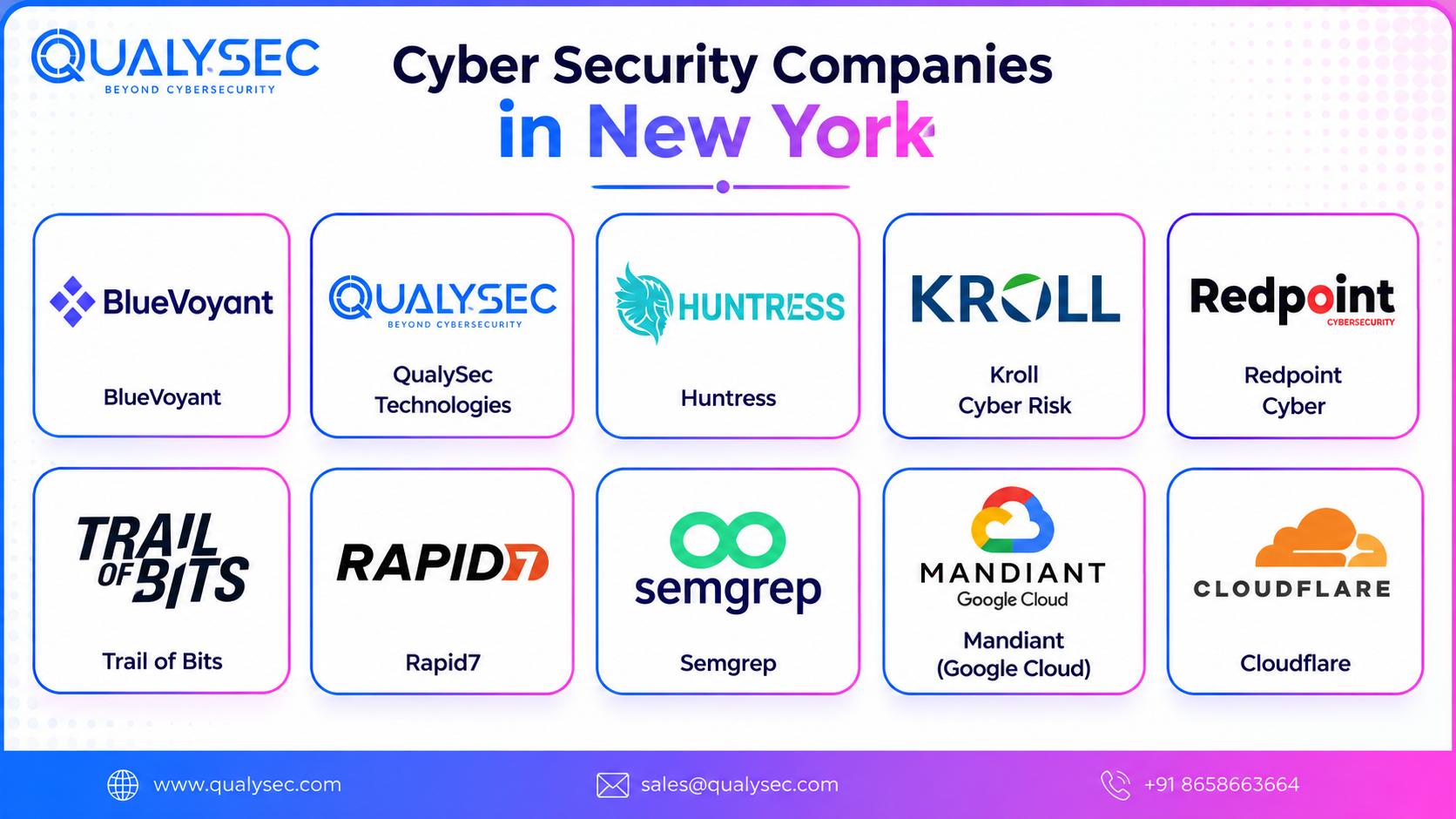
1. BlueVoyant
BlueVoyant is an NYC-based firm that is among the top cybersecurity firms in the city. It is headquartered in NYC, and was designed with financial services, law firms and large buyers in mind. The firm offers analytics-based MDR, supply chain risk monitoring and continuous threat intelligence and is a default managed defence solution for NYDFS-regulated managed defence.
Strengths
- Leading player in financial services on the grassroots level in NYC.
- Post-MOVEless, Okta and SolarWinds, ability to monitor critical events in the supply chain.
- Line-of-sight and real-time threat intelligence.
- Hybrid MDR delivery for the mid-market and enterprise customers.
- Audit-ready evidence packs for NYDFS, SOC 2 and ISO 27001.
Limitations
- Enterprise pricing only suitable for early-stage startups.
- MDR-led model is less hands-on penetration testing compared to boutique.
2. Qualysec Technologies
QualySec is a top cyber security company in New York that customers rely on for in-depth, process-based penetration testing and compliance-based evaluations. While QualySec’s headquarters are not located in NYC, the company provides VAPT services for NYC fintechs, SaaS companies, healthcare networks, and law firms, employing manual VAPT in various application environments such as web, mobile (iOS, Android), API, cloud (AWS, Azure, GCP), IoT, and AI/ML. Compliance coverage includes SOC 2 Type II, HIPAA, PCI DSS v4.0, ISO 27001, GDPR, FDA and NYDFS compliance testing.
Strengths
- Manual-first VAPT methodology that constantly discovers business logic and chained exploits.
- Compliance coverage for SOC 2, HIPAA, PCI DSS, ISO 27001, GDPR and NYDFS.
- Create visual attack-chain maps and executive-ready dashboards along with technical PoC exploits.
- Remediation ticket-ready exported to Jira, ServiceNow, and Azure Boards.
- Post revalidation of the work areas the final piece to the puzzle following the report.
- Loved by global enterprises in critical infrastructure, e-commerce, healthcare, SaaS and fintech.
Limitations
- Operations outside of New York: remote-first delivery, on-site support as needed.
- Best-value engagements usually require a 2-6 week period of time, which is not suitable for last-minute testing requests.
3. Kroll Cyber Risk
Kroll is recognised as one of the world’s leading names in the field of digital forensics and incident response (DFIR), having a strong presence in New York City. When the worst-case scenario occurs (a massive ransomware attack, data breach, or a regulatory inquiry), the firm is the name that springs to mind, and it is also in high demand from law firms and insurers for risk assessments and litigation support.
Strengths
- Global leader in DIY and with extensive knowledge of NYC.
- The default option for major incident responses and regulatory investigations.
- A robust litigation practice for law firms and insurers.
- Established risk-assessment capability in the financial services and legal sectors.
- Adopted by Fortune 500 and international enterprise purchasers.
Limitations
- Enterprise pricing: too expensive for SMBs or startups.
- DFIR-branded: less specialised than dedicated MSSPs in ongoing managed security.
4. Trail of Bits
Trail of Bits is a cybersecurity research and engineering company based in NYC that was named a Leader in The Forrester Wave: Cybersecurity Consulting Services. It has an in-depth knowledge of deep technical security review, blockchain and smart contract audits, cryptography review and adversarial security engineering, all of which are a default for high-stakes technical assessment.
Strengths
- Forrester Wave Leader in Cybersecurity Consulting Services.
- Industry expertise in blockchain, smart contract and cryptography audits.
- Ability to conduct in-depth technical security engineering and adversarial research.
- Second place in finals in 2025 (after being awarded funding by DARPA AIxCC).
- With a global reputation, it is headquartered in NYC.
Limitations
- Engagements with a high level of technical expertise and research are not so well-suited to commodity MSS or continued monitoring.
- The pricing and engagement model is based on specialist positioning.
5. Mandiant (Google Cloud)
Mandiant, a Google Cloud subsidiary, is one of the world’s most esteemed companies in threat intelligence, incident response, and managed defence; they have a strong presence in NYC and service financial services, healthcare, and large enterprise buyers. The firm has played a role in some of the largest breaches ever recorded and is the preferred solution for companies that have been targeted by nation-states or massive ransomware events.
Strengths
- The highest threat intelligence and adversary tracking in the industry.
- Global incident response that is fully developed.
- Managed Defence (MDR) with frontline Threat Intelligence support.
- Excellent fit for NYC financial services, Fortune 500 buyers.
- Supported by Google Cloud scalability, research and worldwide distribution.
Limitations
- Not an SMB’s option: enterprise-only pricing.
- Long engagement cycles in comparison to boutique providers.
6. Rapid7
Rapid7 is a publicly listed (NASDAQ: RPD) leading vulnerability management and SIEM provider with a strong NYC presence. The firm’s InsightVM, InsightIDR, and InsightConnect products each in a different category of vulnerability management, detection and response, and security orchestration, respectively safeguard 11,000+ customers globally.
Strengths
- Advanced vulnerability management and continuous monitoring using InsightVM.
- Strong Analyst Workflows and Cloud-based SIEM/XDR (InsightIDR).
- MDR services for customers that require 24×7 managed detection.
- The research team (Rapid7 Labs) is strong in creating threat intelligence and Metasploit.
- Mid-market & enterprise scale, and a wide range of customers in public companies.
Limitations
- Not as specialised or pure penetration testing as category leaders.
- Platform breadth is defined as a variation in depth by module.
7. Semgrep
A NYC-based application security platform, Semgrep provides powerful, customisable code analysis that runs quickly across large codebases. The company is developing world-leading SAST, dependency scanning, and secrets scanning and is the trusted solution for NYC fintechs, SaaS companies, and all software shipping companies.
Strengths
- Industry-leading SAST platform with rapid, customisable code analysis.
- NYC’s top fintech, SaaS and crypto buyers.
- Includes dependency scanning and secrets scanning.
- Integrations of CI/CD pipelines with GitHub, GitLab and developer workflows.
- Community-based open source, in addition to an enterprise platform.
Limitations
- Platform-led product, not a managed services or VAPT company.
- Resources best used in conjunction with offensive testing and MDR from other vendors.
8. Huntress
Formed by former CIA and NSA cyber operators, Huntress provides enterprise-level MDR to SMB and mid-market customers, among which is a solid customer base in NYC. The firm’s Security Operations Centre (SOC), tightly coupled with its endpoint and identity protection technologies, is offered at SaaS prices, protecting businesses.
Strengths
- Highest MDR for SMB/mid-market at SaaS pricing (uncommon in the market).
- Established by former NSA cyber operators who have a strong background in attacks.
- Seamless SOC + technology delivery model.
- Good for NYC law firms, MSPs and expanding businesses.
- Rapid growth and capital strength ($100M ARR by mid-late 2024).
Limitations
- Emphasis on SMB and mid-market limited fit to Fortune 500 financial services.
- Less specialized when it comes to deep penetration testing or formal compliance audits.
9. Cloudflare
Cloudflare (NYSE: NET) has a large office in NYC and is a world leader in web application security, DDoS protection, content delivery and zero trust network access. The firm’s connectivity cloud is used by over 20% of the internet and is the preferred option of NYC buyers who require edge security at internet scale.
Strengths
- More than 20% of the web is the Internet-scale infrastructure.
- Leading DDoS protection, WAF and bot management.
- Zero-trust network access (Cloudflare One) for distributed teams.
- Cloud-native delivery and fast deployment of global services.
- Security capability goes hand-in-hand with strong CDN performance.
Limitations
- Platform-led product company not suitable for customers looking for hands-on managed services.
- Advanced compliance and security features require enterprise tiers.
10. Redpoint Cyber
Redpoint Cyber is a human-centric and technology-driven NYC cybersecurity firm providing digital forensics and incident response services, cybersecurity consulting on the cloud, threat hunting and ethical hacking. The company is a good match for mid-market NYC buyers that require proactive managed security and IR in a single vendor.
Strengths
- One proactively managed security + IR engagement.
- Strong digital forensics and incident response practice.
- AWS, Azure and GCP Cloud security consulting.
- Threat hunting and ethical hacking as part of a service portfolio.
- Hands-on engagement delivery for NYC and the Tri-State Area.
Limitations
- Mid-market focus limited fit for Fortune 500 cyber programmes.
- Smaller scale than national MSSPs.
At-a-Glance: Leading Cybersecurity Firms & Their Core Strengths
Take advantage of this table to make quick shortlisting based on services, focus and key strengths.
|
Company |
Services Offered |
Industry Focus |
Key Strengths |
|
1. BlueVoyant |
Analytics-driven MDR, Supply Chain Risk, Threat Intel |
Financial Services, Law, Enterprise |
The NYC-HQ MDR leader is someone who brings a pedigree from the financial sector, has been audit-ready and is well-suited to run. |
|
2. QualySec Technologies |
Manual-led VAPT (Web, Mobile, API, IoT, Cloud, AI/ML), Compliance Audits, DevSecOps |
BFSI, Healthcare, SaaS, E-commerce, Govt |
The three key elements of process-based VAPT are ticket-ready remediation and post-fix revalidation. |
|
3. Kroll Cyber Risk |
DFIR, Litigation Support, Risk Assessment |
Law Firms, Insurance, Enterprise |
Be the global leader in DFIR, responding to large incidents and regulatory investigations. |
|
4. Trail of Bits |
Technical Security Review, Blockchain Audits, Cryptography |
Fintech, Crypto, Enterprises |
Forrester Wave Leader is a deep technical research and a finalist of DARPA AIxCC. |
|
5. Mandiant (Google Cloud) |
Threat Intelligence, Incident Response, Managed Defence |
Fortune 500, Financial Services |
Industry-leading threat intelligence, well-developed IR practice, and Google Cloud-supported |
|
6. Rapid7 |
Vulnerability Management, SIEM/XDR, MDR |
Mid-market, Enterprises |
Diversified customers, a mature VM and InsightIDR services. |
|
7. Semgrep |
SAST, Dependency Scanning, Secrets Detection |
Fintech, SaaS, Crypto |
The industry-leading SAST platform provides fast and customisable code analysis. |
|
8. Huntress |
SMB/Mid-market MDR, Identity Protection |
SMB, MSPs, Law Firms |
An enterprise MDR pricing model, with a founding team that has an NSA endorsement. |
|
9. Cloudflare |
WAF, DDoS, CDN, Zero-Trust Network Access |
SaaS, Enterprises, E-commerce |
The demand for Internet-scale infrastructure, edge security leader. |
|
10. Redpoint Cyber |
DFIR, Managed Security, Threat Hunting, Cloud Consulting |
Mid-market, NYC Metro |
A proactive MSS that is human-led and tech-enabled, and everything under one roof. |
Cybersecurity Cost Comparison in New York (2026)
The size of businesses, their regulatory risk and attack surface, and the scale of their cybersecurity investments. Below is a summary of the typical ranges for engagements provided by New York cybersecurity companies.
|
Business Type |
Scope of Engagement |
Estimated Cost (per year) |
Typical Deliverables |
|
Small Businesses & Startups |
Basic MSS, 1–2 web/mobile app VAPT, SOC 2 Type 1 readiness, NY SHIELD Act compliance |
$25,000 – $75,000 |
Managed defence, VAPT report, remediation guidance, baseline compliance documentation |
|
Mid-Size Enterprises |
Multiple apps + APIs, advanced cloud security, NYDFS readiness, HIPAA / PCI DSS / SOC 2, 24×7 MDR |
$100,000 – $400,000 |
Complete MSS, pentests, audit-ready documents, identity governance and NYDFS evidence pack. |
|
Financial Services & Large Enterprises |
Full NYDFS 23 NYCRR 500, 24×7 SOC, IR retainer, identity governance, threat intelligence, cyber insurance prep |
$500,000+ |
Enterprise-grade SOC, NYDFS traceability, IR playbooks, IAM/PAM, board-ready reporting |
Note: This is based on a one-off engagement, varying infrastructure complexities, asset quantity, retesting requirements and/or one-off vs annual retainer. Don’t sign until you are given a sample report and proof of concept. It is the single best indicator of vendor quality.
How to Choose the Right Cybersecurity Partner
The first question that must be asked is what problem is being solved? In order to choose the right partner from the 10 firms above. There is not much common ground between a Wall Street bank subject to NYDFS, a Brooklyn SaaS startup that is getting ready for SOC 2 or a Midtown law firm on the receiving end of a ransomware attack. The decision frameworks below match buyer profiles with cyber security companies in New York that best meet their needs.
1. If you are a financial services firm under NYDFS
Banks, insurers, mortgage brokers, money transmitters, and any entity licensed by DFS should be considering the top three on the shortlist: BlueVoyant, Mandiant, and Rapid7. For buyers with audit-grade MDR requirements, along with comprehensive NYDFS evidence packs and supply chain risk monitoring, BlueVoyant is the best fit. With Google Cloud support, Mandiant is the preferred option for threat intelligence and incident response at the scale of a Fortune 500 company. When it needs to be delivered as an integrated platform with predictable pricing, it has to be Rapid7.
2. If you have an active breach or regulatory investigation
If the worst has already occurred ransomware attack, exfiltration of data, NYDFS or SEC investigation head straight to Kroll Cyber Risk or Mandiant. Kroll is the go-to source for NYC law firms, insurance companies and businesses that require forensic accounting services and litigation support. When the goal is attribution to a nation-state or supply chain, Mandiant is a more suitable option. Both firms also provide 72-hour NYDFS notification timelines, as well as SEC Form 8-K disclosure preparation
3. If your priority is deep penetration testing and compliance assurance
If you are a buyer looking to undergo a SOC 2 Type II, PCI DSS v4.0, HIPAA or NYDFS audit, our recommendation is that you consider shortlisting the following companies: QualySec Technologies, Trail of Bits, and Redpoint Cyber. QualySec’s manual methodology and remediation reports ready for tickets are ideal for regulated workloads where the quality of the evidence is as important as the quality of the test. Trail of Bits is the best approach if the thing under test is very technical, such as smart contracts, cryptography implementations, or research software. If penetration testing is to be followed with on-going managed security and IR solution, Redpoint Cyber is a better choice.
4. If you ship software (fintech, SaaS, crypto)
These three, Semgrep, Trail of Bits, and QualySec, are worth prominently featuring in the shortlist for fintech, SaaS, and crypto firms in NYC. Semgrep is the best option for in-pipeline SAST, dependency scanning and secrets detection in large codebases. Whether it’s high-stakes technical reviews such as smart contracts, cryptography, or critical research, Trail of Bits is the obvious choice. QualySec is the answer to manual penetration testing that requires audit-level evidence for SOC 2, PCI DSS, or NYDFS.
5. If you need edge security and DDoS protection at an internet scale
SaaS, e-commerce, media, and financial services companies with all of their business conducted through web apps and APIs should consider Cloudflare as their top choice. It’s a combination of DDoS protection, WAF, bot management, and zero-trust network access that protects over 20% of the web it’s Cloudflare’s edge platform. If you’re an NYC buyer who’s looking for a similar capability in a larger, managed security program, BlueVoyant and Rapid7 are good options.
6. If you are an SMB, law firm, or growing business
NYC SMBs, law firms and mid-market organisations should consider Huntress, Redpoint Cyber, and Rapid7. Huntress is the ideal solution for enterprise-class MDR and SaaS pricing, especially for NYC law firms and MSPs on enterprise budgets. Redpoint Cyber would be better for those who require a managed security provider with IR capability under one local NYC partner. If you’re planning to grow your applications into the mid-market and you want a publicly listed platform with a predictable pricing model, then Rapid7 is the answer.
7. The non-negotiables before you sign
No matter who you choose, verify four items before you sign the SOW: ask for a sample report or proof of concept the product is the deliverable, generic reports indicate automated tooling; confirm methodology in writing, and ensure it matches sales pitch; confirm that post-remediation revalidation or regular optimisation is in scope, not billed separately; and request two recent client references with comparable architecture from your industry. If the vendor does not offer all four, go to the next.
Conclusion
These ten firms are very different in methodology, specialisation, industry focus and pricing. The determining factor is fit, not reputation, and none of these is universally best. But the financial-sector MDR leaders prevail for NYDFS-regulated banks. When the break-in occurs, forensics experts prevail. For high-stakes, technical audits, boutique research firms prevail. SaaS and fintech are an application security platform’s game. SMBs and law firms are the winners when it comes to SaaS pricing for MDR providers.
Utilise the decision-making structure in Section 9 to narrow down the list of New York City cybersecurity firms that align with priorities, ask for sample reports from the top three, validate methodology and references, and consider continuing optimisation/revalidation as a non-negotiable. Choose the firm with the characteristic that most closely matches the risk you want to control.
Frequently Asked Questions
1. Which is the best cybersecurity company in New York in 2026?
The best firm among the top cyber security companies in New York will vary based on the volume of work, type of regulations and budget. In the short list for financial services, which are regulated by NYDFS, there are three names that stand out: BlueVoyant, Mandiant, and Rapid7. If you’re looking for an active breach responder, Kroll and Mandiant come to mind first. QualySec, Trail of Bits, and Redpoint Cyber are good options for deep penetrating and compliance audits. The best for SMB and law firm budgets are Huntress and Redpoint Cyber. Take advantage of Section 9 to connect your priorities with the right firm.
2. What is the NYDFS Cybersecurity Regulation (23 NYCRR Part 500)?
It’s New York’s cybersecurity rule for financial services companies: banks, insurers, mortgage brokers, money transmitters and any other company in the financial services sector licensed by the DFS. The new Part 500 (which takes effect on November 2023) demands multi-factor authentication, encryption, incident response plans, CISO certification of compliance and breach notification within 72 hours. There are now many New York cybersecurity companies that provide specific NYDFS readiness evaluations. The fines for not complying are now in the millions.
3. How much do cyber security services in New York charge?
For SMB plans, costs are normally in the range of $25,000–$75,000 annually. In contrast, for NYDFS-regulated enterprise programmes that include 24×7 SOC, IDG, threat intelligence and incident response, costs are in the realm of $500,000+ per year. Typically, an average-sized commercial company spends between $100,000 and $400,000 a year, depending on the scope of the regulatory control and complexity of the infrastructure.
4. What is the NY SHIELD Act?
The Stop Hacks and Improve Electronic Data Security (SHIELD) Act broadened New York’s data breach notification requirement, and it covers any business that possesses the private information of New York residents, regardless of where the business is located. It demands adequate security protection measures and timely notifications of breaches. SHIELD Act readiness is part of the standard compliance scoping of most cyber security companies in New York.
5. Are New York City cybersecurity firms suitable for SEC and Wall Street compliance?
Yes, New York is indeed the financial cybersecurity capital of the US. The NYSE-listed firms, banks, insurers and asset managers are all regularly targeted by BlueVoyant, Mandiant, Kroll, Rapid7, and Trail of Bits. Most speak the language of SEC Cyber Incident Disclosure requirements (Form 8-K Item 1.05), NYDFS (23 NYCRR 500), GLBA and SOC 2.
6. How often should we run a penetration test?
At least once per year, after any major infrastructure changes, migrations or compliance events. Quarterly or continuous testing models are typically used for highly regulated workloads such as financial services, healthcare, payments, etc. Regular VAPT is required by all three platforms (NYDFS, PCI DSS v4.0 and HIPAA), and most top cyber security companies in New York include annual retesting in their engagements.
7. What should I always ask for before signing a contract?
Four things: A sample report or a proof of concept, confirmation of methodology (manual, automated or hybrid when it comes to VAPT; platform-led vs analyst-led when it comes to MDR), a commitment to post-remediation revalidation/ ongoing optimisation and two recent client references for similar architecture within your industry.