






Cyber threats continue evolving, and staying ahead means trialling security testing tools. From vulnerability scanning to penetration testing frameworks, the right security assessment tools will help enterprises identify vulnerabilities before they can be exploited against them. A glimpse of the top security testing tools of 2025 comes later, with some new functionalities to enhance security in networks, apps, and on the cloud.
Comparison of Best 10 Security Assessment Tools (2026 Edition)
|
Tool |
Primary Focus |
Best For |
Key 2026 Innovation |
|
Qualysec |
Managed Services |
Businesses needing expert-led testing tools (Cloud and source code) |
Hybrid human-AI pentesting |
|
Invicti |
Web App Security |
DevSecOps / CI/CD Pipelines |
Predictive false-positive filtering |
|
Nmap |
Network Discovery |
IT Admins / Network Mapping |
Advanced service fingerprinting |
|
Nessus |
Vulnerability Scanning |
Compliance and Asset Auditing |
Real-time “TruRisk” scoring |
|
Burp Suite |
Manual/Auto Pentest |
Security Researchers / Web Apps |
Advanced API security crawling |
|
StackHawk |
DevSecOps |
Software Engineers / Developers |
Auto-remediation suggestions |
|
QualysGuard |
Cloud-Native Scan |
Enterprise Cloud Environments |
AI-SPM (AI Security Posture) |
|
Acunetix |
Web & API Scan |
Sensitive Data / E-commerce |
AI-driven discovery of hidden assets |
|
Metasploit |
Exploit Framework |
Ethical Hackers / Red Teams |
Autonomous attack chaining |
|
ZAP (OWASP) |
Open Source Scan |
Budget-conscious Security Teams |
Real-time passive threat detection |
List of the Top 20 Security Assessment Tools in 2025
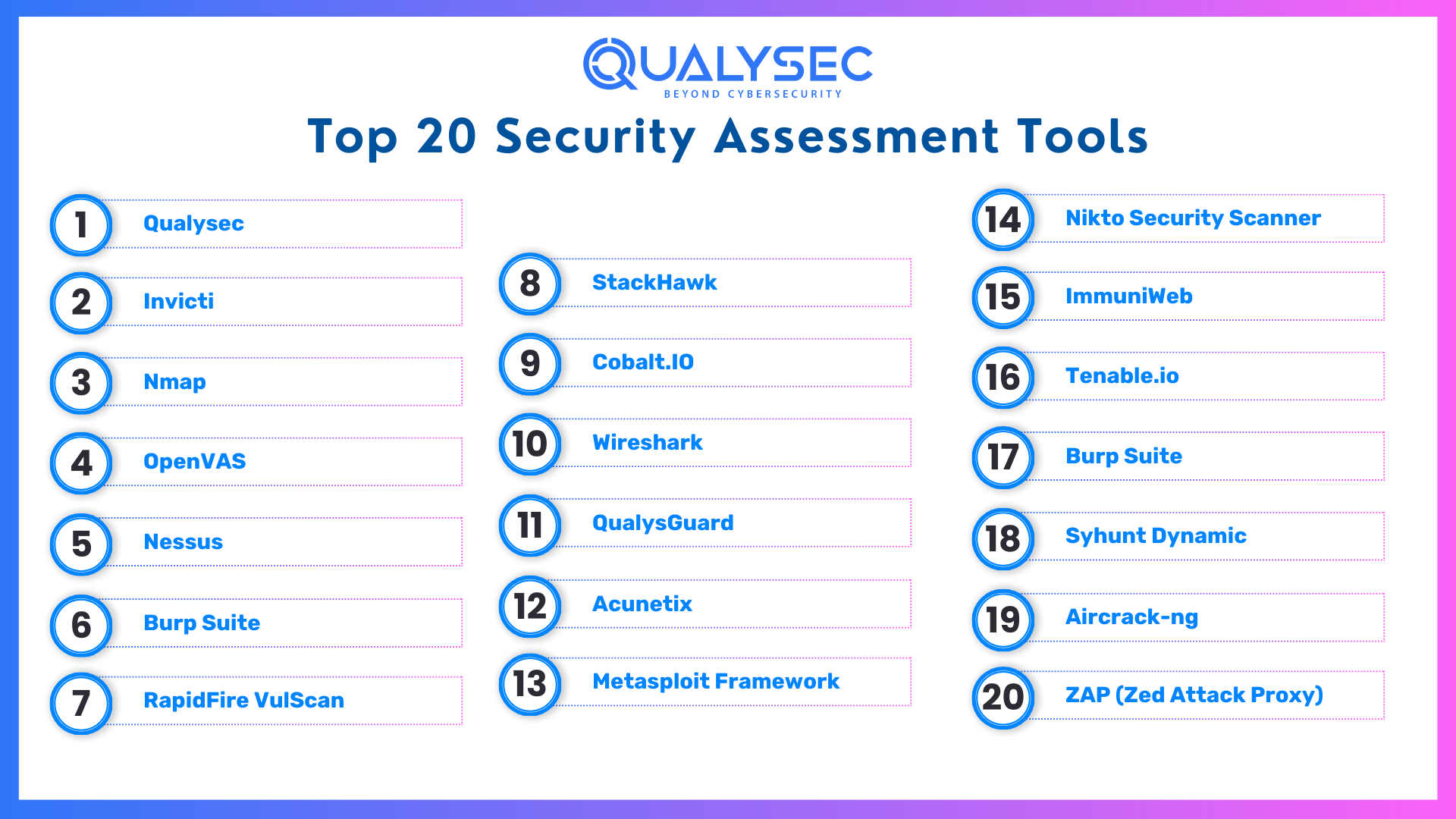
1. Qualysec
Qualysec is a leading security assessment provider that helps businesses identify and fix vulnerabilities in their networks and applications. While it’s not a traditional tool, Qualysec offers expert-led penetration testing and vulnerability scanning services, ensuring strong cyber defenses.
Key Features:
- Vulnerability assessment
- Advance vulnerability scanner (cloud security scanner and source code scanner)
- Regular penetration testing for web, mobile, and cloud security
- Compliance and risk management support
2. Invicti
Invicti provides web application security scanning automatically to offer accurate vulnerability detection. It provides dynamic and static scanning for deep security scanning for DevSecOps teams. The tool also provides intelligent automation to remove false positives.
Key Features:
- Advanced DAST and SAST features
- End-to-end security testing
- Integrated CI/CD integration
3. Nmap
Nmap (Network Mapper) is an open-source network security scanner and discovery tool. It scans ports, discovers hosts, and maps network topology. IT administrators use it extensively to scan vulnerabilities and weaknesses within a network.
Key Features:
- Host and service detection
- Firewall evasion techniques
- OS fingerprinting
4. OpenVAS
OpenVAS is an open-source IT infrastructure security scanner for vulnerability scanning. It has a huge database of known vulnerabilities and supports automatic scanning for wide security testing. It is suited best to be used by organizations for network security auditing.
Key Features:
- Large vulnerability database
- Security testing through automation and manual validation
- Integrated with threat intelligence
5. Nessus
Tenable’s Nessus is a globally renowned vulnerability scanner. It scans for misconfigurations, malware, and outdated software that helps organizations stay compliant with security controls. Cybersecurity professionals use the tool to reduce the number of cyberattacks.
Key Features:
- Vulnerability scanning precisely
- Compliance reporting
- Programmable scan policies
6. Burp Suite
Burp Suite is a feature-rich penetration testing tool used quite often in web security auditing. It provides automated and manual security testing, so it is good for security researchers and ethical hackers. The tool provides extensive analysis of web application vulnerabilities.
Key Features:
- Web application penetration testing
- Traffic analysis intercepting proxy
- Automated vulnerability scanning
7. RapidFire VulScan
RapidFire VulScan is meant for Managed Security Service Providers (MSSPs) and offers real-time vulnerability scanning for several clients. It helps IT companies to tackle enterprises’ cybersecurity on an active basis. The solution offers auto-scanning and compliance management.
Key Features:
- Multi-tenant vulnerability scanning
- Risk-based threat prioritization
- Compliance reporting
8. StackHawk
It is an application security tool that is automatable via CI/CD pipelines. StackHawk enables DevOps to scan for vulnerabilities while developing software. The application is used to facilitate end-to-end detection of security vulnerabilities before they are deployed.
Key Features:
- DevSecOps integration
- Automated API and application testing
- Customizable security policies
9. Cobalt.IO
Cobalt. IO offers cloud security testing to enable organizations to identify web application vulnerabilities. It offers lead-based managed security testing. Organizations utilize the tool to scan threats in real-time.
Key Features:
- On-demand pen testing
- Cloud security testing
- Artificial intelligence-based threat analysis
10. Wireshark
Wireshark is a protocol analyzer that is generally used in security testing and live network monitoring. It does not have intrusion detection but can do deep packet inspection. It is used by security experts to analyze network traffic and look for abnormalities.
Key Features:
- Deep packet inspection
- Real-time network monitoring
- Protocol analysis
11. QualysGuard
QualysGuard is a cloud-based security scanner that provides on-demand security scanning for IT assets in cloud and on-premises environments. It has continuous security monitoring in the sense of automated compliance tracking and risk assessment. It is a scalable and vulnerability-laden solution that organizations appreciate.
Key Features:
- Cloud-native security platform
- Asset discovery and risk analysis
- Automated compliance tracking
12. Acunetix
Acunetix is a web vulnerability scanner for the future that is excellent at discovering SQL injections, XSS, and other web attacks. Using AI-driven scanning, it identifies web app and API vulnerabilities. Businesses handling sensitive data are provided with automated security testing and compliance reporting.
Key Features:
- AI-driven vulnerability scanning
- API and web app security testing
- Compliance reporting
13. Metasploit Framework
Metasploit is a free penetration testing platform utilized by security experts to simulate attacks and assess network vulnerabilities. It has a vast database of exploits, vulnerability scans automatically, and penetration testing tools. Ethical hackers use it to test and strengthen cybersecurity defenses.
Key Features:
- Exploit development and exploitation
- Automatic vulnerability scanning
- Vast exploit database
14. Nikto Security Scanner
This is an automated web server vulnerability scanner and can be used on websites and APIs. It is used primarily by SaaS businesses and e-commerce websites. It checks for security vulnerabilities, malware, and misconfigurations to prevent cyber attacks. With real-time scanning, it delivers continuous website protection.
Key Features:
- Automated security scanning
- Web and API security testing
- Malware detection and removal
15. ImmuniWeb
ImmuniWeb is an amalgamation of artificial intelligence-powered security testing and penetration testing with enterprise compliance management. It offers API security testing and risk-based vulnerability management. Organizations handling sensitive information depend on its compliance-based security features.
Key Features:
- AI-powered security testing
- API security scans
- GDPR and PCI DSS compliance
16. Tenable.io
Tenable.io is a cloud vulnerability management tool with real-time scanning, asset discovery, and compliance monitoring. It offers risk-based prioritization of security vulnerabilities to further enhance cybersecurity programs. It is utilized by businesses because of its enhanced vulnerability analytics and cloud security.
Key Features:
- Cloud and container security
- Automated vulnerability scanning
- Risk-based prioritization
17. Burp Suite Enterprise
Burp Suite Enterprise elevates the penetration testing feature of Burp Suite to the level of the enterprise organization for carrying out ongoing security testing. It is employed for inserting into security workflows for carrying out web security testing on a large scale. Organizations employ it to automate the detection of web application vulnerabilities.
Key Features:
- Mass-scale web security testing
- Scanning and crawling automatically
- Security workflow integration
18. Syhunt Dynamic
Syhunt Dynamic is a dynamic web security scanner that operates in real-time to identify vulnerabilities. It is designed to identify OWASP’s Top 10 security vulnerabilities as well as other web attacks. Developers and security analysts use it to identify source code security.
Key Features:
- Automated security scanning
- OWASP Top 10 scanning of vulnerabilities
- Source code security analysis
19. Aircrack-ng
Aircrack-ng is a test tool applied in wireless network pen-testing and wireless network security pen-testing. It is commonly applied to test Wi-Fi vulnerability and cracking bad encryption networks. Capture and analysis of the network packet is achieved by applying it for network security analysts.
Key Features:
- Security test of the Wi-Fi network
- Capture and analyze the packet
- Cracking of WPA and WEP
20. ZAP (Zed Attack Proxy)
ZAP is an open-source web application security scanner developed by OWASP which is employed for scanning the vulnerabilities in web applications. It offers automatic as well as manual scanning functionality to security experts. Its active and passive security scan helps in the detection of potential threats in real-time.
Key Features:
- The manual and automated vulnerability scan
- Active and passive security scan
- Customization of security rules
The Future of Cyber Security Assessment
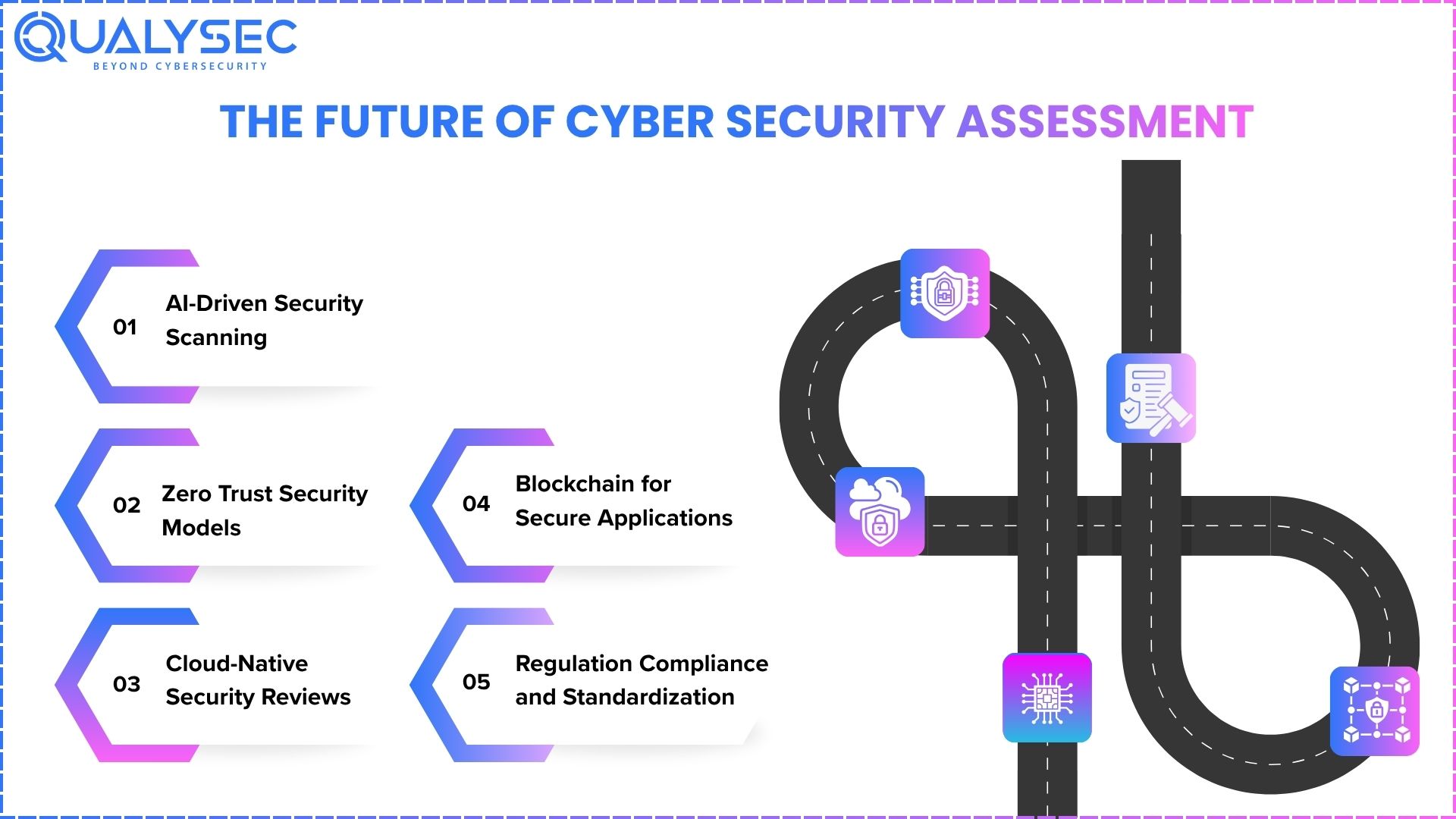
With more technology, cybersecurity policies must evolve to manage contemporary threats. The following are trends that will define the future of security evaluation:
1. AI-Driven Security Scanning
Artificial intelligence is revolutionizing security testing with automated scanning of threats, reducing false positives, and increasing accuracy. AI-driven platforms can pre-predict zero-day vulnerabilities before they are exploited, significantly enhancing security postures. Organizations are incorporating AI-driven scanning software to enhance defenses.
2. Zero Trust Security Models
Adoption of Zero Trust architecture is increasing, with continuous authentication of the applications and users being rendered mandatory. The security model provides a platform where no one is trusted by default, limiting unauthorized access and data loss. Zero Trust is being implemented in companies to safeguard sensitive data in networks and cloud infrastructure.
3. Cloud-Native Security Reviews
With cloud uptake at a historic high, security audits are in the process of moving towards cloud-native controls. These controls involve real-time scanning for vulnerabilities, security compliance scanning based on automation, and the integration of threat intelligence. Cloud security audits ensure that applications and infrastructure are well-protected from threats that constantly evolve.
4. Blockchain for Secure Applications
Blockchain technology is also investigated to enhance application security by guaranteeing data integrity and reducing attack surfaces. Decentralized security architectures can assist in maintaining sensitive data from tampering, and this security benefit can be delivered. Blockchain-based authentication models will revolutionize security audits in the future.
5. Regulation Compliance and Standardization
Governments and industry groups are enforcing stricter security standards. Compliance with standards like ISO 27001, GDPR, and NIST is becoming commonplace for companies to be able to attain cybersecurity resilience. Companies must meet these regulatory standards to evade fines and earn stakeholder trust.
Conclusion
In 2025 and beyond, security assessment or vulnerability assessment will still be a fundamental part of cybersecurity operations. With ever-changing AI-driven security, auto-testing, and real-time monitoring, organizations must leverage security assessment tools to implement proactive and watchful security measures. With the latest AVA techniques, state-of-the-art security hardware and software, and industry best practices, organizations can successfully block threats and safeguard their intangible assets. Being ahead of the cyber attacks is all about identifying threats, yes, first and foremost, proactively preventing those vulnerabilities from turning into actual threats.
Frequently Asked Questions (FAQs)
1. What is the difference between a vulnerability scanner and a penetration testing tool?
A vulnerability scanner (such as Nessus or OpenVAS) is an automated program that attempts to identify known vulnerabilities or out-of-date software. A human uses a penetration testing tool (such as Metasploit or Burp Suite) to proactively use those holes to determine how far an attacker might go into the network. Most platforms are also integrating the two in 2026, in suites known as Exposure Management.
2. What should be the frequency of such security tests of our organization?
Whereas in the past, yearly pentests were the norm, the 2026 guideline is Continuous Security Monitoring. Automated scanners are preferably run weekly or even daily (built as part of CI/CD pipelines), whereas manual penetration tests should be performed after each major software release or at least once a quarter.
3. What is the reason why AI-driven scanning will be obligatory in 2026?
Since the cyber threat has employed AI to create polymorphic malware and advanced phishing, only humans can fail to defend against it. Millions of data points can be analyzed with AI-powered tools to forecast zero-day vulnerabilities and prioritize risks, which are based on real attacker behavior, which can reduce the noise of false alerts by a significant margin.
4. Can enterprise security be done with open-source tools such as Nmap and ZAP?
Discovery and point-in-time testing are best done with open-source tools. But to achieve 2026 compliance requirements (such as GDPR or the EU AI Act), commercial tools are often needed by the enterprise since they offer automated reporting, technical support, and have the Audit Trail mandated by regulators.
5. What is the impact of a Zero Trust model on the utilization of these tools?
With a Zero Trust environment, the security test turns into not defending the perimeter, but instead checking the identity. It is now tested using tools to determine whether a user can access data that he or she should not be able to, even when they are logged in to the network. This implies a greater emphasis on testing API security and Identity and Access Management (IAM).
6. What is Cloud-Native security testing?
Cloud-native testing evaluates containers (such as Docker), orchestrators (such as Kubernetes), and serverless functions in contrast to traditional testing, which examines physical servers. It concentrates on the maladjustments in the cloud setup (AWS, Azure, Google Cloud) that is the most frequent source of information breaches in 2026.