
Cyberattacks targets are growing very fast and most companies are not in a position to match the speed. Small and medium-sized businesses in the United States are the most risky as the attackers know that such companies are not used to a defense with two digits in their protection. By 2025, 43 percent of SMBs had already indicated that they have become victims of a cyberattack, but 83 percent were not ready to recover after it occurred.
Conversely, it is very expensive and hard to employ a security team within a company. There is a lack of skilled analysts and security tools required to monitor and react to incidents are unaffordable to most companies. Therefore, companies continue to be victims of ransomware, data leakage, and cloud breaches which they do not know about.
Using managed security services businesses can get access to expert monitoring, advanced threat detection and incident response without having a complete in-house team. Firms pay to be secure not to face the challenges of managing the staff. It is a faster method of enhancing security and a smarter method of managing costs.
This guide thoroughly covers the scope of managed security services, their functionality, and their cost, as well as how to find an appropriate provider in 2026. When partnering with the right company, security becomes a proactive rather than a reactive measure, thus providing your business with increased protection and a more secure future.
What Are Managed Security Services and Who Are MSSPs?
Managed security services refer to cybersecurity operations that are outsourced to a dedicated security solutions provider who takes over the role of monitoring, safeguarding, and handling threats on a company’s behalf. Rather than setting up their security team, businesses opt for a service provider to oversee the protection, detection, and response activities that are implemented in their networks, systems, and cloud environments.
A company that offers these services is termed as a Managed Security Service Provider (MSSP). The MSSP provides the services of nonstop surveillance, security instrument management, incident response support, and compliance advisory to those enterprises that are incapable of running their own security teams of personnel.
Core Responsibilities of an MSSP
- Ongoing security monitoring and incident handling
- Threat interception and incident handling facilitation
- Firewalls, endpoint, and security tool management
- Performing vulnerability assessments and preparing risk reports
- Regulatory compliance assistance such as HIPAA, PCI DSS, and SOC 2
Simply put, an MSSP serves as your external security team and shields your enterprise from threats that your internal IT staff cannot manage.
What Services Do Managed Security Service Providers Offer?
The outsourced services provided by managed security service providers are to companies who are interested in securing, tracking and responding to security incidents without necessarily having an elaborate security team within their company. They offer their services in the form of threat detection and response, compliance, and constant monitoring of networks, endpoints, and cloud environments.
Core Services Offered by MSSPs
- 24 by 7 Security Monitoring: Uninterrupted observation of networks, cloud systems, and devices to detect abnormal behavior and prevent threats from spreading.
- Threat Detection and Incident Response Support: Fast response guidelines accompanied by the real-time review of alerts are used to reduce ransomware, data breaches, insider threats and phishing attacks.
- Managed Firewall and Network Security: Firewalls, intrusion prevention systems, VPNs and secure access controls will be established, managed and maintained with the assistance of a provider.
- Vulnerability Scanning and Risk Reporting: Conducting a regular scan of software, network and settings vulnerabilities; the related prioritized remediation advice.
- Endpoint Security Management: Laptops, mobile devices, and servers get protection by means of managed antivirus solutions, EDR tools, and device access control.
- Cloud Security Management: The implementation of security measures for data stored in AWS, Azure, or Google Cloud, as well as that in the SaaS platforms, is carried out by identity controls, encryption, and misconfiguration prevention.
- Meeting regulations and Regulatory Support: In the US, compliance services are available, such as assistance in meeting regulatory requirements such as HIPAA, PCI DSS, SOC 2, or state privacy regulations.
- Managed Detection and Response (MDR): Targeted attack prevention through advanced threat hunting and swift action implementation as a business premium add-on.
- Managed Detection and Response (MDR): Precise attack aversion by means of a sophisticated threat hunting and prompt action execution as a business upgrade feature.
Why Companies Should Consider Managed Cyber Security Services in 2026?
Across America, businesses are encountering cyber threats that are not only more frequent but also more sophisticated than they were before. The purpose of these modern attacks is to outsmart the existing security measures, focus on remote work setups, and take advantage of cloud environments that most organizations use. While technology keeps getting better, the security skills needed to protect businesses have to keep up as well.
By using managed cyber security services, companies can enjoy safe protection with the help of experts without having to hire, train, and keep a security team in-house. Instead of investing in building a complex security program all by themselves, companies combine forces with a provider that is already equipped with threat monitoring, incident response, and compliance capabilities.
Benefits of Choosing Managed Security
- Access to Specialized Expertise: Cybersecurity has evolved into a very complicated and technical area that requires the support of skilled analysts, threat hunters, and engineers. Through the use of managed security services, a business can gain access to the people who are specialists and work with the most advanced security tools on a regular basis.
- 24 by 7 Threat Monitoring and Response: There is no specific time when cyber attacks occur. They can happen any time. That’s why managed security providers are always on the lookout; they monitor systems non-stop and if they find any suspicious activity, they react promptly, thus giving the attackers less time to carry out their operations successfully.
- Better Protection for Cloud and Remote Work Environments: Nowadays companies are using multiple platforms such as cloud systems, office networks, and home devices. To protect all these environments in a uniform manner, managed services are the best solution.
- Stronger Compliance for U.S. Regulations: Industrial businesses such as healthcare, finance, retail, and consulting are the ones which have to comply with certain regulations. Cybersecurity providers help these organizations become compliant and keep the correct documentation for audits as well.
- Scalable Security That Grows With the Business: As a business increases in size so will its attack surface. What is more, managed security services are capable of adjusting to new equipment, adding more employees, and even changing technology requiring very little if any money or interruption at all.
When Should an Organization Engage an MSSP?
It’s a security service provider that is managed hence the need for the right time to decide when to hand over our security matters to it. Usually, this time arrives when cyber security tasks cause interruptions in business operations, or the level of security risks is higher than what internal teams can manage effectively. Timing to create a connection with an MSSP depends on factors such as changes in organizations, expansion of technology, and evolution of security standards.
When Security Tasks Distract IT Teams From Core Work:
In case IT personnel time is mostly spent in investigating alerts, upgrading security tools, or controlling access when they should be provision business growth, then there is a need for security to be shifted to specialists.
When the Company Is Rapidly Scaling:
One of the challenges related to fast growth is that protection should be provided for more users, applications, and data. An MSSP can facilitate security foundation building at the beginning stage so that there won’t be any hidden vulnerabilities when scaling.
When Digital Transformation Introduces New Risks:
Digital migration to cloud applications, adoption of remote working tools, or integration with third-party services equals increased exposure. By engaging with an MSSP, companies get wireless protection when embracing new technologies.
When Leadership Should be More Visible and Report:
All the executives and stakeholders require is clear information regarding risks, exposure, and security posture. MSSPs are able to provide adequate reporting, recording, as well as insight services that are difficult to attain by the in-house team.
When Cyber Insurance Requires Stronger Controls:
Insurance providers are more and more expecting well-documented monitoring, incident response plans, and implementation of specific security measures. Therefore, an MSSP is instrumental in meeting these criteria and at the same time, maintaining the eligibility for coverage.
After a Security Assessment Reveals Gaps:
If a penetration test, compliance audit, or risk assessment exposes vulnerabilities that internal teams cannot rectify promptly, then an MSSP is capable of taking over and fortifying the environment.
An MSSP helps equity internally as a securitizing option; however, besides only internal security staff saving, it is the best move when business expansion, exposure to risks, and operational priorities dictate that cyber security should be handled strategically and in a disciplined way.
Cost of Managed Security Services
The pricing of managed security services in the United States is determined by the need of monitoring, size of data, tools utilized, the size of the infrastructure, and the extent of incident response that will be required. The majority of providers utilize tiered or usage-based models giving the organizations an opportunity to select coverage that corresponds to their level of risk and their stage of growth.
Common MSSP Pricing Models
| Pricing Model | How It Works | Suitable For | Typical Range (Monthly) |
| Per User | Charges based on number of users accessing business systems | SMBs with remote or hybrid staff | $8 to $30 per user |
| Per Device | Costs depend on endpoints such as laptops, servers, firewalls, and mobile devices | Companies with many assets or equipment | $5 to $50 per device |
| Per Service Tier | Bundled plans based on available monitoring depth, response support, or compliance | Businesses wanting scalable coverage | $1,500 to $20,000 per month |
| SOC as a Service | Full outsourced security operations center with monitoring, analysis, and threat intelligence | Mid-market and high-risk companies | $8,000 to $40,000 per month |
| MDR Add-On | Advanced threat hunting and rapid response service added to MSSP plans | Organizations facing targeted attacks | $25 to $150 per endpoint |
| Cloud Security Management | Charges based on cloud platforms monitored such as AWS, Azure, or Google Cloud | Businesses operating mostly in cloud | $1,200 to $12,000 per month |
What Influences Pricing?
Pricing depends on several practical variables such as:
- Number of users and endpoints monitored
- Depth of incident response involvement
- Volume of log data analyzed every month
- Type of tools deployed (EDR, SIEM, SOAR, firewall management)
- Whether the provider supplies technology licenses or manages existing tools
- Industry compliance requirements and reporting expectations
How to Budget Effectively
Organizations should request pricing transparency on:
- Data retention charges
- Workload coverage (cloud, on-prem, or hybrid)
- Response time commitments
- Tool licensing versus management cost
A clear breakdown prevents hidden charges and helps compare MSSPs on value, not only price.
MSSP vs MDR: What Is the Difference?
Managed security service pricing in the United States is a different thing for different cases, dependence on that monitoring needs, data volume, tools used, infrastructure size, and the level of incident response required. Most providers operate with tiered or usage-based models, thereby enabling organizations to select the type of coverage that corresponds to their level of risk and stage of growth.
| Feature | MSSP | MDR |
| Primary Purpose | Oversight and management of security tools and policies | Detection of active threats and hands-on incident response |
| Focus Area | Prevention, monitoring, and compliance tasks | Threat hunting, real-time analysis, and containment |
| Technology Involvement | Configures and manages firewalls, EDR, VPNs, SIEM, cloud controls | Uses advanced analytics, behavioral monitoring, and threat intelligence |
| Response Responsibility | Escalates alerts and provides guidance | Coordinates or executes containment and response actions |
| Depth of Threat Investigation | Basic log review and rule-based alerts | Forensic analysis, attacker movement tracking, and root cause insights |
| Ideal Use Case | Organizations needing full security operations support | Teams facing targeted threats or needing rapid breach response |
When MDR Becomes Necessary
MDR is a great tool to have on hand when an attacker uses stealthy, targeted, or bypass basic defenses. Not every organization may feel the need for an MDR service right now. However, it would be a good solution if a business had:
- sensitive data that attracts targeted attackers
- limited internal forensic or incident response skills
- a need for rapid investigation at the first sign of compromise
How MSSP and MDR Work Together
An MSSP is responsible for managing the environment and the tools that ensure security. An MDR service is therefore one step further, as it proactively looks for the intrusions that evade the security. Most of the companies have either of the two or both depending on whether they want to have an internal security team or rely on external teams. Additionally, layered protection created by both prevents, detects, and responds without relying solely on internal teams.
How to Choose the Right MSSP in 2026
Choosing a managed security partner should not be simply considered as a matter of cost or tool coverage. Your right MSSP needs to be functioning like an internal team’s extension and also, give you measurable accountability. Prior to signing a contract, use the checklist below to evaluate providers.
Security Operations Center Capabilities:
It is important to ascertain if the provider operates its own SOC rather than outsourcing monitoring to a third party. By having its own SOC, a provider ensures that the response will be quicker and that it will have better control over the sensitive data.
Clear Incident Response Ownership:
Find out if the MSSP only informs you or also helps with the containment by asking the question. The best providers are those that are directly involved in the investigation hence, they do not simply turn over the lights to the internal teams, but rather, they carry out the work themselves.
Ability to Integrate With Your Existing Tools:
Be sure that your provider is compatible with the current firewalls, cloud platforms, and endpoint tools. However, if they insist on replacing the tools without giving a valid reason, it will only result in an increase in cost, without necessarily enhancing security.
Documented Response Time Objectives:
Make commitments in writing for alert triage, providing containment guidance, and escalation. These defined timelines serve as an accountability tool for businesses to be able to check on the provider during the critical events.
Proactive Threat Intelligence:
Select vendors that utilize threat intelligence feeds, research-based insights, and attacker trend monitoring. This means that they are capable of identifying very recent attacks and not only rule-based alerts which have been there for a long time.
Transparent Pricing and Licensing:
Request the breakdown of the costs for monitoring, incident support, tool licensing, and log retention. Having a transparent pricing model, there will be no surprises in terms of data storage or emergency response fees.
Industry Compliance Expertise:
Confirm the speaker is experienced in regulations that are applicable to your business such as HIPAA, PCI DSS, SOX, SOC 2, or GLBA. Being knowledgeable about compliance lessens the time auditing, and the chances of facing fines as well.
Scalability Without Lock-In:
Your MSSP can continue to work with new users, assets, and cloud platforms, without you necessitating long-term commitments, thus it should not be a problem. Having a flexible contract in place supports business expansion as well as technology changes.
Evidence of Performance:
Demand sample reports, use cases, or anonymized breach response results. The real proof is how they are protecting their customers in a live-attacks situation and not in mere marketing claims.

Red Flags to Avoid When Hiring an MSSP in 2026
Knowing what to avoid is equally important as knowing what to look for when deciding on a managed security partner. We list below the MSSP warning signs that indicate that the partner may actually create risk rather than reduce it. These points do not repeat the information that we have already discussed but focus on what is most likely going to be wrong if you choose your vendor incorrectly.
Only Provides Alerting Without Action:
Simply, if the provider only passes on alerts and does not assist you with investigating or containing threats, then your internal team will be still overworked with no relief. An MSSP must be the one achieving security goals together with you and not the one just informing you about issues.
No Clarity on What Happens During a Breach:
The inability of a provider to delineate its role during an attack means that it is not ready to be the handler of real incidents. In case their containment department responsibilities are somewhat unclear, do not be surprised if there is confusion at the most critical time – when you have to respond.
Claims “One Tool Solves Everything”:
Security cannot be just one layer as it requires several layers of defenses across identity, endpoints, cloud, and network controls. Providers who insist on a single proprietary tool for your solution are normally in the software business and not in the service expertise business.
Focuses Only on Technology and Not on People or Processes:
Effective cybersecurity is dependent on a good strategy of monitoring, escalation rules, and readiness for incidents. In case the vendor speaks only about the tools, it is very likely that he has no firm processes that are necessary for reaction under difficult situations.
No Independent Audits or Certifications:
In a case where the MSSP is not willing to demonstrate evidence of its accordance with the standards such as SOC reports, ISO certifications, or audited controls, then there is no certainty that it will be able to secure operations that are sensitive.
Relies on Shared Accounts or Unstructured Access:
Security providers should implement and follow strict access controls for cloud platforms, endpoints, and policy changes. The use of shared logins makes wrong use easier and, also, in the case of a breach, makes the process of investigation difficult.
Avoids Contractual Service-Level Commitments:
You should question the intention of a provider who refuses to commit to response times, reporting frequency, or escalation procedures, as you will find it difficult to hold this provider accountable later. Appropriate SLAs come to safeguard your business before the occurrence of any issues.
Offers “Unlimited Support” Without Defining Scope:
The term unlimited support most of the time refers to the lack of a clear scope that in turn leads to hidden costs. If there are no descriptions for what is included, then each major incident can be accompanied by an unexpected charge.
Why Qualysec Stands Out in Managed Security Services
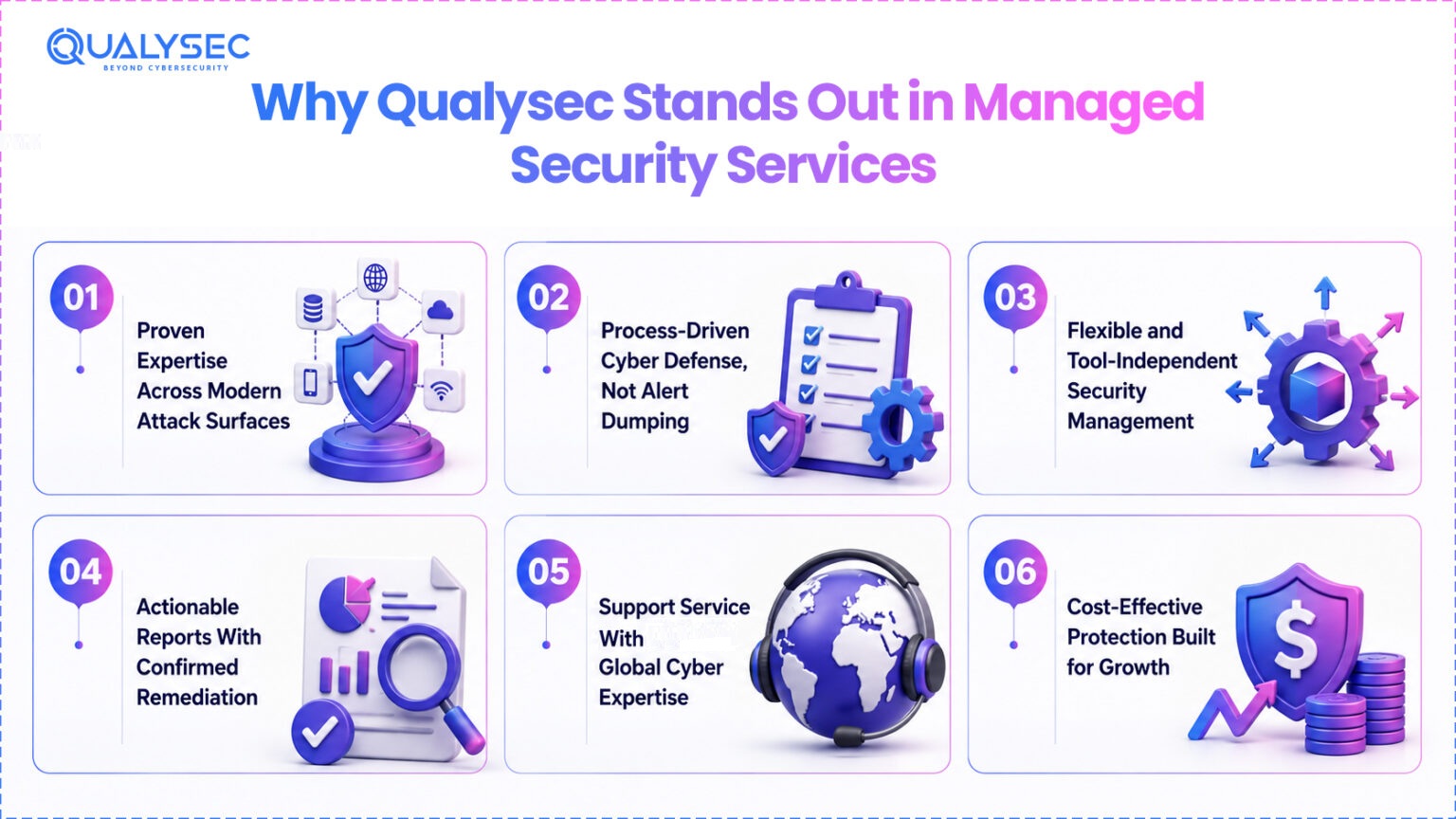
The most effectively managed cybersecurity services offer more than just tool monitoring. They empower whole surroundings, enhance the internal team’s ability to respond, and remove those risks that increase as the business grows. By giving security outcomes that are feasible, supported by acknowledged methodology and real technical depth, Qualysec is in line with such requirements.
Proven Expertise Across Modern Attack Surfaces
Managed security is only as strong as the provider’s understanding of how attackers break into systems. Qualysec has deep experience with penetration testing, API and cloud assessments, mobile and web application security, and infrastructure hardening.
This experience allows Qualysec to protect entire ecosystems for SMBs and enterprises, not just individual devices or firewalls; a critical advantage when choosing a managed security service partner.
Process-Driven Cyber Defense, Not Alert Dumping
Many MSSPs simply forward alerts. Qualysec follows a process-based security model built on manual analysis, automated detection, and data-driven decision making.
This method reduces false positives and ensures that the issues escalated to internal teams are verified risks worth acting on. Businesses get practical guidance and real problem solving, not noise.
Flexible and Tool-Independent Security Management
Instead of forcing clients to adopt a specific technology stack, Qualysec adapts to existing firewalls, cloud setups, and endpoint tools.
This protects clients from unnecessary tool spending and prevents vendor lock-in; a major hidden cost in unmanaged MSSP contracts. Organizations benefit from protection shaped around their business, not the provider’s product catalog.
Actionable Reports With Confirmed Remediation
Qualysec delivers clear reporting that shows what is at risk, how attacks could happen, and how to fix issues step by step. After remediation, Qualysec validates that fixes actually close the gaps.
This approach ensures measurable improvement in security posture, making managed services a continuous value, not a subscription without results.
Support Service With Global Cyber Expertise
Qualysec supports businesses worldwide by applying global industry best practices and compliance standards.
This gives American SMBs and growing enterprises access to high-impact managed cyber security services at a cost that does not demand building an in-house SOC or hiring scarce security talent.
Cost-Effective Protection Built for Growth
Due to its structured processes and technology-agnostic approach, Qualysec provides enterprise-grade managed security at competitive pricing.
This makes advanced protection accessible to small and mid-size organizations that need strong defense but cannot maintain full security teams in-house.
Conclusion
Cyber threats are evolving faster than most organizations can detect, and the cost of a single breach now outweighs the investment in continuous protection. With limited internal resources, remote work demands, and expanding cloud environments, businesses across the Globe need managed security services that deliver real outcomes rather than basic alerting.
The right MSSP strengthens defenses, supports compliance, and becomes a long-term partner in risk reduction. By choosing a provider that understands modern attack behavior and delivers measurable improvement, companies can turn security from a reactive expense into a proactive business advantage.
Want to evaluate your current risk exposure or explore MSSP support? Talk to a Qualysec Security Expert today and get a guided strategy built around your environment.
Frequently Asked Questions
1. What services do managed security service providers offer?
A: Managed security service providers deliver continuous monitoring, threat detection, incident response support, vulnerability management, and compliance assistance. These managed security services help businesses reduce risk without building in-house security teams.
2. When should a company consider managed security services?
A: A company should consider managing cyber security services when internal IT teams are overloaded, compliance requirements increase, or cloud and remote workloads expand. MSSPs provide expert protection before breaches become costly.
3. How much do managed security services cost?
A: The cost of managed security services varies based on endpoints, cloud coverage, data volume, and incident response requirements. Pricing typically ranges from per-user and per-device costs to full SOC and MDR plans for growing businesses.
4. What is the difference between MSSP and MDR?
A: An MSSP handles monitoring, tool management, and routine defense tasks, while MDR provides advanced threat hunting and hands-on response when attacks bypass basic controls. MDR is usually an add-on to managed cyber security services for high-risk environments.