

Introduction
The Gramm-Leach-Bliley Act (GLBA) is a U.S. federal law that requires financial institutions and fintech companies to protect customers’ nonpublic personal information (NPI). As part of achieving GLBA compliance, security testing for fintech organizations plays a critical role in identifying vulnerabilities and validating security controls. A key part of this law is the GLBA Safeguards Rule (enforced by the Federal Trade Commission under 16 CFR Part 314), which requires organizations to implement and maintain a structured information security program to protect sensitive financial data.
Financial institutions and fintech platforms handle large volumes of personal and financial data every day. Managing this information comes with a serious responsibility to protect it from unauthorized access, misuse, or exposure.
As digital banking, online payments, and financial platforms continue to grow, cyber threats targeting the financial sector are also increasing. Financial institutions remain one of the most frequently targeted industries because attackers know these systems store valuable customer data and financial records. Security incidents in this sector can lead to financial losses, regulatory penalties, and loss of customer trust.
To address these risks, the GLBA requires covered organizations to implement structured cybersecurity programs that protect customer information. These programs help organizations identify potential threats, assess vulnerabilities, and implement safeguards to reduce the risk of data breaches and unauthorized access.
This guide explains what GLBA is, what GLBA compliance involves, which entities the law covers, the key security requirements under the law, and the potential penalties for failing to meet those requirements.
What is GLBA?
The Gramm-Leach-Bliley Act (GLBA) primarily focuses on privacy disclosure and protection of consumer financial information, not directly regulating how data is processed. The law mandates that every covered organisation explain its data-sharing practices, allow consumers to opt out of sharing, and implement security programs to protect sensitive data.
Entities covered in GLBA
Financial institutions covered under GLBA include organizations significantly engaged in financial activities such as:
- Banks and credit unions
- Mortgage lenders and brokers
- Insurance companies
- Investment advisors
- Tax preparation services
- Check-cashing and payment services
- Automobile dealers offering financing
- Fintech companies handling financial data
What is GLBA Compliance?
GLBA compliance means meeting all the mandatory requirements under the GLBA. All the covered entities must comply with the three rules:
- Financial Privacy Rule: It governs how financial institutions collect, use, and share consumers’ personal financial information. Under this rule, the covered entities, including fintechs, are required to disclose how the information is used and whether the information is shared with third parties; if yes, then how, up to what extent.
- Safeguards Rule (16 CFR Part 314): This rule focuses on the technical and administrative security measures organizations must implement to protect customer information. It requires financial institutions and fintechs to develop, implement, and maintain an information security program that protects the integrity and confidentiality of customer data.
- Pretexting Provisions: These provisions are designed to prevent unauthorized access to financial information through social engineering or fraudulent impersonation. Pretexting occurs when someone attempts to obtain personal financial information by pretending to be a legitimate customer, employee, or service provider.
GLBA Safeguards Rule
The Safeguards Rule is the cybersecurity component of the GLBA. It requires financial institutions, including fintech companies, to protect customer financial information from unauthorized access, misuse, or disclosure. The rule is enforced by the Federal Trade Commission (FTC) and applies to all organizations that collect or process financial data.
The main objective of this rule is to make sure that organizations protect the security, confidentiality, and integrity of customer information, prevent anticipated threats, and stop unauthorized access. Under the rule, companies must create and maintain a written information security program that ensures the confidentiality, integrity, and availability of customer information.
For businesses keeping Nonpublic Personal Information (NPI) for under 5,000 customers, the Small-Business Exemption Note (§ 314.6) exempts them from official written risk assessments, continuous monitoring or pentesting, incident response plan requirements, and yearly board reporting.
GLBA Security Audit
A GLBA security audit is a systematic evaluation of a financial institution’s information security program to ensure that it complies with the GLBA Safeguards rule. The main objectives of a GLBA security audit are to assess compliance with the Safeguards Rule, identify vulnerabilities, and evaluate the effectiveness of the security systems.
Components of a GLBA security audit
GLBA security audit includes a risk assessment review to identify threats across all systems, applications, and third-party integrations handling NPI. It evaluates policies and procedures for compliance with access controls, encryption, incident response, and employee training. The audit reviews whether the organization implements appropriate technical safeguards such as access controls, encryption, monitoring systems, vulnerability management, and penetration testing to protect customer information. Third-party vendor practices, incident response plans, and employee programmes are assessed to evaluate the effectiveness of the system.
The security audit includes the executive summary of the findings, a detailed description of gaps or vulnerabilities, and remediation steps for improvement.
GLBA Safeguards Rule Compliance Requirements
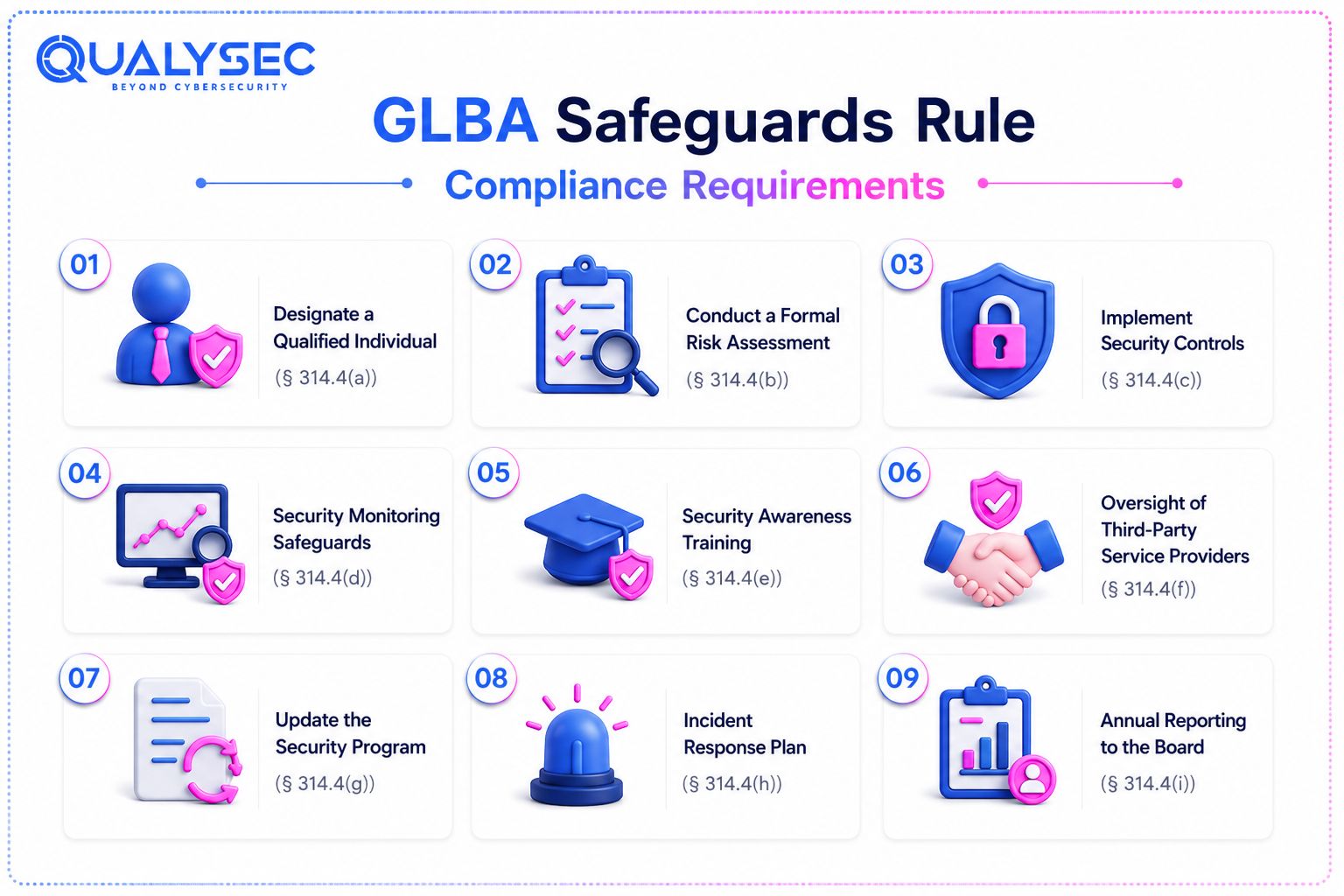
Section 314.4 of 16 CFR Part 314 defines the core requirements of the Safeguards Rule, which outline the essential elements that organizations must include in their information security programs:
1. Designate a Qualified Individual (§ 314.4(a))
One of the first requirements is to designate a Qualified Individual responsible for overseeing the organization’s information security program. This individual is responsible for implementing and supervising the security program and ensuring the organization’s safeguards are properly maintained.
2. Conduct a Formal Risk Assessment (§ 314.4(b))
Law requires organizations to conduct a written risk assessment to identify internal and external threats to customer information. The risk assessment identifies where sensitive customer information is stored or transmitted, evaluates foreseeable security risks, and assesses vulnerabilities that could lead to data exposure or misuse.
3. Implement Security Controls (§ 314.4(c))
Once risks are identified, Section 314.4(c) of the GLBA requires financial institutions to design and implement safeguards that mitigate those risks. These safeguards include several technical and operational controls, such as:
- Access Controls (§ 314.4(c)(1)): Implementing access controls that restrict who can view or use customer information. Access should be granted only to authorized individuals who have a legitimate business need for the data.
- Data Asset Inventory (§ 314.4(c)(2)): Maintaining a clear inventory of systems and data assets so they understand where customer information resides within the infrastructure of the organization.
- Data Encryption (§ 314.4(c)(3)): Data encryption both in storage and during transmission across networks. If encryption is not possible, then alternative security controls must be approved by the Qualified Individual.
- Multi-Factor Authentication (§ 314.4(c)(5)): This applies to individuals accessing systems that contain customer information. MFA requires that users verify their identity using at least two authentication factors, such as passwords, tokens, or biometrics.
- Secure Application & API Security Testing (§ 314.4(c)(5)): Implement procedures and code reviews (such as SAST or DAST) to evaluate and test the security of custom apps, web portals, and financial APIs.
- Secure Disposal (§ 314.4(c)(6)): Securely disposing of the customer information once it is no longer needed.
4. Security Monitoring Safeguards (§ 314.4(d))
Another critical requirement includes ongoing security monitoring and testing of safeguards. Organizations must implement continuous monitoring or conduct annual penetration testing and vulnerability assessments at least every six months.
5. Security Awareness Training (§ 314.4(e))
The covered organizations must provide security awareness training to help employees recognize potential security threats, such as phishing attacks, suspicious system activity, or unauthorized requests for financial information.
6. Oversight of Third-Party Service Providers (§ 314.4(f))
Fintech companies frequently rely on third-party vendors for cloud hosting, payment processing, or financial data aggregation. The GLBA requires that organizations ensure that the service providers maintain appropriate security controls.
7. Update the Security Program (§ 314.4(g))
The security programs must be continuously updated when changes occur in the organisation’s systems, operations, or threat landscape. For example, introducing new financial applications, migrating infrastructure to the cloud, or integrating new APIs may create additional security risks.
8. Incident Response Plan (§ 314.4(h)
The organization must create a written incident response plan that outlines how the company will respond to cybersecurity incidents.
9. Annual Reporting to the Board (§ 314.4(i))
The Qualified Individual must provide written reports to the board of directors or governing body at least annually, documenting an evaluation of the organization’s security program, results of risk assessments, testing outcomes, security incidents, and recommendations for improving security controls.
Security Monitoring safeguards under GLBA
Under the GLBA Safeguards Rule, financial institutions and fintech companies must regularly evaluate the effectiveness of their cybersecurity controls to protect customer information. As part of this requirement, organizations must conduct penetration testing and vulnerability assessments at least every six months to identify and address known security weaknesses in their systems. These assessments help institutions detect vulnerabilities and reduce the risk of unauthorized access.
Penetration Testing
Security professionals perform penetration testing under the GLBA to assess whether an organization’s technical and procedural safeguards can withstand real cyberattacks. It’s aligned with frameworks such as NIST SP 800-115 or OWASP. The test evaluates how effectively existing controls prevent unauthorized access to customer information and financial data. The scope of penetration testing should include systems that store, transmit, or process non-public personal information (NPI). This includes:
- External network penetration testing
- Internal network security assessments
- Web application security testing
- API security testing (OAuth2 flow verification and BOLA checks)
- Authentication and access control testing
- Privilege escalation and lateral movement simulation
- Validation of security monitoring and incident detection capabilities
The organization must incorporate the results of penetration testing into its information security program.
Vulnerability Assessments
Under GLBA requirements, vulnerability assessments must be conducted at least every six months to identify weaknesses, misconfigurations, outdated software, and other security gaps. In vulnerability assessments, analysts identify weaknesses in systems, applications, and network infrastructure that could expose sensitive financial data. The objective behind vulnerability assessment is to identify misconfigurations, outdated software, insecure protocols, and other technical weaknesses that could create a loophole for unauthorized access.
Under the GLBA, vulnerability assessments must evaluate the security posture of the entire information system environment, including servers, databases, applications, network devices, and cloud services that handle customer information. Once vulnerabilities are identified, the organization will analyze the results and prioritize remediation on the basis of risk.
The organization must incorporate the findings from the vulnerability assessment into its information security program.
Penalties under GLBA
| Violation Type | Who can penalize | Maximum penalty |
| Failure to implement adequate safeguards to protect customer financial information, weak cybersecurity controls, lack of monitoring, or failure to maintain a security program | Financial institutions, banks, and fintech companies | Up to $100,000 per violation + regulatory enforcement actions, mandatory security improvements, compliance monitoring |
| Negligence or failure by directors, officers, or responsible employees to ensure the organization complies with GLBA privacy and security requirements | Directors, officers, and responsible managers | Up to $10,000 per violation |
| Unauthorized disclosure, misuse, or improper sharing of customers’ non-public personal financial information | Individuals or organizations responsible for the disclosure | Criminal fines and/or up to 5 years imprisonment |
| Obtaining customer financial information using deception, impersonation, or false pretenses (pretexting) | Individuals committing the fraud | Up to $250,000 fine and/or 5 years imprisonment |
| Conspiring with others to fraudulently obtain or access customer financial information | Individuals involved in the conspiracy | Up to $500,000 fine and/or 10 years imprisonment |
How Third-Party Security Providers Help
Fintech businesses working with CRES-accredited cybersecurity companies like Qualysec often meet strict technical standards of 16 CFR Part 314. Professional security companies help to carry out technical evaluations and create compliant security plans via:
- Penetration Testing: Cybersecurity experts simulate real-world cyberattacks on fintech systems, applications, and APIs to evaluate whether GLBA-required security controls effectively protect customers’ Nonpublic Personal Information (NPI).
- Vulnerability Assessments: Cybersecurity experts identify weaknesses in networks, cloud services, and applications, helping fintechs meet GLBA Safeguards Rule requirements by addressing misconfigurations, outdated software, and insecure protocols.
- Compliance Support: Help in reviewing the organization’s policies, procedures, and technical controls to ensure alignment with GLBA, including Safeguards Rule obligations like risk assessments, employee training, and third-party vendor oversight.
- Remediation Guidance: Qualysec provides prioritized recommendations and remediation steps so fintechs can close gaps, strengthen security programs, and maintain compliance.
- Continuous Monitoring: Qualysec helps fintechs and financial institutions to implement ongoing monitoring of systems and security controls to detect vulnerabilities in real time, which supports GLBA’s requirement for regular evaluation and testing of safeguards.
- Audit Preparation: Qualysec provides detailed documentation and reports that demonstrate compliance with the GLBA Safeguards Rule, including the results of penetration tests, vulnerability assessments, and risk management activities.
Conclusion
Fintech companies handle highly sensitive financial data on an everyday basis, which makes cybersecurity more crucial than ever. GLBA compliance security testing for fintech organizations is essential for meeting the requirements of the Gramm-Leach-Bliley Act Safeguards Rule, which requires organizations to implement structured security testing to protect customer information and reduce cyber risks. Regular penetration testing, vulnerability assessments, and security audits help identify weaknesses in systems before attackers can exploit them.

Frequently Asked Questions (FAQs)
1. Is penetration testing mandatory under GLBA?
Yes, the Gramm-Leach-Bliley Act (GLBA) Safeguards Rule requires financial institutions to test the effectiveness of their security controls. Organizations can either implement continuous security monitoring or conduct periodic penetration testing and vulnerability assessments. If continuous monitoring is not used, annual penetration testing is mandatory.
2. What security testing does GLBA require for fintechs?
Under the Gramm-Leach-Bliley Act Safeguards Rule, fintech companies have to regularly test their security programs. This includes annual penetration testing and vulnerability assessments at least every six months. Additional testing may also be necessary after significant system changes to identify and address potential security risks.
3. How often should fintech companies perform GLBA pentesting?
Fintech companies covered by the GLBA have to perform penetration testing at least once a year if they do not implement continuous monitoring. In addition, vulnerability assessments should be conducted every six months.