

RGPD compliance is one of the core responsibilities of French enterprises that handle personal data. Being compliant with RGPD requires much more than simply adopting proper policies. You must safeguard personal data and have proper security controls. Gaps in these areas can expose sensitive data and lead to regulatory penalties.
In January 2026, France’s data protection authority, the CNIL, issued fines of €27 million on FREE MOBILE and €15 million on FREE. This happened due to security breaches caused by a cyberattack. It was found that the case was connected to a data breach and affected 24 million subscriber contracts.
In this blog, we will discuss RGPD compliance, what steps are required to complete RGPD compliance, and how you can achieve RGPD compliance. We will also discuss what the common mistakes most organisations make are and how you can avoid them. You will get an idea of how French businesses can strengthen data protection while reducing regulatory risks.
Key Takeaways
- RGPD stands for GDPR in French, where the CNIL acts as the supervisory authority in France for data protection compliance.
- Companies should process personal data in accordance with the law and ensure that individuals’ rights are respected.
- GDPR Article 32 requires appropriate safeguards to protect personal data, which include encryption of data, access control, and security testing on a regular basis.
- Data breaches of a reportable type should be reported to the CNIL within 72 hours.
- Successful implementation of GDPR entails mapping of data, risk assessment, elimination of vulnerabilities, and continuous monitoring of security measures.
- Keep the ROPA, data protection impact assessments, contracts with third parties, privacy notices, and a log of breaches.
- Regular security assessment and remediation contribute towards securing personal data.
What Is RGPD Compliance?
RGPD refers to Règlement Général sur la Protection des Données, which is the French name for the General Data Protection Regulation (GDPR). The regulation covers how personal data is collected, processed, stored, and shared. In France, the Commission Nationale de l’Informatique et des Libertés (CNIL) oversees compliance and enforces data protection rules.
Compliance is not only about following EU data privacy law. Personal data must be protected at all stages of its lifecycle and comply with the requirements of the regulation.
What is the Difference Between RGPD and GDPR compliance?
The EU GDPR (EU) 2016/679 was adopted by the European Parliament and the Council of the European Union on 27 April 2016. The regulation came into effect on 25 May 2018 throughout Europe. In France, the same regulation is called RGPD, which stands for Règlement Général sur la Protection des Données.
Both terms refer to the same EU data protection regulation, not two separate laws. In France, the RGPD works alongside the French Loi Informatique et Libertés, which adds national rules in certain areas. The CNIL oversees data protection compliance in France.
What Are the Core Requirements for RGPD Compliance?
RGPD compliance requires your organisation to demonstrate the reasons for collecting personal information. You also have to clarify the use of such information and the protection of such information during its whole life cycle. An RGPD audit helps identify data protection gaps and improve compliance.
1. Lawful Processing, Transparency and Purpose Limitation
Article 5 defines the basic principles for the processing of personal data. Before collecting any data or processing, it is important that the organisation identifies an appropriate legal basis.
- Process personal data lawfully, fairly, and in a transparent manner. Provide clear communication regarding data collection and processing practices.
- Collect data for specific, explicit, and legitimate purposes. The data should not be used for any other purpose.
- Collect only the necessary data for the stated purpose and maintain accuracy and update data where necessary.
- Store the personal data only as long as is necessary for the intended purpose.
- Provide sufficient protection to personal data to prevent any unauthorised access or processing, accidental loss, destruction, damage, or disclosure.
Article 6 identifies six legal bases for processing. These are consent, contractual necessity, legal obligation, vital interests, public task, and legitimate interests. You must select a basis appropriate to each processing activity.
2. Article 32: Security of Processing
Article 32 requires organisations to take appropriate technical and organisational measures suitable for the risks linked with personal data. These measures should cover all risks affecting data processing, storage, and transmission.
- Risk-based security: Select controls based on the nature, scope, context, and purpose of processing, considering the likelihood and severity of risks to individuals.
- Encryption and pseudonymisation: Use these measures where appropriate to reduce the risks of unauthorised access or disclosure.
- Confidentiality, integrity and availability: Protect data against unauthorised access, alteration, disclosure, loss and destruction. Systems must also maintain appropriate resilience and allow access to personal data to be restored promptly after physical or technical incidents.
- Regular testing: Assess and test security measures regularly to confirm they remain effective as systems, processing activities and threats change.
3. Personal Data Breach Detection and Notification
Organisations should detect personal data breaches, evaluate their effects, and issue notifications within relevant time periods. Reporting is determined by the level of threat posed to individuals’ rights and freedoms.
- 72-Hour Rule: Your organisation should inform the CNIL about any breach, without delay within 72 hours after knowing about the breach.
- Notification threshold: Notification to the authority is not required if the breach is unlikely to result in a risk to individuals’ rights and freedoms. Affected individuals must be informed without undue delay if the breach is likely to result in a high risk to their rights and freedoms.
- Information requirement: Notifications should describe the nature of the breach, the categories and approximate number of affected individuals and records, the likely consequences, and the measures taken or proposed to address it.
- Documentation: Document every personal data breach, including incidents that do not require notification. Records must cover the facts, effects, and remedial action to demonstrate how the organisation assessed and handled the incident.
How to Implement RGPD Compliance Step by Step?
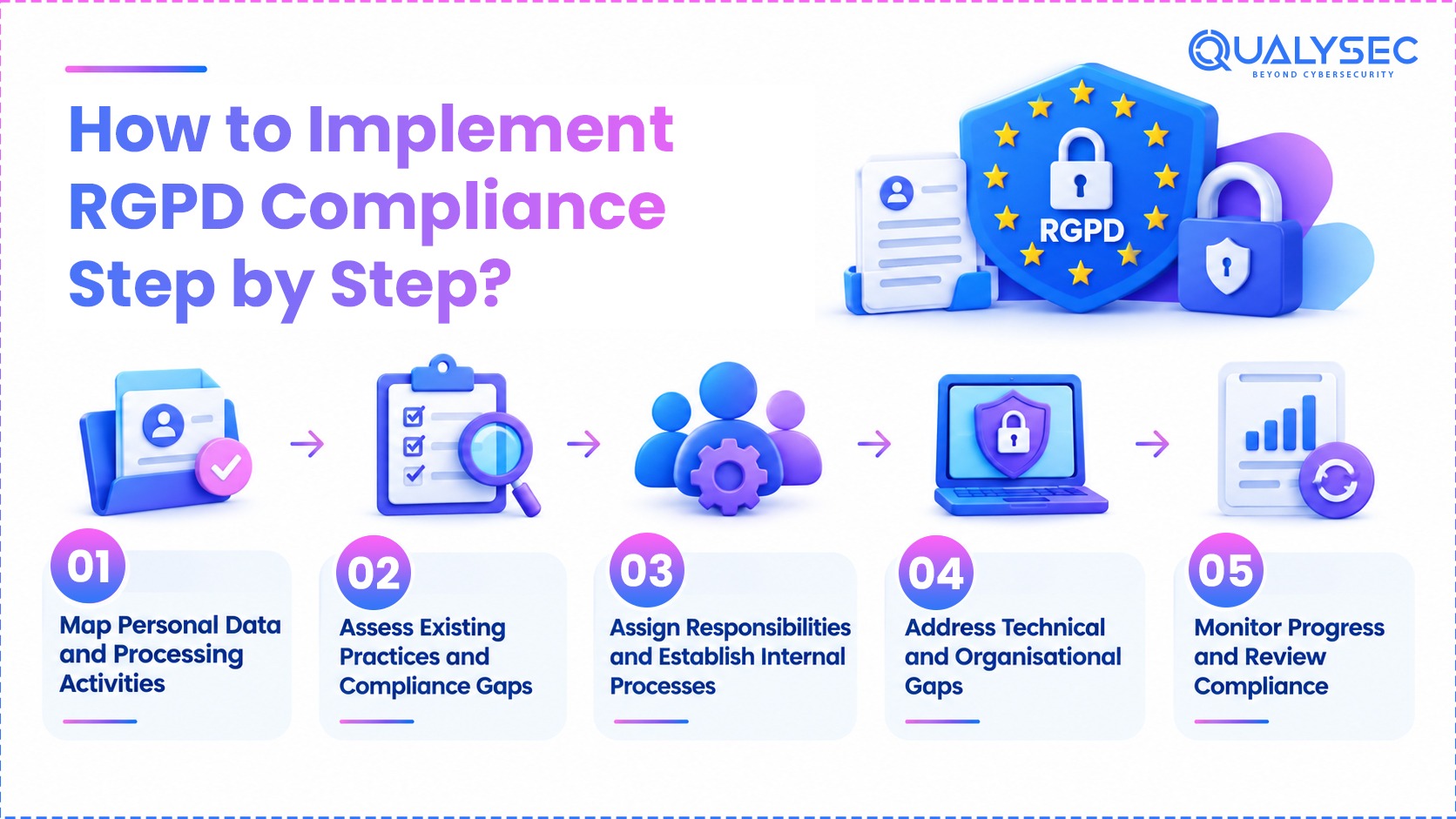
Implementing RGPD compliance means turning legal obligations into practical processes across the organisation. The importance of this work is reflected in the CNIL’s 2025 annual report, published in 2026. It recorded 20,150 complaints, 323 investigations and 83 sanctions, with fines totalling nearly €487 million.
Step 1: Map Personal Data and Processing Activities
Create a catalogue of all personal data processed within your organisation to find any data that can go unnoticed throughout the entire system.
- Find where data is stored: Personal data should be identified wherever it is stored. Whether on-premises, in cloud infrastructure, SaaS tools, databases, or third-party integrations.
- Document the ROPA: Document processing purposes, types of data, storage places, recipients, duration of processing, and security measures implemented.
- Data flow mapping: Map out how data is transferred internally and externally between teams, partners, cloud service providers, and other countries. Identify data transfers across borders that might require specific measures.
- Maintain records up to date: Update the catalog of personal data after implementing new solutions and processing activities.
Step 2: Assess Existing Practices and Compliance Gaps
Analyze the current data processing methods against RGPD requirements to determine where improvements are required. Consider both privacy risks and technical vulnerabilities that might allow exposure of personal data.
- Consider application systems: Check applications, APIs, databases, identity management, and networking pathways for vulnerabilities that might allow exposure of personal information.
- Review organisational processes: Verify whether data collection, access rights, retention methods, vendor relationships, and internal policies meet organisational responsibilities.
- Identify high-risk data processing: See if large-scale profiling, specific biometric monitoring, or large-scale health data processing requires a Data Protection Impact Assessment (DPIA).
- Focus on resolution: List gaps identified, assign responsible parties, establish timelines, and identify outstanding items. List remaining risks after recommended actions.
Step 3: Assign Responsibilities and Establish Internal Processes
RGPD implementation requires coordination between legal, privacy, IT, security, product, and business teams. Clearly assigned responsibilities help ensure compliance activities are completed and reviewed.
- Assign ownership: Appoint a Data Protection Officer (DPO) where required, or designate an appropriate internal privacy lead. Identify the teams responsible for individual processing activities.
- Define internal procedures: Establish workflows for privacy notices, consent management, data subject rights requests, and data retention reviews.
- Manage suppliers: Conduct vendor due diligence and put data processing agreements in place with processors. Assess relevant sub-processors and their data protection arrangements.
- Maintain supporting policies: Keep information security policies, data classification standards, acceptable use rules, and retention schedules aligned with actual business practices.
Step 4: Address Technical and Organisational Gaps
Use the findings from the previous steps to create a remediation plan. Select measures according to the risks identified and integrate them into everyday IT operations, product development, and supplier management.
- Improve identity and access management: Configure role-based access control, least-privilege permissions, multi-factor authentication, and privileged access management where appropriate.
- Strengthen technical safeguards: Address weaknesses through patch management, vulnerability management, secure configuration, security logging, and backup procedures.
- Secure software development: Include security checks throughout development and maintenance processes to identify weaknesses before they affect production systems.
- Prepare operational procedures: Develop incident response runbooks and escalation paths so relevant teams know how to handle suspected data exposure or security incidents.
- Track remediation: Assign responsibility for each finding, record the action taken, and verify that the issue has been resolved.
Step 5: Monitor Progress and Review Compliance
RGPD implementation requires ongoing oversight as systems, business processes, and supplier relationships change. Regular reviews help organisations identify new gaps and confirm that previous remediation work remains effective.
- Conduct periodic reviews: Audit processing activities, review internal procedures, and check whether documented practices match actual operations.
- Test technical security: Schedule penetration tests and security assessments based on the risks associated with applications, infrastructure, and data processing.
- Review third parties: Reassess vendor risks and review data processing agreements when services, suppliers, or processing arrangements change.
- Maintain employee awareness: Deliver privacy and security training and track completion across relevant teams.
- Measure progress: Monitor metrics such as outstanding audit findings, remediation status, vendor review completion, data subject request response times, and breach containment times.
The CNIL’s enforcement priorities further underline the need for effective implementation. It received 6,167 personal data breach notifications in 2025, with hacking involved in about half of reported incidents. The authority also stated that 50% of its controls and enforcement actions in 2026 would focus on data security.

Which Cybersecurity Controls Support RGPD Compliance?
Cybersecurity controls support RGPD compliance by protecting personal data from unauthorised access, loss, alteration, and disclosure. Key measures include access controls, encryption, network security, continuous monitoring, secure backups, employee training, and third-party risk management.
I. Identity Management and Access Control
Identity and access management (IAM) ensures that only authorised employees can access personal data. Strong access controls reduce unauthorised access and internal data exposure.
- Multi-factor authentication (MFA): Requires additional verification before granting access.
- Role-based access control (RBAC): Limits access according to job responsibilities.
- Privileged access management (PAM): Controls accounts with elevated permissions.
These measures support Article 32 security requirements.
II. Network Security, Patching and Secure Configuration
Network controls protect systems that store or process personal data. Regular updates help prevent attackers from exploiting known vulnerabilities.
- Use firewalls, network segmentation and intrusion detection systems to restrict suspicious traffic.
- Apply security patches promptly and scan systems for vulnerabilities.
- Follow secure configuration standards to remove unnecessary services and insecure settings.
III. Encryption, Data Minimisation and Secure Storage
Encryption protects personal data during storage and transmission. Data minimisation reduces exposure by limiting the information an organisation retains.
- Use AES-256 encryption for stored data and TLS 1.3 for transmitted data, where appropriate.
- Automate data deletion when retention periods expire.
- Apply pseudonymisation to separate identifiers from sensitive datasets. Use cryptographic erasure where appropriate to make stored data unrecoverable.
IV. Monitoring, Backups and Incident Response
Continuous monitoring helps organisations detect suspicious activity using Security Information and Event Management (SIEM) and Endpoint Detection and Response (EDR) tools. Encrypted, immutable offsite backups support recovery from ransomware attacks and system failures. Regularly tested incident response procedures help teams assess breaches and meet applicable CNIL notification deadlines.
V. Employee Awareness and Third-Party Security
Regular, role-specific security training helps employees recognize phishing attempts and social engineering attacks. Organisations should also assess third-party vendors’ security practices and use Data Processing Agreements (DPAs) under Article 28 to define processors’ responsibilities and protect personal data shared with them.
How Can RGPD Compliance Impact Businesses in France?
RGPD compliance affects how businesses in France manage personal data, protect systems, and maintain customer relationships. Non-compliance can result in fines of up to €20 million or 4% of total worldwide annual turnover, whichever is higher. The CNIL can also issue corrective orders, publicly announce sanctions, or restrict data processing.
Effective compliance offers business benefits beyond avoiding penalties. Strong data protection practices can help businesses meet security requirements during supplier assessments and public sector procurement.
Data security compliance helps protect sensitive information from unauthorized access, loss, and breaches.
What Documentation Businesses Need to Maintain for RGPD Compliance?
Businesses must maintain accurate, up-to-date documentation to demonstrate RGPD compliance. These records should explain why personal data is processed, who can access it, how risks are assessed, and how incidents are handled. Understanding GDPR France requirements helps businesses protect personal data, meet CNIL obligations, and maintain compliance with European data protection laws.
1. Record of Processing Activities (ROPA)
Article 30 requires most organisations to maintain a Record of Processing Activities (ROPA). It provides an overview of how personal data is collected, used, stored, and shared across the organisation.
- Record processing purposes, legal bases, data categories, and categories of individuals.
- Identify recipients, data processors, and relevant international data transfers.
- Document retention periods and a general description of security measures.
- Maintain records for processing activities where the business acts as a controller or processor, as applicable.
2. Data Protection Impact Assessments (DPIAs)
Article 35 requires a Data Protection Impact Assessment (DPIA) before processing likely to result in a high risk to individuals. It helps businesses identify privacy risks and decide which safeguards are needed before processing begins. A GDPR privacy audit can help assess DPIA documentation, review privacy risk management practices, and identify potential compliance gaps.
- Document the processing activity, its purpose, necessity, and proportionality.
- Assess potential risks to individuals’ rights and freedoms.
- Record planned safeguards, mitigation measures, and any remaining risks.
- Consider DPIAs for activities such as large-scale profiling, large-scale processing of health data, and systematic monitoring of publicly accessible areas on a large scale.
3. Data Processing Agreements (DPAs)
Under Article 28, businesses must have a written agreement with each processor handling personal data on their behalf. These agreements define the processor’s responsibilities and the conditions for handling personal information.
- Specify the processing purpose, scope, and duration.
- Set confidentiality and security requirements, including rules for appointing sub-processors.
- Define assistance with data subject requests, breach handling, and regulatory obligations.
- Cover audit rights, data return or deletion after the service ends, and applicable international transfer safeguards.
- Maintain a vendor register identifying the processors that handle personal data.
4. Privacy and Cookie Notices
Privacy notices explain how and why a business collects and uses personal data. They should be clear, accessible and written in language the intended audience can understand.
- Explain the data collected, processing purposes and applicable legal bases.
- Identify recipients, retention periods, individual rights and relevant privacy contact details.
- Explain cookie use and obtain consent for non-essential cookies where required.
- Maintain records of consent where consent is used as the legal basis for processing.
5. Incident Response and Personal Data Breach Logs
Article 33 requires controllers to document personal data breaches, including those that do not require notification to the CNIL. Keeping incident records helps businesses explain how they assessed a breach, responded to it, and decided whether notification was necessary.
- Record the incident timeline, affected systems, types of personal data involved, and potential impact.
- Document investigation findings, containment measures, root causes, and corrective actions.
- Record whether the incident involved a personal data breach and the reasoning behind the notification decision.
- Retain details of CNIL notifications where required, including the information reported and the reporting timeline.
- Document communications with affected individuals when Article 34 requires notification because the breach is likely to result in a high risk to their rights and freedoms.
How Security Testing Helps Protect Personal Data: A Real-World Case Study By Qualysec
A connected event technology company required an approach to secure transactions and user data across all web applications, a mobile app, and their AWS systems. We conducted a multi-layer security assessment to identify vulnerabilities that could expose sensitive information.
We Found:
- Blind SQL injection, which would allow leakage of application and database information.
- Lack of authentication and forced browsing, which would allow unauthorised access to resources.
- Insecure direct object reference (IDOR) and horizontal privilege escalation issues that allowed other users’ records to be exposed.
How We Helped:
- Implemented parameterised queries to strengthen database security.
- Strengthened authentication, access controls, and server-side ownership validation.
- Reviewed AWS configurations and retested the environment after remediation.
This case highlights how security testing and verified remediation support Article 32 requirements for protecting personal data against unauthorised access and disclosure.
What Common Mistakes Should You Avoid While Preparing for RGPD Compliance?
RGPD preparation not only includes writing privacy policies and getting consent. Your organisations need to close gaps in security, maintain records, and perform regular reviews. This will help avoid mistakes that pose a threat during the compliance process. The common mistakes include:
- Treating compliance as a one-time task instead of reviewing practices as systems, business processes, and regulations change.
- Focusing only on privacy policies while neglecting access controls, encryption, and secure system configurations.
- Overlooking unapproved SaaS applications and cloud services that may store personal data outside approved systems.
- Keeping outdated processing records, privacy notices, and retention schedules that no longer reflect actual business practices.
Quick Checklist for Organisations Preparing for RGPD Compliance
You can use this compliance checklist to review your RGPD readiness and identify areas that need attention. Complete each item to strengthen data protection, improve security practices, and maintain evidence of compliance.
- Inventory personal data and map how it is collected, stored, accessed, shared, and transferred.
- Identify and document a valid legal basis for each processing activity.
- Update privacy notices, cookie banners, and data collection forms to provide clear information.
- Implement multi-factor authentication, role-based access controls, and appropriate identity management.
- Encrypt personal data at rest and in transit using suitable security measures.
- Establish and test an incident response plan that supports applicable CNIL breach notification deadlines, including the 72-hour rule.
- Put compliant Data Processing Agreements in place with relevant vendors, cloud providers and external processors.
- Train employees on data protection practices, phishing detection, and incident reporting procedures.
- Appoint a Data Protection Officer (DPO) where required, or designate an internal compliance lead.
- Schedule regular compliance audits, vulnerability assessments, and penetration tests based on risk.
How Can Qualysec Help Businesses in Achieving RGPD Compliance?
Qualysec is a CREST-accredited specialised penetration testing company. We assist French companies in achieving RGPD compliance by meeting the necessary technical security controls under Article 32. We conduct cyberattack simulations to identify and resolve technical weaknesses that can cause data breaches or CNIL fines.
- Data Protection Penetration Testing: We run thorough testing on web applications, mobile apps, APIs, and cloud infrastructure to detect vulnerabilities.
- Identity and Access Control Testing: The security experts test multi-factor authentication, role-based access control, and system configurations to avoid any kind of internal or external access to private records.
- Simulation of Breach Scenario: Through incident detection testing and testing defenses against ransomware and hacking, Qualysec ensures that you have safeguards that are capable of resisting contemporary cyber attacks.
- Detailed Remediation and Compliance Reports: You will receive remediation plans and compliance reports to fix problems and ensure compliance with data protection requirements.
Conclusion
RGPD Compliance is not just about fulfilling the law; it is about securing personal information and retaining the trust of your clients. This involves keeping track of records, implementing proper security measures, mitigating third-party risk, and testing your system from time to time. With the CNIL enforcing the data protection laws, policies alone will not be enough.
By incorporating privacy and cybersecurity into your business operations, you can minimise the risk of data breaches and manage your relations with your clients better.
FAQs
1. What is RGPD compliance?
RGPD compliance refers to the EU data protection regulations concerning the collection, processing, storage, and transfer of personal data.
2. What are the RGPD penalties in France?
RGPD violations can result in fines of up to €20 million or 4% of worldwide annual turnover, whichever is higher, alongside corrective orders.
3. Does RGPD apply to small businesses?
Yes, RGPD applies to small businesses that process personal data, even though some requirements will be different based on their activities, processing risks, and applicable exemptions.
4. What is the difference between RGPD and other privacy laws?
RGPD establishes data protection requirements for organisations processing personal data within its scope. It defines rules for lawful processing, individual rights, data security, and accountability, with penalties for non-compliance.
5. How does RGPD compliance apply to companies outside the EU?
The RGPD applies to companies outside the EU that offer products or services to individuals in the EU or monitor their behavior in the EU.