

Data protection has changed from being an IT issue to a major priority in an age when data breaches, privacy breaches, and regulatory focus are becoming prevalent. Businesses are under a complete-scale responsibility to be in line with the GDPR in case they operate in or target their business to individuals within the European Union. The consequences of the failure to adhere to the GDPR can be serious in terms of finances as well as reputation. In order to assist with the complexity of the GDPR, it will be useful to apply a systematic GDPR compliance checklist to ensure that organizations do not leave out any important GDPR requirements in their compliance initiatives.
A comprehensive checklist is not only a practical roadmap to GDPR compliance but can be used as a means to assist companies that are about to undergo an audit, release a SaaS product, or handle customer data beyond national borders as well. The blog suggests an in-depth step-by-step guide to GDPR compliance, with the primary concepts, data subject rights, core needs, and best practices.
What is GDPR Compliance and Who Should Comply?
To qualify as compliant with the GDPR, an organization needs to adhere to the General Data Protection Regulation (GDPR), which governs the manner in which organizations in the European Union (EU) and European Economic Area (EEA) handle the personal data of individuals. Companies that gather or handle the personal information of people are expected to comply with the GDPR, irrespective of their geographical locations.
Who Must Comply with GDPR?
Applies under EU General Data Protection Regulation (EU GDPR):
- Companies created in the EU that handle personal data
- Organizations outside of the European Union that provide products or services to European Union citizens
- Organizations are watching the actions of people in the EU
- Data processors and data controllers managing personal information
If they process EU personal data, startups, SMEs, multinational corporations, and SaaS companies all need to follow GDPR. For companies with few compliance resources, a customized GDPR checklist for small businesses or a GDPR SaaS checklist will be extremely helpful.
Key Principles of GDPR Compliance Every Business Should Know
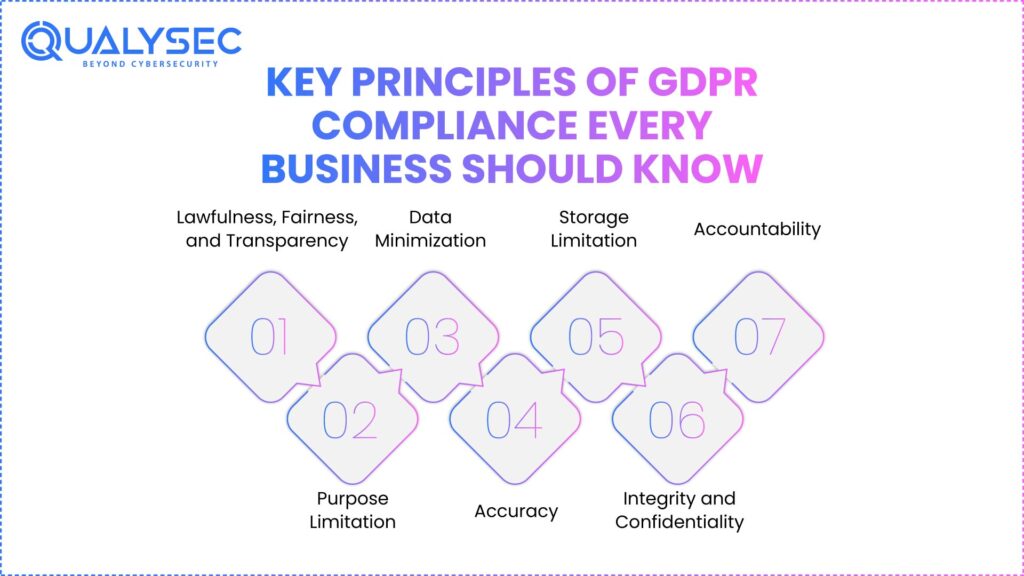
Core GDPR ideas direct legal data processing. Before putting any GDPR requirements checklist into action, one must first understand these key principles.
1. Lawfulness, Fairness, and Transparency: Legitimate, transparent, and fair processing of personal data is required. Organizations have to be clear about how people’s data is used.
2. Purpose Limitation: Data should only be gathered for clearly stated, defined, and legal reasons and not handled in a way contradictory to those intentions. It is supported by appropriate information security measures.
3. Data Minimization: Companies should gather only the information needed for the intended use.
4. Accuracy: With reasonable efforts made to rectify or remove incorrect information, personal data has to be current and accurate.
5. Storage Limitation: Data shouldn’t be kept longer than is needed for its intended use.
6. Integrity and Confidentiality: Personal information has to be safeguarded from unauthorized access, loss, or damage by way of suitable security measures like penetration testing and vulnerability assessments.
7. Accountability: Through documents and controls, organizations have to prove their adherence to all GDPR criteria.
Every GDPR compliance checklist builds upon these ideas, therefore directing the execution of data protection actions.
Understanding Data Subject Rights Under GDPR Regulation
Emphasizing individual rights is one of the most important aspects of the GDPR. Companies need to put methods in place to effectively respect and meet these rights.
- Core Information Subject Rights
- Informed about data gathering and handling
- Access to personal data
- Fixing of incorrect data
- Right to erasing (right to be forgotten)
- Restrict processing
- Data mobility
- Dissent from data processing
- Rights connected to automated profiling and decision-making
Organizations must guarantee safe verification of the identity of the requester and reply to data subject requests within a month. Managing these rights is a key component of any GDPR assessment checklist.
Download a sample penetration testing report to understand how you can identify and document vulnerabilities for GDPR compliance.
Core GDPR Compliance Requirements for Businesses
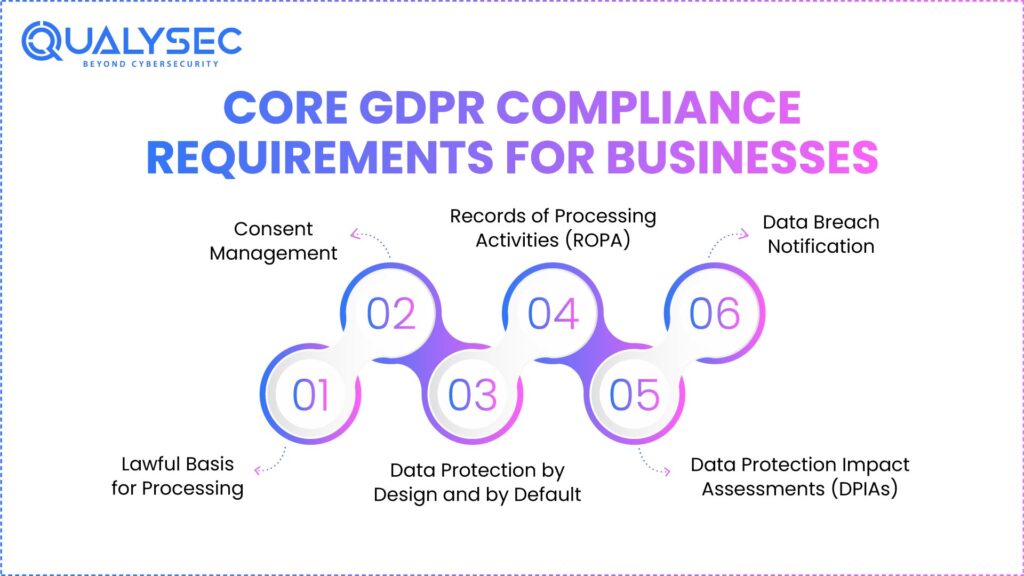
Several GDPR compliance requirements that businesses must follow under GDPR help them to meet compliance.
1. Lawful Basis for Processing
Organisations have to find and record a legitimate justification for processing personal data, including consent, contract, legal requirement, or legitimate interest. Regular evaluation of this foundation will help to confirm it still holds as business practices change.
2. Consent Management
When used, consent has to be given freely, clearly, informed, and unambiguous. Records of permission have to be kept up-to-date. Simple processes for people to revoke permission at any time should also be available for organizations.
3. Data Protection by Design and by Default
From the beginning, privacy issues need to be included in systems and processes. All these issue also supported by strong data security. By default, organizations should process only the absolute bare minimum required personal data to help lower exposure and risk.
4. Records of Processing Activities (ROPA)
Organizations have to record the data they gather, the reasons for processing it, the length they keep it, and the individuals they share it with. These records offer important compliance evidence during regulatory inspections.
5. Data Protection Impact Assessments (DPIAs)
High-risk processing activities call for DPIAs to help to find and reduce privacy concerns. They assist companies in actively resolving possible effects on people’s rights and liberties.
6. Data Breach Notification
Organizations must report breaches of personal data to the appropriate regulatory agency within 72 hours, and they must inform impacted people when there is a significant risk.
To guarantee prompt detection and reaction, clear internal reporting systems are absolutely vital. Central to any GDPR criteria checklist, these requirements form the basis for regulatory reviews.
GDPR Compliance Checklist Step by Step
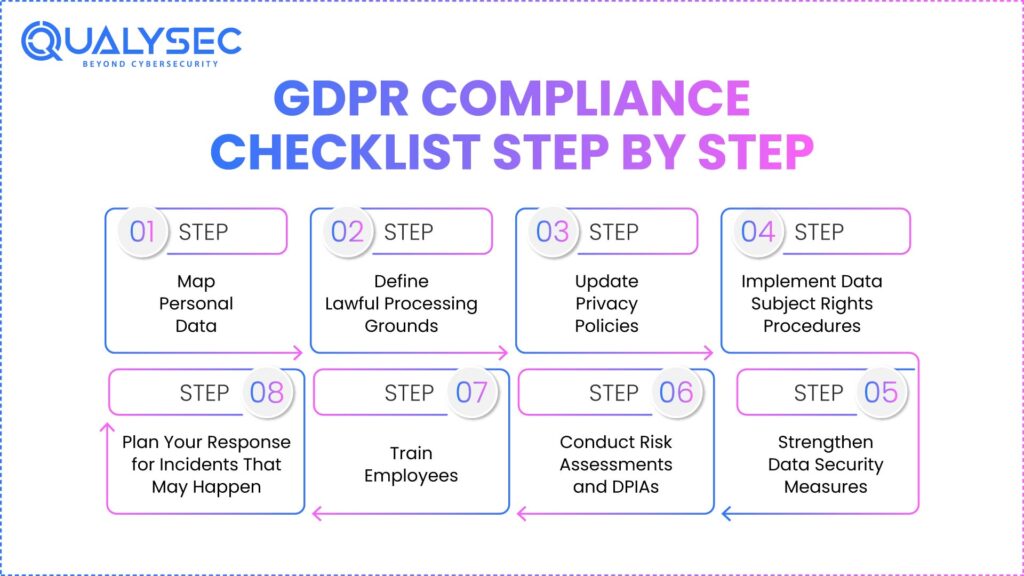
Organizing helps companies go from awareness to total compliance. Businesses can use the following step-by-step GDPR audit checklist.
Step 1: Map Personal Data
Specify where personal information is obtained, how it is handled, and where it is kept, as well as what kind of information it is. Furthermore, document data flows over systems and outside companies to guarantee perfect transparency and accountability.
Step 2: Define Lawful Processing Grounds
Record the legal basis for every activity involving processing. This comprises explicitly relating every data use case to consent, contract, legal requirement, or legitimate interest.
Step 3: Update Privacy Policies
Check that your GDPR-compliant notices are clear, visible, and straightforward. Policies should be simply expressed and constantly modified to mirror developments in data habits.
Step 4: Implement Data Subject Rights Procedures
Develop systems to swiftly manage requests for access, deletion, and correction. Response times, identification verification, and secure request monitoring should be among these protocols.
Step 5: Strengthen Data Security Measures
Employ technical and administrative measures, including surveillance, access restrictions, and encryption. Regular security testing and reviews should be done to guarantee that security measures are still strong against developing threats.
Step 6: Conduct Risk Assessments and DPIAs
Evaluate privacy concerns and record planned solutions. High-risk processing activities call for data protection impact assessments to help to avoid any damage.
Step 7: Train Employees
Make sure personnel grasp GDPR duties and data protection best practices. Training initiatives regularly encourage employees to be aware of data privacy and reduce the potential for human errors.
Step 8: Plan Your Response for Incidents That May Happen
You should establish procedures for identifying, notifying, and responding to data breaches. The policy should include established roles for responding to a data breach, how to escalate incidents, and what methods are available to comply with the 72-hour notification requirement after a data breach occurs.
These steps of the GDPR compliance checklist help demonstrate to businesses the responsibility and the level of preparedness for compliance.
Read our case studies to see how organizations implement GDPR compliance step by step.

GDPR Compliance Certified: Managing Third-Party and Vendor Risks
Organizations often use third-party suppliers to handle personal data; vendor management is a major compliance concern.
Vendor Risk Management Under GDPR
- Before onboarding suppliers, do your homework.
- Make sure Data Processing Agreements are in use (DPAs).
- Check that suppliers have proper security measures in place.
- Regularly examine and ensure compliance with audits by third parties.
For cloud-based providers and those depending largely on third-party infrastructure, a focused GDPR SaaS checklist is especially crucial.
Best Practices for Maintaining Ongoing GDPR Compliance
Compliance with the General Data Protection Regulation is an ongoing process rather than a one-time endeavor.
- Continuous Monitoring: Periodically examine data handling processes and revise papers. This enables companies to rapidly spot new compliance concerns and changes in data use.
- Periodic Audits: Find flaws by means of internal audits using a GDPR audit checklist. Audit results ought to be noted and followed by corrective action strategies.
- Employee Awareness: Offer ongoing training to lower the possibility of human error. Awareness campaigns guarantee staff members stay current on shifting data protection obligations.
- Policy Updates: Maintain policies in accordance with business changes and legal revisions. To match new procedures or technologies, old laws should be quickly changed.
- Security Testing: Regular testing and evaluations will help you to find vulnerabilities. Testing results should inform better controls and avoid data leaks.
These best approaches guarantee ongoing compliance and lower the chance of financial penalties by authorities.
Contact us to schedule a security assessment that helps maintain continuous GDPR compliance.
Role of Penetration Testing in GDPR Compliance
Particularly under the ideals of integrity and secrecy, GDPR is founded upon security. Validating the efficacy of security measures depends critically on penetration testing.
- How Penetration Testing helps GDPR compliance
- Finds exploitable flaws in systems processing personal information.
- Shows regulators’ proactive risk management.
- Supports DPIAs and security audits.
- Reduces the possibility of data breaches and penalties.
Incorporating penetration testing into a GDPR assessment checklist raises an organization’s security posture and compliance maturity.
Why Choose Qualysec for GDPR Assessment and Security Testing
Designed to assist companies in attaining and retaining GDPR compliance, Qualysec offers particular evaluation and security testing solutions. Qualysec helps companies to match technical controls to legal obligations by means of penetration testing, vulnerability analysis, and compliance mapping.
Important advantages of picking Qualysec include:
- Wide GDPR-oriented security evaluations
- Actionable repair advice in line with compliance requirements
- Know-how of SaaS, cloud, and corporate settings
- Encouragement of audits and regulatory preparedness
Integrating Qualysec’s services into a GDPR compliance checklist helps companies to surely satisfy legal as well as technical demands.
Conclusion
The new business operating in a data-driven setting should bear a significant responsibility in the context of GDPR compliance. An orderly GDPR compliance checklist provides motivation, reliability, and confidence in the achievement of legal demands. Every stage, starting with the awareness of data subject rights and the basic concepts up to the collaboration with the suppliers and the conduct of penetration testing, is instrumental to the security of personal data.
Regardless of whether small companies have adopted a GDPR checklist, a GDPR SaaS checklist, or a comprehensive GDPR audit checklist, companies must adopt an active and continuous approach. Correct practices, resources, and professional support transform GDPR compliance as a legal compliance into a competitive advantage on the basis of trust and safety.
Unsure about your GDPR compliance readiness? Schedule a meeting and get expert guidance.

FAQs
1. What are the seven requirements of GDPR?
The seven GDPR obligations are lawfulness, fairness and openness, minimality of purpose, accuracy, limitation of storage, integrity and confidentiality, and responsibility.
2. Which are the top 10 GDPR requirements?
These 10 major GDPR requirements are legal processing, handling consent, rights of the data subject, notification of breaches, Data Protection Impact Assessment, data protection, data storage, data management, privacy by design, and accountability.
3. What are the 5 principles of GDPR?
Lawfulness and transparency, intent restriction, data minimization, accuracy, and storage restriction are the five key postulates of GDPR.
4. What does the GDPR compliance entail?
The authorities will demand the process of GDPR compliance, legal data processing, a high level of security measures, the respect of the rights of the data subject, proper documentation, and the regular evaluation of the risks.
5. What are the 6 pillars of GDPR?
Generally, the six pillars include legal processing, the right of the data subject, accountability, security, governance, and transparency.
6. What are the golden rules of GDPR?
The golden rules of GDPR are to collect only the necessary information, use the personal data in a secure manner, be transparent, consider the rights of the person, and record the compliance measures.