

Any business that is involved in manufacturing or selling wireless devices in Europe must comply with the RED compliance. In addition, the Radio Equipment Directive 2014/53/EU provides extensive safety and compatibility criteria for any radio equipment that is put on the European market. This directive guarantees that wireless products comply with the stringent standards of health, safety, electromagnetic compatibility, and effective spectral utilisation.
Thus, knowledge of the RED directive requirements is essential in the operations of manufacturers, importers, and distributors within the European Union. Also, this guide will take you through all that you need to know concerning the achievement and maintenance of RED compliance of your radio equipment products.
What is the Radio Equipment Directive, and Why Is RED Compliance Important??
In 2016, the Radio Equipment Directive 2014/53/EU, which was appointed earlier in 2014 as the R&TTED directive 2016, was substituted by the new one, RED 2014/53/EU. Therefore, this operational tool is applied to control the manner in which radio equipment can be put in the European market in a lawful way. Moreover, the same directive ensures compliance for all the devices that are wilfully used to emit or receive radio waves to communicate using the same.
Understanding the Scope of the RED Directive
RED compliance encompasses most of the wireless products, such as:
- Smartphones and mobile phones.
- Wireless routers and modems
- Bluetooth products and AR.
- Internet of Things devices.
- Wireless security systems
- Satellite navigation equipment.
Nonetheless, Directive 2014/53/EU does not apply to some equipment. In particular, the aviation equipment that falls under other regulations, marine equipment that falls under merchant shipping rules, and tailor-made evaluation kits that are used for research purposes are not covered. As such, the first thing that businesses should do is to identify the legality of their products within the scope of RED.
Core Objectives of Radio Equipment Directive 2014/53/EU
The RED directive sets three main conditions that radio equipment should satisfy:
- Safety and Health Protection: The equipment should not pose a danger to the health and safety of human beings, domestic animals, and property.
- Electromagnetic Compatibility: This is not good because equipment should not be able to interfere with other equipment.
- Efficient Spectrum Use: Radio equipment ought to make use of the radio spectrum effectively to avoid interference.
The directive further points out that additional regulations on data protection, privacy protection, fraud prevention, interoperability, emergency service access, and software compliance are also to be implemented. As such, the manufacturers have to keep in mind a variety of factors that are not focused on pure functionality.
Recent Updates Strengthening Cybersecurity
By adopting a Delegated Act that brings into effect Articles 3(3) (d), (e), (f), the European Commission has recently enhanced the compliance requirements in RED. This update, therefore, enhances the levels of cybersecurity, personal data protection, and privacy regarding some types of radio equipment. In addition, these improved requirements deal with increasing concerns about having internet-connected devices and the insecurity of wearable technology. As such, manufacturers need to keep up with the 2014/53/EU requirements.
| Requirement Type | Article Reference | Focus Area |
| Safety & Health | Article 3(3)(a) | Physical safety, electrical safety |
| Electromagnetic Compatibility | Article 3(3)(b) | Interference prevention |
| Spectrum Efficiency | Article 3(3)(c) | Effective spectrum use |
| Privacy Protection | Article 3(3)(d) | Personal data security |
| Fraud Protection | Article 3(3)(e) | Security features |
| Network Integrity | Article 3(3)(f) | Network harm prevention |
Visit Qualysec’s comprehensive case studies for additional guidance on radio equipment compliance and cybersecurity best practices. Additionally, explore their full service portfolio to understand how they support businesses throughout the product lifecycle.
How Can Manufacturers Achieve RED Compliance?
To achieve RED compliance, it is necessary to have a systematic conformity evaluation procedure that manufacturers adhere to. Moreover, this is done to make sure that the products are up to all the necessary standards before being put into the European market. Thus, people must know every step to achieve effective data security compliance.
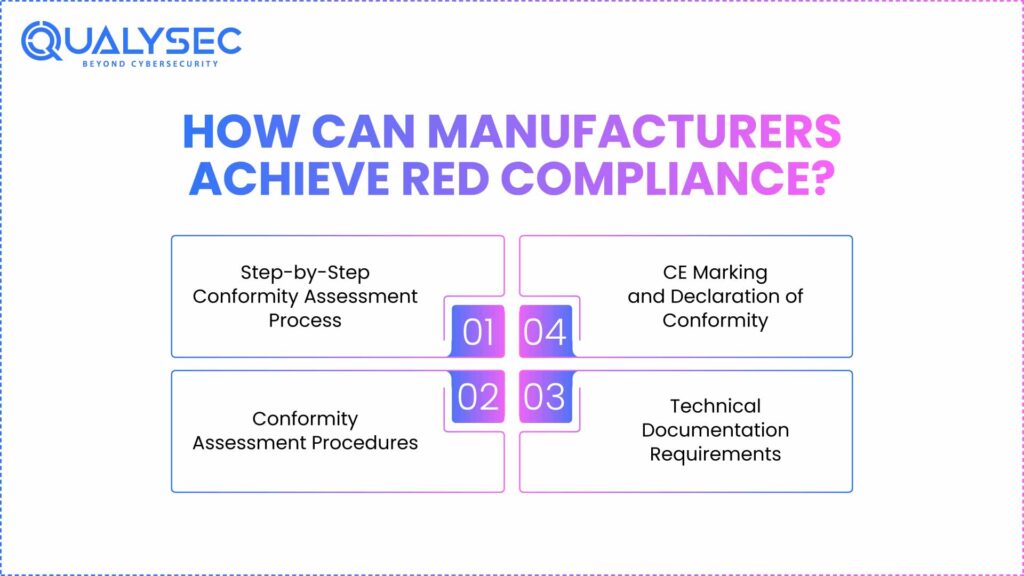
Step-by-Step Conformity Assessment Process
In the first place, manufacturers need to design and manufacture equipment based on the necessary requirements as provided in the Radio Equipment Directive 2014/53/EU. Then, they are to prepare detailed technical documentation of compliance. After that, the necessary conformity assessment process should be done.
Key manufacturer obligations include:
- Ensuring that the products meet essential safety requirements.
- Checking effective radio spectrum utilisation without interference.
- Preparing elaborate technical specifications.
- Conducting conformity assessment procedures.
- Establishing a Declaration of Conformity (DoC)
- Placing the CE marking visibly and legibly.
Moreover, the manufacturers should adopt quality control measures so as to maintain penetration testing compliance during the production process. Additionally, they have to keep records for a period of ten years after they introduce equipment to the market. Consequently, there should be sound record-keeping systems.
Conformity Assessment Procedures
The red directive offers two main conformity assessment routes:
Self-Declaration Route: The manufacturers of most radio equipment are allowed to self-declare compliance by doing in-house security testing to harmonised standards. Nonetheless, it involves comprehensive knowledge of technical requirements.
Notified Body Route: It has equipment categories that require third-party assessment by EU-recognised Notified Bodies. Specifically, equipment or new technologies that are more risky could have to be externally certified. In such a way, producers need to decide the route to follow with their products.
Technical Documentation Requirements
Complete technical documentation should contain:
- General description and proposed use of the product.
- Drawing of design and manufacturing.
- Electrical and mechanical criteria and standards used.
- Reports on compliance with tests.
- Risk assessment report.
- Instructions and warning messages.
Additionally, the documentation should be thorough so that the market surveillance authorities can check conformity. Hence, there should be careful and systematised documentation.
CE Marking and Declaration of Conformity
After conformity assessment has been done, the manufacturers should place the CE mark on their products. Further, the marking has to be noticeable, legible, and unintelligible. Also, the equipment must have a Declaration of Conformity (DoC) attached to it.
The DoC must specify:
- Product identification information.
- Name of manufacturer and address.
- Information of the Notified Body (where applicable)
- References to harmonised standards used.
- Both the signature and the date of declaration.
As such, documentation and marking are crucial steps that should be applied before placing in the market.
What Are the Obligations for Importers and Distributors?
The manufacturers are not the only ones, and they have the responsibility to ensure RED compliance. The importers and distributors are also significant in making sure that only conforming products are given to the European consumers. These obligations should, therefore, be known by all the players in the supply chain.
Importer Responsibilities Under RED Directive
Radio equipment that is imported outside the EU is made available by importers in the European markets. They are therefore expected to ensure that manufacturers comply with all the red. In addition, there are certain functions imposed on importers:
- Checks on the existence and validity of CE marking.
- Making sure that there is technical documentation.
- Confirming the Declaration of Conformity is accessible.
- Including their name and address on products or packages.
- Keeping compliance records for ten years.
- Tracking the safety of products during delivery.
Also, importers are required to report to the authorities immediately if they find non-compliant products. As such, close monitoring of the import process is required. Learn about cybersecurity companies in Europe.
Distributor Obligations
Radio equipment is distributed by distributors following its manufacture by the manufacturers or importers. Nevertheless, they are also in charge of red compliance. In particular, distributors will be obliged to:
- Verify the presence of CE marking before selling
- Use of products is to be accompanied by the necessary documentation.
- Ensure that manufacturers and importers have fulfilled labelling requirements.
- Keep and transport products in good order to comply.
- Report products that are non-compliant to the authorities.
In addition, the distributors are also supposed to cooperate with the enforcement authorities in the course of investigations. Thus, proper record keeping and due diligence checks are part of the business practices.
Supply Chain Traceability
Radio Equipment Directive 2014/53/EU is concerned with traceability in the supply chain. Further, every economic operator is required to provide contact details and record-keeping. This, in turn, allows proper monitoring of the markets and quick action taken to address the safety concerns. Consecutive documentation systems, thus, are advantageous to everyone.
You might like to know more about what the NIS2 Directive. Compliance and Policies
The Post-Brexit Future in Great Britain
As a result of Brexit, Great Britain has established its own regulatory framework in line with the concepts of Directive 2014/53/EU. However, there exist large differences between the EU and GB requirements. This is the reason why companies operating in the two markets should be familiar with such differences.
Radio Equipment Regulations 2017 in Great Britain
After Brexit, Great Britain has created its own regulatory framework based on the principles of Directive 2014/53/EU. EU and GB requirements do have, however, significant differences. Therefore, companies that operate within the two markets must be familiar with such differences.
Key GB-specific elements include:
- GB market placement: UKCA marking.
- Bodies within the UK rather than within the EU.
- Adjusted labelling and record-keeping needs.
- Long adjustment periods on some obligations.
- Northern Ireland goods qualifications.
The UK government, however, stated it would have indefinite recognition of CE-marked products in Great Britain. As such, firms have the option of either CE or UKCA marking for the GB market. However, CE marking is obligatory for the EU and Northern Ireland markets.
Northern Ireland’s Unique Position
In Northern Ireland, the rules are different under the Windsor Framework. In particular, NI keeps complying with EU radio equipment regulations. Thus, products that are offered on the NI market have to be preferably marked with CE. Also, the items that are evaluated by the UK bodies bear both CE and UKNI markings.
Moreover, Northern Ireland qualifying goods can access the GB market without further approvals. Thus, the knowledge of such arrangements assists companies to be efficient in trade related to the UK and the EU. Know about cyber security companies in Ireland.
Practical Implications for Businesses
Businesses selling across multiple markets must consider:
| Market | Required Marking | Assessment Body | Standards Applied |
| European Union | CE | EU Notified Body | EU harmonised standards |
| Northern Ireland | CE (+ UKNI if needed) | EU or UK body | EU standards |
| Great Britain | CE or UKCA | EU or UK body | GB standards (aligned with EU) |
Thus, there should be strategic planning regarding conformity assessment and marking as a condition to enter the market.
Ensure your product meets RED Compliance — Talk to Qualysec’s experts today!

Why is Qualysec the Best Company for Radio Equipment Directive (RED) Compliance Support in Europe?
Professional help, as well as intensive technical assistance, is required to establish and maintain the compliance of RED to be performed. Moreover, the Radio Equipment Directive 2014/53/EU also has complex requirements that might be hard to manoeuvre without experienced partners. Consequently, collaboration with a professional compliance specialist will be far more likely to guarantee the rates of success and reduced time to market entry.
Qualysec is the Crest-accredited top compliance support service provider of radio equipment to manufacturers and distributors in Europe. In addition, they are very useful collaborators as they are well-informed not only about the RED directive technical standards, but also about the new standards of cybersecurity. In addition, Qualysec also offers complete penetration testing services from initial product testing to further the enforcement of surveillance in the market.
Comprehensive RED Compliance Services
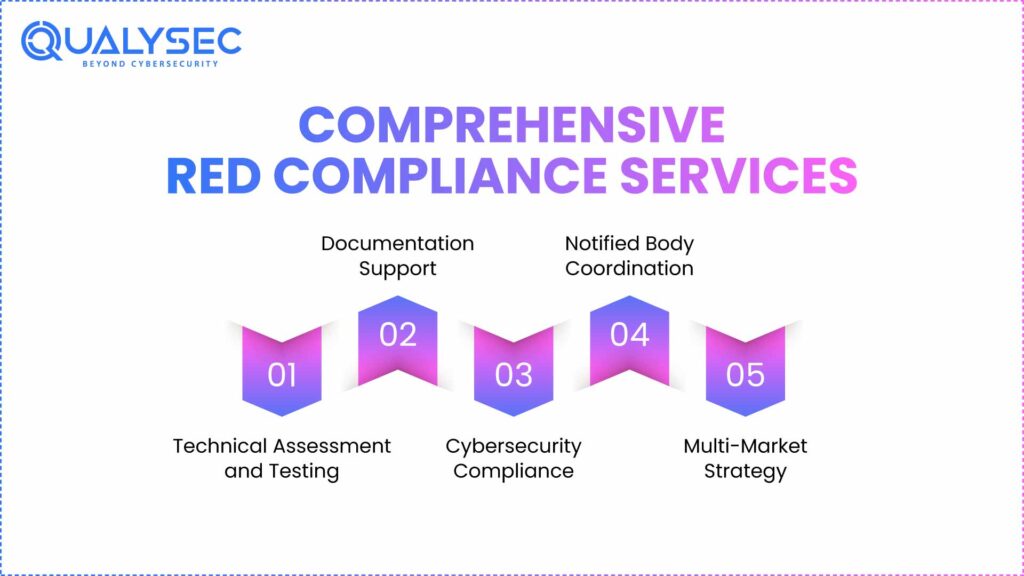
Qualysec provides specialised services tailored to red compliance challenges:
Technical Assessment and Testing: Their professional engineers make extensive reviews on the basis of all the requirements presented in Directive 2014/53/EU. Furthermore, they employ the latest testing laboratories to check electromagnetic compatibility, safety levels, and spectrum effectiveness. Therefore, an in-depth compliance security audit report on any areas of non-compliance with the standards is given to the manufacturers before market placement.
Documentation Support: Qualysec will help to create detailed technical documentation that is in compliance with regulations. Moreover, they aid in the production of conforming Declarations of Conformity and user documentation. Thus, companies will prevent most mistakes in documentation that lead to enforcement measures.
Cybersecurity Compliance: As new changes are in place to enhance cybersecurity requirements under Articles 3(3) (d), (e), and (f), Qualysec provides specialised security tests. In addition, they test privacy, safety, fraud security, and integrity safeguards in the network. They also have excellent cybersecurity knowledge, which makes their products compliant with the changing digital security requirements.
Notified Body Coordination: Qualysec is affiliated with the known EU Notified Bodies and UK Approved Bodies. As a result, they simplify third-party evaluation procedures where necessary. This way, manufacturers enjoy quicker certification.
Multi-Market Strategy: Qualysec designs coordinated cybersecurity compliance service strategies for businesses in the markets of the EU, GB, and NI. In addition, they negotiate the CE marking, UKCA marking, and UKNI marking requirements effectively. Consequently, corporations attain an overall market coverage with maximum resources.
Why European Businesses Choose Qualysec?
Several factors distinguish Qualysec in the red compliance landscape:
Deep Regulatory Expertise: They have a group of people who are up to date with all red 2014/53/EU requirements, such as the latest delegated acts and implementing regulations. Besides, they observe regulatory trends in order to offer proactive advice.
European Presence: Qualysec operates in Europe, and it has an idea of what its local markets need and what they should not need. Moreover, they possess local expertise, which guarantees culturally befitting solutions and solutions that are market-specific.
Technical Excellence: On top of regulatory compliance, Qualysec engineers offer recommendations on technical optimisation. As a result, products are not only able to satisfy requirements but are also at their best.
Comprehensive Support: Qualysec offers full support from the initial idea of the product up until after market surveillance. In addition, they help with market surveillance investigations and regulatory news.
Cost-Effective Solutions: This is because Qualysec allows businesses to save time and money that they would have spent on expensive delays and redesign of the company due to compliance problems detected early. Hence, their services are strategic investments, not costs.
To businesses that are serious about realising the efficient and effective achievement of RED compliance, the partnership with Qualysec gives businesses considerable competitive advantages. Besides, their successful history of certifications in varying product lines is evidence of competence.
Schedule a free consultation with Qualysec now to discuss your specific compliance needs and discover how their expertise can accelerate your market access.
Conclusion
Radio equipment compliance is something necessary and should be understood by any business entering European markets with radio equipment. Moreover, the Radio Equipment Directive 2014/53/EU sets out extensive demands that guarantee safety and electromagnetic compatibility and efficient spectrum utilisation. In addition, the latest cybersecurity patches enhance the security of the interconnected devices and the information of consumers. Thus, manufacturers, importers, and distributors should have alert compliance schemes across the lifecycle of the products.
The RED directive establishes harmonised standards that enable market access in the whole of Europe, as well as safeguarding consumers and the radio spectrum. Nevertheless, compliance in IT security must be done with a keen focus on technical requirements, documentation standards, and conformity assessment procedures. Moreover, the companies that run their business in the markets of the EU, GB, and NI need to overcome various marketing and certification regulations. Thus, the specialised advice of such partners as Qualysec can streamline the compliance procedures and decrease entry barriers to the market greatly.
Finally, RED compliance is a competitive benefit and a regulatory requirement. Safety and compatibility are high in the products that develop consumer confidence and reputation in the market. Moreover, advanced compliance minimises the enforcement risks and expensive product recalls. Thus, investing in total compliance programs provides long-term business value other than just regulatory compliance. Contact Qualysec today or chat with our AI compliance assistant to ensure your radio equipment meets all requirements and successfully reaches European consumers.

FAQ
1. What is RED compliance?
RED compliance: This is compliance of wireless devices with the Radio Equipment Directive 2014/53/EU. In addition, it has protection on products to meet safety, electromagnetic compatibility, and spectrum efficiency standards before their placement in the European markets.
2. What is RED II compliance?
RED II commonly denotes any new requirements in the Radio Equipment Directive and some new delegated acts. Moreover, it deals directly with the improved security of cybercrime, privacy, and fraud prevention of internet-related radio equipment.
3. What is the RED regulation in the UK?
UK Radio Equipment Regulations 2017: The Radio Equipment Regulations 2017 regulate radio equipment in Great Britain. Besides, these rules are replicas of the EU standards and introduce national-level processes such as UKCA marking and UK Approved Bodies.
4. What is the RED directive?
RED directive (Directive 2014/53/EU) is a European law that sets out requirements for radio equipment to be placed on the EU market. Moreover, it guarantees harmonised safety standards, electromagnetic compatibility, and spectrum efficiency standards among member states.
5. What is the RED regulation in the UK?
Radio equipment compliance in Great Britain after Brexit. The Radio Equipment Regulations 2017 regulate compliance with radio equipment in Great Britain. Furthermore, such regulations are consistent with the EU standards and establish GB-specific conformity assessment processes and marking.
6. What is the difference between the Red Directive and the EMC Directive?
The Radio Equipment Directive is a specific piece of legislation that deals with radio waves emitted for communication. In addition, the EMC Directive encompasses electromagnetic compatibility of all electrical equipment, irrespective of whether it is wireless, and therefore, RED is more specialised.
Ready to ensure your radio equipment meets all European compliance requirements? Partner with Qualysec’s expert team for comprehensive RED compliance support. Download our detailed compliance checklist or talk with our experts today to develop a customized compliance strategy for your products.