






On 22nd March 2023, a Capita employee unintentionally downloaded a JavaScript file onto their work device. This unintentional mistake led to the extraction of nearly 974.84 GB of data, which included sensitive information like criminal records and financial data, affecting 6,656,037 individuals. On 15 October 2025, the UK ICO imposed a combined £14 million penalty for breaches of the UK GDPR (specifically Articles 5(1)(f) and 32 on security).
To understand the significance of this penalty, we have to address a common misconception. Post-Brexit, a lot of UK companies had assumed that the UK regime was a ‘same thing but just rebranded’ version of EU GDPR. And this led to another misconception that the UK version does not matter as much as the EU GDPR.
For a while, this thinking did not cause much damage. Then in February 2021, the UK government began to signal that it wanted to diverge from the EU’s data protection framework to create a more ‘pro-business’ and innovation-friendly regime. How? We will get to it.
We used the Capita fine example because it proves that the UK regime does have independent, operational enforcement teeth and the EU regime never lost its own. Now, if your company handles UK and EU personal data, you are now facing two regulators, two sets of procedural expectations, and two routes to a multi-million-pound penalty. Before Brexit, the company just had to face one, the ICO.
This is exactly why it is extremely important to understand GDPR after Brexit and how to stay compliant with EU and UK data protection laws.
What Happened to GDPR After Brexit?
A recap: GDPR before Brexit
Before we learn about what happened to GDPR after Brexit, let’s have a recap of how GDPR was before Brexit. It will help you understand the aftermath more easily.
Today, we are learning about UK GDPR and EU GDPR. But before January 2021, there was no separate UK GDPR and EU GDPR. UK was an EU member state and therefore was bound by the original European regulation (EU GDPR). This was the pre-2021 situation:
| Aspect | Before 1 January 2021 |
| Governing law | EU GDPR (Regulation 2016/679) |
| How it applied in the UK | Directly, automatically, because the UK was an EU member state |
| Supplementary UK law | Data Protection Act 2018 (exemptions, derogations, ICO powers) |
| Was there a “UK GDPR”? | No |
Then, on 23 June 2016, the UK voted to leave the EU, and the UK GDPR came into existence on 1 January 2021. What was happening between June 23 and January 2021?
What happened between the referendum and 1 January 2021?
| Step | Date | What happened |
| 1. The decision | 23 June 2016 | Referendum: UK votes to leave the EU |
| 2. The formal exit | 31 January 2020 | UK legally leaves the EU but enters a transition period |
| 3. The transition | 31 Jan – 31 Dec 2020 | EU law, including the EU GDPR, continues to apply in the UK as if it were still a member. Nothing changes for data protection yet. |
| 4. The new regime | 1 January 2021 | Transition ends. The EU GDPR ceases to apply directly. The UK GDPR comes into existence as domestic law. |
Let’s put GDPR before Brexit and GDPR after Brexit side by side. It will give you a better understanding.
UK GDPR vs EU GDPR (GDPR After Brexit vs GDPR Before Brexit)
As we mentioned, the misconception that the UK regime was just a copy-and-paste version of the EU regime and did not need to be studied properly did not cause immediate problems for UK-only processing. But it stopped being a harmless assumption on 5 February 2026 when the UK introduced a genuinely different rulebook.
This is exactly why it has become important to understand how to stay compliant with EU and UK data protection laws.
| Area | Before Brexit (EU GDPR applied in the UK) | After Brexit: UK GDPR (as amended by DUAA 2025) | EU GDPR today |
Governing instrument |
EU GDPR (Regulation 2016/679), directly applicable; DPA 2018 supplemented it | UK GDPR, DPA 2018, and DUAA 2025 | EU GDPR (Regulation 2016/679), plus national implementing laws |
Regulator |
ICO, operating inside the EU one-stop-shop as the UK’s supervisory authority | ICO, acting autonomously under UK law | National supervisory authorities in each Member State, coordinated by the EDPB |
Lawful bases |
Six bases under Article 6(1) | Seven bases: the original six plus Article 6(1)(ea) recognised legitimate interests | Six bases; no recognised legitimate interests equivalent |
Legitimate interests |
Full three-part test: legitimate interest, necessity, balancing | Recognised legitimate interests: five pre-approved purposes in Annex 1; no balancing test, but necessity still required | Ordinary legitimate interests only; full balancing test required |
Automated decision-making (ADM) |
General prohibition on solely automated significant decisions, subject to narrow exceptions (Article 22) | Permission-plus-safeguards model: Articles 22A–22D; ADM permitted for ordinary data if Article 22C safeguards are in place; special-category data remains restricted | General prohibition remains, subject to specified exceptions under Article 22 |
Subject access requests (DSARs) |
One-month deadline; no statutory “reasonable and proportionate” search limit; no statutory stop-the-clock | One-month deadline, but “reasonable and proportionate” search standard; statutory stop-the-clock for identity verification, clarification, or fee; legal professional privilege exemption | One-month deadline, extendable by two months for complex requests; no statutory search limit; no statutory internal complaints duty |
Complaints handling |
No statutory duty to operate an internal complaints procedure; individuals could complain to the ICO | Statutory complaints duty from 19 June 2026: clear route, acknowledge within 30 days, investigate and respond without undue delay | No statutory internal complaints procedure; individuals complain to the supervisory authority |
International transfers |
UK-EU flows were internal; no transfer mechanism needed | UK IDTA or EU SCCs + UK Addendum for UK restricted transfers; EU SCCs alone are not valid for UK transfers | EU SCCs or adequacy decisions; EU adequacy decision for the UK valid to 27 December 2031 |
Maximum fines |
EU GDPR maximum: €20m or 4% of global turnover | UK GDPR maximum: £17.5m or 4% of global turnover | EU GDPR maximum: €20m or 4% of global turnover |
PECR / e-marketing fines |
PECR maximum: £500,000 | PECR maximum raised to £17.5m or 4% from 5 February 2026, aligning with UK GDPR top tier | ePrivacy Directive and national law; penalties vary by Member State |
Purpose limitation |
Purpose limitation applied strictly; reuse generally required a new lawful basis | DUAA introduced Articles 84A and 84B, giving UK organisations more latitude to reuse data for research and AI training, subject to safeguards | Purpose limitation remains strict; reuse requires a compatible purpose or new lawful basis |
Cookie consent |
Consent required except for strictly necessary cookies | DUAA created additional exemptions to cookie consent, including certain statistical and non-intrusive purposes | Consent required except for strictly necessary cookies, subject to national implementations |
Enforcement intensity (recent) |
ICO enforced EU GDPR actively (e.g., BA £20m, Marriott £18.4m in 2020) | ICO enforcement is narrower in volume than the EU’s; 10 fines totalling £36.2m across 2024/25 and 2025/26. | EU supervisory authorities issued fines totalling approximately €1.2bn in 2025, broadly matching 2024. |
Does Your UK Business Need to Follow Both UK GDPR and EU GDPR?
To see if your UK business needs to follow both regimes, first you need to determine if you need to follow UK GDPR or EU GDPR. These might sound complicated if you are reading the rules for the first time. But by the end, you will have a good understanding.
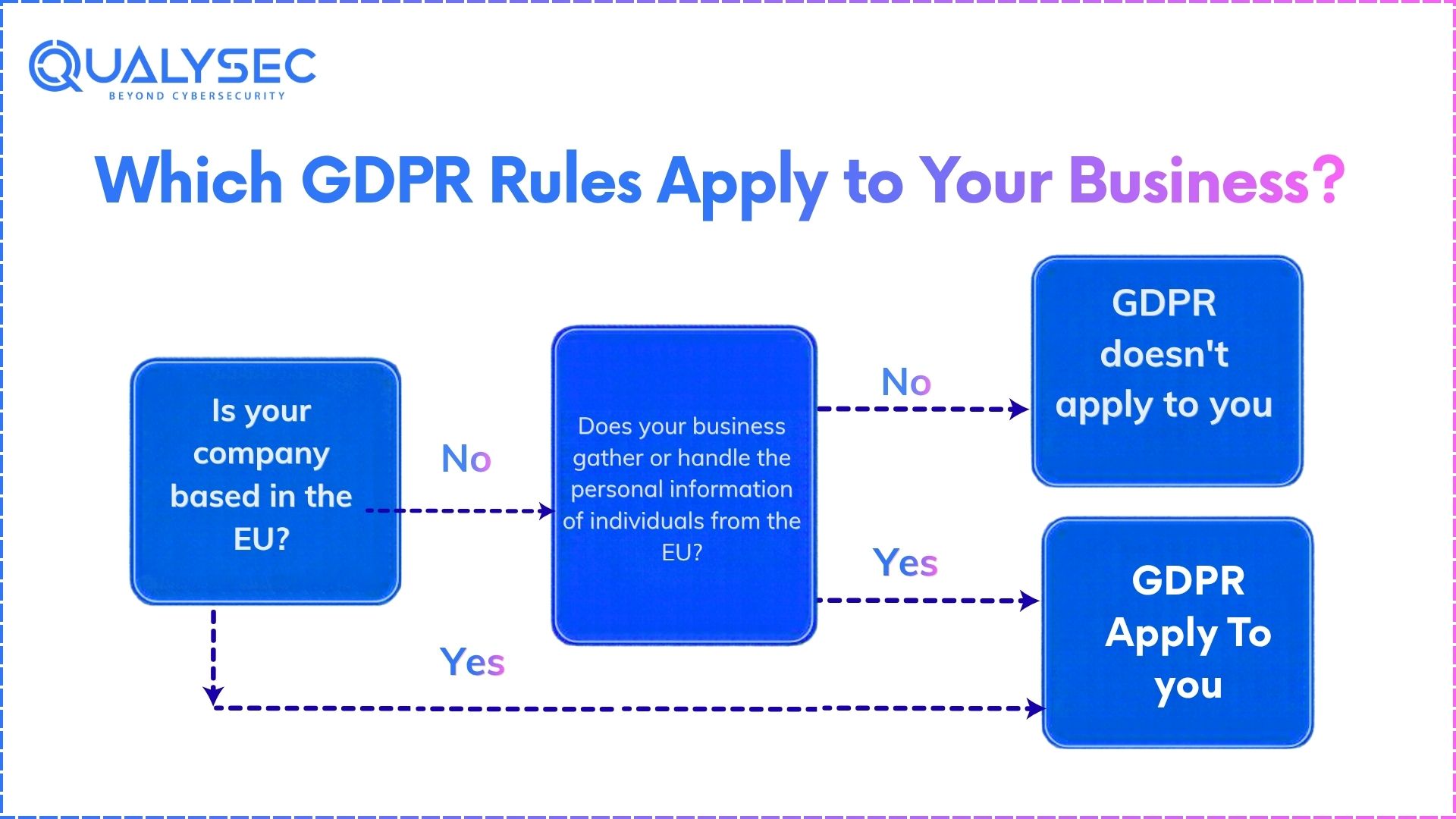
When Does Your UK Business Need to Follow UK GDPR?
According to Article 3 of the UK GDPR, these are the provisions that decide whether UK GDPR after Brexit applies to you.
Rule 1 – If you have a UK base, UK GDPR follows the work that base does
Answer these questions:
- Do you have a stable office, branch, UK company, or staff based in the UK?
- Are you doing real and effective activity in the UK? As in, is there a genuine operation actually doing business here? Not just a server or registered address?
- Is the processing tied to your above activity? Does it exist because of what the UK base does?
If the answers to all these questions are ‘Yes’, then you have to follow the UK GDPR because you have a UK establishment. According to the law, if you have a stable office, branch, or staff based in the UK, and that presence is actually doing business, then you have a stable UK presence.
If you have a registered shell company with no staff, you’re out because you do not fall under question 2. You do not have a UK establishment under rule 1. But you need to analyse properly. You can fall under rule 2.
Rule 2 – If you have no UK base, UK GDPR follows you if you aim at the UK
Even if you do not have a UK base, which means you have no UK establishment, you can still fall under UK GDPR. Having no UK office cannot be your defence.
According to the rules, if you are aiming at (specifically targeting) UK users, you will need to follow the UK GDPR rules. In legal terms, UK GDPR follows you if
- your processing relates to offering goods or services to people in the UK,
- you are watching what people in the UK do online. It can involve tracking, profiling, or analysing what UK users do online
One thing that also falls under this is that even if you are offering free services to UK users, you will still have to follow the UK GDPR. The law applies ‘irrespective of whether a payment is required’.
One thing to keep in mind: if you are not deliberately trying to offer your goods or services to UK users or deliberately watching UK behaviour, you do not fall under UK GDPR. The intention must be there. A UK person finding you by accident is not an intention to target.
Note: UK GDPR only catches the processing connected to your UK activity. It does not follow everything that your company does outside the UK.
If your UK business falls under any or both of the rules, it is time to see if you need to follow EU GDPR too. You can use a GDPR checklist to review these requirements and identify which rules apply to your business.
When Does Your UK Business Need to Follow EU GDPR?
Your UK business needs to follow EU GDPR based on similar rules as above. EU GDPR reaches you if the answer to any or both of these rules is ‘Yes’.
- You have an EU establishment. And the processing is carried out in the context of that establishment.
- You have no EU establishment but you offer goods or services to EU users or deliberately watch or monitor their behaviour online
If your answer to the second rule is ‘Yes’, it is important for you to understand the concept of ‘EU Representative’.
Understanding EU Representative under Article 27
If you do not have an EU establishment but you are caught under EU GDPR, then as per Article 27, you are generally required to appoint an EU Representative. It is a named contact established in a Member State where your EU data subjects are located.
There is an exemption, of course. If your processing is occasional, and it does not involve large-scale special category or criminal offence data, and the processing is unlikely to pose a risk, only then do you get the exemption. The key is, all three conditions must be met together. Public Authorities are also exempt.
We advise you to not make assumptions on your own. One more thing you must always remember: even if you do appoint an EU representative, you will still remain answerable for your business processing. It does not move your legal responsibility at all.
When Does Your UK Business Need to Follow Both?
| Your situation | UK GDPR catches you? | EU GDPR catches you? | You follow |
| UK office + you target EU customers (euro pricing, EU ads, EU delivery) | Yes – Rule 1 (UK establishment) | Yes – Article 3(2) EU GDPR (targeting EU individuals) | Both |
| UK office + EU office (e.g., a branch in Dublin or Berlin) | Yes – Rule 1 (UK establishment) | Yes – Article 3(1) EU GDPR (EU establishment) | Both |
| UK office + you monitor EU users’ behaviour (tracking, profiling, analytics) | Yes – Rule 1 (UK establishment) | Yes – Article 3(2) EU GDPR (monitoring EU behaviour) | Both |
| No UK office, but you target UK users + you also target EU users | Yes – Rule 2 (targeting the UK) | Yes – Article 3(2) EU GDPR (targeting EU individuals) | Both |
| No UK office, but you target UK users + you have an EU office | Yes – Rule 2 (targeting the UK) | Yes – Article 3(1) EU GDPR (EU establishment) | Both |
| No UK office, no UK targeting; you only target EU users | No | Yes – Article 3(2) EU GDPR | EU GDPR only |
| UK office only, no EU office, no EU targeting or monitoring | Yes – Rule 1 | No | UK GDPR only |
| No UK office, no UK targeting; no EU office, no EU targeting | No | No | Neither |
You have to follow both sets of rules if your business triggers at least one UK rule and at least one EU rule. Since the scope depends on each processing activity, it means that UK-facing work will fall under UK GDPR and your EU-facing work will fall under EU GDPR.
Now, you understand where your business stands. If you fall under both EU GDPR and UK GDPR, it means that you will need to stay compliant with both EU and UK data protection laws. This brings us to the main section of our discussion today, ‘How to Stay Compliant with EU and UK Data Protection Laws?’.
How to Stay Compliant with Both UK and EU GDPR
We can give you a long list of steps to help you stay compliant with both UK and EU GDPR, but they will not matter if you do not understand which data belongs to which regime. Every step that we will be discussing will depend on how accurately you know and understand your data. Meeting compliance requirements under both GDPRs depends on these three steps:
Step 1: Map your data flows
It is the foundational control measure. It means you need a record of what data you hold, whose it is, where the data came from, where it goes, who has access to it, and how long you are planning to keep it.
If the record is inaccurate or incomplete, there is a risk of breach of UK GDPR Articles 5(1)(f), 5(2), and 32. As per the ICO, based on your mapping exercise, you will need to produce a Record of Processing Activities (ROPA) under Article 30 of the UK GDPR.
If you need to follow both UK and EU GDPR, your map must also record where the data subjects are located.
Step 2: Tag each activity by regime
Once you have done your mapping accurately, you apply Article 3 UK GDPR and Article 3 EU GDPR to each activity. This means putting your activities under three buckets:
| Bucket | Meaning |
| UK-only | Only UK GDPR catches this activity |
| EU-only | Only EU GDPR catches this activity |
| Dual-regime | Both catch this activity. Where the rules have diverged, you must meet both standards for the overlapping data, or design to the higher standard. Where the activity splits into UK-facing and EU-facing flows, apply the UK rule to the UK flow and the EU rule to the EU flow. |
By the end of this step, you will be able to determine which data belongs to which regime. Your mapping in the first step determines the accuracy of this step.
Step 3: Fix your role and lawful basis for each activity
This step will help you answer two different questions about every single activity on your map.
- Your Role: Are you a controller, processor, or joint controller in this activity?
- The lawful basis: On what legal ground are you allowed to do the activity?
This test is identical under both regimes. You do not need to split by regime for the role question. So, what is a controller, processor, or joint controller?
| Aspect | Controller | Joint controllers | Processor |
| Core test | Decides both the purpose (why) and the essential means (how) of the processing | Two or more parties jointly participate in determining purposes and means through a common decision or converging decisions necessary for the processing | Processes personal data on behalf of the controller, on its documented instructions |
Once you know your role, it is time to identify the lawful basis for the activity. This is where the UK and EU regimes have actually diverged.
| Issue | UK GDPR | EU GDPR |
| Number of lawful bases | 7 – the original 6 plus recognised legitimate interests (Article 6(1)(ea)) | 6 |
| Legitimate interests | Two versions: (a) ordinary legitimate interests (full balancing test still required); (b) recognised legitimate interests – 5 pre-approved purposes in Annex 1, no balancing test, but necessity still required and the right to object preserved | Ordinary legitimate interests only – full three-part test: legitimate interest, necessity, balancing |
| Solely automated significant decisions (ordinary data) | Permitted with Article 22C safeguards: information, representations, human intervention, right to contest | Prohibited unless one of three conditions applies: contract, legal authorisation, or explicit consent |
All these questions need to be answered per activity and not at company level.
Now you have a foundation. It is time to follow the next five operational steps. All these steps are applied to a mapped, tagged, role-assigned activity. When you are staying compliant for both regimes, remember that you are not doing double paperwork. You are running the same activities, but for each one, you’re checking ‘which rulebook covers this data?’ and applying that rulebook to meet the relevant GDPR compliance requirements.
Update your privacy notices
Both regimes require you to mention on your website what data you collect, why, and what rights users have. Brexit changed this step. The UK introduced the concept of recognised legitimate interests.
Split your DSAR workflows
According to both regimes, if someone requests that you share a copy of all the personal data you hold about them, then you have one month to respond. How this month is calculated is where both regimes differ.
- As per UK GDPR, if you have in turn asked them to clarify something, then as per Article 12A UK GDPR, the clock pauses and you have a month from when they reply.
- As per EU GDPR, the clock keeps ticking. So, even if they reply on day 20, you have 10 days left to share the copy with them.
Prepare for two breach assessments
According to both regimes, you must notify the regulator about any security incident that exposes personal data within 72 hours (without undue delay, and where feasible), if the breach is likely to risk people’s rights. But if you fall under both GDPRS, you must conduct two security assessments and make two notifications, one for each regime.
- You must assess the risk separately for the UK data subjects and the EU data subjects.
- And notify the ICO about the UK data and the relevant EU supervisory authority about the EU data.
Check your transfer mechanisms
As per both regimes, you need to send a legal “transfer mechanism” whenever you send personal data out of a jurisdiction to a country without an adequacy decision. But here, both regimes ask for different mechanisms:
- For UK transfers, you need to attach the UK IDTA or the UK Addendum attached to the EU SCCs.
- For EU transfers, you need EU SCCs or any adequacy decision.
Before we move forward, it is important to cover a few things while we are still talking about transfer mechanisms.
- Direction Check: Always check the direction in which the data is moving. The data transfers from the EU to the UK get a free pass. It is valid until 27 December 2031. This is only for data coming in from the EU and does nothing for data going out of the UK.
- Onward Check: If you are sending EEA-origin data anywhere else in the world, this onward transfer will need its own legal mechanism (like an IDTA or UK Addendum). Adequacy does not cover onward transfers.
- Compliance Check: The adequacy decision makes the act of transferring the data lawful but it does not give you a free pass on the rest of your GDPR obligations.
Sort your vendor contracts
As per both regimes, you need to add some data protection terms into the contracts with software vendors, cloud providers, and processors. These terms are about what they can do with your data, how they secure it, when they delete it, and so on. You cannot use the same template if you fall under both GDPRs because DUAA has changed some of the terms for UK processing.
Keep security strong
For this step, both regimes follow the same structure and demands. Under GDPR Article 32 of both regimes, you need appropriate technical and organisational measures. But you still need to map, tag, and apply the correct rules for everything else.
| Area | UK: what to do | EU: what to do |
| Privacy notices | Name the basis from the seven (including recognised legitimate interests where you rely on it) | Name the basis from the six (full balancing test for ordinary legitimate interests) |
| DSARs | Pause the clock for ID/clarification/fee; search only what is reasonable and proportionate | Keep the clock running; search fully as no statutory proportionate-search limit |
| Breach notification | Assess risk to UK data subjects; notify the ICO within 72 hours where the threshold is met | Assess risk to EU data subjects separately; notify the relevant EU supervisory authority in parallel |
| Transfers | Use the UK IDTA or EU SCCs + UK Addendum for UK restricted transfers | Use EU SCCs or an adequacy decision for EU restricted transfers |
| Vendor contracts | Check clauses against UK rules | Check clauses against EU rules |
| Security | One Article 32 programme | Same programme as Article 32 is identical in both regimes |
How Qualysec Helps Secure Your Data
We began with the one error that ended with Capita paying a combined £14 million penalty. Capita failed to protect itself from one obligation that both regimes agree on. Article 32 requires appropriate technical and organisational measures to protect personal data. And Article 32(1)(d) requires a solid process for regularly testing, assessing and evaluating the effectiveness of those measures.
This is where you need excellent penetration testing services. You need someone to find the weaknesses so that your system is not left for 58 hours after a high-priority alert. Qualysec provides hands-on penetration testing and security assessments across web and mobile applications, APIs, and cloud environments on AWS, Azure and Google Cloud, with retesting to confirm fixes hold.
It is important to understand that penetration testing does not help you deal with the whole of GDPR compliance. It will tell you whether your technical controls hold, but the rest of it still needs proper management.
Qualysec will help you close the gap between ‘you have security measures’ and ‘you have documented proof of whether they actually work.’
Conclusion
Brexit did not make GDPR compliance less important for UK businesses. In fact, Brexit made it more complicated for you if your company is handling both UK and EU personal data. With the DUAA 2025 now changing a lot of UK GDPR requirements, you can no longer assume that if you are following the EU rulebook, then you’re automatically compliant with the UK rulebook or vice versa.
Before beginning anything, understand which regime applies to which processing activity. From there, review your lawful bases, privacy notices, DSAR processes, breach response plans, transfer mechanisms, and security controls. A GDPR data privacy audit can also help identify compliance gaps and check whether your data protection practices meet the requirements of both regimes.
Always remember that having security measures in place is not enough. You also need to test whether they work. Qualysec helps businesses assess their security through its hands-on penetration testing across web, mobile, API, and cloud environments, with retesting to confirm fixes.
Talk to Qualysec to assess your security controls before the attackers find your weaknesses.

Frequently Asked Questions
1. Does GDPR still apply to UK businesses after Brexit?
Yes. After Brexit, the UK retained the EU GDPR’s main rules as domestic law and named it UK GDPR. It is currently in force along with the Data Protection Act 2018 and the DUAA 2025.
2. Do UK businesses need to comply with both UK GDPR and EU GDPR?
Only when a processing triggers at least one scope in each regime, whether UK establishment or UK targeting, and EU establishment or EU targeting.
3. Can personal data move freely between the UK and EU?
If you are moving data from the EU to the UK, it is covered by the European Commission’s adequacy decision and is valid up to 27 December 2031. UK to EEA (European Economic Area) flows are covered separately by UK adequacy regulations.
4. What changed under the Data (Use and Access) Act 2026?
UK data protection laws amended the UK GDPR. They introduced four main areas, including recognised legitimate interests, automated decision-making, subject access requests, and data protection complaints.