






A GDPR audit may begin with a documentation review, but missing or outdated records can quickly turn the process into a compliance challenge. GDPR Enforcement Tracker has recorded a total of 3202 cases under GDPR till now, of which 156 cases have happened in the year 2026, with a fine of €6.31B. Security tests are an important part of documentation, which shows that the business has implemented the appropriate measures that are needed before collecting a consumer’s personal details.
Passing a GDPR data privacy audit is not simply about stating that your organisation follows privacy regulations. Regulators expect businesses to provide documented evidence showing how personal data is collected, processed, stored, shared, and protected throughout its lifecycle. As a business, you need to understand that preparing for a GDPR data privacy audit needs much more than gathering policies in one folder.
In this article, you will learn which documents regulators typically review during a GDPR audit, why keeping them updated is essential, and how proper security documentation can help your organisation demonstrate compliance more effectively.
Key Takeaways
- GDPR audits require documented proof of compliance.
- RoPA, DPIAs, DPAs, and policies are core audit documents.
- Article 32 requires evidence of security controls.
- Security reports help demonstrate data protection efforts.
- Breach records and third-party documentation are essential.
- GDPR compliance requires continuous updates and reviews.
- Combining privacy governance with cybersecurity improves audit readiness.
What Is GDPR Documentation?
GDPR documentation is a lawful requirement under which organisations must maintain records and evidence showing how personal data is collected, processed, stored, shared, and protected.
The General Data Protection Regulation came into effect on 25 May 2018 after increasing concern about user data privacy. With the rise of social media platforms, cloud technologies, and large-scale data breaches, there was an increasing need for stronger privacy laws across Europe.
GDPR was introduced to give individuals greater control over their personal information and to ensure that organisations become more transparent about their data handling practices.
Why Documentation Matters in a GDPR Data Privacy Audit?
GDPR documentation matters because when a company collects and stores consumer data, it must prove that it processes the information lawfully and has taken preventive steps to protect it. The documentation is proof that the organisation is not involved in unauthorised data collection, excessive data processing, data sharing with third parties, or weak security practices that could compromise someone’s privacy and expose personal information to misuse, breaches, or cyberattacks.
When you are a start-up, a SaaS provider serving European consumers, or a multinational company handling a large volume of customers’ personal details, GDPR documentation is mandatory to continue the business.
Auditors typically look for:
- What personal data does the organisation collect from users?
- Why is the data required?
- Who can access that data?
- How does the organisation protect the details?
- What happens if a data breach occurs?
- How long will the organisation keep the data?
- How are you handling the individual’s rights?
The answers to these questions should be in the documentation to maintain GDPR compliance. Well-maintained documentation provides consistency across the departments. If an organisation faces any security-related incidents or meets the needs of regulatory investigations, comprehensive records can prove that reasonable steps have already been taken by your company to become GDPR compliant.
Documentation Needed for a GDPR Data Privacy Audit
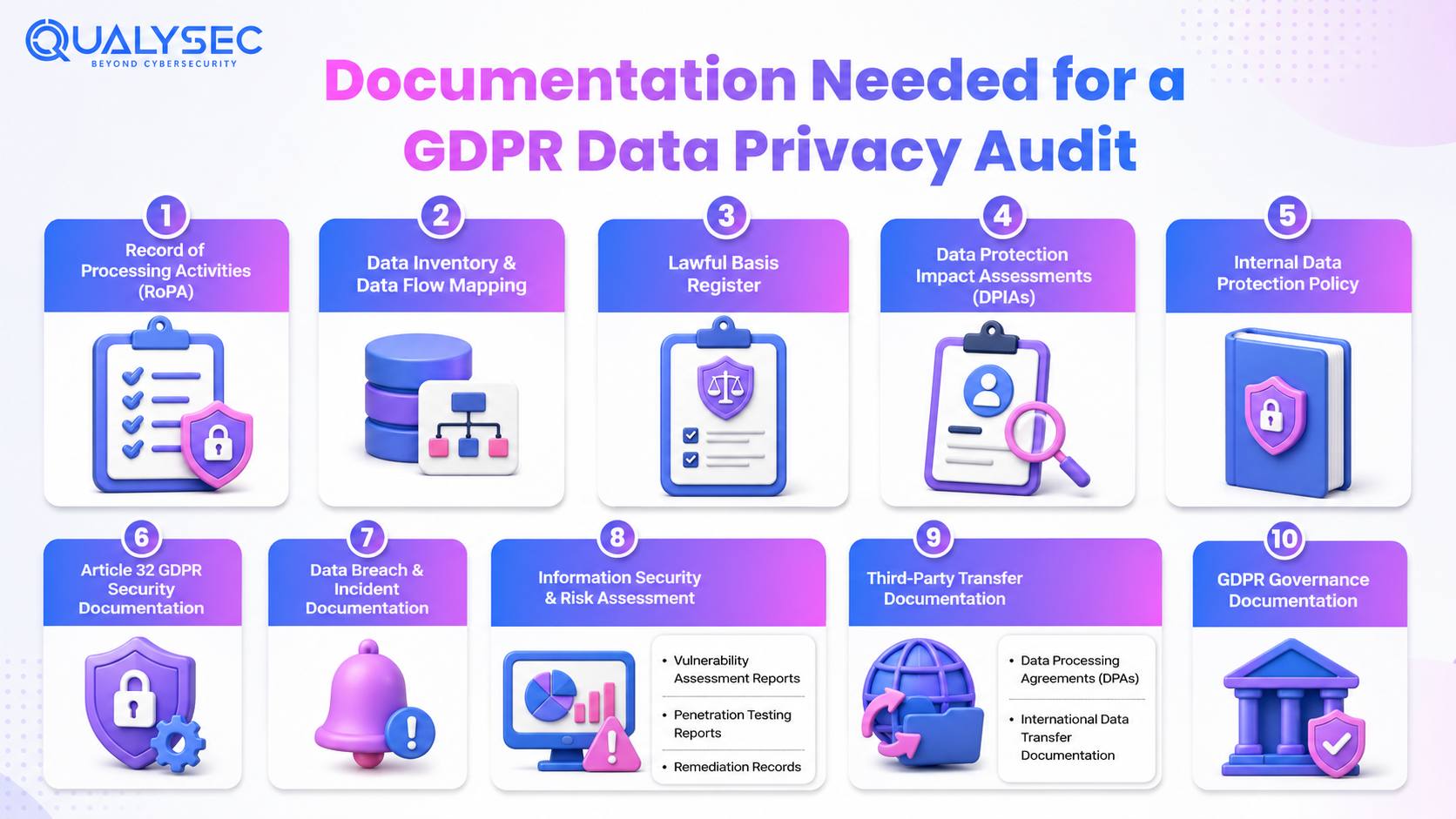
A GDPR audit requires organisations to maintain records that demonstrate how personal data is collected, processed, protected, and governed. Below are some of the key documents commonly reviewed during the audit process.
1. Record of Processing Activities (RoPA)
The Record of Processing Activities, also known as RoPA, is one of the important documents required to fulfil the GDPR privacy and data protection requirements. It is structured to provide an overview of every specific activity involving personal details across the organisation.
It basically includes:
- The goal of each activity processed by the organisation.
- Types of personal data collected from the user, including name, email, and contact number.
- Identifies whose personal data is being collected.
- Whether the data is collected by legal consent or not.
- Shows who gets access to consumers’ data inside or outside the organisation.
- How long is the organisation going to keep those personal details?
- Showcasing how the firm protects the data from getting lost, theft, or unauthorised access.
There is a small exception for companies that have fewer than 250 employees, but they can avoid maintaining a RoPA only when they are handling:
- Low-risk personal data like name and contact details.
- They are not doing data processing on a regular basis; it’s only happening occasionally.
- They are not handling sensitive data like someone’s health information, biometrics, or criminal records.
2. Data Inventory and Data Flow Mapping
Data flow mapping comes in when an organisation does not have enough idea about where the data is getting stored, which can lead to a data breach. According to the “Cost of a Data Breach Report” of IBM in the year 2025, it is reported that the average global cost of a data breach has reached 4.4M USD.
A complete inventory of data shows the exact location where the particular data is collected, stored, and processed. Data flow mapping works by showing how the information is being passed through the internal system, departments, cloud operating systems, third-party vendors, and external persons.
A proper data mapping helps in:
- Identifying if any unnecessary data is being collected
- Reducing the chance of duplication in stored data
- Understanding the third-party dependencies
- Locating if there is any sensitive information
- Supports the data subject rights
- Helps to prepare Data Protection Impact Assessments (DPIAs)
Regular data flow mapping supports the GDPR data protection efforts.
For example, a customer filled in the details through a website form. That form will move to the CRM platform, then to the marketing automation tool, then to the customer support platform, and finally, someone will store it in backup. Each of the stages can create a security and privacy risk which need to be understood and documented.
3. Lawful Basis Register
Lawful Basis Register is needed because, under the EU GDPR policy, organisations can’t process the data of a consumer just because it is useful or convenient. Every activity needs a legal basis. Maintaining a lawful basis documentation helps to understand why each piece of personal data is processed. The bases could be consent, necessity of the data, legal obligations, vital interests, or legitimate interests.
The document should clearly link each of the activities to its corresponding legal requirement. This documentation is similarly important as others during the time of audit, as it demonstrates that the organisation has carefully evaluated the legal justifications.
4. Data Protection Impact Assessment (DPIAs)
A Data Protection Impact Assessment is needed when data processing activities are at a higher risk to the rights and freedoms of an individual. When an organisation conducts activities like:
- Large-scale processing of personal data
- Processing of data of any specific category
- Extensive monitoring of user activity
- AI-based decision making
- User behavioural assessment
- Deployment of new technologies which require user data
These require Data Protection Impact Assessments.
According to the 2026 Cisco AI Readiness Index, nearly 91% of CEOs worldwide now believe that AI has more potential and is more beneficial for business. This means an organisation needs to be more careful when collecting user data in the era of AI. During documentation of the assessment, it generally covers:
- A proper description of the processing activity
- Purpose of processing
- Identified privacy risks
- Chances of potential harms and residual risks
- Decisions made before implementation
5. Internal Data Protection Policy
An internal data protection policy shows how employees should handle the personal data of customers within an organisation. It provides operational guidance to the staff from different departments for successful and consistent data protection. Although the policy can vary between firms, a common policy usually covers the responsibilities of employees, classifications of data, handling procedures, access management, data retention procedures, and escalation processes.
In this policy, you need to document the answers to questions like:
- Which specific persons can access the customers’ data?
- Can employees download the user data on their personal devices?
- Terms and conditions of sharing user data with third parties
- What steps need to be taken if an employee shares data with the wrong person?
6. Security Documentation Under Article 32 GDPR
Where governance documents explain how an organisation manages personal data, Article 32 GDPR allows businesses to demonstrate that they have taken appropriate security measures successfully. It basically follows a risk-based approach. Depending on the organisation, the documentation may include:
- Encrypted personal data
- Access control methods
- Network security control
- Vulnerability management
- Security testing regularly
- Response techniques to security issues
7. Data Breach and Incident Documentation
Organisations with strong security programmes can’t eliminate every cybersecurity risk. This is the reason why businesses have to show how they will handle security incidents, which can compromise user data.
A data breach documentation usually shows how incidents are identified, roles and responsibilities, internal management procedures for the risks, the investigation process, evidence of successful management, communication procedures, and recovery activities.
Under GDPR Article 33, organisations generally have 72 hours to notify the relevant authority, where there is any chance of risk to individuals’ rights and freedoms because of a personal data breach.
Organisations should also maintain the details of the security incident involving personal data, like the timing of the incident, the nature of the incident, systems affected, what personal data was involved in the incident, individuals impacted, and the correct action implemented.
8. Information Security Management and Risk Assessment
An information security policy typically includes the confidentiality and availability of personal data of a customer. Basically, it includes:
- Identity and access management
- User authorisation management
- Backup and recovery of user data
- Logging and monitoring activity
- Management of changes in user activity
This policy also identifies how the business implements the security controls.
Sometimes organisations face issues related to the technologies they are using, data processing activities, and other business operations. Security risk assessment provides the evidence that the risks have been identified and managed properly.
Cybersecurity helps organisations in risk assessments like protection of critical information assets, managing potential threats, finding existing vulnerabilities, checking for exploitation, and taking mitigation measures. Such assessments are not a one-time procedure. New technologies, software updates, and changes in business processes can create new risks that need reassessment.
8.a) A Vulnerability Assessment Report
When new vulnerabilities appear during security tests, it can lead to a failure in the GDPR data protection policy. Before preparing for a GDPR data privacy audit, it is important to go through a vulnerability assessment. Typical vulnerability assessment documentation includes:
- Proper assessment of the whole system
- Finding any existing vulnerabilities
- Affected assets
- Severity of the risk
- Reverification after fixing
When an organisation processes a large amount of personal data, vulnerability assessment demonstrates continuous monitoring and proactive risk management.
8.b) Penetration Testing Reports
Penetration testing goes one step further than vulnerability assessment. It generally simulates real-world attacks against the system that processes the personal data of users. Independent penetration testing provides the evidence that the security controls of the organisation can secure the data and protect itself during realistic attacks and become GDPR compliant. A proper penetration testing report generally includes the scope of testing, methodology of testing, the chance of risk, proof of exploitation, and detailed guidance on remediation.
8.c) Remediation Records
Remediation records typically include a list of vulnerabilities identified, the importance of the risk, action taken by the organisation to manage the risk, compilation date, and re-validation testing. Documenting these properly demonstrates continuous improvement, which is important in maintaining EU GDPR compliance.
9. Third-Party Transfer Documentation
When any organisation relies on external service providers such as cloud providers, software providers, payment processors, marketing tools, and other third parties to process a user’s personal data, these relationships also require proper documentation.
9.a) Data Processing Agreements (DPAs)
When a third party processes the personal data on behalf of an organisation, GDPR generally requires Data Processing Agreements. The agreement shows:
- Instructions for the third party related to data processing
- Security obligations
- Confidentiality requirement
- Breach responsibilities
- Data deletion or return after contract termination
9.b) International Data Transfer Documentation
When an organisation transfers the data outside Europe or the United Kingdom, it must document the legal mechanisms that support those transfers.
The documentation may include:
- Standard Contractual Clauses (SCCs)
- Transfer Risk Assessments (TRAs)
- List of international processors of user data
- Transfer documents that are made legally
- Security steps taken during the transfer process
10. Governance Documentation for GDPR Data Privacy Audit
Strong governance is proof that the data protection responsibilities are clearly assigned throughout the organisation. Research shows that human-led errors cause approximately 60% of data breaches. Depending on the need, the organisation should show roles and responsibilities, internal structure of the system, security committee documentation, and privacy review processes.
Apart from these, proper education for employees on GDPR guidelines, data handling mechanisms, information security practices, phishing awareness, and secure use of the system is also required.
Quick Overview: GDPR Audit Documentation Checklist
| Documentation/ Evidence | Why Needed |
| RoPA | Tracks what personal data is processed and why |
| Data Flow Mapping | Shows where data is collected, stored, and shared |
| Lawful Basis Register | Proves processing has a legal basis |
| DPIAs | Assesses high-risk processing activities |
| Internal Policies | Defines how employees handle personal data |
| Security Documentation | Demonstrates appropriate security measures have been taken |
| Incident Records | Shows how breaches are identified and managed |
| Vulnerability Reports | Identifies security weaknesses |
| Penetration Testing Reports | Validates security through real-world attack simulations |
| Remediation Records | Demonstrates continuous improvement |
| DPAs | Governs third-party data processing |
| International Transfer Records | Validates lawful cross-border data transfers |
| Governance & Training Records | Shows accountability and employee awareness |
How Qualysec Supports GDPR Compliance Through Security Approaches?
Passing a GDPR audit requires more than simply maintaining policies and records. Organisations should continuously review how they process, protect, and govern personal data across their environment.
1. Understand Data Processing Activities
The first step is to identify how personal data moves across applications, cloud environments, third-party vendors, and internal systems. This helps validate documents such as:
- Record of Processing Activities (RoPA)
- Data Processing Agreements (DPAs)
- Data Protection Impact Assessments (DPIAs)
- International data transfer records
2. Review Security Controls
The next step is to evaluate whether appropriate controls are in place to protect personal data, including:
- Access control mechanisms
- Encryption practices
- Cloud and API security controls
- Logging and monitoring processes
- Vulnerability management procedures
3. Validate Security Through Testing
Documentation alone cannot prove security. Vulnerability assessments and penetration testing help identify weaknesses that could expose personal data during real-world attacks.
4. Address and Document Risks
Teams should prioritise and remediate identified issues based on their potential impact on personal data. Maintaining remediation records also demonstrates continuous improvement.
5. Maintain Continuous Audit Readiness
GDPR compliance should be treated as an ongoing process. Regular documentation reviews, periodic security assessments, and third-party risk evaluations help organisations remain audit-ready as business operations evolve.
Conclusion
A successful GDPR data privacy audit requires much more than just a single documentation collection of policies and forms. During the audit, the organisation must demonstrate every single question related to the user’s personal data, starting from how it processes it to when it will retain it. A GDPR compliance checklist can help organisations keep track of these requirements and ensure nothing important is missed during the audit.
Proper security assessments, such as finding vulnerabilities, risk assessment, and penetration testing, not only decrease the risk of cyber issues but also help to manage GDPR guidelines. Till now, a large number of industries like Meta and Amazon have faced issues related to GDPR privacy audits in the past. So, it is important to understand the role of GDPR, whether you are a small start-up or handling a multinational Company.
Ultimately, people shouldn’t view GDPR documentation as only paperwork. It is the proof that an organisation embeds user privacy and security into its daily operations, making GDPR compliance a continuous business practice.

FAQs
1. What mandatory documents are required for a GDPR audit?
To pass an audit, you must provide a Record of Processing Activities (RoPA), Data Flow Maps, a Lawful Basis Register, and Data Protection Impact Assessments (DPIAs).
2. What is a Record of Processing Activities (RoPA)?
A RoPA is a master log that Article 30 mandates and documents what personal data you collect, why you use it, who accesses it, and when it gets deleted.
3. How quickly must a data breach be documented and reported?
Under Article 33, organizations must officially document and report any data breach exposing personal information to a supervisory authority within 72 hours of discovery.
4. What documentation is required for sharing data with third parties?
You must provide signed Data Processing Agreements (DPAs) and, if transferring data outside the EU, documented Standard Contractual Clauses (SCCs).