

Australian businesses often need to show customers and partners how they protect sensitive information. For SaaS companies, technology providers and other data-focused businesses, ISO 27001 Australia certification can provide that assurance.
ISO/IEC 27001:2022 sets the requirements for an information security management system ISMS. It helps an organisation manage information security risks within a defined scope.
If you are planning certification in 2026, the 2022 edition and the 2024 amendment are the current references. This guide explains how certification works, what affects the cost, and where VAPT may be needed.
Benefits of ISO 27001 for Australian Businesses
Before looking at certification, it helps to understand why Australian businesses invest in it.
Competitive Advantage in Enterprise and Supplier Procurement
For SaaS companies, B2B providers and suppliers, ISO 27001 certification in Australia can make enterprise security reviews easier.
A recognised certificate can help you:
- Show procurement teams that an independent body has assessed your ISMS.
- Respond more efficiently to vendor assessments and RFP security requirements.
- Reduce repeated requests for basic security assurance during sales reviews.
- Strengthen your position when customers prefer or require ISO 27001 certified suppliers.
Certification does not guarantee tender approval. Buyers may still ask for security questionnaires, penetration testing reports or other evidence depending on the contract.
Alignment With Australian Privacy and Security Obligations
ISO 27001 can help Australian organisations organise the security controls and records they need for privacy related obligations.
Under APP 11, covered organisations must take reasonable steps to protect personal information. Since 11 December 2024, APP 11.3 has clearly included both technical and organisational measures.
This can include areas such as access control, supplier management, incident response, risk management and technical security.
ISO 27001 certification does not prove compliance with APP 11 or the Privacy Act. Your organisation still needs to identify the Australian legal and regulatory requirements that apply and meet them separately.
Structured Information Security Risk Management
A working information security management system ISMS gives you a consistent way to manage security risks as the business changes.
Instead of treating risk reviews as a one-time audit exercise, you can:
- Identify important information and systems
- Assess threats and business impact
- Decide how each risk will be treated
- Assign responsibility for controls
- Check whether those controls are working
- Update actions when risks or business priorities change
Internal audits, management reviews, corrective actions and security objectives help keep that process active. They also give management a clearer view of whether security controls are still suitable and where changes are needed.
Customer and Stakeholder Assurance
There is an important difference between saying you follow ISO 27001 and holding certification from an accredited body. Certification gives customers independent evidence that your ISMS has been audited against the standard.
Buyers should still read the certificate scope carefully. That scope shows which activities, services and locations were actually covered by the audit.
The Step-by-Step ISO 27001 Certification Process
You do not need to implement all 93 Annex A controls just because they appear in the standard. The process starts with the requirements in Clauses 4 through 10. From there, you assess risk, decide how to treat it, choose suitable controls and keep evidence showing what has been done.
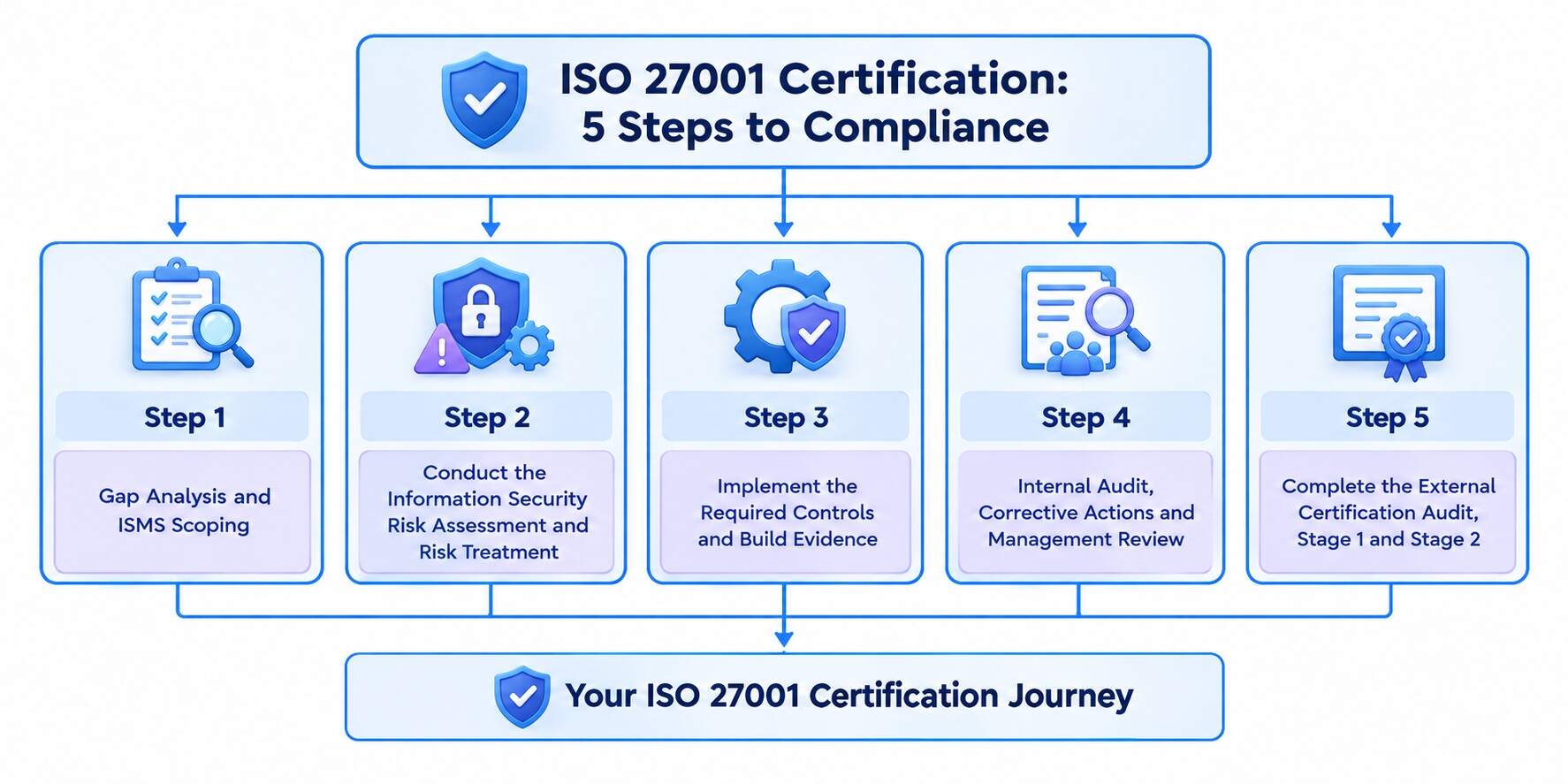
Step 1: Gap Analysis and ISMS Scoping
Start by defining exactly what will sit inside the ISMS.
That can include:
- Business units
- Products and services
- Employees
- Office locations
- Cloud infrastructure
- Development and production systems
- Support teams
- Third party services
The scope needs to be wide enough to cover the service customers are relying on. Making it unnecessarily broad can add more work during implementation and audit.
After that, review what is already in place against ISO/IEC 27001 requirements. The gap analysis should show which processes and controls already meet the standard and where changes are still needed before the certification audit.
Step 2: Conduct the Information Security Risk Assessment and Risk Treatment
ISO 27001 expects you to make security decisions based on risk. That starts with a consistent method for identifying, analysing and evaluating information security risks across the ISMS.
Once a risk is understood, you decide what to do with it. Common options include:
- Reducing it through suitable controls
- Stopping the activity that creates it
- Sharing or transferring part of the risk
- Accepting it when the decision is justified
The risk treatment plan records the agreed actions, who owns them and how they will be carried out. Controls should come from those treatment decisions, then be checked against Annex A so important areas are not missed.
Statement of Applicability
The Statement of Applicability brings those decisions together. It records which controls are needed, whether they have been implemented and why controls are included or excluded where relevant.
Step 3: Implement the Required Controls and Build Evidence
Annex A contains 93 controls grouped into organisational, people, physical and technological categories.
You only implement the controls that are relevant to your risks and treatment decisions. Depending on the environment, that may include:
- Access management and MFA
- Logging and monitoring
- Backups and recovery
- Vulnerability management
- Supplier security
- Staff awareness
- Secure development
- Incident response
- Asset management
For Stage 2, having controls in place is not enough. Auditors need evidence that they are being used.
Useful evidence can include access reviews, training records, change approvals, supplier reviews, patch records, backup tests, vulnerability tickets, monitoring records, and penetration testing findings with remediation evidence where applicable.
2024 Climate Amendment
ISO/IEC 27001:2022/Amd 1:2024 applies to the current standard. Organisations should reflect it in their standards register and consider the updated climate related requirement when reviewing organisational context.
Step 4: Internal Audit, Corrective Actions and Management Review
An internal audit is your own check of the ISMS. It is separate from the certification audit.
The audit should confirm whether the ISMS meets both your internal requirements and ISO 27001. The person carrying it out should be impartial and should not be put in a position where they are simply reviewing their own work.
A practical sequence is:
- Complete the internal audit
- Record any findings
- Investigate nonconformities
- Correct the issues
- Keep evidence of the action taken
- Hold the management review
Management review gives senior leaders a chance to look at audit results, security objectives, current risks, business changes and any areas that need attention.
Step 5: Complete the External Certification Audit, Stage 1 and Stage 2
The external certification audit is carried out by a certification body. Accredited certification usually provides stronger assurance because the certification body itself has been independently assessed for competence.
ISO publishes the standard, your organisation implements it, and the certification body audits your ISMS. An accreditation body then assesses the certification body.
In Australia and New Zealand, JAS ANZ performs that accreditation role. It does not certify individual businesses.
For organisations comparing cyber security auditing Australia providers, this distinction is worth checking before appointing an auditor.
ISO/IEC 27006 Part 1:2024 sets additional requirements for bodies auditing and certifying ISO 27001 management systems, including expectations around competence, consistency and impartiality.
Stage 1 vs Stage 2 Evidence
| Area | Stage 1 | Stage 2 |
| Primary focus | ISMS design and audit readiness | Whether the ISMS is operating effectively |
| Scope | Check that the certification scope is clearly defined | Test activities within that scope |
| Risk management | Review the assessment method and treatment approach | Check whether agreed treatments are working |
| Statement of Applicability | Check that it exists and reflects treatment decisions | Test selected controls using evidence |
| Internal audit | Check completion and readiness | Review findings and corrective actions |
| Management review | Confirm that the process has been completed | Examine evidence of management involvement |
| Technical controls | Check that relevant processes and controls exist | Review records such as access reviews, tickets, logs, patching and remediation |
| Outcome | Readiness issues may need attention before Stage 2 | Nonconformities may require corrective action before certification |
Stage 2 is where the auditor checks whether day to day practice matches what the ISMS says should happen. Evidence may include access review records, vulnerability tickets, log samples, backup tests, supplier reviews, remediation records and other operational records relevant to the sampled controls.
The Critical Role of VAPT in ISO 27001
Does ISO 27001 require penetration testing?
No. ISO/IEC 27001:2022 does not impose penetration testing on every organisation or set a universal annual frequency. The need for testing depends on the systems in scope, technical exposure, development activity, contractual expectations and the controls selected by the organisation.
How VAPT Fits Into ISO 27001 Technical Risk Management
VAPT is most relevant where an organisation needs evidence that technical weaknesses are being found and dealt with.
Two Annex A controls are closely connected to this area:
- A.8.8 Management of technical vulnerabilities, which deals with identifying and managing vulnerabilities in technology.
- A.8.29 Security testing in development and acceptance, which covers security testing during development and before systems are accepted for use.
A vulnerability assessment and penetration testing (VAPT) programme can support these controls by uncovering weaknesses that routine monitoring or automated checks may miss. The findings can also show whether remediation is happening as expected.
The type and depth of testing will vary. An internet-facing application, API or customer portal may call for more extensive testing than a limited internal system.
When Does Penetration Testing Become Particularly Relevant?
Penetration testing is easier to justify when the systems in scope have a larger attack surface, handle sensitive information, or change often.
It is especially relevant for:
- Internet-facing SaaS platforms
- Web applications and APIs handling customer data
- Cloud environments and customer portals
- Privileged administration systems
- New authentication or identity controls
- Major software releases or architecture changes
- Cloud migrations or newly exposed services
- Multi-tenant systems
- Environments storing sensitive or high-value information
- Contracts that require independent security testing
A stable internal environment with limited exposure may need a different testing schedule.
Whatever cadence you choose should be supported by the risk assessment, selected controls, internal procedures and the Statement of Applicability.
Choosing the Right VAPT Scope for Your ISMS
The VAPT scope should reflect the systems and risks inside your ISMS. You do not need every type of test listed below.
| Testing Activity | Best Used For | Possible ISO Relevance | Evidence to Retain |
| Vulnerability scanning | Finding known weaknesses across systems | Technical vulnerability management | Scan results, remediation tickets, closure records |
| External network pentest | Internet facing infrastructure | Exposure and technical risk validation | Scope, findings, fixes, retest results |
| Web application pentest | Application security and business logic | Security testing and vulnerability treatment | Findings, reproduction details, remediation records |
| API pentest | Authentication, authorisation and endpoint logic | Commonly relevant to SaaS and API environments | Endpoint scope, findings, fixes, retest |
| Internal network pentest | Lateral movement and privilege escalation | Depends on architecture and identified risks | Attack paths, findings, remediation |
| Cloud assessment or pentest | Cloud configuration and attack paths | Cloud and infrastructure risk | Scope, findings, corrective actions |
| Mobile app pentest | Mobile application attack surface | Relevant when mobile assets are within scope | Technical findings, remediation evidence |
| Secure development testing | Finding weaknesses during the SDLC | Development and acceptance security | SAST, DAST, SCA and related test records |
| Retesting | Confirming that fixes worked | Evidence that treatment was effective | Retest or closure report |
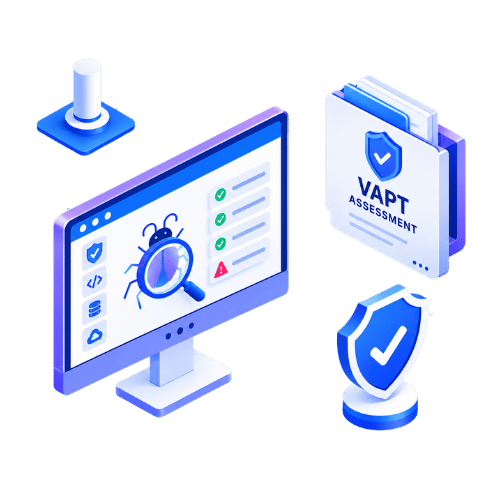
What Makes a VAPT Report Useful During an ISO Audit?
A useful VAPT report should make the test easy to understand and verify.
It should clearly record:
- The date of testing
- The environment tested
- Assets, applications, APIs or endpoints included
- Anything excluded from scope
- Assumptions and limitations
- Testing methodology
- Tester or provider details
- Severity of each finding
- Affected assets
- Technical proof or validation
The report should also make it clear which findings remained open and which were later confirmed as resolved.
Estimating the Cost and Timeline of ISO 27001 in Australia
How Much Does ISO 27001 Certification Cost in Australia?
There is no official fixed price for ISO 27001 certification Australia.
Published Australian estimates for 2026 commonly fall around:
- Small organisations: AUD 15,000 – AUD 35,000 in the first year
- Medium organisations: AUD 30,000 – AUD 80,000
- Larger or more complex environments: AUD 75,000 – AUD 150,000 or more
These are market benchmarks, not standard ISO fees.
The quote only makes sense once you know what is included. A lower figure may cover the certification audit alone. A larger programme may also include gap analysis, implementation support, internal audit, remediation and security testing.
ISO 27001 Cost Breakdown
| Cost Area | What It Can Include |
| Standard and training | Access to the standard, awareness sessions and specialist training |
| Gap assessment | Review of current readiness |
| Internal staff time | Policies, risk work, SoA, evidence and coordination |
| Technical remediation | MFA, IAM, logging, backups, hardening and other security improvements |
| VAPT and security testing | Application, API, network, cloud or other testing where relevant |
| Internal audit | Internal ISMS audit before certification |
| Certification audit | Stage 1 and Stage 2 fees |
| GRC software | Optional tools for evidence and task management |
| Surveillance | Ongoing audits during the certification cycle |
| Recertification | Assessment at renewal |
| Ongoing ISMS work | Reviews, training, supplier checks, testing and corrective actions |
Hidden Cost: Internal Employee Time
Internal effort can become a major part of the overall cost.
Someone needs to own the ISMS, maintain evidence, update policies, review suppliers, coordinate fixes, organise access reviews, prepare management reviews and support auditors.
Two businesses with the same headcount can still spend very different amounts. A company with mature controls and organised records will usually need less preparation than one still building basic security processes.
What Drives the Certification Audit Cost?
Certification audit cost depends on the amount of audit work required.
Key factors include:
- Number of people within scope
- Number of locations
- Geographic spread
- ISMS complexity
- Technologies and services involved
- Outsourcing and third party dependencies
- Certification scope
- Applicable controls
- Integration with other management systems
- Audit sampling needs
- Use of remote auditing where appropriate
How Long Does ISO 27001 Certification Take?
There is no fixed certification timeline.
The main factors are:
- ISMS scope
- Existing security maturity
- Technical and organisational complexity
- Remediation work
- Availability of usable evidence
- Internal resource availability
Australian providers commonly publish ranges from around three to six months for smaller, mature organisations to 12 months or longer for large or complex environments.
A cloud SaaS company with mature controls and a narrow scope may move much faster than a multi-site organisation with legacy systems, several locations and unresolved security gaps.
For planning purposes, use these ranges as estimates only. Your actual timeline will depend on how much work is needed before the certification audit.
Streamlining Your ISO 27001 Journey With Qualysec
Technical testing may become part of ISO 27001 preparation when the systems in scope carry meaningful security risk. Qualysec is a specialized penetration testing company that supports this part of the process. It does not issue ISO certificates.
Use Risk Based VAPT to Support Your ISO 27001 Programme
The testing scope should reflect the assets and risks inside your ISMS.
Qualysec can assess web applications, APIs, mobile applications, cloud environments, external networks and IoT devices where relevant. Its testing approach combines automated techniques with manual validation to identify technical weaknesses and business logic issues that basic scanning may miss.
Build Auditor Useful Technical Evidence
Assessment reports can document:
- Tested scope
- Validated vulnerabilities
- Severity
- Affected components
- Reproduction details
- Remediation recommendations
Your team can use these findings within its own risk treatment, vulnerability management and corrective action records.
Verify Remediation Through Retesting
Retesting checks whether identified vulnerabilities have been fixed within the tested scope. Qualysec also supports remediation discussions and retesting where needed.
Conclusion
ISO 27001 works best when security controls are supported by clear evidence and kept active over time. Australian organisations also need to account for any separate privacy, regulatory or contractual requirements that apply to them.
Penetration testing may be relevant where technical risks, customer expectations or selected controls justify it. Findings should be fixed, retested and properly closed.
Qualysec supports this technical assurance work through automated and manual testing, detailed remediation guidance, consultation and retesting.
Talk to Qualysec about defining a VAPT scope for the applications, APIs, cloud environments and networks inside your ISMS.
FAQs
Is ISO 27001 mandatory for businesses operating in Australia?
Not for every business. ISO 27001 can still become important when a customer, tender, contract or industry expects it. Any legal or regulatory security duties that apply to your organisation remain separate.
What is the difference between ISO 27001:2013 and ISO 27001:2022?
The 2022 edition is the current version. It replaced the withdrawn 2013 edition and introduced a revised Annex A with 93 controls. The transition deadline ended on 31 October 2025. Amendment 1:2024 also applies.
How long does an ISO 27001 certificate remain valid?
Most certificates run on a three year cycle. Surveillance audits usually take place during that period, followed by recertification. Your ISMS still needs to be maintained between audits.