

Australia’s medical device framework is supported by detailed TGA guidance. ARGMD helps you find the information relevant to each stage of the regulatory process.
The Australian Regulatory Guidelines for Medical Devices is not a single piece of legislation or one complete regulatory manual. It now works as an index that connects manufacturers and sponsors with TGA guidance on key regulatory responsibilities.
For anyone dealing with Australia medical device regulations in 2026, ARGMD helps you find the right TGA guidance for each requirement.
In this guide, we will explain how that guidance connects across the medical device lifecycle.
What Are the Australian Regulatory Guidelines for Medical Devices (ARGMD)?
The ARGMD is the TGA’s index of guidance for medical devices in Australia. It helps manufacturers and sponsors find information on relevant regulatory requirements.
The current ARGMD links to guidance on:
- Medical device inclusion
- Device classification and manufacturer evidence
- Global Medical Device Nomenclature
- Essential Principles
- Conformity assessment
- Australian Register of Therapeutic Goods requirements
- Post-market responsibilities
These resources support the Australian regulatory guidelines for medical devices, but they do not replace Australian law.
Is ARGMD V1.1 Still Current?
No. ARGMD V1.1 is an archived TGA document from May 2011. It was previously published as one consolidated reference covering 26 sections.
Those sections were grouped into four parts:
- Introductory regulatory guidance
- Requirements before market entry
- Requirements after market entry
- Navigation and reference material
The TGA keeps V1.1 available for research, but warns that archived pages may contain policies or processes that no longer apply. Current TGA guidance and legislation should therefore be used when checking present requirements.
| ARGMD V1.1 | Current ARGMD |
| Consolidated reference document | Online guidance index |
| 26 sections across four parts | Links to separate TGA resources |
| Published in 2011 | Current TGA resource |
| Archived | Active |
| Best used for historical reference | Used to navigate current guidance |
How to Follow ARGMD Requirements for Australian Medical Device Compliance
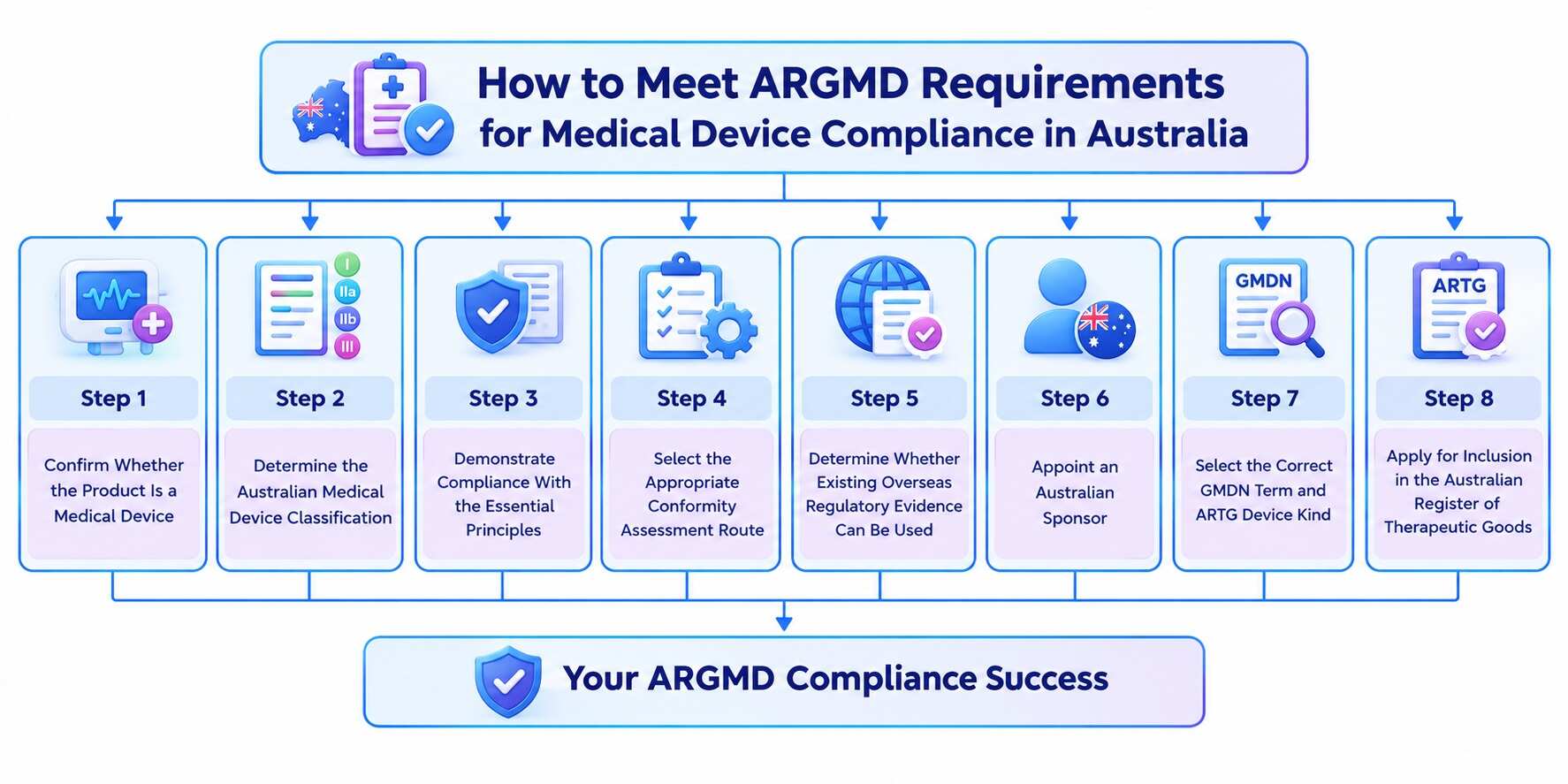
Step 1: Confirm Whether the Product Is a Medical Device
If you are looking at classification or ARTG requirements, first confirm that the product is actually regulated as a medical device in Australia. The TGA looks closely at intended purpose when making this distinction.
Check whether the product:
- Meets the legal definition of a medical device
- Falls outside that definition
- Is specifically excluded from regulation
- Qualifies for an exemption
Excluded products are outside the medical device regulatory framework. Exempt devices are different. They can remain regulated even when ARTG inclusion is not required.
Intended purpose also matters beyond this first check. It affects classification and the evidence needed to support the device.
Step 2: Determine the Australian Medical Device Classification
Australia groups medical devices by risk. Higher the risk, the stricter the regulatory requirements usually become. Classification can affect the evidence you need, the conformity assessment route, the ARTG application and the level of review by the TGA.
| Risk Level | Non IVD Device | IVD Device |
| Lower | Class I | Class 1 |
| Moderate | Class IIa | Class 2 |
| High | Class IIb | Class 3 |
| Highest | Class III | Class 4 |
Manufacturer decides the class by checking the intended purpose and the Australian classification rules. If more than one rule applies, the highest class is used.
Do not rely only on a class given in another country. Australia has its own rules. For example, a simple non invasive device may sit in a lower class, while a pacemaker falls into Class III because of the risk involved.
Step 3: Demonstrate Compliance With the Essential Principles
The Essential Principles are the minimum requirements of safety and performance for a medical device. As part of the legal requirements, they cannot be considered only as a guide to the device design.
The device design should minimize the risk as much as possible, and any residual risk should be considered acceptable relative to the benefit.
The evidence will depend on the nature of the device and may include:
- Risk management records
- Design verification and validation
- Safety testing
- Software validation
- Usability evidence
- Clinical evidence
- Cybersecurity evidence
- Labelling and instructions for use
The australian medical devices guidelines also include an Essential Principles checklist. You can use it to keep the required evidence organised. The checklist by itself is not enough to prove compliance.
Step 4: Select the Appropriate Conformity Assessment Route
Conformity assessment is how a manufacturer shows that the device and its manufacturing processes meet the required Australian standards. The route depends on the:
- Device class and
- Its characteristics
Low risk devices may qualify for self-certification or declaration-based routes. Higher risk devices need stronger quality management and conformity assessment evidence.
A new TGA conformity assessment certificate is not required for every device. In some cases, manufacturers can use evidence from recognised overseas regulators or assessment bodies if it meets Australian requirements.
Conformity assessment also continues beyond the initial application. The TGA describes it as an ongoing review of evidence and procedures used to show that the device continues to meet the Essential Principles.
Step 5: Determine Whether Existing Overseas Regulatory Evidence Can Be Used
If your device already has approval or assessment evidence from another market, check whether the TGA recognises the regulator or assessment body that issued it.
The TGA currently accepts certain evidence from bodies such as the US FDA, Health Canada, Japan’s PMDA, Singapore’s HSA, recognised EU bodies, MDSAP auditing organisations and UK Approved Bodies.
That evidence may be used with an ARTG inclusion application when it meets the Australian requirements for the device. The TGA updated this guidance on 11 May 2026 to add UK Approved Bodies to the recognised list.
Step 6: Appoint an Australian Sponsor
An overseas manufacturer generally needs an Australian Sponsor before supplying a medical device in Australia. The sponsor is the local contact for the TGA.
| Manufacturer | Australian Sponsor |
| Designs and manufactures the device | Represents the device in Australia |
| Sets the intended purpose and classification | Handles TGA communication |
| Keeps technical and compliance evidence | Manages the relevant ARTG application |
| Completes required conformity assessment work | Obtains information requested by the TGA |
| Maintains device compliance | Meets ongoing Australian sponsor duties |
The TGA recommends a written agreement between both parties. It should cover:
- Access to technical documents
- TGA requests and deadlines
- Safety information
- Product changes
- Complaints and post-market issues
- Regulatory communication
The sponsor may need information from the manufacturer during:
- The application and
- After supply begins.
This makes document access and clear communication important throughout the relationship.
Step 7: Select the Correct GMDN Term and ARTG Device Kind
GMDN gives each type of medical device a standard name and code. An appropriate GMDN term is required if you are applying to include a device in the ARTG.
The term should match the device and its intended use. It also helps decide which products can be covered by the same ARTG entry.
Devices are generally treated as the same kind when they have the same:
- Sponsor
- Manufacturer
- Classification
- GMDN code
Class III devices, AIMDs and most Class 4 IVDs must also have the same UPI.
Choosing the wrong GMDN term can cause problems with the application, so it should match the device you actually plan to supply.
Step 8: Apply for Inclusion in the Australian Register of Therapeutic Goods
Most of the medical devices must be included in the ARTG before they can be legally supplied in Australia. The sponsor files the application with the TGA.
The application needs the information and evidence required for that device. This can include:
- Manufacturer evidence
- Device classification
- GMDN details
- Relevant regulatory evidence
- Declarations and supporting documents
Filing an application does not put the device on the ARTG straight away. The TGA first checks the application and can refuse it at this stage if the basic requirements are not met. Some applications are also selected for an audit, where the sponsor is asked for further supporting information.
The device can be supplied once the application is approved and the device is included in the ARTG.

When Does the TGA Audit a Medical Device Application?
The TGA audits an application when the law requires it or when the application meets its audit selection criteria. Some higher-risk applications must be audited. Any medical device application can also be chosen for a non-mandatory audit after preliminary assessment.
During the audit, the TGA may review:
- Labelling and instructions for use
- Technical documents
- Risk management records
- Clinical evidence
- Conformity assessment material
- Software, microbiology or other device-specific evidence
The exact documents requested will depend on the device and the reason for the audit. Manufacturers should have this evidence ready before the application is submitted rather than collecting it only after receiving a TGA request.
There is no single processing time for each and every application. Timing can change based on:
- Device classification
- Quality and completeness of the evidence
- Whether an audit is required
- How quickly the sponsor answers TGA requests
TGA Fees and Annual Charges
A fee is charged for a TGA service, such as an application assessment. Mandatory audits can attract an additional fee. Annual charges are separate and may apply to ARTG entries each financial year.
Check the current TGA fee schedule before setting your budget because the amounts can change.
What Changed for Australian Medical Devices in 2026?
A few 2026 changes are worth checking if you work with TGA medical device regulations. The most immediate one is UDI.
Mandatory UDI Requirements Began on 1 July 2026
From 1 July 2026, Class III and Class IIb devices came under mandatory UDI requirements. The remaining classes follow later.
- Class IIa: 1 July 2027
- Class Is: 1 July 2028
- Class 3 and Class 4 IVDs: 1 July 2028
- Class 1 and Class 2 IVDs: 1 July 2029
UDI gives a device a standard identifier. It also links its details to AusUDID. This makes it easier to trace devices and manage safety issues or recalls.
Comparable Overseas Regulator Guidance Was Updated
The TGA updated this guidance on 11 May 2026 and added UK Approved Bodies to the recognised arrangements. If you use overseas evidence, check the current TGA criteria before relying on an older plan.
Conformity Assessment Reform Remains in Progress
The TGA is still reviewing conformity assessment procedures. The work looks at closer alignment with EU MDR, EU IVDR, IMDRF guidance and MDSAP.
The project is still marked as in progress. It should not be described as a new system already in force.
What Happens After ARTG Inclusion?
ARTG inclusion gives a device market authorisation, but compliance does not stop there.
Once the device is being supplied, the manufacturer and sponsor still need to keep track of its safety and performance. That includes:
- Keeping technical and regulatory records up to date
- Reviewing complaints and safety reports
- Reporting adverse events when required
- Answering TGA requests for information
- Taking part in post-market reviews
- Updating the TGA when relevant regulatory evidence changes
- Meeting any UDI or reporting duties that apply
- Taking action when a safety problem is found
The TGA can review a medical device at any time after it reaches the market. A post-market review can look at whether the device is still safe, performs as expected, and whether the sponsor is meeting its legal obligations.
Recalls, Product Alerts and Product Corrections
If a problem is found after supply begins, the sponsor may need to take market action under the PRAC framework.
PRAC covers actions such as recalls, product alerts, product corrections and quarantine. The process includes:
- Assessing the problem
- Preparing the proposed action
- Notifying the TGA
- Contacting affected customers
- Closing the action once the required work is complete.
Manufacturers and sponsors should agree in advance on how safety issues will be shared and who will handle communication with the TGA. The TGA also has legal powers to require action if a sponsor does not deal with a serious issue appropriately.
Special ARGMD Considerations for IVDs, Software and Exempt Devices
In Vitro Diagnostic Medical Devices
IVDs have their own classification rules under Australian law. Their conformity assessment requirements also differ by class.
Use the TGA guidance written specifically for IVDs when checking manufacturer evidence, conformity assessment and ARTG requirements. Do not apply the non-IVD pathway without checking the IVD rules first.
Software and AI-Based Medical Devices
Software-based devices can need separate classification checks. The intended medical purpose and the level of risk are especially important here.
Cybersecurity should also be considered when a security weakness could affect the safety or performance of the software.
Exempt Medical Devices
An exemption does not always remove a device from TGA oversight. Some exempt devices do not need ARTG inclusion but can still have other regulatory duties.
These may include:
- Advertising requirements
- Adverse event reporting
- Supply notifications
- Other conditions attached to the exemption
How Qualysec Can Support Cybersecurity Testing for Medical Devices
A connected medical device may rely on an app, API or web platform. A weakness in any of these systems can create a security risk for the product.
Qualysec can test:
- Connected and IoT devices
- Web applications
- Mobile applications
- APIs
- Cloud infrastructure
- External networks
Penetration testing shows how these systems respond to real attack methods. It can uncover weak authentication and access control issues that may be missed during development.
The results give your technical team clear issues to fix. Again, retesting then confirms whether those fixes work.
For medical device manufacturers, this testing can form part of the security evidence. It is used to manage cybersecurity risk. Qualysec does not provide TGA approval or conformity assessment. It focuses on security testing.
Talk to Qualysec about penetration testing for your connected medical device.

Conclusion
ARGMD is not one single document that covers everything. The TGA now provides guidance across different pages and resources. In 2026, UDI rules have already started for Class III and Class IIb devices. More classes will follow later.
ARTG inclusion is also not the end of compliance. Manufacturers still need to keep records updated and monitor device safety. Cybersecurity may also need attention for connected products. The safest approach is simple. Check the latest TGA guidance and current Australian law whenever you deal with a medical device requirement.
FAQs
Is ARGMD legally binding in Australia?
No. ARGMD is guidance published by the TGA. The legal requirements come from the Therapeutic Goods Act. ARGMD helps manufacturers and sponsors understand those requirements.
Do all medical devices need to be included in the ARTG?
Most do, but not every device needs ARTG inclusion. Some products are exempt or excluded under Australian rules. You need to check the status of the product before assuming registration is required.
Does CE marking automatically allow a medical device to be sold in Australia?
No. CE marking by itself does not give a device access to the Australian market. Overseas evidence may be accepted in some cases, but the device still has to meet the Australian requirements that apply.
What are the medical device classifications in Australia?
Non-IVD medical devices are grouped into Class I, Class IIa, Class IIb and Class III. Australia also uses separate classes for IVDs. The class depends on the device’s intended purpose and risk.