

The risk to cyber has never been imagined. The data breach cost increased to US$4.44 million in 2025. In addition to the financial implications, breaches will halt operations, destroy unit morale, and place businesses in a position where they may receive regulatory penalties. A VAPT report, or Vulnerability Assessment and Penetration Testing report, is the blueprint that companies follow to stay on top of these risks. It brings out the weaknesses of applications, networks, cloud, and IoT, grades them in terms of their severity using CVSS scores, and explains how attackers may utilize those in real-time situations. More to the point, it offers specific remediation suggestions that can be traced back to compliance standards, such as ISO 27001, PCI DSS, HIPAA, and GDPR.
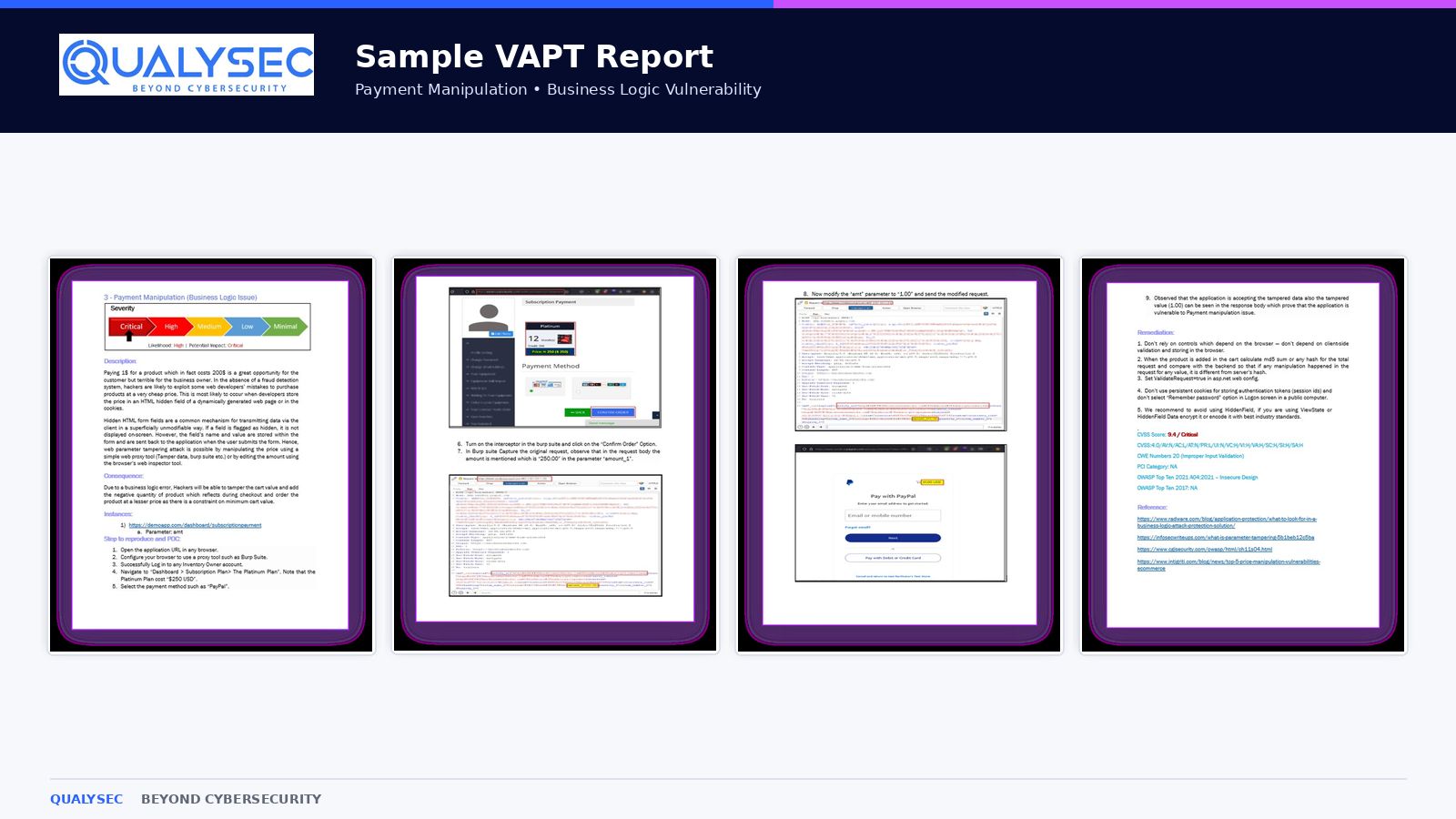
To view how it works in practice, you can download a free VAPT report sample and view what a report supplied by a real-life cybersecurity assessment could look like.
What is a VAPT Report?
A Vulnerability Assessment and Penetration Testing (VAPT) report is a concise security report that lists all vulnerabilities in an organization and their current severity level, along with recommended remediation. In contrast to a bare vulnerability scan, a VAPT test report provides evidence not just of the vulnerabilities, but also of how attackers could exploit them.
To most companies, the VA/PT report is not merely technical. It also serves as proof of regulatory audits, where companies show compliance with regulations such as ISO 27001, HIPAA, PCI DSS, and GDPR. This renders the report an invaluable resource to the IT team, as well as auditors, executives, and even compliance officers.
A VAPT report helps close the gap between the technicians who remediate the vulnerabilities and decision-makers whose priority is to manage the business risks by condensing the technical findings into prioritized action items.
The thorough VAPT (Vulnerability Assessment and Penetration Testing) report finds security gaps in applications, networks, and cloud settings. Using CVSS scores, it provides a prioritised list of vulnerabilities, proof-of-concept (PoC) exploitation evidence, and practical remediation recommendations to meet compliance criteria including ISO 27001, HIPAA, and GDPR.
Download Sample VAPT Report
More than 2,500 companies use Qualysec’s security reports to meet compliance requirements and pass audits faster. Get a Free VAPT Quote
VAPT Report vs Pentest Report
Although these terms are generally used interchangeably, a VAPT report is slightly different from a penetration testing (pentest) report. A VAPT audit report also provides a wider coverage of vulnerability assessment, and a pentest report is narrower in its approach to demonstrate exploitation and impact.
Here’s a quick comparison:
|
Aspect |
VAPT Report |
Pentest Report |
|
Scope |
Isolates vulnerability assessment as well as penetration testing in applications, networks, cloud, and IoT. |
It is mainly concerned with maximizing the simulation of real-world attack conditions, with an aim of taking advantage of vulnerabilities. |
|
Methodology |
Mix of automated scans + manual validation. Prioritizes risks using CVSS and compliance mapping. |
Manual exploitation-led, with emphasis on attack chains and business impact. |
|
Audience |
Broader: security teams, compliance officers, auditors, and executives. |
Narrower: security engineers and developers responsible for fixing issues. |
|
Compliance Focus |
Strong compliance linkage (ISO 27001, HIPAA, PCI DSS, GDPR). Often doubles as an audit document. |
Less compliance-driven, more technical, geared towards red-teaming exercises. |
|
Deliverables |
Risk-ranked vulnerabilities, proof-of-exploit, compliance mapping, and remediation roadmap. |
Exploitation results, attack narrative, and technical fixes. |
|
Use Case |
Perfect match for organizations in search of security posture evaluation and compliance verification. |
Suitable for companies that conduct simulated targeted attacks or determine how resilient they are against a particular threat. |
Key Components of a VAPT Report
A properly organized VAPT audit report is not a list of vulnerabilities. It links business priorities and compliance to business risks in technical situations. The majority of VAPT reports have a layered layout that makes them suitable for engineers and decision-makers.
|
Component |
Purpose |
|
Executive Summary |
Gives CXOs and auditors a non-technical snapshot of overall risk posture and compliance gaps. |
|
Methodology & Scope |
Defines what systems were tested, which tools were used, and the depth of manual vs automated testing. |
|
Findings with Severity |
Lists vulnerabilities with CVSS scores, potential exploits, and proof-of-concept evidence. |
|
Business Impact |
Explains how each issue could disrupt operations, finances, or customer trust. |
|
Remediation Guidance |
Provides step-by-step fixes mapped to compliance frameworks like ISO 27001, HIPAA, and PCI DSS. |
|
Appendices |
Technical details, exploit walkthroughs, and references for developers. |
Benefits of VAPT Report

A VAPT report cannot be a technical checklist only. It offers direct business value with implications for revenue, trust, and long-term resilience when leveraged correctly.
1. Avoid Regulatory Penalties
Industries such as finance, healthcare, and SaaS are subject to heavy fines due to non-compliance with standards such as ISO 27001, HIPAA, PCI DSS, and GDPR. A VAPT audit report not only serves as a verification document, but also eradicates the costs of litigation and loss of reputation.
2. Win Customer Contracts
Increasingly, procurement teams are requesting to see current VAPT reporting before contract signature. The structured report of a VAPT test can help in gaining the confidence of the buyer, closing their deals faster, and sometimes becoming a decision factor in receiving RFPs.
3. Reduce Downtime and Losses
Breaches not only acquire information but also result in the halting of operations. A VAPT report identifies vulnerable areas before attackers use them and puts a stop to expensive downtime and business interruption.
4. Improve Executive Decision-Making
The VA/PT report enables executives to have clear guidance on where to allocate budget and resources to address the most ROI-effective vulnerabilities, which are transformed into prioritized business risks and not simply a list of vulnerabilities.
5. Build Investor and Partner Trust
In the case of startups and developing companies, it is an added benefit to share a VAPT independently audited report, as it will ensure investors and partners that investor protections are in place and being taken seriously.
Compliance Standards Achievable Through VAPT Reports
A VAPT audit report is not a mere security checklist; it serves as supporting regulatory audit documentation and creates compliance preparedness with a faster turnaround time. This helps businesses to be able to expand, have enterprise contracts signed, and ward off legal fines.
|
Compliance Standard |
What VAPT Proves |
Business Value |
|
Shows documented risk assessment and treatment |
Faster certification, stronger partner and regulator trust |
|
|
Maps vulnerabilities against cardholder data security controls |
Smooth QSA audits, uninterrupted ability to process payments |
|
|
Demonstrates safeguards for patient health information |
Prevents costly fines, reassures patients about data privacy |
|
|
Provides accountability for personal data risks |
Builds credibility with EU clients, reduces regulator scrutiny |
|
|
DPDP Act & CERT-In |
Validates secure data infrastructure, technical safeguards, and continuous vulnerability management practices. |
Helps avoid DPDP penalties, meets CERT-In compliance requirements, and supports RBI/SEBI regulatory readiness. |
How Much Does a VAPT Report Cost? (Pricing Guide)
VAPT test report cost in India varies according to the size of the company, IT infrastructure, and compliance requirements. Companies that require ISO 27001, PCI DSS, HIPAA, or GDPR compliance have to anticipate increased expenses as reports have to be audit-worthy.
|
Business Type |
Approx. Cost in India |
Compliance Tie-In |
|
Startups |
₹50,000 – ₹2,00,000 |
Basic VAPT test report to secure customer data and meet early-stage investor/vendor expectations |
|
SMEs |
₹2,00,000 – ₹8,00,000 |
VAPT certification cost in India rises due to more assets, cloud workloads, and compliance-driven reporting |
|
Enterprises |
₹10,00,000+ |
Detailed VAPT audit report mapped to multiple frameworks (ISO 27001, HIPAA, PCI DSS, GDPR) with board-level reporting. |
Pro Tip: Most businesses in India would accept only a recent VAPT test report before inducting new vendors, and thus it has become a compliance as well as revenue driver.
Best Practices for Writing or Reviewing a VAPT Report
The following best practices will enable your VAPT audit report to deliver tangible business benefits, and not just an enumeration of vulnerabilities:
|
Step |
Description |
|
1. Understand Your Audience |
While writing a penetration testing report, it is necessary to adjust the tone and language of the technical details. A large firm prefers high-level overviews, while technical teams need detailed descriptions. |
|
2. Prioritize Vulnerabilities |
Prioritize findings. This can be done based on risk, critical risks, and the frequency of the vulnerabilities occurring. One should use a risk assessment framework like CVSS. |
|
3. Use Consistent Structure |
Maintain a logical structure for easy understanding. Use clear headings, subheadings, and bullet points. |
|
4. Include Visuals |
Improve comprehension with screenshots, tables, and diagrams. Use video walkthroughs to demonstrate proof-of-concept demos and complicated procedures. Also, ensure visuals are well-labeled. |
|
5. Provide Recommendations |
Offer actionable steps to fix vulnerabilities. Tailor recommendations to individual assets and suggest additional resources if needed. |
How QualySec Creates VAPT Reports
Among leading service providers in how it identifies weak spots and what makes QualySec stand out as one of the best VAPT companies in India is not merely the capacity to detect vulnerabilities, but how the process of reporting is designed to encompass business outcomes, compliance, and trust. Unlike other providers that use high levels of automation, QualySec uses a manual-first approach, combined with automation to provide highly accurate results with actionable information and audit-ready findings.
Manual-First Methodology
All reports begin with rigorous, hands-on manual penetration testing by licensed security engineers. While automation accelerates initial scans, manual verification eliminates false positives and uncovers complex logic errors that automated scanners miss, guaranteeing a superior VAPT report compared to generic tools.
Risk-Prioritized Findings
QualySec formats each report so results are expressed in rank order of business risk rather than technical severity. Rather than simply bombarding teams with the litany of problems, however, the VA/PT report focuses on first outlining the issues that can do the most harm.
Compliance-Aligned Reporting
The reports can be aligned to achieve compatibility with compliance programs like ISO 27001, HIPAA, PCI DSS, and GDPR. This readies them to be audited and advances the certification processes, meaning lower costs and risks of fines.
Beyond Reporting: Remediation + Revalidation
QualySec goes beyond the delivery of a document. Security specialists collaborate with your team and remediate vulnerabilities, and then test revalidation to validate the remediation. By doing so, you do not just get a report; you get the confidence that your systems really are secure.
Additionally, their expertise lies in helping businesses navigate complex regulatory frameworks like HIPAA, SOC 2, GDPR, and ISO 27001.
Qualysec offers a range of services, including:
- Cybersecurity Audit
- Web Application Penetration Testing
- Mobile Application Penetration Testing
- Cloud Pentesting
- API Pentesting
- Thick Client Pentesting
- AI/ML Pentesting
- IoT Device Pentesting

Conclusion
A VAPT Report is an important resource when it comes to protecting your organization against cyber threats and good defense. A company must organize regular VAPT Testing and read the reports so as not to face security risks. Therefore, this will help identify weak areas that might not be easy to detect when done regularly, ensure that rules are followed, and help win the trust of customers and partners.
If you want to have a checklist for a VAPT report or VAPT testing that covers all the important parts of your organization’s security, then get in touch with Qualysec. Additionally, our services give you the insights to strengthen your defenses and stay ahead of cyber threats. Contact us now to level up your security.
FAQ
1. What are VAPT reports?
A VAPT report, or Vulnerability Assessment and Penetration Testing report, is a report that outlines vulnerabilities, the associated rating of the risk, and the kind of fixes that need to be done. It assists businesses in improving defenses and can be used in an audit of compliance as pieces of evidence.
2. How is VAPT testing done?
VAPT is a combination of automated scans and manual penetration testing to locate vulnerabilities and exploit them. The outcome is a VAPT test reportthat provides findings, a proof-of-exploit, and remediation guidance to both IT and those in charge of compliance.
3. Are audit and VAPT the same?
Nope, a security audit can only examine policies and compliance, whereas a VAPT audit report actively tests systems for correctable flaws. Together, they provide finishing touches in terms of compliance as well as real-life resilience to security.
4. What is the cost of VAPT testing?
A VAPT test cost in India depends on the size of the business and compliance requirements. A sample VAPT audit report for startups will cost 50,000, and an enterprise may prefer to spend 10 lakhs or above when it comes to a detailed VAPT audit report that aligns with ISO 27001, PCI DSS, HIPAA, or GDPR.
5: What is the main purpose of a VAPT report?
A: The main aim is to give security fixes a roadmap. It lets IT teams fill gaps and helps leaders to make sure everything is in line with the law by bridging the divide between computer flaws and commercial risk.
6: Are a security audit and a VAPT report the same?
A: No. While a VAPT report actively tests and exploits technical weaknesses to demonstrate actual resiliency, a security audit examines policies and compliance measures.
7: How often should a VAPT report be updated?
A: Most compliance systems (ISO 27001, PCI DSS) call for at least once yearly or whenever major changes are made to your network or application infrastructure, an updated VAPT report is needed.