

Cyber threats keep getting smarter. With 2025 approaching, businesses face a landscape rife with both opportunity and danger. Network breaches are no longer isolated incidents; each one is a potent reminder of how crucial effective security measures have become. This blog is about the top 10 network security testing methodologies that every cybersecurity professional should adopt in 2025. By learning and implementing these, organizations can strengthen their defenses and stay safe from attackers.
The sophistication level of cyberattacks is staggering. From AI-driven phishing schemes to ransomware-as-a-service, attackers find innovative ways to exploit vulnerabilities. For businesses and organizations, this means one thing, i.e. keeping your networks secure isn’t optional; it’s non-negotiable.
Why Network Security Testing Matters in 2025
Before we get to the methodologies, it’s worth understanding why strong network security testing is more critical than ever:
- The Explosion of IoT (Internet of Things): With more devices connected to networks, there is a larger attack surface for cybercriminals to exploit.
- Cloud Dependencies: Cloud solutions have become foundational. While they offer flexibility, they also demand stringent monitoring.
- AI-Powered Threats: Cybercriminals now use AI to identify vulnerabilities faster than traditional methods.
- Cost of Breaches: A single breach can cost millions, not just financially but also in terms of reputation.
If you’re caught unprepared, this means your organization is handing over the keys to attackers. The only solution is being proactive through network security testing.
Top 10 Network Security Testing Methodologies You Must Know in 2025
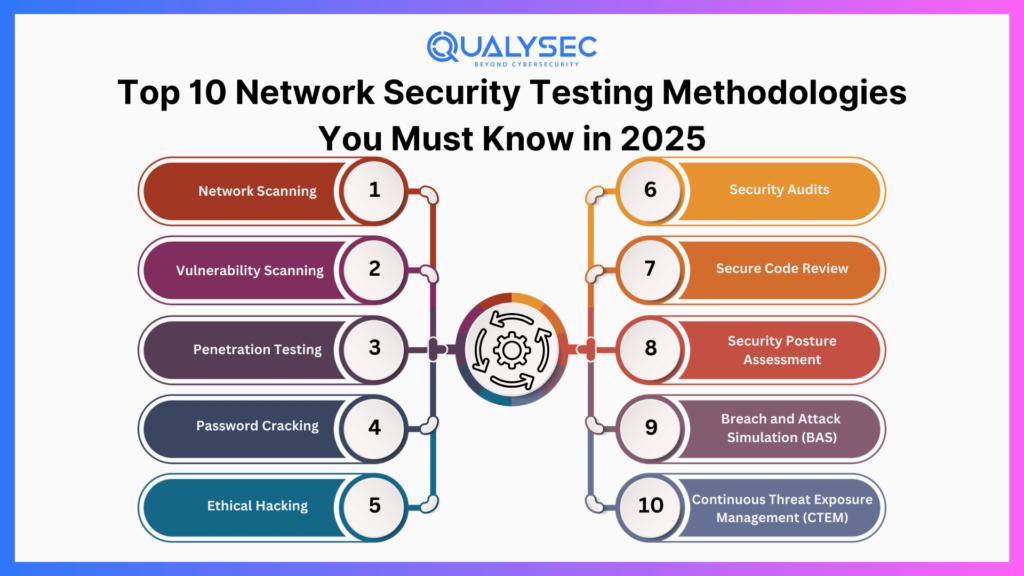
1. Network Scanning
Network scanning is a routine process that identifies active devices, open ports, and services within a network. It’s like taking a real-time inventory of all the devices connected to your system.
- Techniques
Tools like Nmap, OpenVAS, and SolarWinds Port Scanner are commonly used to detect unauthorized devices, services, or configurations that may expose the network to vulnerabilities.
- Importance
Network scanning acts as a foundation for security. By identifying network assets, it becomes easier to monitor, protect, and establish a baseline for detecting anomalies or unauthorized access.
2. Vulnerability Scanning
Vulnerability scanning involves automated tools to identify and assess known vulnerabilities in network devices, software, and applications.
- How It Works
By running regular scheduled scans, organizations can detect security weaknesses before they are exploited by attackers. These scans reveal gaps such as outdated software, unpatched systems, and misconfigurations.
- Recommended Tools
Popular tools include Nessus, Qualys, and Rapid7 InsightVM, each offering a range of functionalities to tackle diverse security needs.
- Key Benefit
Proactive identification of vulnerabilities reduces risk exposure and helps prioritize remediation efforts.
3. Penetration Testing
What is it?
Penetration testing is a simulated cyberattack performed to assess the security of a network by mimicking real-world hacking scenarios.
Methodologies
- Black-Box Testing: Conducted with no prior knowledge of the system.
- White-Box Testing: Performed with full system knowledge.
- Gray-Box Testing: A hybrid approach that combines limited system knowledge with realistic attack, offering a balance between the two extremes.
Why It Matters
network penetration testing service provide critical insights into system weaknesses and help mitigate potential real-world attacks before they occur.
4. Password Cracking
Password cracking tests the strength of credentials by attempting to decipher or bypass passwords stored within a network.
Techniques
- Brute-Force Attacks: Trying all possible combinations until the right one is found.
- Dictionary Attacks: Using a predefined list of possible passwords.
- Rainbow Tables: Precomputed hash databases used for reverse password decryption.
Prevention
Strengthen defenses with robust password policies, enforce multi-factor authentication (MFA), and educate employees about secure password practices.
5. Ethical Hacking
Ethical hacking involves authorized attempts to bypass a system’s defenses to find and fix vulnerabilities.
Scope
Ethical hackers (or white-hat hackers) assess the full spectrum of an organization’s infrastructure, from applications to policies.
Certification
Hiring certified ethical hackers (e.g., CEH or OSCP) ensures that your assessments are reliable and conducted responsibly.
Why You Need It
Ethical hacking uncovers weaknesses that automated scans may not detect, offering an extra layer of security assurance.
6. Security Audits
A security audit is the systematic evaluation of an organization’s information systems against a set standard or regulation.
Process
Security audits combine vulnerability scanning, manual penetration testing, and compliance checks to deliver exhaustive reports on system weaknesses.
Outcome
These audits produce clear documentation of vulnerabilities along with CVSS scores (Common Vulnerability Scoring System) and actionable recommendations to resolve them.
7. Secure Code Review
Secure code review is the process of examining the source code of software to identify and fix security flaws before deployment.
Methods
Automated tools (like SonarQube, and Checkmarx) and manual reviews ensure vulnerabilities—like SQL injection or API exposure—are minimized during development.
Best Practices
Integrate regular code reviews into the software development lifecycle (SDLC) and follow industry security standards such as OWASP’s Top 10.
8. Security Posture Assessment
This involves a holistic evaluation of an organization’s overall security readiness, including all operational policies, procedures, and technology.
Core Components
- Assess organizational policies and controls.
- Evaluate technical weaknesses and gaps.
- Run risk management scenarios.
Benefits
By leveraging this assessment, enterprises can gain a clear roadmap for improving security while aligning with regulatory compliance.
9. Breach and Attack Simulation (BAS)
BAS tools automate the testing of security defenses by replicating advanced attack techniques.
How It Works
These simulations mimic TTPs (tactics, techniques, and procedures) employed by cybercriminals to highlight vulnerabilities.
Why It’s Effective
BAS continuously alerts organizations to potential exposure, allowing proactive measures to be implemented without waiting for a real attack.
Recommended Platforms
Platforms such as Cymulate and SafeBreach are leaders in enabling these fast-paced simulations.
10. Continuous Threat Exposure Management (CTEM)
Continuous Threat Exposure Management focuses on maintaining a real-time overview of emerging threats and vulnerabilities on a constant cycle.
Implementation
Using real-time threat intelligence and continuous monitoring helps organizations stay ahead of zero-day attacks.
Outcome
CTEM ensures businesses maintain an ongoing, up-to-date security posture capable of countering sophisticated threat landscapes.
Stay Ahead of the Threat Curve with QualySec
Effective network security testing methodologies require a thorough, proactive approach. However, while these methodologies are vital, knowing how to execute them correctly can be overwhelming for most businesses.
That’s where QualySec steps in! We specialize in penetration testing and network security services tailored to your organization’s specific needs. With process-driven insights and state-of-the-art tools, we ensure your network is always one step ahead of potential threats.
Why QualySec?
- Trusted by top businesses worldwide.
- Cutting-edge approach to cybersecurity.
- Experienced team of ethical hackers and security specialists.
Protect your business today! Contact QualySec for a consultation or explore how we can elevate your network security strategy.