

In 2026, software is no longer just a collection of deterministic rules; it is a landscape of probabilistic brains. AI Application Security is the specialized discipline of safeguarding these artificial intelligence models, autonomous agents, and their underlying data pipelines from a new breed of cognitive threats. While traditional application security (AppSec) focuses on closing backdoors in code, AI AppSec focuses on securing the model’s logic against manipulation and exploitation.
As organizations transition from static software to agentic workflows, the attack surface has fundamentally shifted. Security teams are no longer just fighting SQL injections; they are defending against Prompt Injection, Training Data Poisoning, and System Prompt Leakage. This guide explores the essential frameworks, technologies, and best practices required to build a resilient “Wall of Defense” around your AI-driven digital assets.
What is AI Application Security?
AI Application Security is a specialized branch of cybersecurity that protects Artificial Intelligence models, their data pipelines, and autonomous agents from unique exploitation. Unlike traditional security, which focuses on deterministic code, AI security manages the unpredictable nature of Large Language Models (LLMs) and Generative AI. In 2026, securing an AI application means moving beyond the network layer to defend the Model Boundary. It involves shielding the system from adversarial inputs that can force an AI to leak data or execute unauthorized commands.
AI Security Core Pillars (OWASP 2026 Standards)
|
Threat Category |
Defense Strategy |
2026 Best Practice |
|
Prompt Injection |
Shielding the model from malicious user instructions. |
Use LLM Firewalls to sanitize inputs. |
|
Training Data Poisoning |
Preventing backdoors in the model’s learning phase. |
Implement Data Lineage & Provenance checks. |
|
Excessive Agency |
Restricting an AI Agent’s power to take real-world actions. |
Apply Human-in-the-loop (HITL) approvals. |
|
System Prompt Leakage |
Keeping internal AI instructions confidential. |
Use Adversarial Red-Teaming for discovery. |
|
Insecure Output Handling |
Validating AI-generated code before execution. |
Mandatory Sandboxing for all AI outputs. |
Types of Application Security
Application security may include a variety of capabilities and technologies. The following are some of the most popular categories of security procedures:
- Authentication – Ensuring an individual is who they claim to be.
- Authorization – Preventing unauthorized users from accessing an application’s services and information.
- Encryption – Sending private information in code form so it remains confidential during travel over networks and servers.
- Logging – Tracking who has access to an application, who last used it, what they did, etc.; useful for establishing what occurred following an attack, or to indicate suspicious activity in real-time.
- Application security testing – Regularly testing the security of an application to ensure that it’s performing as it should.
Securing the Agentic AI Workflow
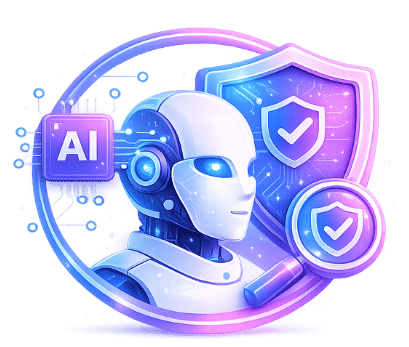
In 2026, most AI applications are Agentic, meaning they can call APIs and make decisions. This creates a new Attack Path where a compromised agent becomes a high-level insider threat.
To secure modern AI, organizations are adopting Zero Trust for AI Agents:
-
Identity for Agents: Every AI agent must have its own unique, short-lived security token.
-
Least Privilege Agency: If an agent only needs to read emails, it should not have the permission to delete them.
-
Real-time Observability: Monitoring for hallucination-based attacks where someone tricks the AI into hallucinating a malicious API endpoint.
Benefits of AI Application Security

Companies depend on applications to drive almost everything they do, so it is not negotiable that they must be kept secure. Some of the numerous advantages of investing in AI application Security are listed below:
- Less risk from internal and third-party sources – By removing as many vulnerabilities as you can, you can enhance your ability to repel attacks.
- Greater customer confidence and trust – By showing that your applications are secure and reliable, you can build greater customer confidence, which may also generate loyalty and word of mouth.
- Protection of brand reputation – Attacks place companies in the news, and that is bad publicity.
- Greater third-party stakeholder, client, and partner trust – Individuals want to do business with trusted companies.
- Lower disruption to operations – By recognizing potential security risks and fixing them prior to them resulting in a full-blown attack or loss of information, you can prevent unwanted disruption to operations.
- Issue identification while developing – By using the correct AppSec solution, you can recognize common attack patterns and vulnerabilities during development and develop a resolution plan for them ahead of deploying an application into production.
- Earlier detection of possible threats – Most application security tools detect security vulnerabilities and notify administrators about the presence of possible problems, so you can resolve the threats and remove vulnerabilities before an attacker can exploit them.
- Greater compliance with security regulations – A broad range of industry and government security regulations and requirements govern modern data.
Download a penetration testing report to explore how strong security practices can enhance AI application security and reduce potential risks.
The AI-Specific Threat Landscape
1. Indirect Prompt Injection
This is the Silent Killer of 2026 AI apps. A hacker uploads malicious code onto a webpage. When your AI application summarizes that site, it is unwittingly ingested with the instruction to steal the user session cookies.
Solution: Divide the attention of the model into user data and system instructions with Contextual Analysis tools.
2. Model Inversion & Membership Inference
To reverse engineer the sensitive data on which the AI was trained (e.g., private medical records or trade secrets), attackers query the AI many times.
Resolution: Use Differentiated Privacy on training models and high Resilience on inference APIs.
3. Vulnerability of the Supply Chain (The AI BOM)
Unverified open-source base weights can introduce pre-packaged vulnerabilities.
Solution: Keep an AI Bill of Materials (AI BOM), which keeps a record of all the models, datasets, and libraries used in your pipeline.
PRO-TIP: “LLM-Guard” is the New WAF In 2026, a standard Web Application Firewall (WAF) cannot stop a Prompt Injection attack. You must deploy an LLM-Guard or AI Gateway that sits between the user and your model to perform semantic analysis on every request.
AI Application Security: Challenges and Best Practices
1. Cloud application security
Cloud application security may become complex due to the following reasons: 1) cloud environments are distributed and shared, 2) cloud services are often complex, and 3) cloud deployments are dynamic. Your cloud applications must remain secure without affecting their scalability, flexibility, and cost-effectiveness.
The most prevalent challenges (and solutions) for cloud application security are as follows:
Shared Responsibility Model:
In the cloud, you do have some security responsibilities regarding your applications, and your cloud provider does, too. Every provider might be a little different, but generally, the cloud provider is responsible for securing the cloud infrastructure and the underlying processes, and you are responsible for securing your data and applications. Your responsibility would also include virtual machines and operating systems.
The answer here is to ensure you have a good, clear understanding of where your security responsibilities start and finish, and what responsibilities sit with your cloud provider. Also, carry out regular security training and awareness sessions with teams like DevOps and app dev teams to check that the proper security controls and governance practices are in place as they should be.
Distributed nature of cloud application data:
It’s not at all unusual to have application data stored and processed in more than one place on cloud platforms—or even across multiple clouds. That can make it difficult to maintain consistent availability, integrity, and privacy of the data, but you must do so.
Solutions to this problem include encryption of data in transit, at rest, and in processing. Data classification and access control products can further assist you in determining the most sensitive data and ensure that security controls are uniform across platforms and sufficient for the type of data it is. Cloud providers typically provide users with geo-replication capability and data residency products, which can further assist you in remaining compliant with data security, privacy, and sovereignty laws. Limited visibility into cloud data and risk of misconfiguration.
Solutions to overcome this include automated configuration management tools, which cloud services commonly include or build. They can detect discrepancies from pre-defined policies and conditions and inform you about possible issues. Another best practice is regular ongoing monitoring and logging of all the cloud resources. Once again, you’ll be able to detect anomalies or suspicious activity, which can allow you to correct vulnerabilities before they become actual issues.
Identity and access management:
The cloud’s nature is that large numbers of people can access data and applications stored anywhere. But that convenience then also presents the challenge of figuring out who should have access to what and when. Too often, users can have unfettered access to data that they don’t require, or users maintain access to cloud resources after leaving the company or no longer requiring them.
One key solution to this problem is to implement the principle of least privilege, whereby users and services are given the minimum set of permissions necessary to perform their work.
A cloud-specific plan must define how your company will contain attacks, analyze threats or attacks, and recover data and operations. There are several cloud-native solutions you can use for threat detection and response.
2. Web application security
Security for web applications is very critical since web apps are prime targets for malicious users. Some of the types of web app attacks that you may encounter include:
Injection attacks:
These happen when an attacker enters untrusted data into a system command, which makes the system run commands it should not. Methods of preventing these attacks include parameterized queries, which prevent user input from being executable code, and input validation tools that validate all users (and their inputs) and sanitize them of suspicious or disallowed characters.
Cross-site scripting (XSS):
Certain attackers embed malicious code into web pages that infect the browser of any visitor who views that page. The code can be configured to record keystrokes, redirect the browser to malicious sites, or steal session cookies. Output encoding, or encoding data before displaying it in the browser, can keep others from injecting executable code. It’s also a good idea to implement a strong content security policy that limits which domains are allowed to host scripts. This will hinder malicious script execution.
Cross-site request forgery (CSRF):
Anti-CSRF tokens can prevent such an attack and function by confirming that the action was requested through an authenticated user. SameSite cookie attributes can stop attackers from accessing a user’s session cookie. And several organizations are now requiring users to re-authenticate or employ multifactor authentication before executing crucial actions.
Weak authentication controls or poor session management:
Insecure storage of passwords, fixed session IDs, and weak session expiration policies can cause account hijacking, unauthorized access, and user session hijacking. These can be mitigated with strong authentication, ideally multi-factor. One must store passwords securely in the form of a strong, salted hash. Session expiration and timeout controls need to be put in place as well.
Inadequate logging and monitoring:
This creates challenges for your detection and response to security threats and allows attackers to spend more time in your system before authorities apprehend them. This problem can be avoided by an extensive logging procedure that is safe and centralized, and records useful information such as IP addresses and request information. Monitoring in real-time is also advisable for noticing suspicious behavior and possible threats.
Denial of service (DoS) attacks:
Web applications are susceptible to DoS or distributed denial of service (DDoS) attacks, which consist of sending traffic to the applications at the same time, so that other users cannot access, which can overwhelm the web infrastructure and bring down the application.
Web application firewalls can assist you in evading these attacks.
And so can rate limiting and throttling, which prevent abuse of application resources and render it impossible for a single user to overwhelm the application. Load balancing is another mechanism for preventing these attacks, as it allows you to spread traffic across multiple servers.
3. Mobile application security
Mobile app security can be particularly difficult, owing to the great diversity of devices, operating systems, and networking infrastructure in which mobile applications run. Some of the most typical problems with mobile app security are:
Insecure device storage
When sensitive user data is stored on the physical device in mobile applications, it can be exposed to attackers if the device is breached. Encrypting sensitive information is one key method to avoid this issue. Another thought is not to store sensitive information on the device itself. You can also utilize secure storage areas integrated into some devices, which are created to safeguard information even if the device is breached.
Man-in-the-middle (MITM) attacks
A certain network communication infrastructure is not securely configured, allowing attackers to sniff your confidential data during an MITM attack, where they intercept your information when it’s being transported. You should always use HTTPS to encrypt data in transit between the app and the server. You can also use certificate pinning, where you tie the server’s SSL certificate inside the app to avoid rogue certificates.
Lack of authentication and authorization
Lax authentication or authorization validation can provide attackers with access to your mobile application and enable them to take unauthorized actions or sabotage your information. Prevent it through the use of multifactor authentication and strong password policies. Even biometric capabilities can be effective against those types of attacks. Role-based access control would come in handy, providing users with access only to authorized resources.
Insecure third-party libraries and APIs
When mobile apps rely on third-party libraries or APIs for their functionality, they can put these outside resources at risk of security breaches—particularly if they don’t update and patch them regularly. Regular patching and updating can prevent problems here. So can perform vendor security audits before integrating these libraries or APIs.
Insecure data erasure
Removing an application from your mobile device doesn’t always indicate that all the remaining data has been erased. When you sell or dispose of a device, personal information like user credentials or transaction records might still be present in caches, storage, or backups. Secure data deletion techniques will ensure that removed data can’t be retrieved by attackers. Additionally, make sure that all the data is properly erased from local device storage and application caches.
Poor app permissions
Several of the mobile apps request permission to access various components of your device, i.e., camera, microphone, location services, etc. They may not require that info to operate sometimes, and granting the app permission can create vulnerabilities that get exploited. Utilizing the principle of least privilege for app permissions can secure your data. Runtime permission requests are a great idea since they ask only for access to a feature when the feature is needed. Malware and other harmful software.
Conclusion
AI Application security is the crucial practice of safeguarding software applications from threats and vulnerabilities. By implementing proactive measures like secure coding, regular testing, and access controls, organizations can protect sensitive data, maintain user trust, and ensure the reliable operation of their digital assets in today’s evolving threat landscape.

FAQS
1. Will AI threats be stopped by traditional antivirus software?
No. Antivirus seeks malicious files. AI threats such as Prompt Injection are fileless and only exist in the form of text instructions that resemble regular conversation.
2. What is Red-Teaming with AI?
AI Red-Teaming is an ethical hacking effort whereby AI ethical hackers attempt to compromise the AI by identifying prompts that bypass safety filters, divulge system secrets, or produce harmful content.
3. Is “Hallucination” a security risk?
Yes. A hallucination in a security sense may lead to an AI giving a false software library name, which has been registered by an attacker (a “Dependency Confusion” attack).
4. What impact will the EU AI Act (2026) have on the security of my app?
It categorizes some AI applications as “High Risk” and mandates them to possess strong cybersecurity, logging, and human controls, and imposes hefty fines in case of non-compliance.
5. What is “Model Shadowing”?
It is at this point that employees access unauthorized AI models (such as their personal ChatGPT accounts) to run company data, exposing it to enormous data leaks.
6. Do I encrypt my weights on my AI model?
Yes. A significant threat is called Model Theft. This can be done by encrypting weights at rest and inference with secure enclaves (such as Intel SGX) so that competitors or attackers cannot steal your proprietary AI.