

Key Takeaways
- EU AI Act penalties for prohibited practices have been in effect since February 2025, up to €35 million or 7% of global turnover, with GPAI enforcement and transparency duties landing on August 2, 2026.
- Gartner found 43% of organisations can’t even produce a full AI inventory, which is usually step one for any of these frameworks.
- Having a policy isn’t the same as passing an audit. Auditors want to see testing records, data lineage, and explainability documentation behind it.
- The 2025 OWASP Top 10 for LLM Applications lays out the specific technical weaknesses that make an AI system non-compliant, not just insecure in the abstract.
- ISO/IEC 42001 comes with third-party certification. NIST AI RMF 1.0 doesn’t, but the FTC, SEC, and FDA all lean on it as their working benchmark anyway.
Introduction
Gartner’s 2025 research found that 43% of organisations cannot produce a complete inventory of the AI governance compliance systems they’re running. That’s a problem, because nearly every major governance framework – the EU AI Act, NIST AI RMF, ISO 42001 – starts by assuming you already know what you’re supposed to be governing. And the stakes behind that gap have gotten a lot more real lately. Under the EU AI Act, prohibited practices have carried penalties of up to €35 million or 7% of global turnover since February 2025, and enforcement powers for general-purpose AI obligations kick in on August 2, 2026, along with Article 50’s transparency rules, conformity assessments, and CE marking.
Standard legal paperwork just wasn’t built for this level of scrutiny. Sign an AI ethics policy, bolt a privacy addendum onto an existing contract, and none of that actually shows a model’s training data was clean, its outputs can be explained, or its API can’t be tricked into leaking the exact data the policy claims to protect. What regulators want in 2026 is evidence, not good intentions on letterhead.
That’s the gap Qualysec exists to close, the space between the legal policy an organisation writes and the technical security enforcement that actually proves it’s real. This guide covers what AI governance compliance genuinely means this year, the regulations and frameworks worth treating as binding law even where they’re technically voluntary, and the practical steps that separate a defensible artificial intelligence compliance programme from a document nobody has stress-tested.
Talk to Qualysec about strengthening your AI governance programme!
What AI Governance and Compliance Means in 2026
Beyond Theory
A few years ago, AI governance mostly meant an ethics committee, some internal principles, maybe a slide deck the board saw once. That’s not enough anymore. In 2026, it means keeping an actual inventory of every model in production, classifying the risk on each one, mapping real technical controls to that risk level, and having audit trails that prove those controls work rather than just exist. Governance implies oversight. Regulators now want proof of the oversight, not just a claim that it happens.
Policy vs. Enforcement
The distinction that trips up most organisations is the gap between having a policy and having enforcement behind it. A policy says what should happen. Enforcement is the technical and procedural infrastructure that makes sure it does: access controls that actually restrict who can deploy a new model, logging that actually captures what a system did, and testing that actually confirms a vulnerability doesn’t exist rather than assuming it doesn’t. Auditors in 2026 increasingly ask for the second thing, not the first.
Why Modern Enterprise AI is Failing Audits
The Risk Factor
Adoption has simply moved faster than governance could keep up. Teams push models into production, plug in third-party APIs, fine-tune pretrained systems on their own timeline, and none of that waits for security or compliance to catch up. So the risk surface keeps expanding week over week, while a lot of oversight programmes are still running on an annual review cycle built for a much slower world.
The Disconnect
But the real problem sits deeper than the pace of adoption. It’s organisational. Legal and compliance teams write the policies. Engineering and data science teams build and deploy the systems. Security teams test infrastructure that often wasn’t designed with AI-specific attack surfaces in mind. When these three functions don’t share a common technical evidence base, an organisation can have an approved AI policy, a functioning engineering team, and a competent security programme, and still fail an audit, because none of those groups can produce the connected proof a regulator is asking for.
Key AI Governance Regulations and Frameworks to Treat as Law
The EU AI Act
Regulation (EU) 2024/1689 rolled out in phases starting Aug 2024, when prohibited practices, social scoring, untargeted facial scraping, and manipulative systems became enforceable. General-purpose AI obligations followed in August 2025. Then, on August 2, 2026, the enforcement powers behind those obligations actually switch on, right alongside Article 50’s transparency rules, conformity assessments, and CE marking.
Worth flagging one recent wrinkle here. The Digital Omnibus, Regulation (EU) 2026/1744, entered into force July 27, 2026, just days ahead of the original deadline, and pushed full Annex III high-risk system obligations out to December 2, 2027. But that delay is narrow. It only covers high-risk system requirements. The prohibited-practices penalties already in force, and the GPAI and transparency obligations landing this August, aren’t touched by it at all, so anyone reading this as a blanket delay is reading it wrong.
| Penalty Tier | Maximum Fine | Applies To |
| Prohibited AI practices | €35M or 7% global turnover | In force since February 2025 |
| High-risk system violations | €15M or 3% global turnover | Annex III obligations, now December 2027 |
| Incorrect information to regulators | €7.5M or 1% global turnover | Ongoing |
US Executive Orders & State Privacy Patchworks
There’s no single federal AI law in the US that plays the same role the AI Act plays in Europe. What organisations get instead is a genuine patchwork. Federal executive orders shape how agencies buy and deploy AI. The FTC and FDA issue their own sector-specific guidance. And then there’s a growing pile of state laws on top of that, Colorado’s AI Act among them, California steadily expanding its own AI-specific privacy and transparency rules. For a company operating across multiple states, that patchwork is often harder to work through than one strict federal law would be, mostly because clearing the bar in one state says nothing about the next.
Global Standards (ISO/IEC 42001 & NIST AI RMF 1.0)
ISO/IEC 42001:2023 is the first international standard built specifically for an AI Management System. Unlike NIST’s framework, you can actually get certified against it: an accredited third-party body audits the organisation, the certification holds for three years, and annual supervision audits keep it current. It swaps out ISO 27001’s 93 information security controls for 38 built specifically for AI, which makes it a fairly small lift for any organisation that already runs an ISO management system.
NIST AI RMF 1.0 came out in January 2023. It’s voluntary, with no formal certification attached to it, but don’t mistake that for weak influence. The FTC, CFPB, FDA, SEC, EEOC, and the Department of Defence all reference it, and its four functions – Govern, Map, Measure, Manage – have basically become the default structure US enterprises build their AI risk programmes around, whether they ever get certified or not.
| Dimension | ISO/IEC 42001 | NIST AI RMF 1.0 |
| Status | Certifiable via third-party audit | Voluntary, no formal certification |
| Structure | 38 AI-specific management controls | Four functions: Govern, Map, Measure, Manage |
| Validity | 3 years, with annual supervision audits | Ongoing, no expiry |
| Best fit | Organisations needing third-party assurance | Organisations building an internal risk programme |
Beyond Checklists: The Real-World Vulnerabilities Threatening Compliance
A policy document doesn’t stop an attacker from exploiting a poorly secured model. A buggy, exploitable AI system is, by definition, a non-compliant one, since nearly every governance framework in force requires demonstrable risk management, and an unpatched vulnerability is unmanaged risk by definition.
The OWASP Top 10 for LLMs
The OWASP Top 10 for LLM Applications, now in its 2025 edition, is the most widely referenced technical framework for understanding where AI systems actually break. The list includes:
- Prompt injection (LLM01), holding the top spot for the second consecutive edition
- Sensitive information disclosure (LLM02), where a model exposes PII, credentials, or proprietary data in its outputs
- Supply chain risk (LLM03), from vulnerable third-party models, datasets, and plugins
- Data and model poisoning (LLM04), manipulated training or fine-tuning data introducing backdoors or bias
- Improper output handling (LLM05), where unvalidated model output reaches a browser or database and executes as code
- Excessive agency (LLM06), where an AI system is given more autonomy or permission than its task requires
Each of these maps directly to a compliance failure, not just a security one. A model susceptible to prompt injection can’t reliably demonstrate the output controls most AI regulations require. Check out our comprehensive guide on AI Application Security to understand these attack surfaces deeper.
Data Lineage & Training Data Poisoning
There’s a question regulators keep coming back to: where did this model’s training data actually come from, and can you prove nobody tampered with it along the way? That’s what data lineage is for: the documented trail showing where the data originated, what happened to it, and who had their hands on it. Skip that documentation, and you genuinely can’t rule out poisoning, and you can’t show the data governance that ISO 42001 and the EU AI Act both expect to see. Learn more about running a complete AI Security Audit to secure your data pipeline.
The Danger of “Shadow AI”
Unsanctioned AI tools running inside an organisation without security or compliance review, shadow AI, are one of the largest blind spots in enterprise AI governance today. In financial services specifically, 72% of employees report using at least one unsanctioned AI tool, an industry that carries among the highest regulatory exposure for unauthorised data processing. An organisation can build a technically sound governance programme around its approved AI systems and still fail an audit because of tools nobody in security or compliance knew existed.

Core Pillars of an Effective AI Compliance Program
Pillar 1: Algorithmic Transparency and Explainability (XAI)
Auditors need a real answer for why a model produced the output it did, especially for high-stakes uses like credit scoring or hiring decisions. Explainability isn’t some nice extra feature you bolt on later. More often than not, it’s the exact piece of evidence a conformity assessment is looking for.
Pillar 2: Strict Data Privacy and Consent Tracking
Every dataset feeding a model needs a documented, provable chain of consent and lawful basis, tracked with the same rigour GDPR already requires for personal data generally, extended to cover training, fine-tuning, and inference data specifically.
Pillar 3: Continuous Technical Penetration Testing and Threat Modelling
Policies and documentation describe intent. Actually testing the system through rigorous Penetration Testing is what confirms its real security posture, and that’s the whole reason this pillar sits underneath the other two as the verification layer.
How to Build a Defensible AI Governance Framework
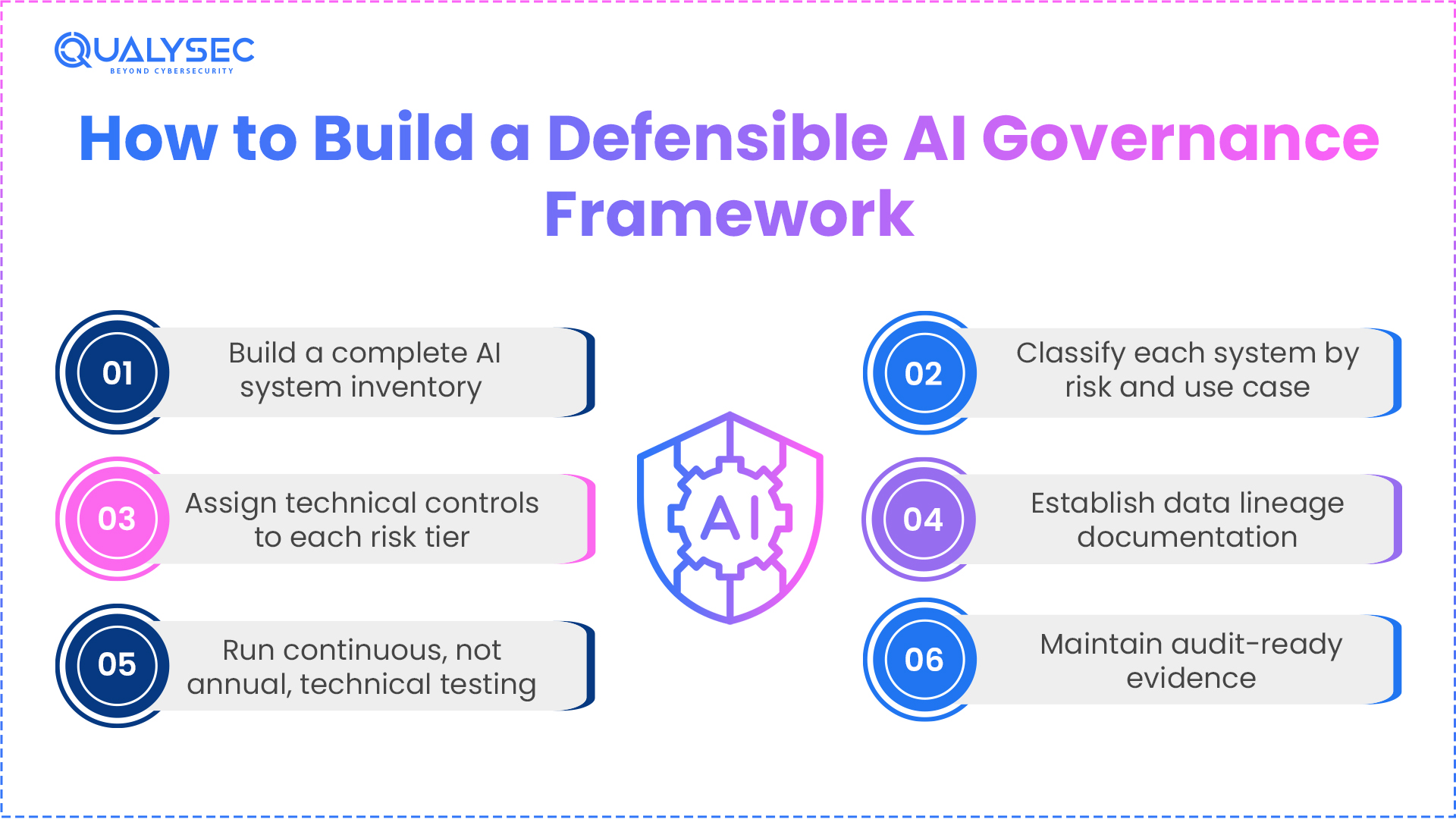
A defensible framework, one that survives contact with an actual regulator or auditor, tends to follow a consistent build order:
- Build a complete AI system inventory covering every model developed, purchased, or embedded, including shadow AI running on personal accounts. Most organisations trip on this step first, honestly, and everything else on this list depends on getting it right.
- Classify each system by risk and use case. Map each one to the regulatory categories that actually apply to it, whether that’s EU AI Act risk tiers, NIST AI RMF functions, or both at once where the exposure overlaps.
- Assign technical controls to each risk tier, not a single blanket policy applied uniformly regardless of what a system actually does.
- Establish data lineage documentation for every model’s training, fine-tuning, and inference data sources.
- Run continuous, not annual, technical testing against the OWASP LLM Top 10 and system-specific threat models.
- Maintain audit-ready evidence, test reports, remediation records, and lineage documentation, organised for rapid production, not reconstructed after a regulator asks.
The Role of Advanced Security Testing in AI Compliance
Documentation proves an organisation intended to build a secure, compliant AI system. Testing proves it actually is one. This is where the gap between policy and enforcement closes in practice, and it’s the layer most AI compliance programmes underinvest in relative to how much scrutiny it receives during an actual audit.
Among the AI Security solutions available to enterprises today, Qualysec provides the technical testing layer that turns AI governance policy into verifiable evidence. Our assessments cover LLM and AI-specific Penetration Testing Types mapped directly to the OWASP Top 10 for LLM Applications, prompt injection and output handling testing, model and API Penetration Testing, and data pipeline reviews that support data lineage and training data integrity claims.
What comes back isn’t a generic pentest report with AI buzzwords sprinkled in. Findings carry validated evidence and severity ratings, and the remediation guidance is written to plug directly into ISO 42001, NIST AI RMF, and EU AI Act documentation. Sample Pentesting Report to see how actionable our security findings are.
Schedule an AI governance security assessment with Qualysec!
3 Costly Mistakes Enterprises Make When Securing AI
- Treating the policy as the finish line. An approved AI governance policy is the starting point for a compliance programme, not evidence that one exists. Auditors in 2026 ask for the technical proof behind the policy, not the policy document itself.
- Testing the model but ignoring the pipeline. Organisations often test the AI model’s outputs directly while leaving the data ingestion pipeline, the APIs feeding it, and the infrastructure hosting it, largely unexamined. Attackers rarely go straight for the model when the surrounding infrastructure offers an easier path in.
- Treating shadow AI as a training problem. A memo telling employees not to use unsanctioned AI tools doesn’t stop the behaviour. The data consistently shows it doesn’t. Shadow AI requires detection and enforcement infrastructure, not just a policy update, since the underlying incentive to use faster, unsanctioned tools doesn’t disappear because a memo asked it to.
AI Governance & Compliance Checklist for 2026
-
- Complete, current inventory of every AI system in use, including shadow AI
- Risk classification for each system mapped to applicable regulatory categories
- Documented data lineage for all training, fine-tuning, and inference data
- Explainability documentation for high-risk use cases
- Continuous penetration testing against the OWASP Top 10 for LLM Applications
- Consent and lawful basis tracking for all data feeding AI systems
- Audit-ready evidence repository, organised and current, not reconstructed on demand
- Technical controls mapped to each system’s specific risk tier, not a single blanket policy

Conclusion
AI governance compliance in 2026 isn’t a documentation exercise anymore. The EU AI Act’s penalty structure is real and already active for prohibited practices, GPAI enforcement lands in August, and the frameworks organisations are being measured against – ISO 42001, NIST AI RMF, and the EU AI Act alike – all converge on the same underlying expectation: prove it, don’t just describe it. Organizations that pair their governance policy with continuous technical testing, real data lineage, and an honest AI inventory are the ones positioned to survive an audit. Organisations still treating the policy document as the finished product are the ones about to discover the difference the hard way.
Contact Qualysec to close the gap between your AI governance policy and technical security enforcement!
FAQ
1. Can standard VAPT tools satisfy 2026 AI compliance requirements?
No. Standard VAPT Testing tools are built for traditional infrastructure and web applications, not the specific attack surface AI systems introduce: prompt injection, training data poisoning, model supply chain risk, and excessive agency, among them. Meeting 2026 AI compliance requirements means testing against AI-specific frameworks like the OWASP Top 10 for LLM Applications, not just running a conventional vulnerability scan against the infrastructure hosting the model. Check out our detailed guide on What is VAPT to understand the core differences.
2. How often should our AI and LLM models undergo penetration testing for compliance?
Continuous or at minimum quarterly testing is the practical standard for production AI systems, not an annual cycle. Models get fine-tuned, retrained, and connected to new data sources and APIs frequently enough that a security posture confirmed once a year is often stale within weeks. Any significant model update, new integration, or data source change should trigger fresh testing regardless of the regular schedule.
3. How does Qualysec help companies achieve compliance with frameworks like the EU AI Act or NIST AI RMF?
Qualysec provides the technical testing and evidence layer these frameworks require but don’t themselves generate: AI-specific penetration testing mapped to the OWASP LLM Top 10, model and API security assessments, and data pipeline reviews supporting data lineage documentation. Findings and remediation records are structured to map directly to EU AI Act conformity documentation and NIST AI RMF’s Measure and Manage functions, giving compliance teams verifiable evidence rather than a generic security report. Read how AI-Based Security Systems help strengthen risk response.
4. Is a policy document enough to pass an AI governance audit in 2026?
No. A policy demonstrates intent, but 2026 audits increasingly require technical proof that the policy is actually enforced: a current AI system inventory, documented risk classifications, evidence of continuous security testing, and data lineage records. An organisation with a well-written policy and no supporting technical evidence is likely to fail an audit that an organisation with weaker policy language but strong technical documentation would pass.