






Payment Services Act Singapore compliance starts with a licence, but the cybersecurity duties sit in MAS notices and guidelines, not in the statute. Many searchers get lost at this point, so this guide helps anyone who wants to know which rules actually bind a payment firm.
The technology risk notice FSM-N13 was issued on 9 May 2024.
It took effect on 10 May 2024 for designated payment system operators and settlement institutions, and on 6 November 2024 for digital payment token (DPT) service providers. The framework sets an incident clock of one hour. However, it does not mention vulnerability assessment or penetration testing.
So does the law require testing at all? And what would an examiner or a partner bank expect to see on file? This guide gives a rule map for Payment Services Act Singapore licensees, a component-by-component test method, a table of reporting clocks and a worked example from a documented wallet theft.
Talk to Qualysec’s security experts about testing your payment platform against these rules: Schedule a meeting!
What Does the Singapore Payment Services Act 2019 Cover?
The Act came into force on 28 January 2020, according to Allen & Gledhill. The Payment Services Act 2019 replaced the Payment Systems (Oversight) Act and the Money-changing and Remittance Businesses Act with one activity-based framework.
The regulator regulates seven payment services.
- Account issuance
- Domestic money transfer
- Cross-border money transfer
- Merchant acquisition
- E-money issuance
- Digital payment token services
- Money-changing
There are three classes of licence that follow: money-changing, standard payment institution, major payment institution. MAS can also designate significant payment systems. The Singapore Payment Services Act 2019 licenses firms by activity, meaning that the class is based on the services offered.
Table 1 presents the split next to the cyber instruments that reach each group.
| Licence class | Services | Cyber instruments |
| Money-changing licensee | Money-changing only | FSM-N14 (MAS states licensees need to comply) |
| Standard payment institution | Any of the seven services, below the volume thresholds | FSM-N14 |
| Major payment institution | Any of the seven services, above the volume thresholds | FSM-N14 |
| DPT service provider | Acting as an agent for digital payment tokens or in exchange for digital payment tokens | FSM-N13 from 6 November 2024, FSM-N14, TRM Guidelines |
| The System Operator (SO) and Settlement Institution (SI) are both appointed to act as the designated operator of the system. | Systems MAS identifies as important. | FSM-N13 from 10 May 2024, FSM-N14 |
The team must mark two cells with a caveat. According to MAS’s page on payment service providers, the licensees are required to adhere to FSM-N14. That text does not name the other classes, but FSM-N13 names them. It would be useful for each firm to verify its own status with MAS.
What is binding and what is merely guiding under the Payment Services Regulations Singapore?
Think of a ladder. The Act is at the top, followed by the regulations under the Act, followed by MAS notices, followed by guidelines. Notices bind licensees. Guidelines establish expectations with a level of judgment by supervisors.
If you are reading through the payment services regulations that Singapore has published for a penetration testing task, it is advisable to start with the notices, which provide the operational detail. There are 5 sources of cyber duties under the Payment Services Act 2019, as listed in Table 2.
| Instrument | Applies to | Binding? | Key requirement |
| FSM-N13 | Designated system operators, settlement institutions, DPT service providers. | Binding notice | Critical systems, downtime cap, recovery time, MAS notice in 1 hour, root cause report in 14 days, IT controls for customer information |
| FSM-N14 | Each payment licensee, per MAS | Binding notice | Administrative accounts, Risk-Based Patching, Security Standards, Network Perimeter, Malware Protection, MFA on Critical Systems |
| TRM Guidelines (January 2021) | Financial institutions including payment licensees | Guidelines | Vulnerability Assessment, Black and Grey Box Testing, Red Team Exercises, Remediation |
| The incident circular from MAS is dated 16 December 2025. | Financial institutions | Effective 1 February 2026 | This is the template for reports submitted through MAS-Tx. |
| PDPA breach notification | Organisations that keep personal information. | Law | Notice to the PDPC within 72 hours of assessment |
FSM-N13 vs. FSM-N14: Key Requirements and Regulatory Updates
This is the heavier of the two notices, FSM-N13. A DPT provider must identify critical systems (section 4). The maximum for unscheduled downtime is 4 hours per critical system in 12 months (section 5). Organizations must validate recovery within 4 hours every year (section 6). Organizations must submit a root cause report within 14 days of reporting a relevant incident to MAS (section 8), and they must report the relevant incident to MAS within 1 hour (section 7). The IT controls for customer information are in Section 9.
FSM-N14 reads differently. Its MAS FAQ says: “An FI should implement multi-factor authentication for administrative accounts on its critical systems.” It also requests risk-based patching. There is no attestation or audit report to submit to MAS, and MAS supervises compliance.
The rules are also on the move. Waystone said MAS consulted in 2026 on the updated technology risk notices. The feedback closed on 31 July 2026, and a 12-month transition will follow once they are final.

Should Firms Following the Payment Act Singapore Be Penetration Tested?
Not by name. The Singapore Payment Services Act does not mention it, nor does FSM-N13. Neither is there any reference to penetration testing in the FAQ on FSM-N14. It discusses the process of determining the severity after discovery of a new vulnerability.
Testing is reflected in the TRM Guidelines. According to law firm summaries, section 13.1.2 covers vulnerability assessment, section 13.2 covers black-box and grey-box testing, and section 13.4.1 covers red team exercises. They’re guidelines. They set no frequency and no independence rule.
The gap has a practical edge, however. FSM-N14 recommends risk-based patching. A company with no testing history would have a hard time proving how it ranks vulnerabilities by risk. That’s where the examiner would ask.
How to Test a Payment Service?
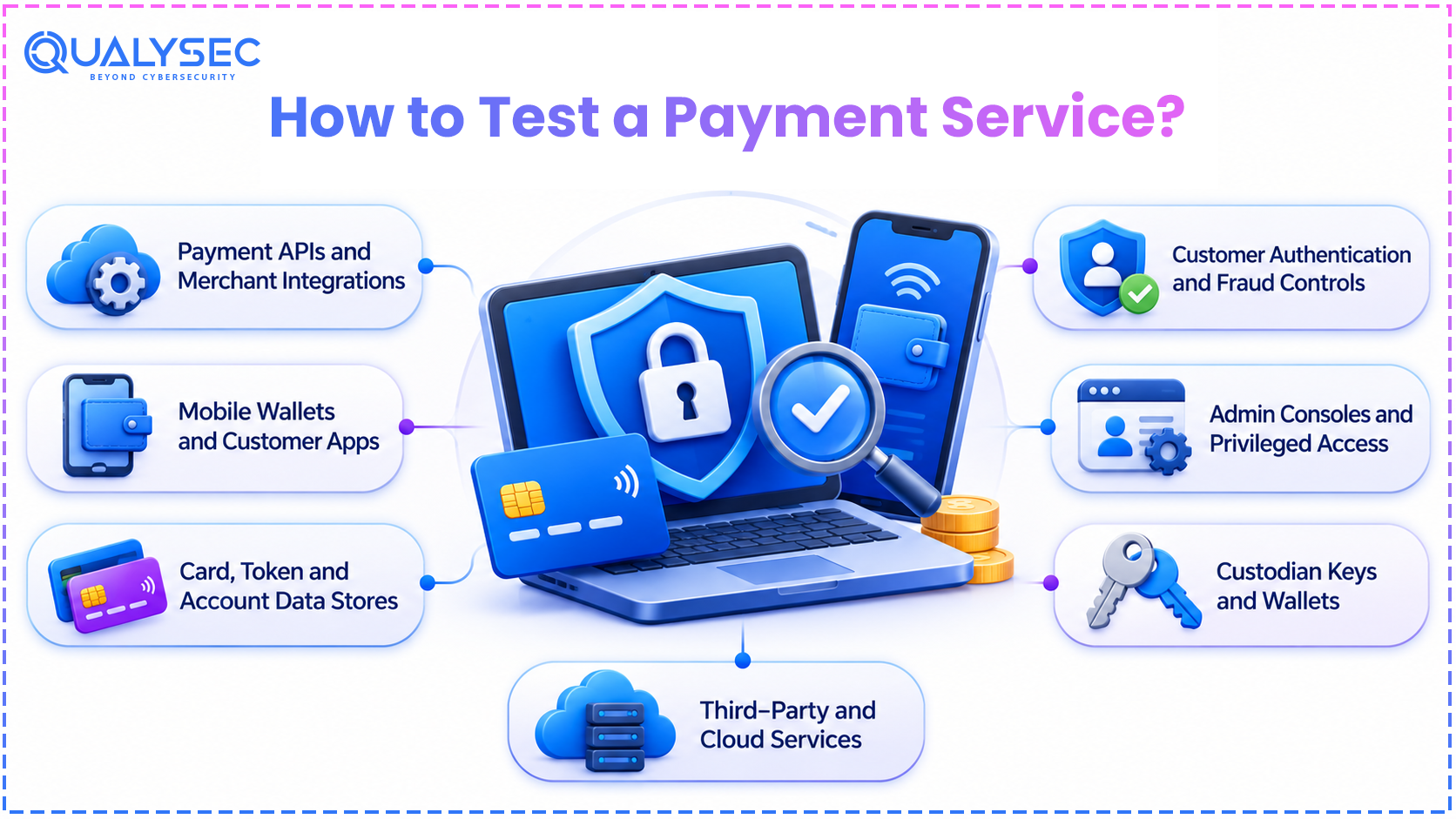
Following the Payment Services Act, Singapore companies should test their own environment. Run one loop for each component. Record normal behaviour first, then change one input and then try another pathway to the same outcome. Take some snapshots of the reaction as evidence, and retest after the fix.
Payment APIs and Merchant Integrations
For processing payments, scope includes payment initiation, refund and webhook endpoints. The team replays requests with a different merchant token and modified amounts and forges callbacks. Pass condition is: rejected, with no cross-merchant data. Request and response captures are the evidence.
Mobile Wallets and Customer Apps
The team tests the app for hard-coded keys and weak local storage. The team then captures traffic on a rooted device. Pinned sessions should stay pinned and should not be recoverable. The team confirms this through extraction logs and traffic captures.
Card, Token and Account Data Stores
Testers attempt to access other consumers’ records via injection, open storage and backup access. FSM-N13 section 9 requires IT controls for customer information, and the team considers successful reads a finding. The team records queries on file, along with configuration exports.
Customer Authentication and Fraud Controls
The first are credential stuffing, one-time password replay and step-up bypass.Then the system splits a large transfer into smaller transfers to determine whether velocity rules fire. Pass: The system blocks or flags each attempt to pass. The evidence is the alert records.
Admin Consoles and Privileged Access
The recommended practice for FSM-N14 is multi-factor authentication of administrative accounts of critical systems. A console that accepts a password alone, without a second factor, fails. The team also tests role changes made without authorization and logins to revoked accounts. The team maintains screenshots and access logs.
Custodian Keys and Wallets
It is relevant to the DPT providers. The security team examines key generation, key storage, and key signing, as well as who may approve a transfer. The team checks whether the transaction that the signer views matches the payload that the signer signs. The team uses signing logs and captures of both views as evidence.
Third-Party and Cloud Services
The security team reviews permissions to access cloud storage, build pipelines, and third-party scripts on payment pages. If someone modifies a script without permission, the firm considers it a finding because the dependency falls outside the firm’s boundaries. Permission exports and file hash comparisons back this up.
Should Testing Depth be matched to the Service?
The notices don’t set test depth. Singapore’s payment services regulations provide for a firm to determine the depth. Table 3 is a recommended model provided by Qualysec and not MAS text.
| Tier | Example component | Test depth | Independence | Retest trigger |
| High | The company is working on payment initiation APIs, DPT custody and signing services. | A full test of all components in the chain | Outside the build team. | Each material change, plus a schedule prepared by the firm. |
| Medium | Admin consoles / Merchant dashboards | Access control and data exposure focused testing. | Second line of defence | Role changes, data changes or integration changes. |
| Low | Marketing site without customer data | Ensure baseline is taken and configuration reviewed | Build team with peer review. | Version changes |
At What Speed Does an Incident Need to be Reported?
Table 4 collates the clocks for a payment act Singapore licensee with both MAS and personal data duties.
| Event | Deadline | Recipient | Source |
| A relevant incident (scope FSM-N13) | Within 1 hour | MAS | FSM-N13 section 7 |
| Root cause report | Within 14 days | MAS | FSM-N13 section 8 |
| The breach is likely to cause significant harm, or has affected at least 500 individuals. | No later than 72 hours from the organisation’s assessment | PDPC | PDPC guide |
| Breach discovered by a data intermediary | Within 24 hours | The organisation for which it processes data. | PDPC guide |
The one-hour clock is the winner by a considerable margin. The Payment Services Act Singapore (PSA) notice should be the starting point for a runbook for PSA licensees, followed by the PDPC assessment. Reporting through MAS-Tx has been in effect since 1 February 2026, under the circular dated 16 December 2025.
A case study about a documented wallet compromise.
Nearly $1.5 billion in Ethereum was stolen from the exchange Bybit during an attack on 21 February 2025.The FBI said the theft was the result of a gang they dubbed Trader Traitor. The FBI said the attackers dispersed the stolen assets across thousands of addresses on multiple blockchains.
Bybit hired two security firms, Sygnia and Verichains, to investigate what caused the problem, which they determined to be malicious code delivered via Safe{Wallet}’s infrastructure, an AWS S3 bucket. They did not see any evidence of a compromise of Bybit’s own systems. A Safe{Wallet} said a hacker compromised the developer’s machine. The hacker replaced a legitimate JavaScript file on 19 February, and it activated on 21 February.
As a result, the code targeted Bybit’s Ethereum cold wallet and modified transaction information during signing.
All the money went out the door, and the transfer seemed to be correct to the signers.
These sources do not refer to Bybit as a Singapore licensee, and it is not a MAS case. It maps to a licensee under the Payment Services Act Singapore regime like this.
- A critical systems list (FSM-N13 section 4) that lists the signing interface and any third-party code it loads in.
- The test that finds it: compare the transaction displayed to the signer with the payload signed, and validate the integrity of each third-party script on the signing page
- Pass condition: If there is any mismatch or a change in the script is not approved, the system catches it before a transfer is signed.
- The evidence includes the transaction views, script hash comparisons and the alert record.
What should be included in a Payment Security Finding?
The Payment Services Act (PSA) Singapore file, who look for artefacts, not intentions. Findings should include an ID, the service/service class, and the MAS instrument associated with the finding. It also requires the component, preconditions, steps, as well as expected and observed behaviour.
The remaining portions of the record are the evidence, severity rating, customer information breached and the retest status.
The key is the reproducible steps. Other members of the build team should be able to repeat the finding and obtain the same result.
How Qualysec supports payment firms.
Qualysec’s web page for MAS TRM penetration testing is as follows: “Testing in Web, API, Cloud, Network and Mobile environments, in Black Box and Grey Box. Findings include severity ratings, reproduction steps and remediation guidance.”
Application Testing & API Testing Services
Security teams test payment initiation, refund, webhook, and merchant endpoints for broken authorization, injection, and business logic flaws. Development steps are provided to assist developers in addressing each finding.
Mobile, Cloud and Network Testing
For companies regulated by the Singapore Payment Services Act 2019 (PS Act), Qualysec conducts tests on all of these environments. Security teams test wallet apps, cloud storage, build pipelines, and network segments as one chain. The Bybit case demonstrates how the weak link can be outside of the company’s code.
Retesting and Reporting
Each fix is verified through retesting, and the evidence closes the findings. Table 2 can place the instrument references next to each finding, providing a technical category and a link to the relevant MAS instrument.
Testing is not a certification of compliance. It remains the responsibility of the licensee.

Conclusion
For Payment Services Act Singapore firms, the duty does not end with licensing. The cyber duties arrive via FSM-N13, FSM-N14 and the TRM guidelines. FSM-N13 has hard clocks and no testing duty. The guidelines provide the test yardstick.
A company can respond to a supervisory question if it records tests, owners, and retests for each component.
Have your payment security testing narrowed down by the experts at Qualysec: Schedule a Meeting!
FAQs (Frequently Asked Questions)
Does the Payment Services Act require penetration testing?
The Payment Services Act 2019 and FSM-N13 do not contain any named duty to test. Penetration testing is recommended in the FTRM Guidelines as guidance, and the technical detail on the licensing framework is in notices. Therefore, a firm with no testing record still has a tough case to make on risk-based patching and security.
What is the date of implementation of the Payment Services Act Singapore?
SPSA took effect on 28 January 2020. It replaced the Payment Systems (Oversight) Act and the Money-changing and Remittance Businesses Act. The regulator now assigns licences based on activity, and the class of licence depends on the service or services the firm provides and the volume of services it provides.
Is there any payment licensee that is not covered by FSM-N13?
Not on its face. The text identifies the payment system operators, settlement institutions and DPT service providers. Additionally, payment licensees are required to adhere to FSM-N14. according to MAS. Firms not listed under FSM-N13 should verify their status as a Singapore licensee, as the notices and the proposed changes to the FSM notices in 2026 could alter the landscape.
What is the required time for the payment incident to be reported?
FSM-N13 requires organizations to notify MAS within 1 hour of an incident of a relevant nature, and submit a root cause report within 14 days. Separately, Additionally the PDPC expects notice within 72 hours of assessment in the case of a breach that is likely to cause significant harm. Data intermediaries must notify the organisation they act for within 24 hours.
Do the TRM Guidelines cover payment firms?
Sections 13.1.2, 13.2, 13.4.1 and 13.6.1 respectively discuss vulnerability assessment, black & grey box, red team exercise and remediation. However, the guidelines do not specify a regular testing frequency; therefore, you should record your reasoning. Moreover, use the guidelines as references rather than required reading. Additionally, consider the relevant guidance when determining your testing approach. Consequently, document how the guidance informs your testing decisions.