

On July 28, 2026, the Monetary Authority of Singapore and the Association of Banks in Singapore jointly established the AI-Driven Cyber and Technology Risk Taskforce, an industry-wide response to frontier AI’s growing ability to identify and exploit vulnerabilities at scale. It’s a direct signal from Singapore’s regulator that the technology risk landscape financial institutions operate under isn’t static, and neither are MAS’s expectations around how institutions test and defend their systems.
Penetration testing sits at the centre of that expectation. Under the MAS Technology Risk Management Guidelines, financial institutions in Singapore are required to test their systems using qualified, independent assessors, and CREST accreditation has become the credential most widely accepted as evidence of that qualification. This guide explains what MAS TRM actually requires, where CREST penetration testing fits into meeting those requirements, and what financial institutions should look for when choosing a provider for MAS TRM penetration testing.
Key Takeaways
- MAS TRM Guidelines, last revised January 18, 2021, require penetration testing by qualified, independent assessors, with the frequency set by system criticality and risk exposure.
- Section 13.2 specifically requires a combination of black box and grey box testing, not just an external scan.
- Testers who previously installed, maintained, or supported the assets being tested are disqualified from testing those same assets under MAS’s independence rule.
- MAS doesn’t name CREST directly in the guideline text, but CREST accreditation is the credential MAS examiners most consistently recognise as proof of tester competence.
- A new MAS circular on incident reporting, effective February 1, 2026, adds a further layer of regulatory expectation around how quickly and clearly institutions respond once a vulnerability becomes an actual incident.
What Is MAS TRM?
The MAS Technology Risk Management Guidelines are Singapore’s core regulatory framework for how financial institutions govern and secure their technology environments. First issued in 2001 and most recently revised on January 18, 2021, the current guidelines run over a hundred pages and apply broadly across Singapore’s financial sector.
| Entity Type | Examples |
| Banking institutions | Banks, finance companies |
| Insurance | Registered insurance brokers |
| Capital markets | Capital markets intermediaries |
| Trust and credit | Licensed trust companies, licensed credit bureaus |
| Payments | Payment services licensees |
The 2021 revision sharpened several areas that mattered less a decade earlier:
- Board and senior management accountability for technology risk, not just the IT function
- Closer scrutiny of third-party vendors with access to the institution’s systems
- A stronger emphasis on monitoring, testing, and sharing cyber threat information across the financial sector
Sections 13.1.2 and 13.2 specifically govern vulnerability assessment and penetration testing, setting out both the minimum scope of testing and the methodology institutions are expected to use.
MAS doesn’t prescribe a fixed toolkit or a single testing vendor. It sets outcomes for Singapore financial cybersecurity. Thorough, risk-based, independently verified testing and leaves the implementation choices to each institution. That flexibility is useful for mature security teams, but it also means institutions need to understand exactly what “thorough” and “independent” mean in MAS’s own terms, not just in general industry practice.
Why Penetration Testing Is Important Under MAS TRM?
Penetration testing isn’t a single line item buried in MAS TRM. It’s the mechanism the guidelines rely on to confirm that everything else – access controls, network segmentation, secure coding practices – actually holds up against a real attempt to break in.
Section 13.1.2 sets the minimum scope for vulnerability assessment, covering:
- The vulnerability discovery process itself
- Identification of weak security configurations
- Open network ports
- Application and web-based vulnerabilities, where applicable
Section 13.2 goes further, requiring penetration testing to combine black box and grey box methods rather than relying on either alone. A black box test starts with nothing more than public information, IP ranges and known URLs, simulating an outside attacker with no inside knowledge. A grey box test gives the tester the same access credentials a real customer would have, surfacing a different class of vulnerability entirely, the kind that only shows up once someone is logged in.
| Testing Type | Tester’s Starting Access | What It Reveals |
| Black box | Public information only (IP ranges, known URLs) | Perimeter weaknesses an outside attacker could exploit |
| Gray box | Customer-level access credentials | Vulnerabilities reachable only once authenticated, closer to real fraud scenarios |
| White box | Full access (source code, architecture diagrams, admin credentials) | Deep structural flaws, source code vulnerabilities, and internal logic errors |
Frequency under penetration testing MAS guidelines isn’t fixed by a single universal number either. MAS expects testing at least annually as a floor, with more frequent testing required as system criticality and risk exposure increase, and testing triggered by significant changes to the IT environment regardless of the regular schedule. An institution that only tests once a year regardless of what changed in between is meeting the letter of a minimum, not the actual risk-based standard MAS is asking for.
How CREST Penetration Testing Supports MAS TRM Compliance?
Independent Security Validation
MAS TRM includes a specific independence rule that’s easy to miss: testers who were previously involved in installing, maintaining, or supporting the internet-facing assets being tested are not eligible to test those same assets. This rules out a common shortcut, having an internal team or an existing IT vendor “test” infrastructure they built or manage.
CREST-accredited firms satisfy this requirement structurally rather than as an afterthought, because:
- They operate as genuinely independent third parties with no prior involvement in the systems under test
- Independence is a standing organisational policy, not something arranged per engagement
- Their accreditation itself is subject to independent review by CREST, adding a second layer of separation
For institutions comparing providers, this structural independence is one of the clearest ways to demonstrate MAS’s requirement is actually met, not just assumed.
Identifying Critical Vulnerabilities
CREST’s accreditation process validates both the organisation and the individual tester:
- At the company level, CREST reviews documented methodology, quality assurance processes, and professional indemnity coverage
- At the individual level, CREST-certified testers pass practical examinations requiring live exploitation of real vulnerabilities, not multiple-choice theory tests.
That combination matters for MAS compliance specifically because Section 13.2’s black box and grey box requirement depends on testers who can actually find and demonstrate exploitable weaknesses, not just run an automated scanner and forward the output.
Meeting Regulatory Expectations
MAS doesn’t name CREST in the guideline text itself. What the guidelines require is a “qualified” and “independent” assessor, and CREST accreditation has become the credential MAS examiners, and the institutions being examined, most consistently point to as evidence that requirement is satisfied. Institutions that engage CREST-accredited providers are demonstrating regulatory due diligence in a way that’s easy for both internal risk committees and MAS reviewers to verify, without needing to evaluate an individual tester’s competence from scratch. This is a meaningful part of cybersecurity compliance that Singapore institutions are expected to demonstrate proactively, rather than only when asked.
Supporting Risk Management
A penetration test only supports MAS TRM compliance if its findings actually feed into the institution’s broader risk management process. CREST-accredited engagements are built to make that connection straightforward:
- Findings are validated, not just flagged, with clear severity ratings and reproduction steps
- Risk teams can prioritise remediation against real exploitability rather than a raw vulnerability count
- Critical issues typically follow a remediation timeline of around 30 days, high-severity ones around 90
- The exact SLA should reflect each institution’s own risk appetite, documented in a form MAS examiners will expect to see
Improving Incident Readiness
MAS TRM’s incident management provisions, set out in Sections 12.3.1 and 12.3.2, require institutions to establish clear processes for investigating and responding to security deficiencies. That expectation was reinforced further by:
- MAS’s new Circular on Financial Institution Incident Reporting
- The requirement to submit reportable incidents through the updated MAS-Tx platform from February 1, 2026 onward
- A sharper regulatory focus on how quickly, not just whether, institutions respond once a weakness becomes an actual incident
A CREST penetration test that simulates a realistic attack path gives incident response teams something closer to a live rehearsal than a checklist, exactly the kind of preparation MAS’s guidelines, and increasingly its own reporting infrastructure, are built around.
Common Security Testing Required by MAS TRM
MAS TRM’s testing expectations extend across every layer of a financial institution’s technology stack, not just the public-facing website.
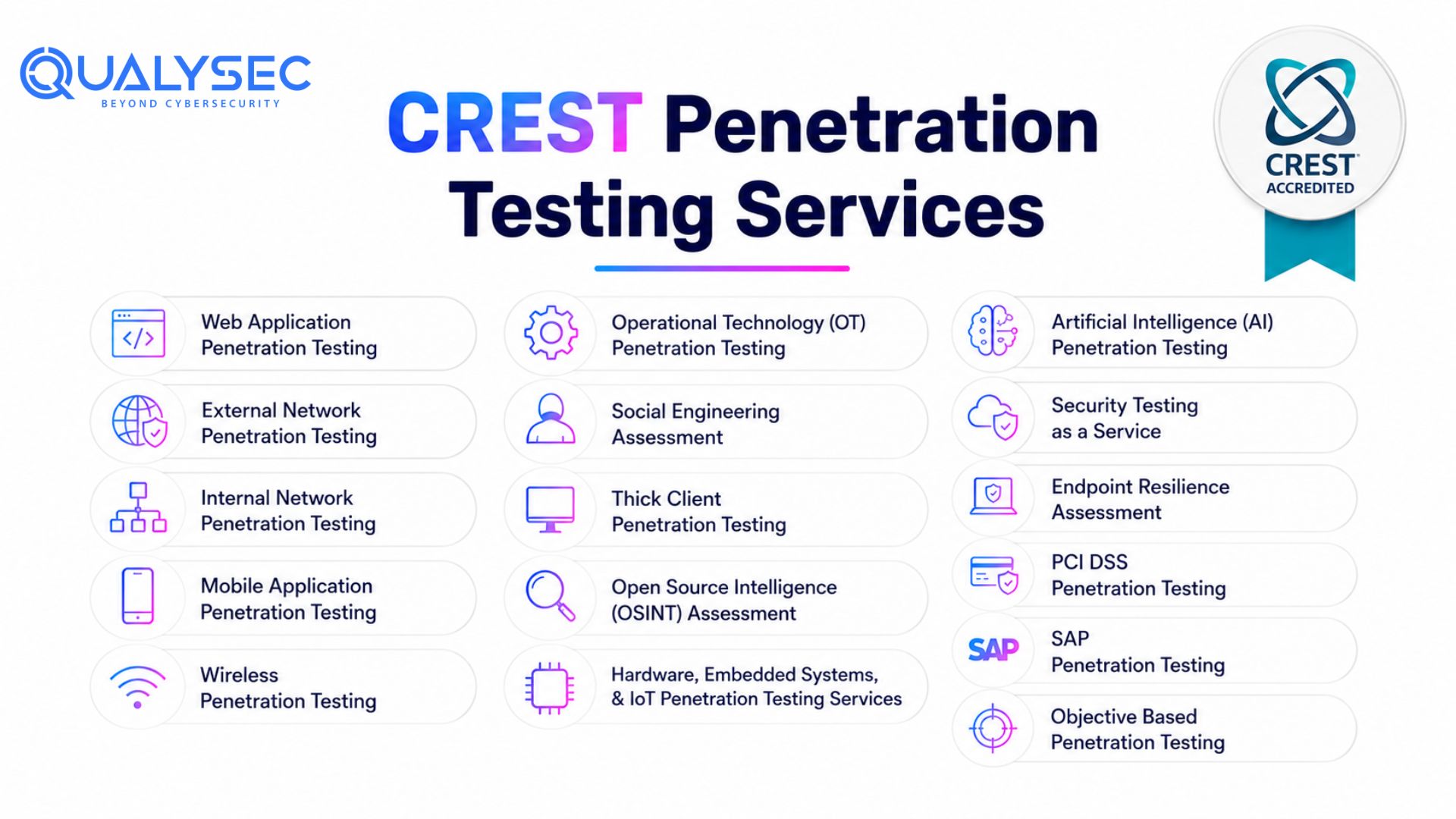
- Web application testing – Online banking portals, customer-facing web applications, and internal web tools all fall within scope, tested for the kind of logic flaws and access control gaps that automated scanners routinely miss.
- API testing – As financial institutions increasingly connect through APIs, whether for open banking, payment rails, or internal service integration, API-specific testing has become as important as testing the applications sitting on top of them.
- Cloud testing – Misconfigured storage, overly permissive IAM roles, and exposed management interfaces are common findings in cloud environments, and MAS’s 2021 revision specifically called out cloud technology as a growing risk area.
- Network testing – Internal and external network testing checks segmentation, firewall configuration, and whether a foothold in one part of the network can be used to reach more sensitive systems.
- Mobile testing – Mobile banking apps need testing across both the client application itself and the backend services it talks to, since vulnerabilities can exist on either side of that connection.
Best Practices for MAS TRM Compliance
Institutions that stay ahead of MAS reviews, rather than scrambling before one, tend to share a few habits in common.
- Treat testing frequency as risk-based, not calendar-based. Annual testing is the floor, not the target. Systems handling higher transaction volumes, greater customer data sensitivity, or recent significant changes warrant more frequent testing than the minimum.
- Verify tester independence before every engagement, not just the first one. If a testing provider has done implementation or support work on a system since the last test, that independence has been compromised for this round, even if it wasn’t an issue previously.
- Insist on both black box and grey box coverage. A test that only covers the external perimeter leaves the authenticated, logged-in attack surface, often where real fraud happens, completely unexamined.
- Build remediation tracking into the same process as testing. MAS reviewers look for evidence that findings were fixed and verified, not just identified. A test report with no documented remediation trail raises more questions than it answers.
- Participate in sector-wide exercises, not just internal ones. MAS and the Association of Banks in Singapore coordinate industry-wide cyber exercises that test coordination and response across institutions, not just within one. These complement, rather than replace, individual penetration testing programmes.
Why Financial Institutions Choose Qualysec
Qualysec delivers CREST-accredited penetration testing structured specifically around MAS TRM’s requirements. Our work spans penetration testing that financial institutions in Singapore rely on across banking, insurance, and payments, with a few things that consistently set the engagement apart:
- Full black box and grey box coverage across web applications, APIs, cloud environments, internal and external networks, and mobile platforms
- Structural independence by design, with testers who have no prior involvement in the systems being assessed, satisfying MAS’s independence rule automatically rather than by exception
- Validated findings, not raw scanner output, backed by clear severity ratings and reproduction steps
- Practical remediation guidance that risk and compliance teams can act on directly
- Retesting built into the engagement, so institutions can demonstrate that identified vulnerabilities were genuinely closed, not just documented
Conclusion
MAS TRM doesn’t leave penetration testing as an optional line item. Sections 13.1.2 and 13.2 set specific expectations around scope and methodology, the independence rule closes off an obvious shortcut, and the guidelines’ broader emphasis on board accountability and third-party oversight means testing results need to feed into decisions made well above the security team. CREST accreditation isn’t named directly in the guideline text, but it remains the clearest way for an institution to demonstrate that its testing provider meets the qualification and independence bar MAS is actually looking for. As Singapore’s regulators turn more attention toward AI-driven threats and tighten incident reporting expectations, the institutions in the strongest position are the ones treating penetration testing as an ongoing discipline, not an annual formality.
FAQs
1. What is MAS TRM?
MAS TRM refers to the Technology Risk Management Guidelines issued by the Monetary Authority of Singapore, first introduced in 2001 and most recently revised on January 18, 2021. The guidelines set expectations for how financial institutions in Singapore govern technology risk, covering IT governance, cybersecurity, third-party oversight, incident response, and system development, with penetration testing as a core requirement under Sections 13.1.2 and 13.2.
2. Does MAS TRM require penetration testing?
Yes. MAS TRM requires financial institutions to conduct penetration testing using qualified, independent assessors, with frequency determined by system criticality and risk exposure rather than a single fixed schedule. Section 13.2 specifically requires a combination of black box and grey box testing, and testers previously involved in maintaining the systems under test are disqualified from testing those same systems.
3. What is the relationship between CREST and MAS TRM?
MAS TRM’s guideline text doesn’t name CREST directly. It requires testing by “qualified” and “independent” assessors, and CREST accreditation has become the credential most widely recognised in practice as evidence that requirement is met, both by financial institutions selecting providers and by MAS examiners reviewing testing evidence during inspections.
4. How often should financial institutions perform penetration testing?
MAS TRM sets annual testing as the minimum, but expects more frequent testing for systems with higher criticality or greater risk exposure, along with testing triggered by significant changes to the IT environment. An institution’s actual testing cadence should reflect a documented, risk-based decision rather than defaulting to the regulatory floor for every system regardless of its risk profile.
5. Is CREST accreditation mandatory for MAS TRM compliance?
Not in a strictly textual sense. MAS TRM doesn’t state that testers must hold CREST accreditation specifically. In practice, though, CREST is the credential institutio ns most commonly rely on to demonstrate the “qualified and independent” standard MAS requires, since it’s independently verified at both the organisational and individual tester level.
6. Which organisations should comply with MAS TRM?
MAS TRM applies to banks, insurers, capital markets intermediaries, licensed trust companies, finance companies, licensed credit bureaus, registered insurance brokers, and payment services licensees operating in Singapore. The specific requirements and expected testing depth scale with each institution’s size, risk profile, and the criticality of the systems it operates.