
Financial institutions operating within Singapore’s highly regulated and technology-driven ecosystem have prioritised compliance with the Monetary Authority of Singapore (MAS) at the executive level. With the growing number of cyberattacks, complicated outsourcing arrangements, and a quickening pace of digital transformation, MAS is ramping up its regulatory expectations across all areas of the financial services industry. The MAS compliance framework includes requirements for governance/risk management, cyber security, and third-party oversight. Compliance does not just mean ‘checking the box’ any longer; it has become a continuous discipline for banks, fintechs, and payment service providers.
Adopting a better understanding of the scope of MAS regulations and their intent, as well as how they are applied in practice, is critical in order to avoid regulatory fines and protect your company’s reputation. This article outlines the full MAS compliance requirements, with specific emphasis on technology and cybersecurity for 2025.
What Is MAS Compliance?
Compliance with MAS regulations is defined as following the rules, regulations, and supervisory requirements of the Monetary Authority of Singapore (MAS) for reporting and managing all types of risk. The MAS compliance requirements include supervisory and operational stability, technological risk management, data privacy and protection, and preventing financial criminal activity.
The MAS wants all institutions to have well-established governance structures, internal controls, and risk-based compliance programs. Compliance with MAS regulations can be enforced with several different forms of legislation, regulation, notice, and guidelines under the individual forms of law.
Institutions are required to maintain compliance with MAS regulations by undergoing compliance audits, assessments, regulatory reporting, and so on. If an institution fails to comply with the MAS regulations, it can face penalties, restrictions on its operating licence, or regulatory enforcement action against the institution.
Which Financial Institutions Must Follow MAS Regulations in Singapore?
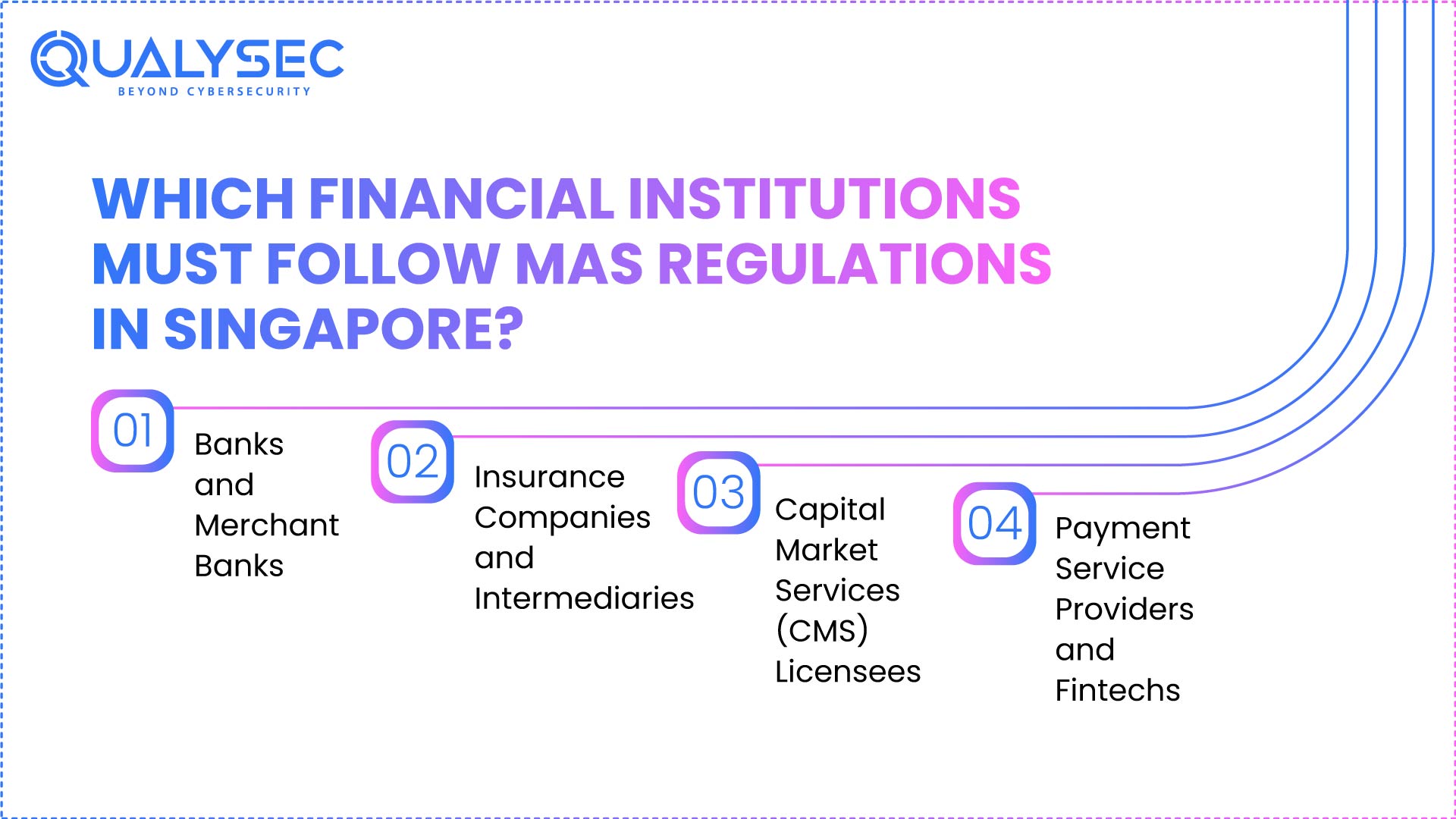
The Monetary Authority of Singapore (MAS) is the regulator of Singapore’s financial services industry and applies its regulations consistently to traditional and newer, digital firms within the industry. Any company that has been granted a license or otherwise operates under the authority of MAS must meet the applicable regulatory guidelines.
Banks and Merchant Banks
For banks, including commercial banks, wholesale banks and merchant banks, MAS imposes significant requirements. It includes capital adequacy, risk management, compliance with the MAS Technology Risk Management guidelines, and cybersecurity. Because banks continue to be systemic to the Singaporean economy, regulators consistently supervise them and also subject them to regular inspections of their technology-related risk.
Insurance Companies and Intermediaries
For Life, General, and Composite Insurers and their brokers must also meet the governance, outsourcing, and technology risk guidelines of MAS. Insurers are becoming more closely monitored for their level of Cyber Resilience due to the sensitive customer information collected, as well as the online distribution method.
Capital Market Services (CMS) Licensees
Fund managers, securities brokers, and financial advisors are subject to comprehensive oversight by MAS. They must maintain strong AML/CFT controls and robust Protect Client Assets (PCA) processes. They are also required to fully comply with all Technology Risk Management (TRM) requirements set by MAS for their trading and portfolio management systems.
Payment Service Providers and Fintechs
Digital Payment Token Providers, E-Wallet Operators, and Payment Gateways are subject to licensing, safeguarding and cybersecurity obligations under the PMA. All Fintechs will need to be compliant to a similar level of maturity as that required by traditional financial services providers.
Core MAS Regulatory Framework Business Need to Know
The structure of MAS regulations consists of a hierarchy of Acts, Regulations, Notices, and Guidelines. A detailed understanding of MAS’s framework allows an organisation to focus its compliance efforts effectively and allocate the appropriate amount of resources towards compliance activities.
Acts and Regulations
The Banking Act, Insurance Act and Payment Services Act are Acts that provide the basis for MAS’s supervisory role. The Regulations that are based on these Acts provide a formal framework to which organisations are expected to comply.
MAS Notices
MAS Notices set out enforceable obligations, including AML/CFT controls and technology risk management, and Cyber Hygiene measures, which are critical to financial services cybersecurity. An organisation that fails to comply with these Notices may face regulatory action.
MAS Guidelines
MAS Guidelines (Compliance and TRM Guidelines) set out expectations of an organisation’s operations and best practices. While Guidelines do not have immediate legal force, MAS expects organisations to comply or otherwise explain why they have not complied.
Codes and Practice Notes
MAS Codes and Practice Notes provide further detail regarding an organisation’s day-to-day operations and clarify MAS’s regulatory intent. Auditors and Regulators will typically use Codes and Practice Notes to evaluate the adequacy of an organisation’s internal control system.
Contact Our Team for Tailored MAS Compliance Solutions for Financial Institutions.
MAS TRM Guidelines: Key Technology & Cybersecurity Requirements
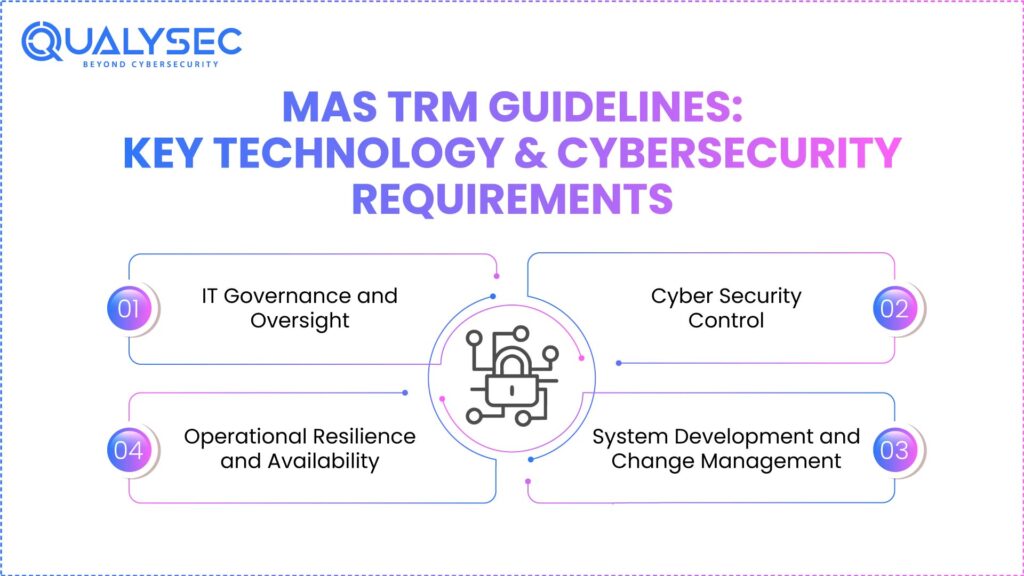
The Technology Risk Management (TRM) Guidelines published by the Monetary Authority of Singapore represent a framework for Cybersecurity and Technology Governance in Singapore. It helps financial institutions meet their security compliance requirements. The TRM Guidelines intend to provide a safe, robust, and appropriately governed technological environment for all Financial Institutions.
IT Governance and Oversight
Institutions will have clear lines of responsibility for technology risks, both within the Board of Directors and at the Senior Management level. The Board of Directors should define the “appetite” for risk and provide regular reports to the Board of Directors and the Executive Management team, including an independent assurance function.
Cyber Security Control
As part of meeting the TRM requirements of the MAS, institutions must have an appropriate level of security for all layers of their network. The MAS requires a comprehensive layer of security controls that must include network segmentation, endpoint protection, and configured, secure servers and workstations. Additionally, institutions must keep accurate and up-to-date threat intelligence and incident response capabilities.
System Development and Change Management
The TRM Compliance Checklist of the MAS includes implementing secure SDLCs, sufficient vulnerability management, and appropriate processes for controlling change. Weak controls in the development environment(s) are considered high-risk.
Operational Resilience and Availability
The MAS expects Financial Institutions to meet a goal of guaranteeing Timely Availability (TA), Disaster Recovery Tests (DRTs) and Business Continuity Plans (BCPs). Institutions are required to demonstrate their capability to recover from Cyber Incidents within their established Recovery Objectives (RO) timeframe.
MAS Cyber Hygiene Notice: Mandatory Security Controls
The MAS Cyber Hygiene Notice outlines the minimum security controls that regulated entities are required to implement at all times. These controls help reduce the likelihood of an attacker exploiting common methods used by cyber criminals and help decrease the overall amount of systemic cyber risk within the organisation.
Management of Privileged Accounts
All organisations must manage privileged accounts in a secure manner. Effective management of privileged accounts includes proper separation of administration from user-level access (two-person or multiple-person accounting). It also requires completion of regularly scheduled access reviews and enhanced audit logging.
Regular Security Patch Management and Review
Regulated entities must patch their operating systems and applications promptly for vulnerability purposes. Regulated entities should assess their security vulnerabilities on a regular basis, review the results of those assessments, and correct any identified vulnerabilities as soon as practicable.
Malware Protection and Hardening
Regulated entities must have updated antivirus/malware protection solutions installed on their servers and endpoints. They must also have appropriate measures in place to harden their computers and network against potential threats. The use of unsupported or end-of-life systems is not acceptable.
Network Security
Organizations must implement network firewall security, intrusion detection systems (IDS), and secure remote access solutions. Firewalls, IDS and remote access solutions should be continuously monitored for any suspicious activity.
MAS Outsourcing Guidelines: Managing Third-Party Risks
Outsourcing for Financial Services: Outsourcing has become integral to financial services and has also brought with it many operations and cyber risks to manage. The MAS Outsourcing Guidelines require financial services institutions to manage their outsourcing-related risks proactively.
Assessing Outsourcing Risks
When considering vendors, financial services institutions must conduct security assessments of how significant (material) the outsourcing may be on their business. They must assess how sensitive the data is that they may be sharing with the vendor and whether they have a concentration risk associated with outsourcing (e.g., too many vendors providing the same service). Vendors that are identified as high-risk would require additional due diligence.
Contractual Protections
Any contracts between institutions and vendors must contain audit rights, security requirements, and incident notification provisions. The MAS requires that financial services institutions maintain ultimate accountability for any functions that are outsourced to a vendor.
Ongoing Monitoring and Review
Financial services institutions must periodically assess their vendors’ performance and security posture. Conducting vendor audits and penetration testing should also be prioritised when appropriate.
Exit and Contingency Planning
The MAS requires that financial services institutions document exit strategies to ensure that they can continue their service. If their vendor goes out of business or terminates its contract with the financial institution.
Payment Services Act (PSA) Compliance Essentials
The primary goal of the Payment Services Act is to provide a single regulatory framework for all payment-related activities in Singapore. The key areas of focus for PSA compliance include Safeguarding, Risk Management and Technology Resilience.
Licensing and Scope of Activities
The licensing that payment service providers must obtain depends on the type of service they provide, and if they operate outside the licensed scope, that constitutes a serious breach of regulation.
Safeguarding Customers’ Money
Institutions must separate their customers’ money from other funds by keeping it in separate accounts, with the use of trust accounts or other mechanisms for protection.
Technology and Cybersecurity Controls
PSA licenses must comply with the MAS Technology Risk Management (TRM) and cyber hygiene requirements to the same extent as banks due to the increasing risks associated with cyber-attacks in the area of digital payments.
Regulatory Reporting and Audits
Compliance with the PSA requires ongoing independent third-party security audits, in addition to the continuous requirement to report to the applicable regulator regarding the financial health of the payment service provider.

AML/CFT Requirements for Financial Institutions
The Monetary Authority of Singapore has identified AML/CFT compliance as a significant aspect of its supervisory activities, with an increased emphasis on Technology-Enabled Controls and Risk-Based Monitoring.
Customer Due Diligence (CDD)
All institutions must complete a risk-based process for onboarding new customers, continue to conduct ongoing monitoring, and complete enhanced due diligence for high-risk customers.
Transaction Monitoring
Automated Transaction Monitoring systems must be implemented by institutions to identify suspicious transactions and transaction trends across all product channels. Institutions must tightly control access to their automated monitoring systems to prevent manual overrides.
Suspicious Transaction Reporting
Authorities must receive all reported Suspicious Transactions on a timely basis, and they must accurately report the details of the Suspicious Transaction. Any failure to do this is considered a serious violation of the compliance requirements.
Independent Testing and Auditing
There is an expectation from the MAS that all institutions conduct regular testing and cybersecurity auditing of their AML/CFT Framework to ensure their continued effectiveness and alignment with the regulations.
Common MAS Compliance Challenges to Watch Out For
Many financial organisations face difficulties in delivering on the MAS guidelines due to a number of factors, including the rapid digital transformation of their businesses and the limitations of their internal resources. The following is a summary of the major obstacles that financial institutions face when complying with the MAS TRM standards.
Regulatory Complexity
The complexity of overlapping notices, guidelines, and sector-specific guidance can make it challenging for organisations to navigate the MAS TRM framework, particularly for organisations classified as fintechs.
Lack of Cybersecurity Expertise
The shortage of internal cybersecurity experts makes it difficult for organisations to fully comply with MAS TRM standards and deal with rapidly changing cybersecurity threats.
Third-Party Risks
The reliance on cloud computing providers and other third-party vendors for support has made organisations more vulnerable to compliance risks in relation to third parties.
Lack of Documentation and Evidence
Many organisations are not able to adequately document their compliance with MAS TRM standards during the MAS inspection process.
How Penetration Testing Supports MAS TRM & Cyber Hygiene Compliance
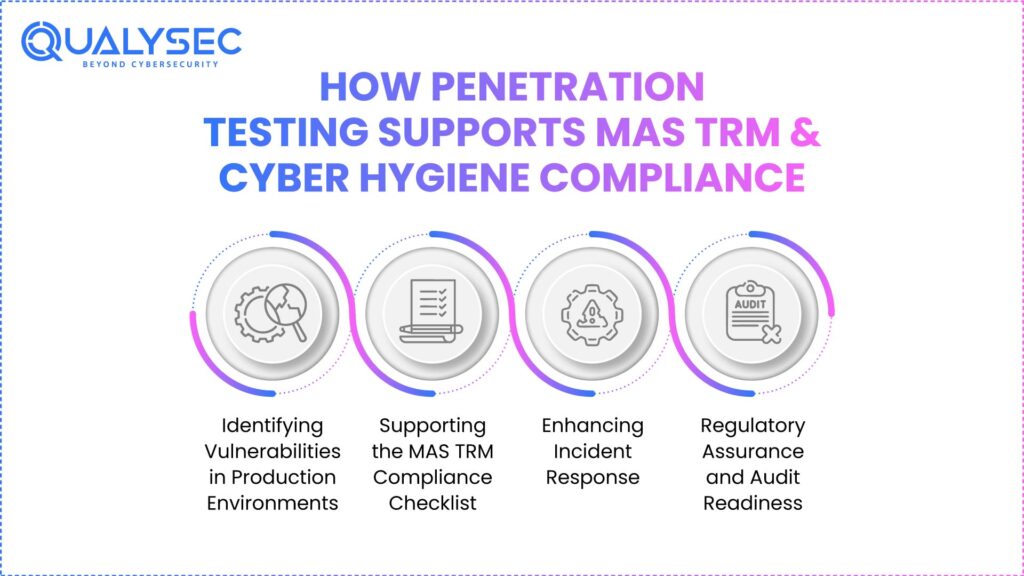
Penetration Testing is an important method to provide assurance regarding meeting MAS Technology and Cyber Security requirements. Penetration Testing will also provide an independent assessment of your security controls.
Identifying Vulnerabilities in Production Environments
Penetration Testing simulates a real-world attacker’s activity to identify vulnerabilities in production environments, including applications, networks, and Cloud.
Supporting the MAS TRM Compliance Checklist
Regularly conducting Penetration Tests allows financial institutions to demonstrate compliance with the MAS Testing and Vulnerability Management requirements.
Enhancing Incident Response
Penetration Test findings are an essential component of Incident Response planning and will assist in minimising the impact of a breach.
Regulatory Assurance and Audit Readiness
Penetration Test Reports provide significant support for regulatory requirements during inspections and audits conducted by MAS.
Why Qualysec Is a Trusted Partner for MAS Compliance & Security Testing
Choosing a compliance service provider is critical to ensure long-term compliance with regulatory requirements. Qualysec has extensive experience in security for the financial services industry and provides a comprehensive suite of services.
–> Focus on Security Regarding the MAS
Qualysec develops and applies test methods to specifically meet regulatory requirements (MAS TRM) associated with cybersecurity, including MAS TRM.
–> Complete Test Coverage
Qualysec’s pentesting services include penetration testing of applications, networks, clouds, and APIs for organisations in regulated industries.
–> Accessible and Audit-Ready Reports
While testing results will include reports at the individual test level, they will also map to requirements that provide insight into how to remediate issues and report to regulators.
–> Continuous Consulting Support
Qualysec assists clients in preparing for compliance with regulatory obligations through compliance readiness assessments and risk evaluation, as well as by developing a comprehensive security strategy for the long term.
Conclusion
Continuous and proactive investment in cybersecurity capabilities and MAS compliance will determine the long-term success of financial institutions. As the expectations surrounding regulatory compliance will shift and evolve over the next five years, the organisation’s ability to successfully embed MAS compliance as part of its core operations will provide the best opportunity to innovate securely and sustainably.
Partnering with a reputable MAS Compliance service provider can significantly lower the organisation’s compliance risk and enhance the organisation’s ability to respond effectively during audits. As cyber threats and regulations grow more stringent, financial institutions will need to ensure governance, technology, and security practices meet MAS expectations to build trust and confidence in Singapore’s financial systems.
The following are some of the many critical elements of operational resilience and compliance with the MAS TRM guidelines and cyber hygiene controls, along with all the obligations related to the outsourcing and AML/CFT guidelines. All of these frameworks have an important role in maintaining operational resilience, as well as the protection of customers and institutions alike.
Schedule a meeting to explore practical steps for regulatory MAS compliance, risk mitigation, and security improvement.

FAQs
1. What is MAS compliance in Singapore?
All financial institutions in Singapore must follow the regulations, notices, and guidelines issued by the Monetary Authority of Singapore (MAS). This ensures that all regulated entities maintain sound governance, financial stability, resilience against cyber threats, and protection from financial crime.
2. What are MAS guidelines?
The MAS intends the Guidelines as a means of guiding regulated entities about the supervisory expectations and best practices of the MAS with respect to risk management, use of technology, outsourcing activities and compliance activities. Although they are not laws, regulated entities are expected to be compliant with them or have an appropriate reason for not being compliant with them.
3. What are the three types of compliance?
Regulatory compliance, corporate or internal compliance, and industry/standards-based compliance constitute the three types of compliance that people generally accept. These three types of compliance ensure that businesses meet their legal obligations, comply with their own policies, and follow recognised best practices.
4. Are MAS guidelines mandatory?
The MAS Guidelines are not mandatory in nature; however, they are expected to be adhered to by all regulated entities. Regulators will likely subject regulated entities to regulatory review and/or supervisory action if they do not comply with the Guidelines and cannot provide good reasons for non-compliance.
5. Who is required to report under MAS?
The MAS requires the following entities to report to it: any entity that it licenses, approves, and/or regulates, including, but not limited to, banks, insurers, Capital Market Intermediaries, and Payment Services Providers. Reporting requirements usually include the submission of Financial Returns (FRs) and incident reports, as well as compliance reporting.
6. What is regulatory compliance?
In theIn the financial services sector, we use the term regulatory compliance to describe adherence to the rules, regulations, and supervisory requirements set by the regulatory authority. Regulatory compliance will assist in mitigating risk and maintaining the integrity and transparency of the market.