

Malaysian financial institutions are experiencing an increase in cyber threats in 2026. Malaysian SMEs face surging ransomware, with businesses recording a 153% year-on-year increase in attacks in 2024 and losses exceeding RM1.22 billion, hitting smaller firms hardest. Phishing accounts for 71% of fraud-related breaches in Malaysia’s financial sector, making it the leading attack vector. Global data breach costs average millions per incident, with detection times reaching 187 days. Malaysian SMEs report RM180K+ in losses per ransomware attack, creating room for BNM RMiT compliance.
BNM RMiT compliance is being adopted at a slow pace, with millions in fines imposed on large banks in 2025, including Bank Rakyat and BSN for downtime breaches. As a result, banking professionals predict more severe cyber attacks by 2027, and this would bring even broader issues. The non-compliance fines are on the increase in order to manage digital risks. What other factors? Let’s find out!
Why BNM RMiT Matters to Financial Institutions?
The BNM Risk Management in Technology (RMiT) policy of Bank Negara Malaysia informs banks, insurers, operators, development financial institutions and other regulated companies on how they should deal with technology risk. It demonstrates that the regulator regards technology as an essential component of banking operations and growth.
RMiT is important since the banks are trusted by the people. That trust can be destroyed by system failures, data hacks, or lengthy outages that can harm financial stability. With the rise of digital banking, cloud usage, use of open APIs, and fintech collaborations, businesses now include technology risk in business risk.
How to Deal with Technology Risk in Financial Institutions throughout the Lifecycle?
BNM Risk Management in Technology encompasses the planning, construction, launching, operating, and decommissioning of systems. Institutions need to incorporate risk checks at every stage by using clear methods.
Change Management and System Development
The institutions will have to consider security, reliability, integration, and legal concerns of BNM cybersecurity requirements before constructing a new system or implementing a significant change. Software design should include safe building practices, effective testing, test and live drawing, and approval.
The change rules should ensure that live systems accept, try, and document changes happening in them. Controlled steps should be followed in making emergency changes and then reviewed and approved later.
IT Operations and Infrastructure Controls
The concept of keeping the system in operation is important to BNM RMiT compliance. The institutions should maintain secure environments, appropriate access controls and vigilant systems in every section of the infrastructure. Who knows what comes after the least privileged rule, and we need to strictly regulate and monitor any special access.
Monitoring and logs must allow institutions to identify issues, investigate, and store evidence. The controls should encompass data centres, end devices, software and network levels.
What Does RMiT Do to Enhance Cybersecurity Practices?
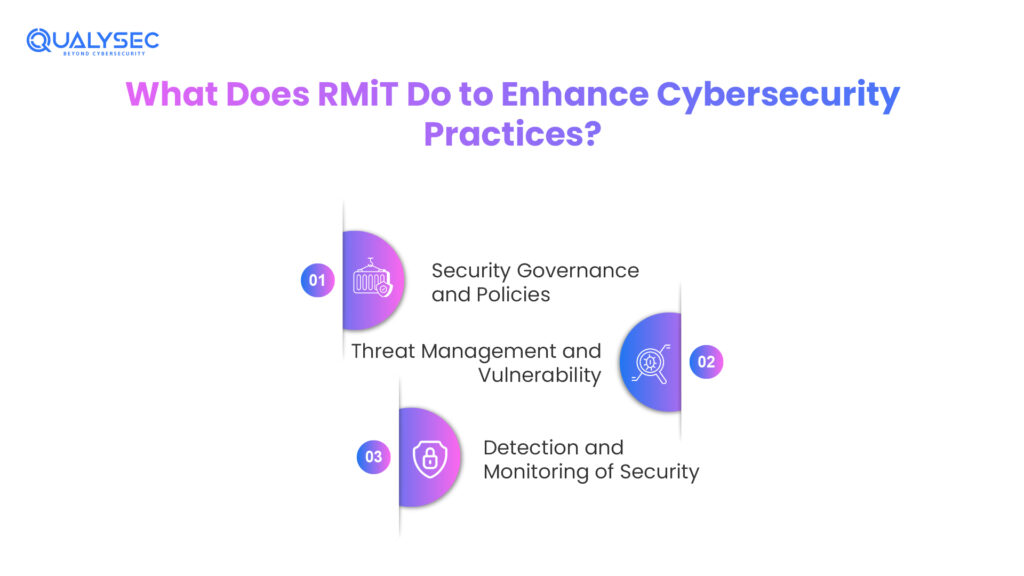
One of the key pillars of BNM RMiT compliance is cybersecurity. Banks would need to install preventative, detection, response, and recovery layers of security.
Security Governance and Policies
An organisation should integrate an effective cybersecurity plan with the risk strategy. Small rules need to specify what can be done, how access is granted, encryption requirements, how security holes are addressed, and how to react to incidents. At the top level, leaders should enforce cybersecurity responsibility.
Threat Management and Vulnerability
Banks have to identify weaknesses through regular checks, attack tests, and reviews. They should utilise threat info in order to identify new threats early enough. Patch processes should correct serious weaknesses in a speedy manner.
Detection and Monitoring of Security
One has to watch constantly to notice suspicious activity. A security operation should be sufficient to identify and examine threats in real time by banks, either in-house or through their partners. Watching should be expanded to third-party connections and cloud locations in case they are utilised.
What are the Expectations of Third-party or Outsourcing Risk Management?
Numerous external providers serve banks, which is why RMiT imposes stringent regulations on outsourcing control.
Risk Assessment and Due Diligence
Banks also need to verify the security, work capability, financial soundness, and prior compliance before employing a provider. They will have to conduct a proper risk assessment and scale data sensitivity, system importance, and cross-border issues.
Contract and Oversight
BNM RMiT compliance requirements, audit rights, incident notification policies, and service standards should be outlined in contracts. Banks remain accountable for the work outsourced and should maintain control, such as periodic performance audits and compliance audits.
Cloud Risk Management
In the cloud, banks need to review the location, encryption, and accessibility, as well as the risk of overdependence. They should have effective exit strategies and contingency plans to prevent service interruptions or loss of providers.
Wish to comply with BNM RMiT? Contact Qualysec Technologies now to get started!

What Should Institutions Do to Be Operationally Resilient and Business Continuity?
Operational resilience, when provided under RMiT, goes beyond disaster recovery. Banks should identify those systems that are critical and establish recovery objectives that are commensurate with business impact studies.
Business Continuity Planning
Serious yet likely incidents such as cyberattacks, system malfunctions, or infrastructure issues should be included in continuity plans. The goals of recovery time and recovery point should correspond to the risk appetite and impact of the bank on its customers.
The team should test the continuity plans and disaster recovery plans on a regular basis to ensure that they are functional. The team ought to document, discuss, and employ the results of the test to build resilience.
Crisis Management and Communications
Banks need to establish a crisis plan to demonstrate who emerges, how to communicate, and who makes decisions. Leaders need to be involved during crises to have quick, joint responses.
What Does RMiT Entail in the Structure of Data Governance and Protection?
Technology risk control includes data governance, known as a key pillar of cybersecurity in the banking sector. Banks need to maintain customer and transaction information confidential, accurate and accessible.
Data Classification and Data Handling
The sensitivity and the implemented guarding measures are to identify the data. When necessary, someone applies encryption to data in motion or at rest. Organizations should restrict and monitor access to sensitive data.
Information Protection and Recovery Management
Banks need to establish mechanisms to ensure that they keep data right and to prevent unauthorized modifications. Backup procedures should be secure, regularly tested, and capable of restoring data within a short time in case of an incident.
Auditability and Retention of Records
Missed logging and poor record keeping prevent you from tracking activities and holding people accountable. Audit trails should assist regulators and investigations in case of necessity.
How Qualysec Technologies Can Help You
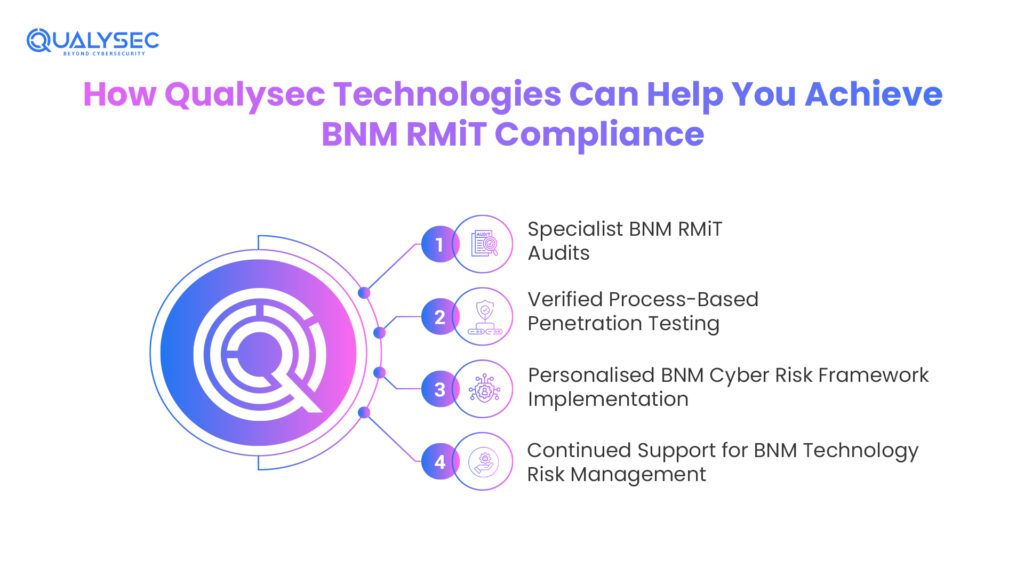
Qualysec Technologies assists Malaysian financial institutions in complying with the BNM RMiT as required in a short time and with precision. The experts will take you through all the components of the BNM technology risk management framework, making sure that you not only satisfy BNM cybersecurity regulations but also develop solid BNM operational resilience. Experts will make visible plans that ensure you are not a victim of the cyber threats that keep increasing in 2026 and beyond.
Specialist BNM RMiT Audits
Qualysec Technologies conducts comprehensive BNM RMiT compliance audits that are compatible with your technology. The certified auditors would review your systems against the risk framework of BNM and identify weaknesses in your governance, risk checks, and controls. They have simulated cyber scenarios that we run and report on in detail, providing the most important fixes first.
The teams consider the third-party connections and cloud setups to ensure compliance with the risk standards of BNM IT. You obtain fact-based discoveries that can be ratified by boards, immediately accelerating your journey to complete compliance.
Verified Process-Based Penetration Testing
The pentesting method employed by Qualysec Technologies is an established process-based approach in terms of compliance with BNM RMiT. Engineers work in a four-step method which includes discovery, penetration, gap analysis and certified remediation.
During the discovery step, all IT assets are enumerated and identified against the BNM IT risk management Malaysia. Penetration testing can then recreate such attacks, such as phishing and ransomware, against major services such as payment systems. All tests record timestamps and verifiable data, and hence, no confusion can arise during BNM inspections. In contrast to generic scans, this technique will cut false positives through repeated scans.
Personalised BNM Cyber Risk Framework Implementation
Qualysec Technologies develops tailored BNM cyber risk frameworks and supports them with 24/7 monitoring and multi-factor authentication. These experts have controls that prevent fake OTP redirects, fulfilling new BNM cybersecurity requirements.
The experts train your employees on incident reporting guidelines to make sure the alerts are delivered to the BNM cyber risk framework promptly. Organisations establish Cyber Resilience Frameworks based on automated workflows, reducing detection time, which is 187 days on the industry average, to hours.
Continued Support for BNM Technology Risk Management
Qualysec Technologies provides 24/7 assistance in maintaining your BNM technology risk management framework in good condition. The quarterly reviews ensure the controls are always sharp, and the annual penetration tests are in line with the required reassessment.
The experts assist in capacity planning and mapping interdependencies, which will prepare you for the future processing deadlines. In dashboards, they monitor compliance metrics in real-time, which provides senior management with the means to solve issues promptly.
| Service | Key Benefit | BNM RMiT Alignment |
| Risk Assessments | Identifies hidden vulnerabilities | Risk identification requirements |
| Penetration Testing | Validates control effectiveness | Cybersecurity testing mandates |
| Compliance Audits | Produces regulator-ready reports | Governance and oversight |
| Resilience Drills | Ensures service continuity | Operational resilience standards |
| Training | Builds internal expertise | Board and management responsibilities |
| Monitoring | Enables proactive defense | Continuous surveillance needs |
Qualysec Technologies is unparalleled in terms of value, providing tested process-based testing. Their thoroughness cannot be duplicated by any other provider – delivering BNM-ready compliance.
Planning for BNM RMiT compliance? Download the sample Penetration Testing Report to see how we help organisations secure critical systems.
Conclusion
Banks in Malaysia can do well at present by remaining focused on BNM RMiT Compliance rules. Leaders have to move more rapidly to implement the RMiT framework into daily operations. Directed and frequent tests protect the future by guarding it with good governance. Qualysec Technologies provides complete support.
Ready to achieve BNM RMiT compliance? Schedule a call with our cybersecurity experts today.

Frequently Asked Questions
1. What risks does BNM RMiT address?
BNM RMiT addresses cyber risks, operational interruptions, third-party vulnerabilities, and technology malfunctions within financial institutions. Institutions investigate BNM IT risk management in Malaysia, cloud risks, and interrelations and implement measures such as multi-factor authentication. Good governance identifies threats on time.
2. Is BNM RMiT compliance mandatory?
All regulated entities (those of banks, insurers, payment operators, and e-money issuers in Malaysia) have to comply with BNM RMiT. BNM revised the policy on November 28, 2025, and is very strict with it. The ultimate responsibility is with the board – violations of rules would result in on-the-spot fines. It can be neglected at the cost of operations and trust. Disobedience retains licenses and constancy.
3. How does BNM RMiT relate to cybersecurity?
BNM RMiT integrates cybersecurity into its model, requiring 24/7 monitoring, MFA, and binding transactions. When the primary threat involves credit theft, frequent, swift detection of incidents requires institutions to establish BNM operational resilience. Updates compel device-specific authentication against fake OTP fraud. In 2026, AI-based phishing is on the increase, and finance firms are combating it. This assimilation makes the complete system more resistant.
4. Does BNM RMiT require cybersecurity incident reporting?
BNM RMiT requires immediate reporting on cybersecurity incidents to BNM within limited timeframes for major events. Institutions establish playbooks and response workflows as automated to eliminate delays. The mean response time is 187 days, which increases the risk of an outage. Compliance refers to systematic notices, recovery plans, and lessons learned in order to prevent repetitions. The regulators seek transparency in the name of securing the entire industry.
5. What happens if an institution fails to comply with BNM RMiT?
Institutions incur administrative penalties if they do not comply with BNM RMiT. BNM is able to limit the activity and solicit fixes. Failure to comply evokes audits, a change of leadership, and loss of customers. Companies face years of scrutiny, which is undermining trust. Someone must prevent these extreme consequences promptly.
6. How often should RMiT controls be reviewed?
The regulators expect the institutions to review RMiT controls at least once a year as per BNM RMiT compliance requirements, and the boards to do so once a quarter, to ensure that they are effective. Risky areas such as cyber require semiannual thorough inspections, and an incident will lead to an immediate review. November 2025 updates will result in an ongoing audit in accordance with changing threats. Periodic reviews fulfil BNM cybersecurity needs, capacity planning and resilience testing. This timeframe makes this system flexible and audit-ready.