






According to Cisco’s Cybersecurity Readiness Index 2025, only 7% of Indian organisations feel fully prepared to defend against cyber threats. Nowadays, Indian organizations are publishing new apps, new APIs, and new customer experiences every week. With more speed comes another problem. If the security testing doesn’t keep up the pace, the threat will come. That’s why many security and DevOps teams are turning toward Automated Security Testing Tools. These tools bring continuous testing into the software delivery process. Vulnerability Scanning during development, staging, and deployment is vital.
In this blog, we explain what automated Security Testing tools are, how they work, which ones top the list in 2025, and how businesses can combine automation with human expertise for complete protection.
What Are Automated Security Testing Tools?
Automated security testing refers to the automated process of identifying vulnerabilities in applications, APIs, networks, or cloud systems by specialised software. These tools incorporate a set of pre-established test scripts, scanners, and AI-enhanced logic to identify vulnerabilities that may be used by attackers.
Thousands of endpoints and configurations can be scanned much more quickly by these tools than by any manual test.
Some automated security testing tools focus on source code and build pipelines; others simulate attacks on live applications. Together, they help teams maintain continuous visibility into their security posture.
Book a consultation with Qualysec’s security experts today!
Top 5 Automated Security Testing Tools
1. Qualysec
Qualysec offers one of the most advanced cloud vulnerability scanners in the industry. We seamlessly combine automation with expert manual validation for unmatched accuracy. Our hybrid testing model covers AWS, Azure, and Google Cloud environments, detecting weaknesses across configurations, APIs, containers, and web applications.
What truly makes Qualysec stand apart is the hands-on consultative approach. Each project includes detailed, prioritized reports, guided remediation support, and post-fix retesting to ensure every vulnerability is resolved.
Key features:
- Seamless vulnerability detection across multi-cloud environments
- Detailed, prioritized vulnerability reports
- Compliance-aligned assessments and regulatory mapping
- Ongoing monitoring and remediation validation
2. Burp Suite Enterprise Edition
Burp Suite has been a popular penetration testing tool. The PortSwigger Enterprise Edition is based on a scanning engine and automates the carcass of the scanner to work in a large-scale environment.
It works perfectly with piping mechanisms for CI/CD, such as Jenkins and GitLab, for all types of security teams to arrange periodic scans or initiate scanning after every build.
Key features:
- Automated DAST scanning with minimal manual setup
- Centralised dashboard for vulnerability management
- Authentication support for complex login workflows
- Integrations with Jira and Jenkins for DevSecOps workflows
3. OWASP ZAP (Zed Attack Proxy)
ZAP is one of the best open-source security testing tools, developed under the OWASP Foundation, and it is one of the most popular DAST tools in the world.
It is easy to use but potent enough to be used by intermediate and advanced users. There is a tendency to run lightweight key automated scans with ZAP as a part of CI/CD pipelines in security and QA teams.
Key features:
- Intercepting proxy for real-time traffic inspection
- Automated active and passive scanning
- Plug-in marketplace for extended functionality
- Scriptable API and command-line automation
4. Invicti
Invicti’s biggest strength is proof-based scanning. It is capable of automatically testing a large number of vulnerabilities by exploiting them in a controlled environment in a safe way. False positives are dramatically minimized, which becomes a significant source of frustration when using large teams with dozens of web assets.
Key features:
- Authenticated and unauthenticated scanning
- API and web application testing
- Detailed reporting with CVSS scoring and compliance mapping (ISO 27001, PCI DSS, etc.)
- Multi-user collaboration features for enterprise teams
5. Nuclei
Nuclei is a high-speed, scriptable scanning framework used by DevSecOps engineers and bug bounty professionals. It uses YAML-based templates to detect vulnerabilities across multiple asset types, from web applications and APIs to cloud environments.
Key features:
- Thousands of community-maintained templates
- Parallel scanning across massive environments
- CI/CD pipeline integration and vulnerability management platform integration.
- Open-source and highly customisable
Schedule a demo of our advanced Application Security Testing Tools today.
How to Choose the Best Automated Security Testing Tools?
The truth is that there are numerous tools out there, and, with the amount of existing choices, there is no problem in choosing a tool. However, it is critical to identify the one that suits your organisational goals, work processes, and work compliance requirements.
Take a look at how you can opt for the best Automated Security Testing Tools –
- Start with your assets.
Identify what you need to secure. It can be web apps, APIs, mobile apps, or cloud infrastructure. Not all tools cover every surface equally. - Check compliance alignment.
In case your company is governed by the ISO 27001, SOC 2, or HIPAA rules, select the tools capable of generating audit-ready reports and exportable pieces of evidence to regulators. - Look for CI/CD integration.
The most appropriate tools can be included in your DevSecOps pipeline. As an example, Burp Suite Enterprise and Invicti have Jenkins and GitLab runners. - Validate false-positive control.
Some tools verify vulnerabilities automatically by reproducing them, while others simply flag potential issues. Prioritise those that confirm findings to save engineering hours. - Review reporting and remediation support.
Choose a tool that goes beyond “issue found.” Reports should explain what it means, how to fix it, and where it was detected. - Test scalability and support.
Open-source tools like ZAP or Nuclei are great for smaller setups but need internal maintenance. Larger firms may prefer managed or hybrid models like Qualysec’s process-based framework, which combines automation, human review, and retesting.
Benefits of Using Automated Security Testing Tools
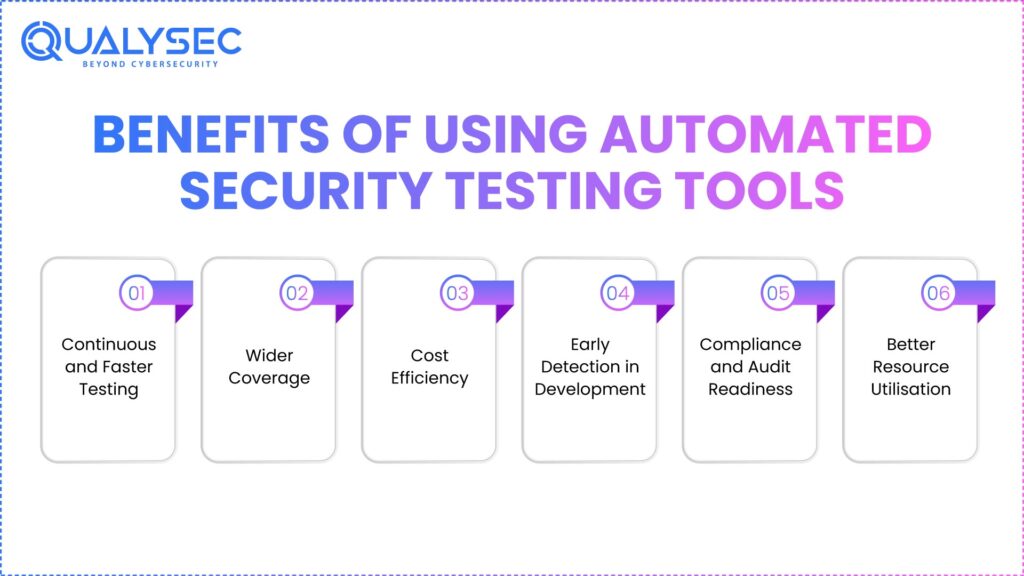
Automated security testing tools are now a necessity for the teams that deliver software regularly or whose environment is intricate and cloud-based. While they don’t replace expert-driven testing, they offer significant advantages that strengthen both security posture and productivity.
1. Continuous and Faster Testing
Scans can be executed with automated pen testing tools as a part of your development or CI/CD process. Such tools can point out weaknesses each time new code is deployed. This helps to eliminate the distance between development and security and assists teams in locating and resolving problems before they hit production.
Tools such as Invicti and Burp Suite Enterprise enable scheduled or triggered scans, providing security teams with almost real-time data, without delaying release.
2. Wider Coverage
Manual testing is comprehensive and time-constrained. Hundreds of applications, microservices, and APIs can be covered at the same time with the help of automated penetration testing tools.
They aid in the detection of common threats like SQL injection, XSS, weak authentication, and weak setups, which otherwise would have never been detected in manual testing.
3. Cost Efficiency
It is much more cost-effective to have automated scans as opposed to having several full-scale manual penetration scans.
The extent of automation enables companies to have a minimum level of security assurance without having to strain their budgets by performing manual testing prior to any major release or passing compliance audits.
4. Early Detection in Development
Static (SAST) and interactive testing (IAST) tools detect coding vulnerabilities during early development, long before deployment.
This saves both remediation time and cost, since fixing vulnerabilities post-release can be up to 10 times more expensive, according to IBM’s Cost of a Data Breach Report.
5. Compliance and Audit Readiness
The majority of compliance standards, like ISO 27001, SOC 2, and HIPAA, demand evidence about the routine security tests.
This is facilitated by penetration testing automation tools that produce audit-worthy reports that show the frequency of the test, vulnerabilities identified, and fixes implemented.
6. Better Resource Utilisation
Repetitive scanning can be carried out by automation so that the human tester can concentrate on more complicated attack simulations, chained exploits, and flaws in the business logic.
Conclusion
The modern security team has changed its operations due to automation. It is fast, predictable, and early, which are vital in rapid development cycles. However, there is not a single tool that can be compared to human capacity to analyze risk or use logic gaps innovatively. That is why opting for the best automated security testing tools is the best decision.
At Qualysec, we opt for a process-based hybrid model. Our specialists combine the effectiveness of automated testing with a thorough manual validation, elaborate reporting, and compliance mapping. It is an evidence-based practice that is pragmatic and assists companies in remaining safe, audit-compliant, and sure about any launch.
Request a demo for application vulnerability assessment.

FAQs
1. What Are Automated Security Testing Tools?
Automated security testing tools refer to software applications that continually scan applications, APIs, and infrastructure to test for vulnerabilities based on predefined checks, code scripts, or simulation methods. They detect vulnerabilities such as SQL injections, cross-site scripting, and misconfigurations much faster than manual methods.
2. Why Is Automated Security Testing Important?
The reason why automated security testing is essential is that software is changed every day. Manual testing is not able to keep pace with the high pace of releases. Automated penetration testing guarantees that all the builds and deployments are security checked to eliminate vulnerabilities and seal gaps before they are discovered by attackers.
3. Which Are the Best Automated Security Testing Tools in 2025?
There are multiple automated security testing tools you can find in 2025. For example, if you need testing for an enterprise, the best choice is Burp Suite Enterprise Edition. On the other hand, for proof-based scanning, Invicti is the ideal option. However, if you are eager to opt for reliable and accurate pen testing, you can choose Qualysec.
4. What Is the Difference Between Automated and Manual Security Testing?
Wondering about Manual vs Automated Pen Testing. Take a look at this:
- Automated testing runs scans using software and predefined logic. It’s faster, repeatable, and suitable for ongoing security maintenance.
- Ethical hackers who think creatively, chain exploits, and identify business logic flaws that automation can’t detect, perform manual testing.