

The SEBI cybersecurity model has changed the way financial institutions in India are dealing with security. Besides, due to the ever-changing cyber threats, the compliance requirements are becoming tighter in regulatory bodies across the globe. In August 2024, a broad Cybersecurity and Cyber Resilience Framework (CSCRF) was published by the Securities and Exchange Board of India (SEBI) to be applicable to different regulated entities. As a result, financial organisations need to incorporate effective security practices that include frequent penetration tests as a way of ensuring that confidential information is safeguarded and that the organisation adheres to the regulations. Moreover, this framework is a notable change in the approach of participants in the markets to cybersecurity issues in a more digital world.
What Makes the SEBI Cybersecurity Framework Critical for Financial Organisations?
Understanding the Scope of SEBI Regulations
The SEBI cybersecurity framework applies to a wide range of financial institutions in the Indian securities market, ensuring security compliance for financial institutions. It also removes all the existing issues of circulars and develops a consistent manner of addressing cybersecurity. Based on the framework, there are five types of Regulated Entities: Market Infrastructure Institutions (MIIs), Qualified REs, Mid-size REs, Small-size REs and Self-certification REs.
The classification depends on several factors:
- Asset Under Management (AUM) for mutual funds, portfolio managers, and Alternative Investment Funds (AIFs)
- Active client base for stock brokers
- Number of folios serviced for Registrar and Transfer Agents (RTAs)
- Type of operations for custodians and depository participants
Thus, the initial move towards compliance would be to know what category your organisation belongs to. Thresholds and categories of regulated entities under the CSCRF were revised by the regulator, where Portfolio Managers with Assets Under Management of Rs 10,000 crore and above would be considered as Qualified REs.
Key Requirements Under Cyber Security SEBI
The cybersecurity SEBI regulations impose a number of important security measures. To begin with, every regulated body should develop a detailed policy of cybersecurity and cyber resilience. Second, certain technical controls are to be implemented in organisations, which are dependent on their classification. Third, regular audits and evaluations are required.
The REs must record and enforce the authentication, access policies, log collection and retention policies, and must also design and deploy network segmentation methods to limit access to sensitive data, hosts, and services. Also, the framework stresses continuous monitoring and threat detection.
| Entity Type | AUM/Client Base Threshold | Category | Key Requirements |
| AIFs | INR 1000+ crores | Qualified REs | ISO 27001, Red Teaming, SOC |
| Stock Brokers | 5,00,000+ active clients | Qualified REs | VAPT, API Security, CCMP |
| Mutual Funds | INR 1 lakh+ crores | Qualified REs | Data Encryption, Audit Reports |
| Portfolio Managers | INR 3000-10000 crores | Mid-size REs | Risk Assessment, VAPT |
| RTAs | 1-2 crore folios | Mid-size REs | Access Control, Monitoring |
Learn How Cybersecurity in the Banking Sector Protects Your Bank
How Does Penetration Testing Address SEBI Compliance Requirements?
The Role of VAPT in Meeting Regulatory Standards
Penetration testing is a foundation of the SEBI cybersecurity compliance plan. In particular, Vulnerability Assessment and Penetration Testing (VAPT) will be conducted to identify vulnerabilities in the IT environment of all critical systems, the components of the infrastructure, and other IT systems. Hence, this is a requirement that cannot be ignored by financial firms.
VAPT can assist organisations in several forms:
- Identifying Security Gaps: Penetration testers mimic actual attacks to help identify areas of weakness before attacks can be perpetrated by bad actors.
- Validating Security Controls: This is done to determine whether the security controls implemented are functioning as intended.
- Meeting Audit Requirements: VAPT reports are a demonstration of due diligence in regulatory auditing.
- Reducing Breach Risk: Proactive testing can significantly reduce the likelihood of successful cyberattacks.
- Building Stakeholder Confidence: Frequent security evaluations will show the desire to take care of the data of clients.
- Supporting Continuous Improvement: Test results guide security enhancement initiatives.
Aligning Penetration Testing with SEBI Guidelines
The SEBI framework of cybersecurity demands varying testing rates depending on the classification of entities. Furthermore, the testing should include all the critical systems such as client-facing applications, internet-facing systems, as well as back-end infrastructure. An empanelled IS auditing organisation, under CERT-In will conduct periodical audits to audit the implementation process and ensure adherence to the relevant standards and required guidelines.
Consequently, it is recommended that organisations come up with an elaborate testing schedule. Besides, they should ensure that penetration testing includes:
- Network Infrastructure: firewalls, routers, switches and network segmentation.
- Web Applications: Trading applications, client portals, and mobile applications.
- APIs and Interfaces: Application Programming Interface (API) security and Endpoint security solutions shall be provided with rate limiting, throttling and effective authentication and authorisation measures.
- Cloud Environments: Cloud-based services and storage, where applicable.
- Social Engineering: Evaluation of awareness and reaction of employees to phishing.
- Physical Security: Data Centre and Infrastructure Accessibility.
Why Should Financial Firms Prioritise Red Teaming Exercises?
Beyond Traditional Penetration Testing
Whereas typical penetration testing reveals the technical vulnerabilities, red teaming is intelligent security testing at a new level. Notably, MIIs and Qualified REs will undertake red teaming exercises as a component of their cybersecurity program, which is described as an exercise that simulates the real-world situation and is undertaken as a simulated adversarial endeavour to disturb company missions or business processes.
The benefits of red teaming exercises are as follows:
- Realistic Attack Scenarios: Teams are taken through complex multi-vector attacks which reflect the behaviour of threat actors.
- Testing Detection Capabilities: The exercises will establish whether the Security Operations Centres (SOCs) would be in a position to detect and react to the attacks.
- Validating Incident Response: Organisations subject Cyber Crisis Management Plans (CCMP) to real-world testing.
- Identifying Process Weaknesses: In addition to technical faults, red teaming reveals the weaknesses of practices and people.
- Comprehensive Security Assessment: This entails an assessment of the security capabilities of an organisation and its systems in detail.
Learn How Red Team Cybersecurity Protects Your Business
Implementing Effective Security Operations Centres
The cybersecurity SEBI framework gives a lot of attention to constant monitoring. REs will implement the right security measures in the form of a Security Operations Centre (SOC) that can be located in the RE itself or in a collective body, or even with a third party. Also, the SOC should perform the ongoing monitoring of security incidents to ensure that abnormal behaviours are identified promptly.
In the case of smaller entities, the Bombay Stock Exchange (BSE) and the National Stock Exchange (NSE) have been required by the SEBI to establish Market SOC, where small-sized REs and Self-certification REs will be onboarded. Thus, smaller entities will have access to enterprise-level security monitoring.
What Are the Consequences of Non-Compliance and How to Avoid Them?
Understanding the Risks of Inadequate Cybersecurity
When financial firms do not comply with the requirements of the SEBI cybersecurity framework, they suffer greatly. To start with, fines imposed by the regulators can be huge. Second, the reputational losses associated with a security breach may kill decades of trust with clients. Third, interruptions to operations in responding to the incident may cost millions.
SEBI explained that its cybersecurity framework would only apply to systems that are solely used in regulated operations, and shared infrastructure would also be audited unless already handled by the RBI or a different regulator. Thus, companies are not able to get away with turning a blind eye by saying that their systems have several functions.
Learn more on RBI Cybersecurity Framework
Building a Comprehensive Compliance Strategy
Organisations ought to take a systematic approach to ensure that their policies are compliant with SEBI cybersecurity:
1st Phase: Assessment and Planning (Months 1-3)
- Identify the classification of entities using CSCRF.
- Gap analysis against the requirements of SEBI.
- Establish a compliance roadmap with objectives.
2nd Phase: Implementation (Months 4-9)
- Implement compulsory security measures that are classification-based.
- SOC capabilities need to be established or strengthened.
- Use data encryption and controls of access.
- Policy and procedure of document security.
3rd Phase: Testing and Validation (Months 10-12)
- Conduct comprehensive VAPT across all critical systems
- Perform red teaming exercises (if applicable)
- Test incident response and disaster recovery plans
- Obtain ISO 27001 certification (if required)
4th Phase: Monitoring and Reporting (Ongoing)
- Maintain continuous security monitoring through SOC
- Submit compliance reports as per SEBI timelines
- Conduct periodic audits by CERT-In empanelled auditors
- Update security measures based on emerging threats
Moreover, zero-trust principles in the form of network segmentation, high availability, and single-point avoidance must be implemented in regulated entities with the consent of their IT Committees.
Why is Qualysec the Best Partner for SEBI Cybersecurity Compliance?
Leading the Way in Financial Security Testing
In the case of attaining SEBI compliance with the cybersecurity framework, the selection of the appropriate security partner is everything. Qualysec is the leading penetration testing and security assessment firm for financial institutions, both in India and in any other country.
Why Financial Firms Trust Qualysec:
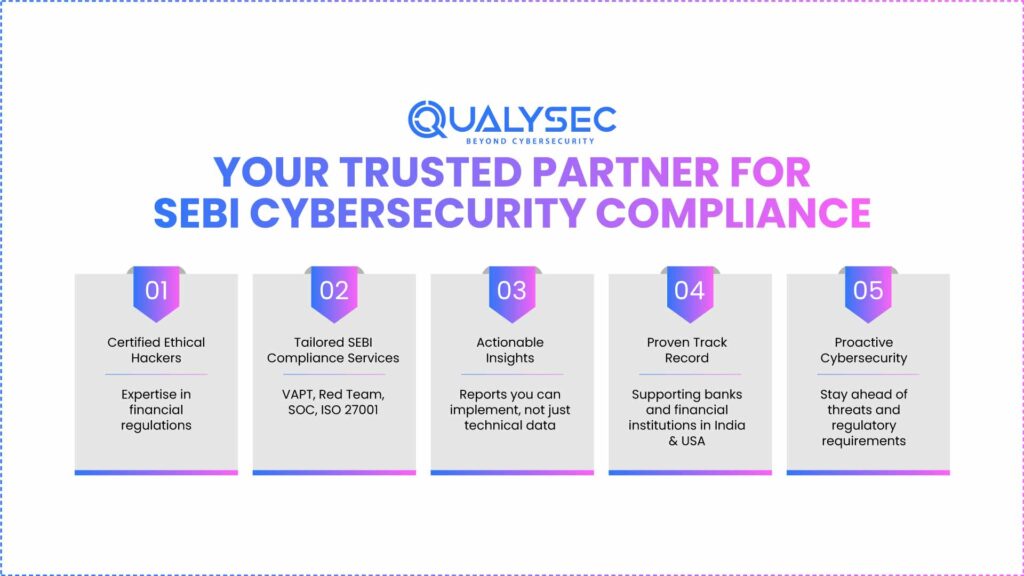
Qualysec introduces unrivalled competence to SEBI compliance issues. To begin with, they have a team of ethical hackers who are certified and have extensive knowledge of the regulations in the financial sector. Second, they are aware of the special operational limitations that trading platforms and financial services are subject to. Third, Qualysec will provide actionable information as opposed to mere technical reports.
Comprehensive Services Aligned with SEBI Requirements:
Qualysec has a full range of services tailored towards cyber security SEBI compliance:
- VAPT Services: Comprehensive vulnerability testing and penetration testing, including web applications, mobile applications, networks and API.
- Red Team Exercises: Advanced Adversarial exercises that put your whole security posture to the test.
- Compliance Audits: Gap analysis and remedial advice on CSCRF requirements.
- SOC Setup and Enhancement: Security Operations Centre support.
- ISO 27001 Consulting: Advice on certification needed to be QREs and MIIs.
- Incident Response Planning: Cyber Crisis Management Plans Development and testing.
Proven Track Record:
Qualysec is a company that is based in India and has a significant presence in the USA, where it has assisted various financial institutions in ensuring and sustaining regulatory compliance. Their procedures are fully in line with the standards of CERT-In and SEBI expectations. In addition, Qualysec offers comprehensive documentation that can be submitted to the regulatory authorities.
Visit Qualysec to explore their comprehensive security solutions. Their expert team understands the nuances of the SEBI cybersecurity framework and can tailor testing programs to your specific classification and needs.
Take Action Today:
It is not until a security incident or a regulatory notice that you will resolve your cybersecurity gaps. Schedule a free consultation with Qualysec now and see how SEBI compliance works today. Their security team will assess your present state of compliance and build on a unique roadmap to complete compliance.
Furthermore, download valuable security resources to the Qualysec knowledge base in order to learn the best practices of penetration testing and compliance. As cyber threats are becoming more dynamic every single day, by collaborating with Qualysec, it is guaranteed that your organisation is ahead of its competitors and the government.

Conclusion
The SEBI cybersecurity framework is a landmark event in the security of the financial sector in India. Furthermore, it provides transparent, enforceable standards that safeguard institutions as well as investors. Penetration testing is an important instrument towards compliance in this framework. Moreover, companies that are proactive to these requirements will be in a better position to address the arising cyber threats.
The framework of SEBI promotes the use of such tools as threat simulation, vulnerability management, and decoy systems, which are not mandatory. Thus, progressive organisations must think of going beyond requirements. Also, in the case where regulated entities are in accordance with RBI or other regulator cybersecurity regulations that are equal to that of SEBI, the markets watchdog will consider compliance.
To achieve success, a holistic and integrated approach that involves technology, processes, and people is needed. Financial organisations need to invest in an effective security infrastructure, perform frequent testing and employee training, and keep watch over employees by constant monitoring. The compliance schedule is also obvious, and organisations should take action and ensure that they meet the deadline and develop sustainable security programs.
FAQ
1. What is the SEBI Cybersecurity Framework, and which firms must follow it?
SEBI Cybersecurity Framework is a set of standards of security that have been reinforced in August 2024. It applies to a range of regulated organisations such as stock brokers, mutual funds, AIFs and portfolio managers, among other financial institutions, which fall within the securities market in India.
2. Why is penetration testing crucial for SEBI-regulated financial organisations?
Penetration testing assists in identifying the vulnerabilities in critical systems before attackers put them to use. The SEBI regulations on cybersecurity require periodic VAPT to guarantee that the financial institutions have strong security measures and safeguard confidential client information.
3. How frequently should SEBI-regulated firms perform penetration testing?
The frequency of testing is subject to the classification of entities based on the cybersecurity SEBI framework. REs and MIIs are usually required to be assessed after half a year, whereas the minimum requirement for mid-size and small REs is to undergo testing once a year.
4. What are the key benefits of combining SEBI compliance with security testing?
Organisations will achieve regulatory compliance, lower risk of breach, enhance client trust and secure information. The SEBI framework on data protection and security guarantees that companies adopt best security practices that help mitigate the emerging cyber threats.