

Cloud computing security means ensuring that the applications, services and data we interact with daily (think email, payroll, websites, backups) are as safe as they can be in the cloud. All of this data is sitting on remote servers and powerful computers somewhere else. Good security is all about adding layers of security to keep your data from leaking, being stolen, or experiencing downtime.
To put it simply, cloud security is the implementation of security tools and best practices with the goal of identifying problems early and avoiding damage in the first place. The cloud allows businesses to achieve speed and scale, but with speed comes new risks. In this article, we will break down cloud security in basic terms and present the six pillars of cloud security that you should familiarise yourself with.
What Is Cloud Computing Security?
Cloud computing security (also known as cloud security) consists of tools, controls, policies, and practices to secure assets hosted in the cloud. This includes applications, data at rest and in transit, and the infrastructure that secures this.
Cloud security can include everything from identity (who can log in) to how a customer can encrypt data, how networks are segmented, and how incidents will be detected and handled.
It also encompasses the shared responsibility model of the cloud provider and customer. Good cloud security strikes a balance between protecting the cloud, usability, and cost.
Understand your cloud risks—request a full security risk assessment.
Why Cloud Security Matters More Than Ever
An increasing number of organisations have migrated their most critical systems to the cloud, and, not surprisingly, attackers always follow the data. Cloud incidents commonly arise from misconfigurations, weak identities, and silos between teams.
Attacks using artificial intelligence are occurring more rapidly than ever, and supply-chain risks are growing. This exposes cloud providers, and their business users, to more risk. When a breach occurs, there is an impact beyond repairing the breach: damaged trust from customers and potentially significant financial ramifications.
For these reasons, an increasing number of businesses are considering cloud security services a priority, rather than an afterthought. Industry reports have shown how costly breaches have become, and how AI introduces additional risk.
Find and fix your cloud security gaps with Qualysec today! Get expert insights to strengthen your cloud infrastructure and stay fully protected.
The Top 6 Pillars of Cloud Security
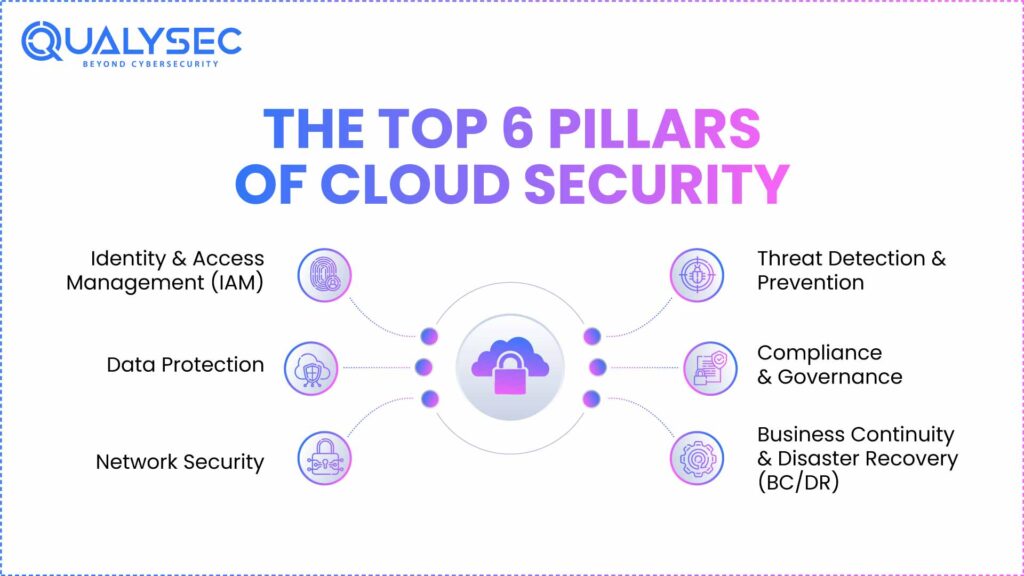
To protect cloud environments, think of pillars – core grips/pillars you must address, so nothing extreme slips through the cracks. These pillars, when pooled together, allow teams to design, operationalise, and improve security in the cloud without relying on one tool or mode/method. Cloud penetration testing helps identify vulnerabilities while teams design and improve security. Below each of the pillars are explained in a simple manner:
1. Identity & Access Management (IAM)
Identity and access management (IAM or IdAM) determines “who” or “what” can access cloud resources. In other words, FMFA, least-privilege roles, and stringent session control comprise strong/authentic IAM. In its absence, an attacker is free to use stolen credentials to roam through your cloud. Always use role-based access, use short-lived credentials for automated systems, and perform regular access review. When your identity is solid, the attacker makes the rest of your cloud a lot more difficult to access.
2. Data Protection
This is fundamentally the process of shielding sensitive data – whether it’s in the cloud or in transit over the network. The goal is that if the data gets into the hands of an unauthorized person, it cannot be read or stolen. This is accomplished through protecting the data when at rest, in transit, and providing extra protection to the most sensitive data. In addition, consider the use of obfuscation for development copies and backups , this is a common leak point for secrets, particularly in test environments. Additionally, the trends of post-quantum cloud data security and confidential computing are advancing in this area as we move toward 2025.
3. Network Security
Cloud-based Network Security uses segmentation, firewalls, secure gateways, and the concept of zero-trust networking to limit lateral movement. As opposed to trusting everything within the network, cloud-based networking is now strictly defined for services and users. Tools like SASE and SSE can help centralise policy and logging for cloud-distributed and remote users. Having the right network controls helps to reduce the blast radius when an attacker gains access.
4. Threat Detection & Prevention
This means monitoring your cloud environment closely so that, if there is any suspicious activity, it can be identified quickly. The quicker a threat is detected, the quicker it can be remediated. Effectively, cloud cyber security is similar to a security system that monitors your environment, determines when to notify you, and takes steps to prevent bad actors from compromising your cloud.
Because scale renders manual response too slow, machine learning, behavior analytics, and automated playbooks have become common. The investment in detection is rising, as attackers continue to incorporate AI and automation.
5. Compliance & Governance
This addresses ensuring that enterprises abide by compliance rules/regulations and standards for utilising the cloud. Those compliance rules assist in safeguarding customer data as well as promoting trust with customers and external regulators.
Effective governance enables policies to remain uniform across distributed teams and multiple cloud providers. Conducting periodic audits/reviews and updates helps to keep an organisation’s policies current. If they fail to do so, the consequence could mean fines/penalties, lost business, and damage to their reputation.
6. Business Continuity & Disaster Recovery (BC/DR)
BC/DR is all about planning for outages, data loss, or ransomware incidents. This pillar helps ensure that backups are reliable, recovery plans are properly executed, and that failover is drilled. In the cloud, you should regularly do test restores, keep a backup immutable, and design for regional failures or outages from providers. The faster we can recover and the more tests that are done, the less downtime and damage after an incident.
Download our sample cloud penetration testing report to see how we uncover and fix critical vulnerabilities.
Best Practices for Cloud Security
An intelligent pratices is to embrace a Zero Trust mindset,always assume that a breach can happen and establish your planning on that assumption. Automating security checks to catch mistakes early on, before the issue spirals out of control, is quite a proactive step.
Utilising contemporary security technologies makes it possible for teams to identify risks across the entirety of systems, applications, and data to patch vulnerabilities in a timely fashion. For extremely sensitive data, ensure that this data is securely stored with strong encryption and secure computing processes.
Train employees on cloud security best practices and risk tabletop exercises in relation to incident response. Lastly, plan for existence in the AI era , securing models, data serving as inputs to training, and guardrails around LLM usage. Many vendors have packaged many of these capabilities together, as clouds and workloads are more complex than ever.
Schedule a call today to strengthen your cloud computing security with Qualysec!
Conclusion
Cloud computing security is not a single product but a collection of practices and tools associated with the six pillars: IAM, data protection, network security, threat detection, compliance, and BC/DR. As cloud use increases and adversaries get smarter (believe it or not, using AI), organisations will need to continue investing in automation, visibility, and identity-first controls.
Small wins with efforts such as limiting roles, automating vulnerability scans, and testing restores yield rapid benefits. If you consider these pillars your checklist, you’ll be much more resilient and prepared for the threats 2025 will bring.
Protect your business with Qualysec’s cloud security strategies. Get in touch with us today!

FAQ’s
1. What does cloud computing security mean?
Cloud computing security is a set of tools, rules, and processes to provide protection for data, applications and systems within a cloud computing environment. It ensures the right people can access the data and that information remains confidential. It also continuously monitors for threats. Both the organisation using the cloud service and the cloud service provider are responsible for securing data, applications, and systems.
2. What are the top five security features of cloud computing?
The five key characteristics include managing data access, which provides confidentiality and privacy using encryption technology, securing connections in the cloud network, monitoring and detecting threats, and compliance. All of these measures ensure that sensitive information is protected while getting the organisation ready to address various cyberattacks and risks in the cloud.
3. What are the categories of cloud security?
Cloud security is most often categorised by data security, identity and access management, application security, network security, and compliance. Each category impacts an aspect of cloud security, and when aggregated, it creates an ongoing, layered security measure that can ensure data is secure, applications are secure, and compliance adheres to standard operating procedures.
4. What are the 4 C’s of cloud security?
The four C’s of cloud security are Cloud, Clusters, Containers, and Code. These represent the layered approach of protecting cloud environments. Protecting each layer , all the way from application code up to the cloud infrastructure, minimises risks and improves overall security.
Secure your cloud today—chat with Qualysec’s AI chatbot to assess your defenses instantly!