

Cybersecurity Companies in Singapore recorded a significant year-on-year rise in phishing attempts in 2024, according to the CSA Singapore Cyber Landscape 2024 report published by the Cyber Security Agency of Singapore. In 2024, the Singapore Police Force confirmed that total scam losses had hit S$1.1 billion – the largest annual figure ever reported. Cyber threats are not slowing down. They are getting more expensive.
Organizations in the finance, e-commerce, logistics and SaaS industries need more than simple protection. They require cybersecurity companies that provide penetration testing, cloud and mobile apps security, and compliance assistance in line with PDPA, ISO 27001, MAS TRM, and GDPR.
This report provides a list of the 10 best Cybersecurity companies in Singapore in the year 2026. These companies are all chosen according to verified service depth, client-facing compliance capabilities, technical know-how, and market penetration – not mere popularity. This list provides you with a real starting point, whether you are preparing a fundraiser, auditing, or just trying to gain the trust of your client.
Why Does Singapore Need Strong Cybersecurity in 2026?
(I) Regulations Now Have Real Consequences
Singapore’s regulatory environment has teeth. The amended PDPA of Singapore, which came into effect in February 2021, allows the PDPC to impose financial fines of up to SG$ 1 million or 10 percent of the annual turnover – whichever is greater. During 2022-2024, the PDPC presented enforcement decisions that covered organisations in the healthcare, financial, and retail sectors. The MAS TRM Guidelines make it mandatory that financial institutions have periodic, formal penetration tests. Companies that have a history of not conducting security testing are put under increased scrutiny when they undergo MAS tests.
Compliance is not a future goal. It is an active enforcement reality.
(II) The Talent Gap Drives Outsourcing
According to the ISC2 Cybersecurity Workforce Study 2024, it is reported that there is a shortage of professionals in cybersecurity in the world (4.8 million). Asia-Pacific is one of the regions with the fastest shortage. Cybersecurity Companies in Singapore cannot hire their way out of this problem. Instead, they outsource expert services – penetration testing, cloud security, and compliance advisory – to outside vendors.
(III) Cloud Adoption Creates New Attack Surfaces
Companies migrating to AWS, Azure, and multi-cloud SaaS are now exposed to API, microservice, and containerised deployment vulnerabilities. According to the CSA, vulnerabilities in web applications and phishing are the two most frequent attack points in 2024 in Singapore. The adoption of the cloud does not generate new risk categories. It scales existing ones across a wider and less visible surface.
(IV) Security Is Now a Board-Level Concern
Before funds are raised, investors need evidence of security maturity. Before enterprise clients sign contracts, they demand security documentation. As part of supervisory examinations, regulators check security posture. Cybersecurity evaluation has become a boardroom issue.
Our Evaluation Methodology
In this list, we screened more than 50 vendors. Our standards provide objective and practical recommendations.
- Technical Rigour: We evaluated VAPT depth, false-positive rates, and exploit verification.
- Compliance Alignment: We verified compliance with PDPA, ISO 27001, SOC 2, and MAS TRM.
- Client Impact: We examined remediation support, report clarity, and retesting policies.
- Market Presence: We checked local experience, reaction time, and industry specialisation.
Why Qualysec Ranks First: Across the four criteria above, Qualysec scored highest in technical methodology, compliance-ready reporting format, and post-assessment remediation support. This would be most applicable to SaaS and fintech organisations – the two leading segments of Cybersecurity Companies in Singapore in 2026. This ranking is a criteria-based evaluation. It is not a commercial arrangement.
Comparison Table: Top 5 Cybersecurity Companies in Singapore
This table compares the leading vendors to help you decide quickly.
|
Company |
Best For |
Key Strength |
Pricing Model |
Compliance Focus |
|
Qualysec |
SaaS, Fintech, Audits |
Human-led AI-powered testing, Auditor-ready reports, Human-verified findings only. |
Project-based. VAPT starts at S$3,000. Includes retesting. |
SOC 2, ISO 27001, PDPA, GDPR, HIPAA. |
|
Ensign InfoSecurity |
Enterprises, Government |
Regional scale, Proprietary analytics, Large SOC operations. |
Enterprise contracts. Annual retainers. High-ticket |
MAS TRM, Government standards, ISO 27001. |
|
ST Engineering |
Defense, Public Sector |
National infrastructure security, OT protection, and war-gaming. |
Government tenders. Large custom projects. |
Defense standards, CSA, Critical Infra. |
|
Horangi |
Cloud-Native, Startups |
Warden platform, Real-time monitoring, AWS expertise. |
SaaS subscription + Project fees. Scales with usage. |
ISO 27001, SOC 2, CIS Benchmarks. |
|
SecureAge |
Data Protection |
Zero-trust encryption, Signature-less detection, CatchPulse. |
License-based per endpoint or server. |
PDPA, Data residency, Encryption standards. |
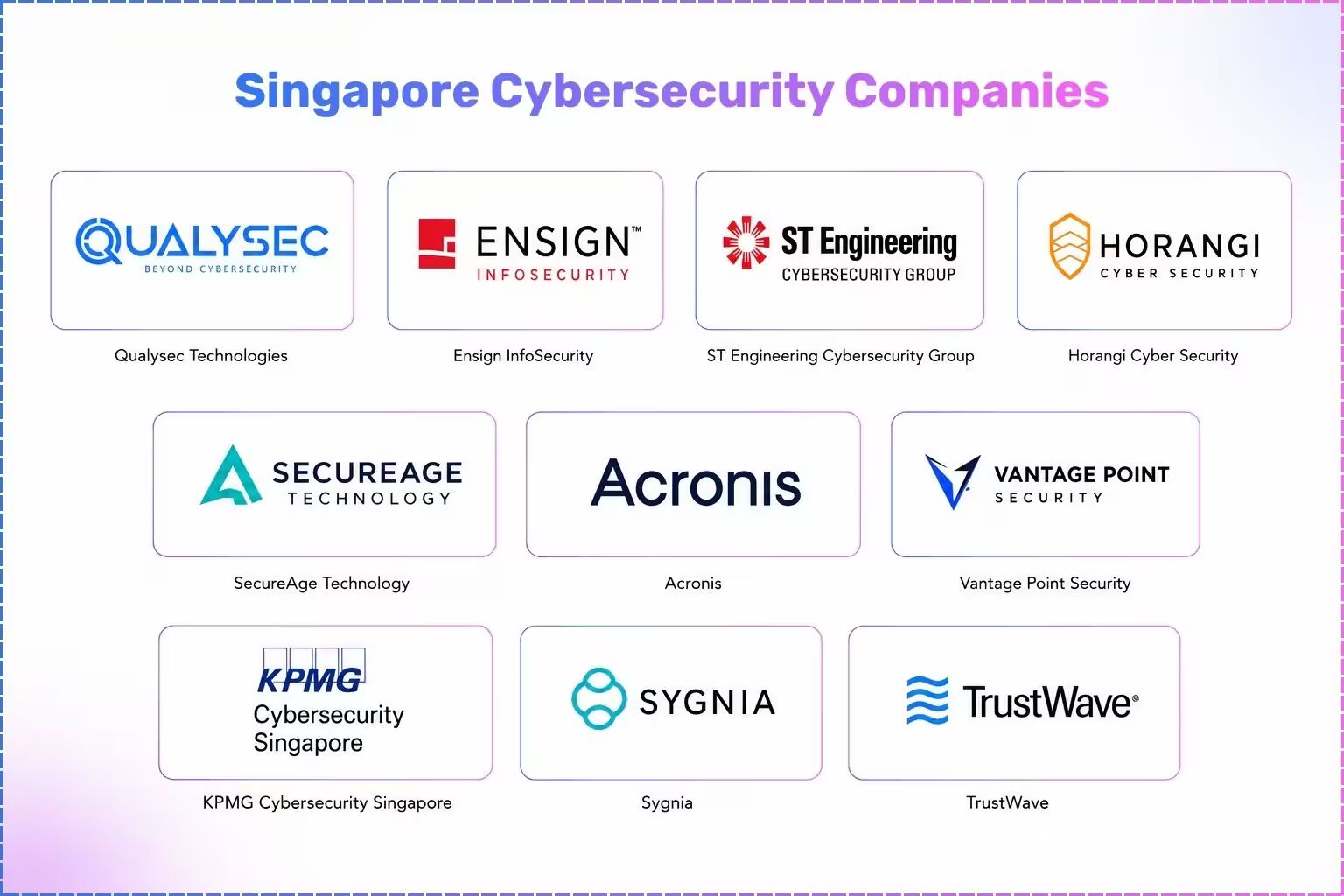
Top 10 Cyber Security Companies in Singapore
1. Qualysec Technologies
Best on: SaaS, fintech, mobile-first, API security, compliance-driven organisations.
Starting price: S$3,000- Penetration testing of web applications.
Qualysec delivers human-led AI penetration testing, VAPT, and security consulting. Every engagement combines automated discovery with manual expert testing. This hybrid approach finds business logic flaws, authentication bypasses, and API-level exposures that purely automated tools miss.
Services offered:
- Web Application Penetration Testing.
- Mobile Application Penetration Testing (iOS and Android)
- API Penetration Testing
- Cloud Security Penetration Testing.
- IoT Penetration Testing of Devices.
- AI/ML Penetration Testing
- Compliance- aligned VAPT – ISO 27001, SOC 2, PDPA, MAS TRM, HIPAA, GDPR, PCI-DSS.
Compliance alignment: The reports are directly linked to the ISO 27001 Annex A controls, MAS TRM technical risk requirements, OWASP Top 10, and PDPA data protection requirements. The report is sent straight to your auditor without the need of being translated by an internal team.
Pros
- Retesting included as standard
- Compliance-ready audit reports
- Covers AI/ML security testing
Cons
- Currently expanding global reach
- Requires a advance booking schedule.
- Rapidly growing enterprise portfolio

2. Ensign InfoSecurity
Best fit: Large companies, government-connected organizations, critical infrastructure operators.
Starting price: Custom quote depending on the scope and period of engagement.
Ensign InfoSecurity is one of Asia’s largest pure-play cybersecurity organizations. It has its headquarters in Singapore and deals with enterprise clients in the region.
Ensign has its own proprietary Cyber Analytics. This platform identifies sophisticated threats by behavioral and threat intelligence – not only signature-based detection. This is important because organizations that are dealing with complex threats that are lasting and not commodity-based.
Services offered:
- 24/7 Security Operations Centers that have real-time response capability.
- Digital forensics and incident response
- Security consulting and risk management.
- Managed security services
- Cyber intelligence and threat intelligence.
Ensign has a history of winning national-level and large-scale public infrastructure projects in Singapore. It collaborates with government-related organizations and operators of key infrastructures in the region.
Pros
- Strong government-sector experience
- Proprietary threat analytics platform
- 24/7 regional SOC coverage
Cons
- Pricing not publicly available
- Not as well-suited for startups.
- Minimum engagement scope is large
3. ST Engineering Cybersecurity Group
Best in: Government, defense, maritime, aviation, utilities.
Initial cost: Custom quote – generally enterprise agreements.
The cybersecurity unit of ST Engineering supports industries in which operational technology security is as critical as IT security. Maritime navigation systems, aviation infrastructure, and utility control systems all demand security skills that most of the commercial firms lack.
Services offered:
- War-gaming and simulation of cyber defense at the national level.
- Tailor-made defense and aerospace secure hardware.
- Maritime, aviation, and utility OT environment security.
- Critical infrastructure managed security services.
- Risk assessment and incident response.
Pros
- Advanced OT security knowledge.
- National defense-grade capabilities
- Strong critical infrastructure coverage
Cons
- Not suited for SMEs
- No published pricing
- Less focus on cloud-native
4. Horangi Cyber Security
Best for: Companies that use AWS a lot, SaaS companies, and startups that are based in the cloud.
Starting cost: Roughly S$5,000 for penetration testing assignments
Horangi is a cybersecurity firm started in Singapore. With great support for AWS settings and growing coverage across multi-cloud deployments, its Warden platform offers real-time cloud security posture monitoring. This makes Horangi very useful for companies that require ongoing cloud compliance monitoring together with active offensive testing.
Services provided:
- Web and API penetration tests
- social engineering checks and red teaming
- A platform for managing Warden cloud security posture
- Real-time compliance tracking for ISO 27001, SOC 2, and CIS standards
- Services related to incident response
Pros
- Monitoring cloud compliance in real time
- Built for fast-scaling startups
- Hands-on offensive testing included
Cons
- Strongest just on AWS
- Limited depth of corporate MSSP
- Warden coverage varies by cloud
5. SecureAge Technology
Best for: Government, defense, organizations mostly concerned with data privacy, Finance, healthcare
Starting price: Personalized estimate depending on the scope of deployment
SecureAge builds data security on a zero-trust, data-centric model. By default, it encrypts data when it is at rest, in motion, and in use. This contrasts with perimeter-based security, which safeguards the border but leaves data unprotected once it is violated.
Services available:
- Automatic file encryption based on policies with SecureData
- CatchPulse – signature-free endpoint defense leveraging zero-trust application control
- Government and business settings’ infrastructure security
- Data loss prevention integration
Based on internal records, which an outside audit has not separately verified, SecureAge asserts it has kept a record of zero customer data breaches throughout its more than 20 years of operational history.
Pros
- Zero-trust encryption by default
- Signature-free endpoint protection
- Strong government sector track record
Cons
- No offerings for penetration testing
- Limited cloud security scope
- Vendor claims not third-party corroborated
6. Acronis
Best for: Businesses needing ransomware recovery, hybrid infrastructure, and scattered teams
Starting point: Around S$85 a month per workload for cyber protection plans
Headquarters note: Acronis is incorporated and mostly based in Schaffhausen, Switzerland. Singapore is home to its Asia-Pacific regional operational center. It’s not a Singapore-based company.
Acronis bundles backup, disaster recovery, virus protection, and endpoint defense onto a single platform. Its artificial intelligence-based ransomware protection relies on behavior-based detection rather than just recognized threat signatures.
Provided services:
- Automated disaster recovery and backup
- AI-based ransomware detection and blocking
- Behavioral analysis as part of endpoint protection
- On-premises, cloud, and mobile workloads’ cyber protection
- Delivered via a partner network spanning over 150 nations
Pros
- Backup and security combined
- AI-based ransomware detection
- Transparent entry-level pricing
Cons
- Not a pentest provider
- Swiss HQ not local to Singapore
- Limited compliance advisory depth.
Take a look at Qualysec’s ratings and reviews on Clutch to see how we help businesses secure their data.
7. Vantage Point Security
Most suitable for: mobile application security, fintech businesses, groups with active development teams
Starting price: Around S$4,000 for application security scans
2014 saw the birth of Vantage Point Security in Singapore. It focuses on deep application security testing across web, mobile, and API layers, with a particular emphasis on developer education and testing delivery.
Available services:
- Mobile application and web application penetration testing
- API security testing
- Secure code review and assessment
- Developer workshops on safe coding
- Application security testing with high stakes during product launch phases
Pros
- Developer training included
- Deep application security focus
- Strong fintech testing track record
Cons
- Limited recent public activity
- There is no managed security service.
- Smaller team capacity
8. KPMG Cybersecurity Singapore
Most suitable for: Publicly traded corporations, big businesses needing board-level security governance, MAS-regulated financial institutions
Starting price: Personalized quotation, engagement-based advisory fees
The Singapore branch of KPMG’s cybersecurity practice falls under the Advisory – Risk Consulting sector. It provides cyber risk consulting, regulatory compliance audits, and enterprise-level security transformation programs.
Offered services:
- Cyber risk consulting in line with worldwide standards, ISO 27001, PDPA, and MAS TRM
- Board-level security governance reports
- Third-party and provider risk analysis
- Planning for incident response and tabletop simulation activities
- Management of security transformation initiatives
KPMG’s credibility profile that specialist cybersecurity companies cannot match comes from its ties with the authorities in Singapore’s financial sector. KPMG’s participation has institutional weight when a MAS-regulated entity has to show security governance to regulators.
Pros
- Strong MAS regulatory credibility
- Board-level governance reporting
- Big Four institutional trust
Cons
- High engagement cost
- Not a technical testing firm
- Slow for startup timelines
9. Sygnia
Best for: Companies in the financial sector, businesses that have been through complex attacks, and those in charge of post-breach forensic investigation.
Starting price: From roughly S$8,000 for incident response retainer contracts
Sygnia is a worldwide cyber resilience and incident response company. In 2021, Temasek Holdings bought a sizable position in Sygnia, which helped it grow faster in Singapore and the Asia-Pacific region.
Services available:
- Specialized incident response and digital forensic investigation
- Cyber resilience guidance for financial institutions and businesses
- Advanced continuous threat detection and threat hunting
- post-breach recovery and remediation planning
- Proactive evaluations by red teams
Sygnia fills a need that most of the other businesses on this list do not address with quite the same level of depth. Sygnia’s forensic investigation and recovery skills are significantly different from those of a typical incident response firm when an entity has already been compromised or faces a strong enemy.
Pros
- Extensive knowledge of post-breach forensics
- Temasek-backed regional credibility
- Strong APT detection capability
Cons
- Not a company offering compliance advice
- High-retainer starting point
- Less suited for SMEs
10. TrustWave
Suitable mostly for: finance, retail, hospitality, and e-commerce companies with PCI-DSS demands
Starting price: From about S$3,500 for managed security service entry points
Trustwave is a worldwide provider of managed security services with a strong Asia-Pacific presence. It is quite strong in PCI-DSS compliance, a field in which many Cybersecurity Companies in Singapore have little depth. PCI Security Standards Council qualifies Trustwave as having Qualified Security Assessor status.
Services:
- Managed detection and response
- QSA services and PCI-DSS compliance tests
- Retail, e-commerce, and financial sectors are subject to penetration testing.
- Application security testing and database security
- Managed firewall and network security services
Pros
- Verified PCI-DSS QSA status
- Strong retail sector expertise
- Managed security entry-level pricing
Cons
- Less Singapore-native focus
- Limited cloud-native pentest depth
- Not suitable for pure SaaS businesses
Still unsure which cybersecurity company suits your needs? Talk to an expert
How Much Does Cybersecurity Cost in Singapore?
Official pricing is not disclosed by most cybersecurity businesses. Singapore’s real market appearance in 2026 is as follows.
|
Service |
Typical Price Range (SGD) |
What Affects Price |
|
Web App Penetration Test |
S$3,000 – S$12,000 |
App complexity, number of endpoints |
|
Mobile App Penetration Test |
S$4,000 – S$10,000 |
iOS vs Android, API connections |
|
API Security Testing |
S$2,500 – S$8,000 |
Number of endpoints, authentication complexity |
|
Cloud Security Assessment |
S$5,000 – S$20,000 |
Cloud provider, scope, multi-cloud |
|
Network Penetration Test |
S$4,000 – S$15,000 |
Number of IPs, internal vs external |
|
Red Team Engagement |
S$15,000 – S$50,000+ |
Duration, objectives, physical component |
|
ISO 27001 Gap Assessment |
S$5,000 – S$18,000 |
Organization size, current posture |
|
Managed Security (MSSP) |
S$3,000 – S$25,000/month |
Scope, SOC coverage, SLA requirements |
|
Incident Response Retainer |
S$8,000 – S$30,000/year |
Response time SLA, coverage scope |
Important: In 2024–2025, these price ranges capture market observations throughout the Cybersecurity Companies in the Singapore procurement scene. Precise quotations differ depending on the supplier, range, and degree of involvement structure. Before comparing quotations, always ask for a thorough scope of work. Check if compliance paperwork and retesting are either added or invoiced independently.
Costs vary based on your requirements. Request a personalized pricing quote today.
Singapore’s Cybersecurity Compliance and Regulatory Framework
Singapore keeps a very organized and rigorously enforced cybersecurity regulatory environment. Regulators like CSA, MAS, and PDPC regularly check companies, make public enforcement actions, and give out fines. Compliance is a major motivator of cybersecurity plans for companies in industries including fintech, healthcare, and e-commerce. It specifies particular guidelines for penetration testing, breach reporting deadlines, and evidentiary criteria during investigations.
The following breakdowns show particular guidelines for your company and the requirements for your cybersecurity partner.
Key Regulatory Frameworks Singapore 2026
|
Framework |
Administered By |
Applies To |
Key Cybersecurity Requirement |
Penalty for Non- Compliance |
|
Cybersecurity Act 2018 |
Cyber Security Agency (CSA) |
CII operators across 11 sectors |
Incident reporting within 2 hours, regular audits, and risk assessments |
Up to S$100,000 or 2 years imprisonment |
|
MAS TRM Guidelines |
Monetary Authority of Singapore |
All MAS-licensed financial institutions |
Documented penetration testing, access controls, and vendor risk management |
MAS supervisory action, license conditions |
|
MAS Notice PSN02 |
Monetary Authority of Singapore |
Payment service providers under the PS Act 2019 |
Cyber hygiene controls, MFA, and security testing of internet-facing systems |
MAS enforcement action |
|
PDPA |
Personal Data Protection Commission (PDPC) |
All organizations handling personal data in Singapore |
Security arrangements, breach notification within 3 calendar days |
Up to S$1 million or 10% of annual turnover |
|
ISO 27001:2022 |
ISO certified by BSI, SGS, and Bureau Veritas in Singapore |
Any organization seeking ISMS certification |
Full ISMS, 93 Annex A controls, regular audits |
Loss of certification, failed client procurement |
|
SOC 2 |
AICPA is performed by accredited CPA firms |
SaaS, cloud service providers handling customer data |
Trust Services Criteria, pentest included in audit prep |
Stalled enterprise deals, failed vendor assessments |
|
GDPR |
European Data Protection Board |
Any organization processing EU residents’ personal data |
Security measures, breach notification within 72 hours, and DPIA for high-risk processing |
Up to €20 million or 4% of global annual turnover |
|
PCI-DSS v4.0 |
PCI Security Standards Council |
Any organization accepting, processing, or storing card payment data |
Quarterly vulnerability scans, annual penetration tests, and cardholder data protection |
Card brand fines, loss of card acceptance privileges |
Note: The deadline for the ISO 27001:2013 transition, October 31, 2025, has now passed. Organisations still complying with ISO 27001:2013 are relying on a replaced standard. Not a future concern, but rather an urgent need is the change to ISO 27001:2022.
Did You Know?
The enforcement decisions of PDPC indicate that organizations that have registered penetration testing records are always given reduced penalties in breach cases, despite the fact that the identified vulnerabilities have not been completely addressed yet.
How to Choose the Right Cybersecurity Partner in Singapore
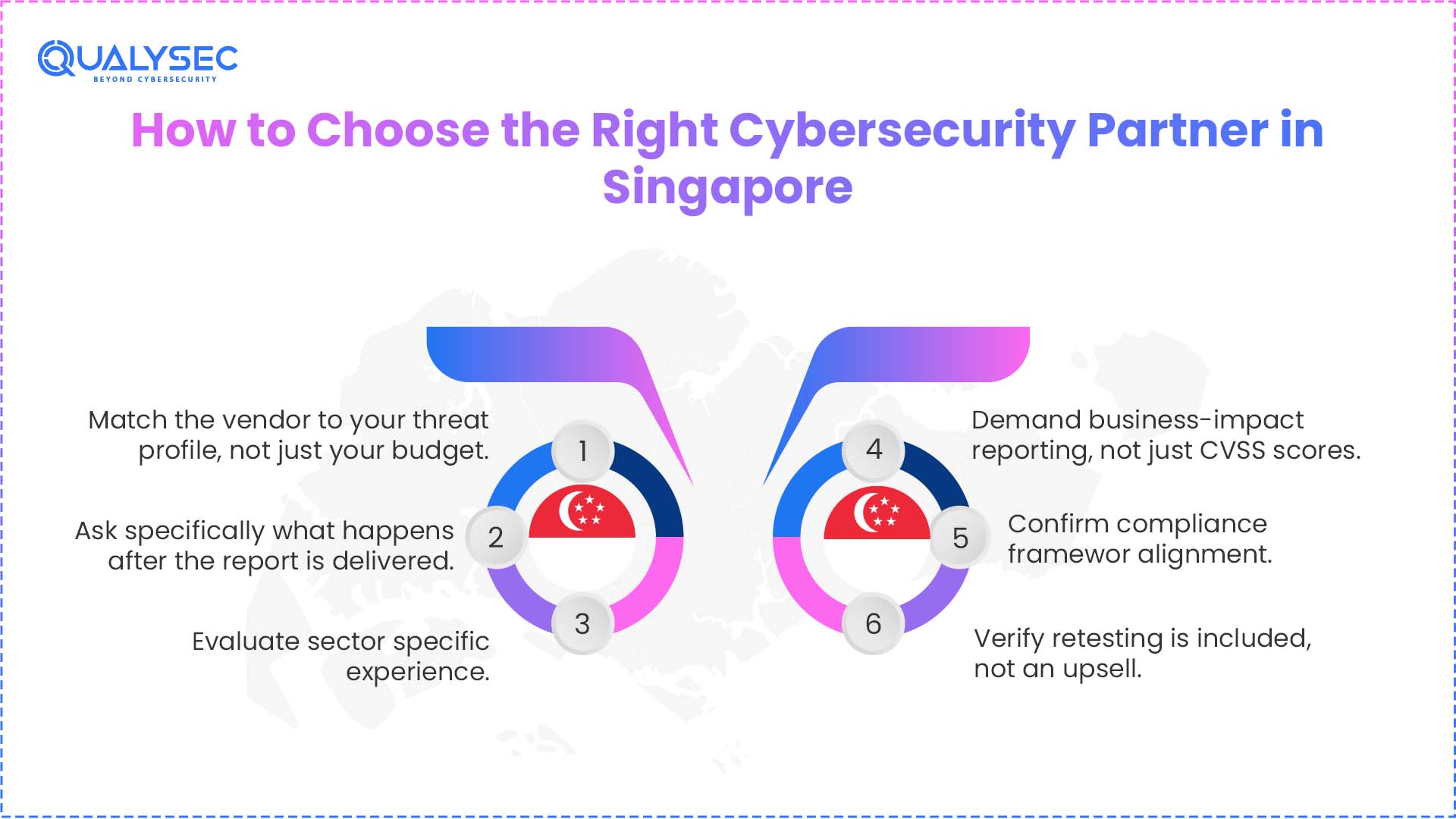
1. Match the vendor to your threat profile, not just your budget.
A company getting ready for a Series A due diligence needs compliance-ready VAPT paperwork. A bank governed by MAS requires a vendor with reports written in MAS TRM format and regulatory integrity. A company following a breach calls for a forensically thorough investigation. These are various criteria requiring various vendors.
2. Ask specifically what happens after the report is delivered.
Does retesting come included? Does the team walk you through remediation? An unverified security report is an unfinished service. Any buyer in Singapore should ask this question before signing any engagement.
3. Evaluate sector-specific experience.
Deep fintech experience helps a company to know payment security testing and MAS TRM requirements. A business with experience in SaaS knows DevSecOps integration and the depth of API security. A background in general IT does not instantly translate to these fields.
4. Demand business-impact reporting, not just CVSS scores.
Technical advice is necessary for developers. Decision-makers must have risks described in commercial language. Good reports help both groups of people. Before deciding on any supplier, request to view a sample report.
5. Confirm compliance framework alignment.
Not simply general compliance awareness, your partner ought to show particular familiarity with PDPA, MAS TRM, CSA rules, and ISO 27001. Inquire which particular controls their reports cover and how they relate data to those controls.
6. Verify retesting is included, not an upsell.
Singapore’s regulatory environment expects evidence of remediation — not just identification. If a vendor charges separately for retesting after initial fixes, factor that cost into your total engagement price.
You can view the attached, comprehensive penetration testing report to evaluate what the whole assessment consists of.
How Qualysec Supports Singapore’s Cybersecurity Landscape
Singapore’s financial industry has rigorous MAS TRM Guidelines requiring frequent vulnerability assessments and penetration testing. Institutions must document results and demonstrate remediation through records that withstand regulatory scrutiny.
Qualysec connects every result to business impact context, OWASP Top 10, and MAS TRM technical risk controls. This generates a report a developer can instantly use and a compliance officer can show to a MAS examiner without further explanation.
Retesting is critical since MAS checks to see if any weaknesses discovered were really corrected. Recorded remediation helps to substantiate an institution’s technological risk management claims.
Qualysec Expert Insights: Singapore’s Financial Sector Gets a Reality Check
Financial institutions in Singapore have a penetration testing gap: MAS TRM Guidelines require testing, but do not specify documentation standards. As a result, many get technically correct reports deficient in the corporate background needed for regulatory inspections.
For payment processors and online banks, one API bug can simultaneously infringe MAS Notice PSN02 and cause PDPA breach notifications. CVSS scores alone cannot gauge severity; it calls for knowledge of particular data flows and legal responsibilities.
Ask your vendor clearly how their report covers the legal ramifications of every conclusion, not only its technological severity. That question separates reports that satisfy MAS examiners from those that do not.
Singapore’s Cybersecurity Act and Mandatory Incident Reporting
Owners of Critical Information Infrastructure (CII) under the Cybersecurity Act 2018 are required to notify CSA of major cybersecurity events within two hours of discovery. Under the Cybersecurity Act, non-CII companies have no compulsory reporting deadline; yet, PDPA breach notification requirements call for reporting to PDPC within three calendar days for data breaches impacting 500 or more people. These two timelines generate practical needs that cybersecurity companies must integrate into incident response plans.
Conclusion
Cybersecurity Companies in Singapore in 2026 operate inside a specific regulatory, business, and threat environment. The right partner depends on your organization’s size, sector, risk profile, and compliance obligations — not on which company has the most recognizable name.
This guide provides a starting point. Shortlist two or three vendors whose depth of service best meets your particular demands. Ask each of them for a sample report, a thorough scope of work, and specifics on how post-engagement assistance looks.
The ten companies shown here stand for diverse strengths in the Cybersecurity Companies in Singapore scene. Match the vendor to your real requirements, then check their capacity before you sign on.
Book a security assessment now.
Frequently Asked Questions:-
Q: How to choose a cybersecurity company in Singapore?
Choose vendors depending on threat and compliance profiles, not only cost. Companies regulated by MAS, SaaS startups, and hacked businesses all have different needs, including forensics, TRM reporting, or VAPT. Check retesting, sample reports, regulatory mapping, and support to find vendors with extensive compliance knowledge before hiring.
Q: Does Singapore have a cybersecurity framework?
A: Yes, there is the Cybersecurity Code of Practice and frameworks such as the Cybersecurity Act and PDPA that the majority of cybersecurity firms in Singapore are also aligning with, along with ISO-27001 and MAS TRM requirements.
Q: What is MAS TRM, and why does it matter for cybersecurity?
A: MAS Technology Risk Management Guidelines establish expectations for financial institutions controlled by the Monetary Authority of Singapore for technology risk management. They need the capacity to respond to incidents, manage access control, and have documented penetration tests. MAS supervisory reviews may lead to legal action for businesses lacking proof of compliance.
Q: How much does a penetration test cost in Singapore?
A: Depending on application complexity and endpoint count, web application penetration testing usually starts around S$3,000 and runs to S$12,000. Cloud security reviews range in price from S$5,000 to S$20,000. Red team projects cost at least S$15,000. Prices change depending on scope, participation framework, and supplier. Always request a detailed scope of work before comparing quotes.
Q: What does the Cyber Security Agency of Singapore do?
A: Singapore’s national cybersecurity plan is led by CSA. It publishes the yearly Singapore Cyber Landscape report, administers the Cybersecurity Act, oversees Critical Information Infrastructure protection, and runs SingCERT – the Singapore Cyber Emergency Response Team.
Q: What are the 5 C’s of cybersecurity?
A: The 5 C’s are change, compliance, cost, continuity, and coverage. The robust cybersecurity services in Singapore enable businesses to address all five aspects with tailored approaches.
Q: What are the four pillars of cybersecurity?
A: The central pillars are risk identification, protection, detection, and response. Cyber security consulting in Singapore aims to achieve four aspects of operations.
Q: What are the 5 Ps of cybersecurity?
A: They entail policy, protection, prevention, people, and physical security. The best cybersecurity Singapore companies develop their security roadmaps using these concepts.