






The United States standard for protecting healthcare information since 1996, when the Health Insurance Portability and Accountability Act of 1996 (HIPAA) was signed into law, is HIPAA. The privacy and security protection of the ePHI is the sole intention behind the act. Due to its global application by healthcare systems, ePHI cyberattacks have become a reality now. Penetration testing, perhaps the most effective method to guard against such attacks, is a simulation that simulates cyberattacks to discover vulnerabilities of the target organization’s infrastructure. This article will explore how penetration testing helps conduct HIPAA risk assessment and ePHI through first-hand experiences, case studies, and facts. Understanding HIPAA Risk Assessments.
Hippa risk assessment services are part of the measures health care organizations implement to ascertain risk to ePHI confidentiality, integrity, and availability. BAs and CEs, as HIPAA law mandates, should perform a series of risk analyses as they proceed towards compliance with Security Rule standards (45 CFR §164.308(a)(1)(ii)(A)).
Risk analysis would then generally involve determining the risks to an organization’s systems, processes, and network that would lead to unauthorized access to the ePHI. Enumerating vulnerabilities, the organization would have to estimate the potential damage and probability of such a risk to take necessary steps to prevent such risks.
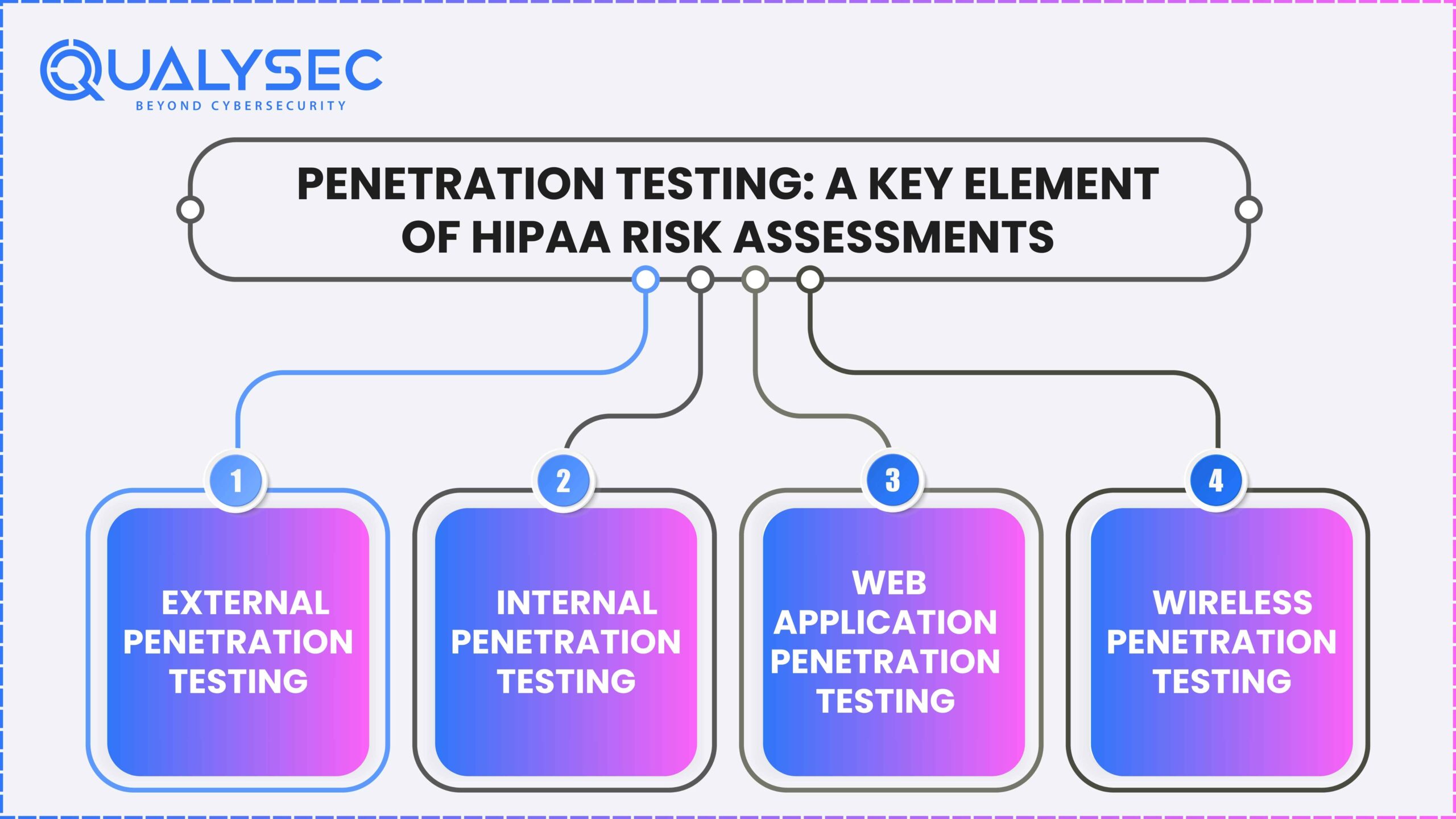
Penetration Testing: A Key Element of HIPAA Risk Assessments
This is an intrusive process in which trained hackers simulate actual attacks in an organization’s infrastructure to identify and take advantage of vulnerabilities before malicious attackers. Penetration testing, as per HIPAA Security Rule, allows organizations to ensure adequate security controls and effectively protect ePHI from cyberattacks.
There are different ways in which penetration testing can be classified:
1. External Penetration Testing
The process of external penetration testing an organization’s system that can access outside, i.e., email server, websites, and other interfaces outside.
2. Internal Penetration Testing
Internal Penetration Testing is performed inside an organization’s network to evaluate internal security controls, including network segmentation and access control mechanisms.
3. Web Application Penetration Testing
Submits web applications, which are used the most in healthcare organizations for scheduling programs, billing applications, and patient portals, to Web Application Penetration Testing to ensure their security and reliability.
4. Wireless Penetration Testing
Secures the Wi-Fi network of the organization against encryption vulnerabilities or rogue access points through Wireless Penetration Testing.
Penetration Testing Secures ePHI
1. Identification of Vulnerabilities
HIPAA Compliance Service Providers help uncover weaknesses in systems, applications, and networks that are likely to be exploited by hackers. For example, if an unpatched system is at risk, an attacker gaining entry can leverage that access to escalate privileges and potentially acquire sensitive ePHI, giving them significant bargaining power.
Case Study: In 2020, a healthcare services provider company discovered via penetration testing that the old software they used had a critical vulnerability. A cyber attacker might have exploited the system for nothing but patient data theft, which would have been HIPAA non-compliant. The vulnerability was patched before it was utilized for its intended malicious intent.
2. Modeling Real-World Attacks
Penetration testing imitates the steps, processes, and forms of the attack employed in real-time attacks by cybercriminal hackers. HIPAA risk assessment companies often use this approach to provide real-time measurement of an organization’s ability to defend itself against potential intrusions.
Statistic: In 2020, according to the Verizon Data Breach Investigations Report, hacking or IT incidents accounted for 45% of healthcare data breaches. Healthcare organizations can apply penetration testing to simulate such breaches and evaluate their readiness to prevent them.
3. Testing Incident Response Capability
Penetration testing discovers system vulnerabilities and checks an organization’s capacity to respond. A good quality HIPAA security assessment, which includes penetration testing, helps determine how well an organization can detect and respond to security breaches—an essential factor in minimizing exposure to electronic Protected Health Information (ePHI).
Case Study: While performing an internal penetration test on a hospital network belonging to them, attackers revealed multiple vulnerabilities on the network that attackers could utilize for lateral movement. The test helped their IT department harden their system to the point where the response time and intrusion detection became better, intrusion compromise chances for ePHI increased, and ultimately, information was made safer.
4. Improving Access Controls
Penetration testing is most likely to uncover access control weaknesses like poor passwords, the absence of role-based access, or the lack of effective multi-factor authentication (MFA). This way, organizations can further guard themselves and ePHI.
Statistical Fact: The healthcare industry has the highest average data breach cost of $7.13 million, as access controls are compromised, according to the Ponemon Institute 2020 Cost of a Data Breach Report. Penetration testing enables organizations to remediate such vulnerabilities before they become costly breaches.
5. Testing Network Segmentation
Network segmentation is a critical security practice that reduces the exposure of ePHI. As part of a HIPAA security risk analysis, penetration testing would determine whether the network was effectively segmented and whether unauthorized personnel could access ePHI through lateral movement on the network.
Case Study: One of the healthcare firms’ 2019 penetration testing identified that policy segmentation had directed the attackers’ point of entry into networks, such as patient information, following a breach of an insecure part of the network. Since the company had already applied hardening segmentation, it could reduce unauthorized entry risk to a very low level.
Penetration Testing vs. Vulnerability Scanning
Penetration testing and vulnerability scanning are both critical to the security of ePHI, but are different from each other.
Facts about Penetration Testing
1. Healthcare Cybersecurity Environment
83% of the health care organizations were compromised in the past two years, among which 50% said that they had witnessed more than one breach, according to a survey conducted by the Ponemon Institute in 2021. Penetration testing should be performed regularly to identify likely attack surfaces and avoid such attacks.
2. Penetration Test Success Rate
77% of the organizations for which security program penetration testing was a part achieved breach mitigation and incident response time by 40%, according to a SANS Institute survey.

Conclusion
Penetration testing is a key part of every thorough HIPAA Risk Assessment.
It is superior to vulnerability scanning because it emulates the actual attack scenarios to identify vulnerabilities in the systems’ security adopted for ePHI storage and processing. After vulnerability scanning and remediation, penetration testing enables health organizations to achieve HIPAA compliance and safeguard sensitive patient information against cyberattacks. As threats become real-time, regular penetration testing and a cautious risk management plan are the most significant processes among ePHI security and patient and regulator trust development.