

Today’s connected world creates new cybersecurity threats for UK firms, whether from ransomware or zero-day exploits. When cyberattacks become harder, it is not enough just to rely on a firewall or antivirus. That’s the point where vulnerability assessment services become important.
By performing a vulnerability assessment, businesses can locate weaknesses in their systems, networks and applications ahead of any attackers. In finance, healthcare, education or e-commerce, knowing where you are at risk should be your first priority for keeping safe.
The blog outlines in detail what vulnerability testing is, the main approaches to testing, the key stages and the leading providers who help with vulnerability scanning services in the UK.
What is a Vulnerability Assessment?
A vulnerability assessment service looks for, categorizes and ranks the weaknesses of your company’s digital infrastructure in a planned way. Problems could develop in the servers, in the network itself, in web applications, in databases, or in various endpoint devices. It’s essential to discover entry points that hackers could use before they are exploited.
Where a pentest acts out an actual attack, a vulnerability test is designed to find and list as many weaknesses as possible. It allows you to find risks and address them at the beginning of the project.
Typically, vulnerability assessment services consist of the following:
- Vulnerability tests can be conducted automatically with trusted systems and recent databases
- Manually going through each result to remove false positives
- Reports organised to highlight risks in terms of danger and the influence on operations
- Tips and steps given to help IT groups handle issues as fast as possible
In the UK, it is common for GDPR, ISO 27001 and Cyber Essentials to recommend or insist that businesses conduct regular assessments. Because of these facts, companies are better off using vulnerability testing as a practice and not something optional.
Key Stages in a Vulnerability Assessment Service
Learning how a cyber security vulnerability assessment functions helps organizations organize, focus on, and address their security issues. Now let’s go over the important phases:
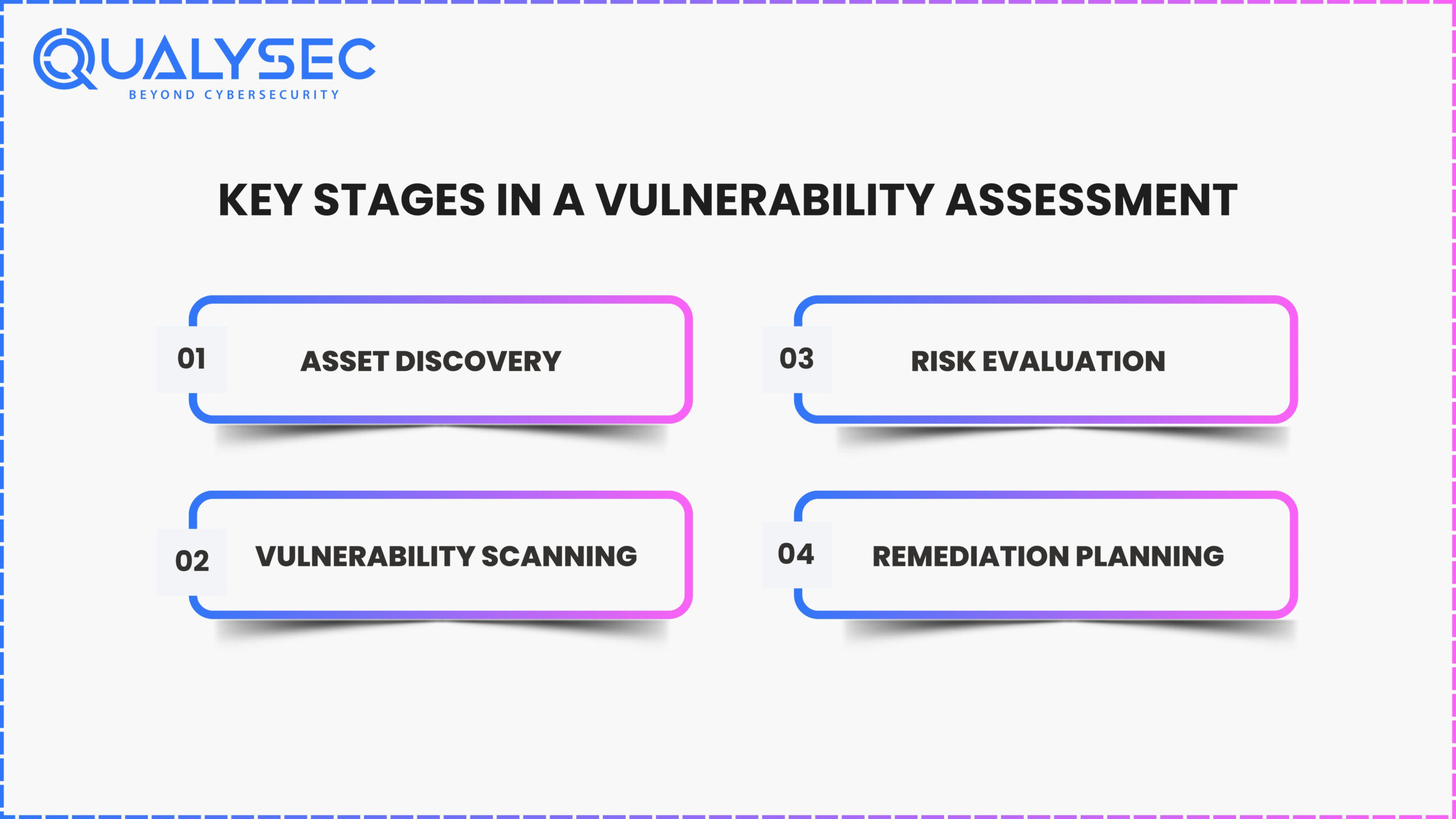
1. Asset Discovery
Part of this is listing and mapping out your IT infrastructure’s servers, endpoints, software applications, cloud settings, and APIs. If we don’t know what is there, we can’t protect it.
2. Vulnerability Scanning
With automated tools and updated databases, the vulnerability scanner checks systems and flags any weaknesses, unpatched systems, or incorrectly set permissions.
3. Risk Evaluation
Some vulnerabilities put your system at greater risk than others. At this stage, experts list vulnerabilities by how easily they may be exploited and how serious the possible outcomes could be. We need to make sure we focus on the main areas.
4. Remediation Planning
A roadmap for fixing the problems is made by assigning jobs to the appropriate teams. As part of this, you can update software, rewrite code, or alter configurations. Certain vendors will run another test to ensure the fix has worked.
Note: Scalable and efficient, vulnerability assessment is an ideal starting point for organizations looking to identify security weaknesses. Each assessment follows a proper Vulnerability Assessment Methodology and includes a detailed report with clear findings and recommendations. Look at the client testimonial for verification of our service.
Types of Vulnerability Assessments
Each vulnerability is not alike, so different ways to find them should not be treated the same. The infrastructure, goals, and overall risk found in your organization will help you choose the right kind of vulnerability assessment as a service (VAaaS). The list below explains some of the most common issues:
1. Network-Based Assessments
Concentrates on spotting unprotected systems, outdated software used for communication, misconfigured network firewalls, and systems with open ports.
Best for: These products are ideal when enterprises have big IT infrastructures, remote staff, or both.
2. Application-Based Assessments
Views web and mobile applications to find outdated code, security gaps from SQL injection, lacking user verification, and improper session management issues.
Best for: SaaS sites, ecommerce businesses, and companies providing customer-centric applications.
3. Host-Based Assessments
Checks workstations and servers individually to find operating system problems, outdated applications or improper permissions.
Best for: Firms that hold sensitive information on local machines or shared systems.
4. Performing evaluations for wireless networks
Analyzes dangers in Wi-Fi security such as weak encryption, unauthorized access points, and mishandled guest networks.
Best for: Workplaces with wireless access points and networks used by visitors.
Every assessment approach helps build a complete view of the risks to security. Merging the assessments permits the exposure of weak points at several layers in your IT system.
Need both scanning and exploitation analysis?
Top Vulnerability Assessment Service Providers in the UK
If your UK company wants to improve security and is looking for a vulnerability assessment company. Here are a few top companies that provide useful vulnerability assessment services. They help find, rank, and solve security issues before bad actors can use them. We created this list after carefully checking and verifying different criteria. Those are the criteria an organisation must have: Crest accreditation, human verification must be more than 60%, on-time reporting, and retesting service with proper remediation.
1. Qualysec

As a Crest-accredited top cyber security company, Qualysec delivers innovative vulnerability assessment services designed for both UK enterprises and startups. With a lot of attention to manual testing, they detect advanced security risks that computers often fail to identify.
Services Offered:
- Reviews are performed on web, mobile, API, and cloud applications.
- Penetration testing is performed in IoT, AI/ML, and blockchain sectors.
- In addition to surveys, the group should focus on critiquing code and implementing a secure development lifecycle.
Key Strengths:
- Testing the security of an application that reveals errors caused by the logic in the code, but are invisible in CVE lists
- GDPR, DORA, ISO 27001, HIPAA, PCI DSS, FCA, and additional compliance requirements are covered by our reports.
- Well-organized records and steps that can solve the risks identified
- Following the assessment, there is extra support, another testing option, and remediation advice.
- Experience with auditing healthcare, BFSI, and government organizations
2. CYFOR Secure
CYFOR Secure uses managed vulnerability assessments to show UK businesses which security issues affect both external and internal parts of their network.
Key Highlights:
- Checking processes designed for every size of organization and its level of risk
- Regular support for scanning equipment
- A well-integrated approach with response and digital forensics services
3. CyberLab
Using both semi-automated CREST-approved and automated methods, CyberLab provides vulnerability testing services in the UK for scalable results.
Key Highlights:
- Keeping the scanner active all the time protects you.
- Reports that need to be acted on most urgently
- Definitely useful for SMEs wishing to conduct testing repeatedly
4. Sencode
Sencode merges assistance from bots with expert understanding to give effective vulnerability assessment services and security vulnerability assessment.
Key Highlights:
- Checking the accuracy of what the computer indicates
- After finishing remediation, you can obtain a fresh set of test results without charge.
- We set prices for small to midsize businesses.
5. Evalian
Evalian’s vulnerability scanning services in the UK are tailored to meet important rules set by regulations.
Key Highlights:
- To avoid disasters, ensure your company follows ISO, NIST, and GDPR rules.
- Presentation of information that business leaders can understand
- Location outreach aims to serve large corporations working in finance, legal, and SaaS sectors.

Comparison table: Best Vulnerability Assessment Consultants UK
| Company | Key Focus & Strengths | Primary Certifications & Accreditations | Pricing Structure & Models | Target Audience |
| Qualysec | High manual testing ratio (more than 70%), application logic flaw detection, compliance support, included retesting support | CREST, ISO 27001, ISO 13485, ISO 9001 | Custom (Varies by application assets, IP counts, and compliance requirements) | Enterprise (Every Industry) |
| CYFOR Secure | Managed vulnerability assessments, integrated incident response, digital forensics, and infrastructure scanning | CREST, ISO 27001, ISO 9001, ISO 14001, NCSC CIR, Cyber Essentials Plus | Custom Quote (Scales with network size and endpoints) | Small, Mid-Market & Enterprise Organizations |
| CyberLab | Continuous automated scanning combined with CREST-approved manual testing methods for continuous visibility | CREST, Cyber Essentials Plus, IASME | Recurring Subscription (Annual OR monthly scanning plans) | SMEs & Mid-Market Businesses requiring continuous scanning |
| Sencode | Hybrid scanning approach (automated tools + manual verification), free post-remediation retesting included | CREST, Cyber Essentials | Fixed Quote | Small to Mid-Sized Businesses (SMBs) |
| Evalian | Regulatory compliance-focused testing (ISO 27001, NIST, GDPR), executive-level reporting | CREST, ISO 27001, ISO 9001, Cyber Essentials | Project-Based Custom Quote | Mid-Market & Large Enterprise (Finance, Legal, SaaS) |