

Key Takeaways
- The global appsec market hit $11.62 billion in 2025. It will reach $25.92 billion by 2030. This growth is fuelled by attack surface expansion. It is not governed by bigger security budgets. (Mordor Intelligence).
- About 63 percent of first-party code applications are deficient, and about 70 percent of applications are deficient in third-party code (Veracode 2024 State of Software Security), and the figure is even higher when AI-generated code is factored into the equation.
- Between 2020 and 2024, supply chain attacks increased 700% – i.e. the non-written code you do not write has now become the most likely code to get you breached. Software Supply Chain: (Source: Sonatype State of the Software Supply Chain)
- The feature lists are not the ones that make the difference in 2026-fix rates – the ones whose results are actually fixed, since experience of the developer and false-positive rates are the ones that make an appsec programme work or get neglected.
- The majority of organizations require two complementary application security vendors: one with continuous automated coverage and one with expert manual testing, as neither one can cover all.
Introduction
The vast majority of application security companies‘ guides begin with a market size figure. This one begins with a more practical fact: 63% of first-party code applications contain flaws, and 70% of third-party code contains flaws. Not down. Up.
The appsec market is booming with 11.60 billion globally in 2025, with rapid growth, but the attack surface is increasing at a higher pace. AI-generated code, microservice sprawl, API ecosystems that no one has ever fully documented, and supply chains that advanced adversaries are now considering the entry point of choice. On that basis, it is not whether you need application security or not. It is whether the vendor you are considering is designed to meet the threat environment in which you are currently operating.
The construction of this list – and a confession. This is a guide published by the editorial and security research team at Qualysec, and as we are listed here, transparency of methodology is important. Our criteria to select vendors were based on five criteria, namely testing breadth (manual and automated), quality of compliance reports in line with auditor requirements, false-positive rates benchmarked with G2 and Gartner Peer Insights, depth of workflow integration, and original vulnerability research output.
Qualysec comes up first due to the weighted compliance-ready documentation and manual testing depth, in which our hybrid VAPT model would be most applicable to the SMB and mid-market buyers that this guide is aimed at. In the case of others doing better than us, it is mentioned in their profiles.
We could not receive the proprietary pricing data of all vendors and internal false-positive benchmarks, other than those that are publicly disclosed; where the data is not available, we used peer-review sites and documented vendor material.
How we built this List – Our Evaluation Methodology
Vendors were rated on five dimensions. Every weight indicates the results of buyers, rather than marketing statements.
|
Dimension |
Weight |
|
Testing breadth (manual + automated) |
25% |
|
Compliance report quality vs. auditor requirements |
20% |
|
False-positive rates |
20% |
|
Workflow integration depth |
20% |
|
Original vulnerability research output |
15% |
Qualysec is the first one due to the fact that compliance-ready documentation and manual testing depth are weighted in this framework. Where others are doing a better job than Qualysec, it is mentioned on their profiles.
The Application Security Companies That Matter in 2026
It is not a ranked list that follows. The 1-20 ranking of application security companies suggests that there is a universal hierarchy, which is non-existent – the most suitable vendor to a fintech startup with three APIs is not the same as the most suitable vendor to a healthcare enterprise with 400 legacy applications in a hybrid cloud.
Rather, every vendor is considered in what it is truly best at, where it has failed, and with what type of buyer it is best suited. In case a supplier is strong in certain aspects and weak in other aspects, this is stated as such.
Vendor Comparison at a Glance
|
Vendor |
Primary Method |
Best For |
Compliance Support |
Free Tier |
|
Qualysec |
VAPT (Manual + Auto) |
All-size businesses needing compliance-ready reports |
HIPAA, PCI DSS, ISO 27001, DPDP Act |
Free consultation |
|
Veracode |
SAST + DAST + SCA |
Enterprise SDLC integration |
PCI DSS, HIPAA, FedRAMP |
No |
|
Checkmarx |
SAST + DAST + SCA + IaC |
Large codebases, low false positives |
SOC 2, ISO 27001, FedRAMP |
No |
|
Synopsys |
SAST + SCA + IAST |
SBOM, licence compliance, regulated industries |
PCI DSS, HIPAA, GDPR |
No |
|
Snyk |
SAST + SCA + Container + IaC |
Developer-first shift-left security |
SOC 2, ISO 27001 |
Yes |
|
Prisma Cloud |
CSPM + Code + Container + API |
Multi-cloud DevSecOps |
GDPR, PCI DSS, DORA, HIPAA |
No |
1. Qualysec – Ideal SMBs and compliance-based engagements

Qualysec conducts human-led AI-powered scanning of web, mobile, API, and cloud-based applications, plus penetration testing. Provides structured remediation reports that are directly linked to compliance frameworks (OWASP, HIPAA, PCI DSS v4.0, ISO 27001, DPDP Act).
The latter is of more importance than it sounds. When you are going into a SOC 2 or an ISO 27001 audit, how your security testing report is laid out influences the quality of your evidence package – and many of the automated tools generate output that is not designed to be read by the auditor.
Qualysec provides a no-cost initial consultation, which is actually handy to organisations that have not scoped a security engagement previously. One of the most prevalent causes of appsec engagements being over-budgeted is scope confusion.
The honest evaluation: Qualysec is not a self-service scanning solution. In that layer, you require Snyk or Veracode in case you require an automated tool to run within your CI/CD pipeline each time you commit. What Qualysec offers is the professional testing layer that confirms that your automated tools are, in fact, capturing what matters – and in our experience, the difference between what automated tools identify and what manual testing identifies is where the breaches exist.
2. Snyk – Frictionless developer-first security
Snyk is the tool in the bibliography of the teams which would like to have security built into the development, not deployed as a final gate.
It scans code, open-source dependencies, containers, and IaC configurations – and displays their results in the IDE, the CI/CD pipeline, and pull requests, and includes one-click fix suggestions where they exist.
The SCA functionality is truly powerful, with profound integrations in GitHub, GitLab, Bitbucket, and Jenkins. There is one minor truth that is straight: Snyk is designed to be used by developers. The workflow assumptions are less well, especially when you are a security team trying to operate a programme in a large enterprise without buy-in amongst the developers.
The honest evaluation: Snyk does a terrific job of its subjects – dependency vulnerabilities, code patterns, and container misconfigurations. It does not replace manual penetration testing. Business logic vulnerabilities, authentication bypass chains and API authorization vulnerabilities all involve human reasoning, which cannot be mimicked by the automated analysis of Snyk. Continuous coverage with Snyk. Test on a partner that Snyk is blind to.
3. Veracode – Best enterprise SAST + DAST platform

One of the most commonly implemented enterprise appsec systems in the world is Veracode, and its 2024 State of Software Security report is likely the most-referenced source on the topic.
It integrates SAST, DAST, SCA, and manual penetration testing on the same platform with extensive support in enterprise developer tooling – Visual Studio, Eclipse, IntelliJ, and all the major CI/CD platforms.
The most significant addition is the Package Firewall that is able to prevent malicious open-source packages before they reach the development flow in 2026. The concept of supply chain and software security has ceased to be a checkbox and is now a true architectural request, and the very fact that Veracode is building it clearly shows where the threat is shifting.
The honest evaluation: Veracode State of Software Security report of 2024 is among the most referred materials within the industry, which is relevant to the research credibility. The scope of the platform is real. Complexity is a tradeoff – smaller teams often report that onboarding and configuration are more effort than they expected, and the value is proportional to organizational maturity. Without the internal ability to respond to findings, the output of Veracode is turned into a costly dashboard that no one will visit.
4. Checkmarx – Ideal when the false-positive rate is important, and the codebase is big

Checkmarx has a 4.4/5 rating on G2, and the feedback is quite unanimous: people like it particularly due to the accuracy and customizability of the SAST engine.
In large or complicated codebases, the one where a tool with a high false-positive rate generates so much noise that developers are now used to producers of a tool with a high false-positive rate, then the customizable rule engine is a point of significant differentiation.
Checkmarx One is a platform that encompasses the security of SAST, DAST, SCA, and IaC.
The honest evaluation: Checkmarx has strength in depth in the static analysis. Its DAST and SCA capabilities are competent, but not category-leading on their own – they are there to offer a unified platform experience. Synopsys Black Duck can be more competitive in that particular dimension in organizations where extreme SCA requirements (SBOM generation, license compliance in regulated industries) are particularly demanded.
5. Synopsys – optimum enterprise portfolio controlled industries

The most extensive portfolio in the category belongs to Synopsys: Coverity, SAST, Black Duck, SCA, Seeker, IAST, as well as API security and professional services division.
Black Duck prevails as the SCA tool in the most regulated industries – its licence management and SBOM generation are the standard for organizations with severe open-source legal risk. When you require a software bill of materials that can undergo regulatory examination, then that is where the majority of enterprises find themselves.
The honest evaluation: Coverity, Black Duck, and Seeker are independent platforms. Operational overhead is created when all three are managed. It has enhanced integration, but it is not as smooth as Checkmarx One or the integrated platform of Veracode.
6. Palo Alto Prisma Cloud – Ideal in multi-cloud code-to-run security

Prisma Cloud is the first to enable code to cloud security on AWS, Azure, GCP and on hybrid environments, all in one platform: IaC scanning, container security, API security, CSPM and runtime protection.
Prisma Cloud provides one visibility tier between code commitment and production runtime. It discusses AWS, Azure, GCP, and hybrid environments. It is the most comprehensive cloud-native solution for DevSecOps teams working with multi-cloud deployments at scale.
The honest review: Prisma Cloud is mighty and cumbersome. It will be over-engineered with smaller teams operating a single cloud provider. This is indicated in the pricing. Instead, AWS-only stores should begin with AWS-native security tools.
7. Aqua Security – Container/Kubernetes best

Aqua is designed to bridge the security gap that traditional application scanners are incapable of addressing: container images, Kubernetes runtime threats, and serverless functions.
It analyses pictures before deployment, monitors clusters for runtime threats, and oversees compliance with CIS Benchmarks, NIST, and PCI DSS. Aqua specializes in the security layer of DevOps teams operating cloud-native infrastructure (not a general scanner incidentally with container features).
The honest evaluation: Aqua is a cloud-native infrastructure security tool, but not an application code security tool. It will inform you that your container is insecure with a library – it will not inform you that your application code contains a SQL injection vulnerability. Combine it with a code-level test suite (SAST or pentest) to have full coverage.
8. Contrast Security – Ideal when it comes to real-time detection and in-production block
Contrast uses a single platform based on IAST-RASP instrumentation. Instead of reading between the lines, it teaches the running application – identifying vulnerabilities as they are stressed during testing and blocking attacks as they run in production.
This provides a very low false-positive. You do not need a discrete WAF to protect runtime. Best suited to API-heavy architecture and teams with rapid release cycles in which accuracy is more important than coverage.
The real evaluation: The approach of Contrast is truly novel, yet instrumentation involves agent deployment in every application, which adds the consideration of performance and compatibility. It cannot be easily supported in all application architectures, especially legacy monoliths or those applications that are hosted in constraining environments.
Validate this approach with real deployment insights. See practical implementation and outcomes.

9. Rapid7 InsightAppSec – Best suited when the team does not have full security staff

InsightAppSec provides DAST on both modern web apps and APIs, including CI/CD integration. However, what many organizations are more interested in is the Managed Application Security service – the Rapid7 expert team performs the testing, eliminates the false positives, verifies the vulnerabilities, and does the business logic testing.
In the case you have application security requirements and no internal AppSec team to run a platform, it is one of the most operationally viable responses.
The honest assessment: Rapid7 DAST capabilities are strong but not of category-leading detail. Accessibility and integration are the strengths of InsightAppSec rather than the scanning granularity of a dedicated SAST engine. Rapid7 truly differentiates in the managed service layer.
10. Cloudflare – The best edge-layer protection for performance-sensitive applications
Cloudflare provides WAF, DDoS protection, bot control, and Zero Trust access at the network edge – before traffic is sent to your origin server. In applications that are facing the public and latency is a concern, the edge architecture implies that security does not cost performance. The API security and rate limiting features have grown much; it is not a WAF anymore.
The honest evaluation: Cloudflare secures the edge. It neither runs your application code, nor analyzes your dependencies, nor detects vulnerabilities in your business logic. It is not a testing layer but a protection layer. It should be treated as infrastructure security, rather than as an alternative to application security testing.
11. GitGuardian – Secret-best in Git repositories
Among the most actively used vulnerabilities is one of the least complex: API keys, tokens, database credentials, and private keys accidentally left in sources.
GitGuardian not only monitors the public and private repositories on the fly but also scans historical commits – not only the current code. It seals a hole that the general SAST tools lack on a regular basis, and amongst development teams with Git based workflows, it is one of the most lucrative security tools on the list.
The honest evaluation: GitGuardian is a single thing that does it better. It is neither a generic SAST tool, nor a DAST scanner, nor a pentest alternative. It spans a narrow sub-category of vulnerability. It should not be used as a stand-alone programme but as a speciality layer in your application security services stack.
12. F5- Ideal for enterprise API and financial security
 Application security and delivery – BIG-IP Application Security Manager (ASM), NGINX, and Distributed Cloud Services. Application security and delivery. The security of web applications, APIs, and microservices.
The API security of F5 is one of the most developed in the market. F5 is the choice when the application architecture of an organisation is heavily API-driven, such as policy-based API access control, schema validation, and behavioural analytics to identify patterns of API abuse, including broken object-level authorisation (BOLA) and mass assignment. The customers of the financial services and the government that require high availability and strict security of the API-layer often find their way to F5.
The honest evaluation: F5 is an enterprise-capable and enterprise-complex system. The hardware and software complexity to install and support F5 is beyond the capability of most mid-market organisations. With a team of three engineers and 12 APIs, F5 is more than you need.
13. IBM Security- Best for enterprise consolidation and risk scoring

Enterprise application security as a part of the larger security product portfolio – AppScan for SAST, DAST, SCA and IAST, and managed security services through the X-Force threat intelligence and 24/7 SOC services.
IBM Security brings together application security, managed services, threat intelligence, and incident response with a single vendor. This is the breadth that is not comparable with any other platform. Businesses that minimise the vendor proliferation in the market are enjoying the integration of IBM, which cannot be matched. IBM platform connects the weaknesses of the applications with the threat information and infrastructure risks. This provides context-sensitive risk scoring. This cannot be done by standalone appsec tools.
Huge organisations with multi-domain security needs, regulatory policies (GDPR, HIPAA, PCI DSS, SOC 2), and a preference to consolidate with a vendor.
The honest assessment: The platform of IBM is not agile. The developer experience is not as competitive as Snyk or GitGuardian – the tools at IBM were created as security teams and only secondarily as developers. Firms with the developer adoption and shift-left integration as the main requirement will experience more friction here than with developer-native ones.
14. GitLab (Security Features)- Ideal for native, seamless DevSecOps lifecycle integration
DevSecOps security features: SAST, DAST, SCA, secrets detection, dependency scanning – included in the GitLab CI/CD platform without the need to integrate any separate tool.
In the case of organisations that have standardised on GitLab as a development and CI/CD platform, the security functions are already available – there is no further procurement, integration, or workflow adjustments required. Findings on security are shown together with merge requests and code reviews, in context, at the time when developers can take action on them.
Teams that are fully devoted to the GitLab ecosystem require security and development in one platform.
The honest review: GitLab has a wide, but shallow, security area. All of the individual capabilities – SAST, DAST, SCA – are capable and do not rival the detection granularity of specialised tools such as Checkmarx (in the case of SAST) or Snyk (in the case of SCA). You are exchanging scanning depth with workflow integration. That is the right trade in the mind of many teams. In extremely regulated environments where the maximum depth of detection is important, it is not.
15. Zscaler- Best for zero-trust attack surface reduction

Minimal or zero trust application access with a cloud-native platform that renders applications unseen by unauthorized users by acting as an intermediary based on identity and context instead of network location.
Zscaler never reads your code or audits your APIs – it removes the attack surface upon which such attacks can take place in the first place. By taking applications off the direct internet and enforcing an identity-authenticated context-aware access per-session, Zscaler solves a root-cause security issue that WAFs and code scanners are unable to fix: that your applications are exposed to the rest of the internet.
Organisations that employ remote or hybrid workforces have their applications spread over several cloud environments, and they have a security strategy that focuses on reducing attack surfaces rather than detecting and responding to attacks.
The honest observation: Zscaler represents access-layer security, rather than application-layer security. It can manage access control to your application – it does not test the security of your application. It is not a replacement for application security testing.
16. HCLSoftware (AppScan) – Enterprises Moving out of Legacy IBM Tooling
In 2019, HCL purchased AppScan as an IBM product and has invested in the modernisation of the platform. It has a comprehensive enterprise policy management of SAST, DAST, IAST and SCA. Organisations, which already have AppScan, which was in use during the IBM era, find it an easy migration process.
The honest evaluation: The detection engine of AppScan is stable and experienced. The developer experience is not as good as Snyk and Checkmarx. Security teams are the first to be served on the platform. This is not the place to start if developer adoption is what you are concerned about.
17. Invicti (previously Netsparker) – Best DAST Accuracy of Web Application Scanning
The scanning is proven to be vulnerability safe by inviting the vulnerability through the scan by Invicti. This significantly decreases false positives – Invicti boasts close to zero false positives on confirmed results. The platform discusses web apps and API that have a high CI/CD integration.
The honest evaluation: Invicti is DAST-oriented. It lacks native SAST and deep SCA support. Invicti is available in combination with a SAST tool in case you require full-lifecycle security of the code. It is one of the best in its category when it comes to pure web application dynamic testing with high accuracy.
18. OpenText (Fortify) – Ideal Government/ Defence Sector
Fortify under OpenText provides SAST and DAST with the help of Fortify Static Code Analyzer and Fortify WebInspect. It has a high adoption in the U.S. federal government, defence and aerospace segments where FedRAMP authorisation and NIST 800-53 compliance are more critical than devel-9+oper experience.
The honest evaluation: Fortify has a great depth of scanning. Its user interface and the integration of developer workflow have failed to match up with the current competition. Teams selecting Fortify are typically selecting it based on the regulatory acceptability in government contracts, rather than developer contentment.
19. Mend.io (previously WhiteSource) – Open-Source license compliant and SCA
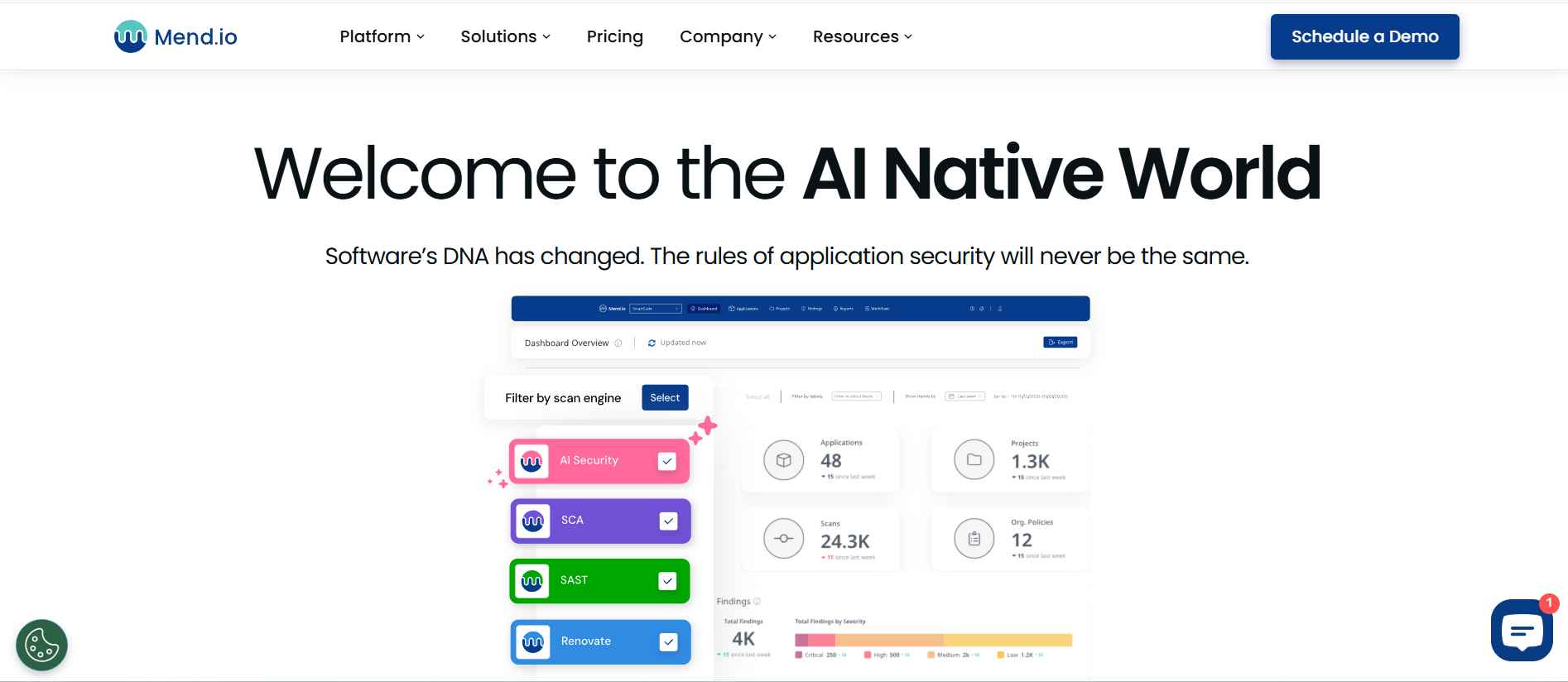
Mend.io is a deep license compliance manager of SCA. It identifies open-source components automatically, maps identified vulnerabilities, and identifies license conflicts. The platform is part of CI/CD pipelines and offers automated vulnerability remediation recommendations, such as version upgrade paths.
The honest analysis: Mend.io has direct competition with Synopsys Black Duck in the SCA arena. It is usually easier to implement and cheaper. The tradeoff: it is not as deep as Black Duck is in SBOM generation in highly regulated environments. Mend.io is the viable option in the case of mid-market organisations that require a solid SCA but do not require enterprise pricing.
20. Semgrep – Optimised for Custom Rule Writing and Open-Source SAST
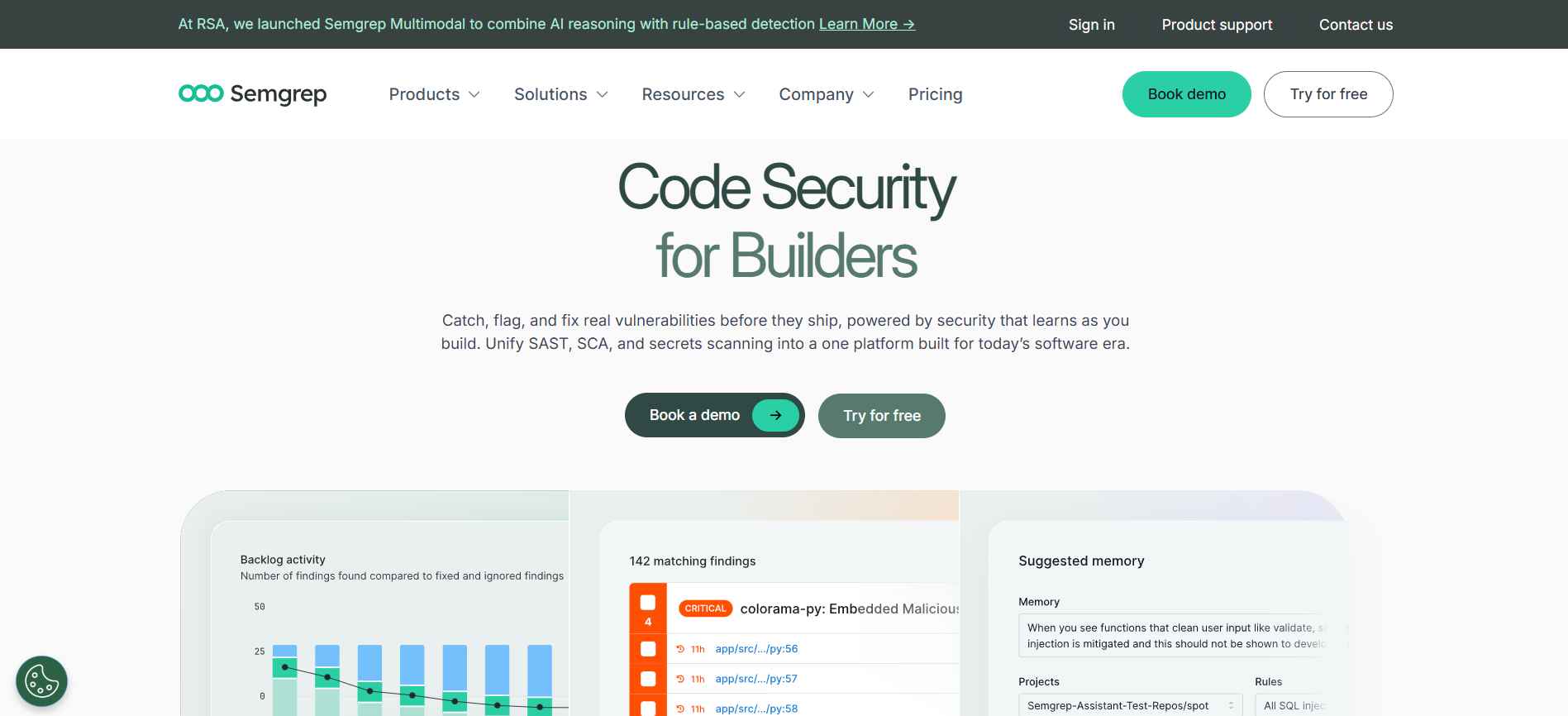
Semgrep executes lightweight static analysis that has a rule syntax that can be read and written by developers. The open-source engine is not costly. The business platform (Semgrep Cloud) introduces CI/CD aggregation, teamwork, and an increasing community-based rules library. Semgrip has more than 100,000 organisations using it in one way or another.
The honest evaluation: the advantage of Semgrep is speed and customisability. Its weakness is coverage of the complex patterns of vulnerabilities – it will pick what you write a rule for. Unless it is heavily tailored with custom rules, it will not be as out-of-the-box able to detect as Checkmarx or Veracode. Very good as an outer coating. Inadequate as a stand-alone company, SAST.
Pro Tip: Before you request vendor demos, take one week to run that internal application inventory. All application security company engagements that exceed the budget have their roots in a scope that was not defined with such a step. You can not have what you have not mapped.
Compliance-Mapped Vendor Selection
It is often more effective to select an application security firm using your compliance requirements than to begin with feature comparisons. Various rules have various testing requirements, and only some appsec vendors generate the documentation format that each framework requires.
|
Regulation |
Key AppSec Requirement |
Recommended Vendors |
|
PCI DSS v4.0 |
Vulnerability management (Req. 6), script integrity monitoring (Req. 6.4.3), DAST for public-facing apps |
Qualysec, Veracode, Checkmarx, Rapid7 |
|
HIPAA |
Risk analysis covering software vulnerabilities; technical safeguards for PHI |
Qualysec, IBM Security, Veracode |
|
GDPR |
Data protection by design; security testing of systems processing personal data |
Snyk, Checkmarx, Synopsys, Prisma Cloud |
|
DORA |
ICT risk management; application testing for financial entities; incident reporting within 4 hours |
Veracode, IBM Security, Checkmarx, F5 |
|
DPDP Act 2023 (India) |
Documented security safeguards for apps processing Indian user data |
Qualysec, Checkmarx, Snyk |
|
SOC 2 Type II |
Continuous security monitoring; documented vulnerability testing evidence |
Qualysec, Snyk, GitLab, Veracode |
What Application Security Companies Are Selling (And What They Are Not)
It is a broad term, and therefore it is worth being specific. Application security companies test, monitor, and defend software – web, mobile, API, and cloud. Both approaches are aimed at various types of vulnerability:
|
Method |
When It Runs |
What It Actually Finds |
|
SAST (Static Analysis) |
On source code, before compilation |
Insecure patterns, hardcoded secrets, logic flaws |
|
DAST (Dynamic Analysis) |
Against live applications at runtime |
Injection vulnerabilities, auth bypasses, and real misconfigs |
|
IAST (Interactive Analysis) |
During the QA and testing phases |
Combined approach, very low false positives |
|
SCA (Software Composition Analysis) |
At build time |
Vulnerabilities in third-party libraries, licence risks |
|
RASP (Runtime Self-Protection) |
In production |
Active attack blocking from inside the application |
|
Pentest |
Pre-release, post-change |
Business logic flaws, chained exploits — the stuff automation misses |
At least three of these approaches are combined in the application security services that will actually secure organisations in 2026. When a vendor sells only one, then you are purchasing a scanning tool, not a security programme.
Threat Context: In 2024, there was a 73-per cent increase in the number of attacks targeting web applications in Asia-Pacific to 51 billion attacks (Akamai State of the Internet Report). API endpoints were mostly targeted by attackers. The attack surface is now wider than the approach of any single methodology can encompass.
How to really Select- Before You See a Vendor List
The biggest error that most teams make is to have a list of vendors and start backwards. The vendors all present similar abilities. The difference lies in the false-positive rates, experience with the developers, the quality of managed services, and the usefulness of the reports they give to the individuals required to act on them.
You should begin with three questions, and then you look at one demo.
What’s your architecture? A developer-first tool such as Snyk is a perfect fit for a React + Node SaaS firm. It is not the correct solution for a healthcare company that requires auditable records of HIPAA. An edge-based WAF is rational in the case of a high-traffic consumer app. It leaves no service to vulnerabilities in your API authentication logic.
Who’s running this? Others are designed to be used by the developer who uses it daily as a part of his or her existing workflow. Others need a managed service or an assigned security team. Acquiring a platform requiring a staff you do not possess is a quick method of using funds and producing no security gain.
What is it you have to prove? PCI DSS v4.0, HIPAA, SOC 2, DPDP Act – these standards have certain application security criteria, and they need documented evidence. Not all vendors generate the appropriate type of report for all frameworks.
|
Profile |
Your Architecture |
Compliance |
What You Actually Need |
|
Startup / SMB |
SaaS, WordPress, React + Node APIs |
OWASP, basic PCI DSS |
Developer-first SCA (Snyk) + secrets detection (GitGuardian) + quarterly VAPT (Qualysec) |
|
Mid-Market |
Microservices, cloud-hosted, CI/CD |
HIPAA, SOC 2, ISO 27001 |
Platform SAST/DAST (Veracode or Checkmarx) + managed pentest |
|
Enterprise |
Hybrid cloud, thousands of APIs |
PCI DSS v4.0, DORA, HIPAA |
Unified AppSec platform + RASP + quarterly expert VAPT |
|
Cloud-Native |
Kubernetes, containers, serverless |
CRA, GDPR |
Container security (Aqua) + API security (F5 or Cloudflare) |
|
BFSI / FinTech |
Legacy + modern hybrid, open banking APIs |
DORA, PCI DSS v4.0, RBI |
Enterprise AppSec + API gateway security + quarterly VAPT |
What 347 Pentests Told of Automated Tool Gaps
The testing team of Qualysec tested 347 production applications between January 2024 and March 2026. One of the patterns that repeatedly failed to be detected by automated tools that DAST scanners identified as low severity or no longer existed is that 73% of applications had multi-step authorization bypasses that were either not detected by the DAST scanners or detected as low severity. We re-scanned 89 applications that had been scanned by Burp Suite, OWASP ZAP, and commercial services. The gap is that DAST tools are used to test each endpoint separately. They do not string requests between sessions in the way that real attackers do. In 52 of automated scan flows that were missed by automated scans, manual testing detected account takeover risks.
Need help choosing the right application security partner? Talk to Our Experts.
How Validation-First Testing Assists Contemporary Development
Security teams often struggle with tool sprawl. They purchase numerous scanners and correct some of the bugs. The true guide of a buyer is concerned with the rate of remediation. You must have a partner who converts technical blemishes into business risks. This will make sure your developers prioritise important fixes. It transforms security into a blocker into a compliance property.
Qualysec Expert Insights: The Reality Check
The 2026 Security Paradox actually occurs: businesses, on the one hand, pay more money for tools, on the other hand, they are hacked more frequently. This is motivated by vulnerability fatigue. When your tool identifies 1,000 bugs and developers fix 10, this does not mean that your security posture is better. It is not about discovering everything. It is located exploitable. Enquire whether your team can handle its output before purchasing an enterprise suite. Otherwise, a managed VAPT service will practically always be more ROI than a SaaS licence that is not used.
The Bottom Line
The most common trap is to pick application security companies based on brand awareness or even positioning by analysts, but not what fits with your specific architecture and compliance needs. The category leader in the category may be totally inappropriate in a startup within a serverless microservices stack. The developer-first tool that is excellent in a SaaS company could result in nothing of use in a healthcare organisation that requires organised audit evidence.
The advanced security programs require two concurrent functions: the automated tooling to provide the periodic coverage, and the professional manual testing to identify the vulnerabilities that the automated tooling fails to provide at all times. Neither of these is enough. It is the vendors who assure you that you should be sceptical of them.
Begin with what you are really running. Compare that to your compliance requirements. Then select vendors on fit, not those who had the best booth at the last security conference.
FAQ’s
Q. How often should application security testing be performed?
CI/CD pipelines (every commit or build) must be scanned automatically. High-risk and semi-annual or medium-risk apps should be manually pentested quarterly, or following significant changes. PCI DSS v4.0 calls for organisations to continuously monitor vulnerabilities and periodically perform pentesting instead of an annual assessment.
Q. How do I choose when every vendor describes similar capabilities?
Architecture fit, false-positive rates, integration of workflow with developers, managed service availability, and quality of remediation reports. The lists of features are similar. The reality of using these tools on your codebase is not usually as pleasant.
Q. What are the four security applications?
There are four categories: Web (injection, XSS, CSRF), Mobile (storage and session security), Cloud (containers and IAM), and API security (BOLA and data exposure). The most rapidly expanding sector is API security, and Akamai notes that API endpoints are the most popular target in 51 billion web attacks in APAC in 2024.
Q. What compliance frameworks require application security testing?
The important compliance standards are PCI DSS v4.0 (Requirement 6 and 6.4.3), HIPAA (PHI safeguards), SOC 2 Type II (continuous monitoring), ISO 27001 (Annex A), GDPR (design-phase testing), DORA (EU ICT risk management), and DPDP Act 2023 in India (documented safeguards).
Q. Which are the best application security tools?
The best application security tools in 2026 are Snyder, developer-first scanners, Qualysec hybrid VAPT, Veracode, which uses enterprise-grade SAST/DAST, and Checkmarx, which uses high-accuracy code analysis. It is selected based on your compliance requirements and tech stack.