

The HIPAA compliance checklist assists healthcare organizations in evaluating and reinforcing protections for protected health information (PHI). These tools describe notable steps that are consistent with the Privacy, Security, and Breach Notification Rules of HIPAA based on recent updates in 2025-2026, such as recommendations for improved risk analysis and multi-factor authentication.
By the end of 2025, reports indicated that nearly 57 million individuals were affected by large healthcare data breaches, with over 640 breaches (affecting 500+ individuals) listed on the OCR portal. Nineteen cases ended in settlements totalling over $8.8 million, most tied to missed risks and weak access controls. That’s a clear sign: when organizations don’t spot their weak points or let people slip through access gates, it’s expensive. Hence, we have put together a HIPAA Compliance Checklist: Step-by-Step Guide for Healthcare Organizations. Read on to find out!
Pro Tip: Vet All Vendors
Never hand patient data to a third party unless there’s a signed Business Associate Agreement (BAA). No exceptions.
Summary Points: HIPAA Compliance Checklist
- Provide administrative, physical, and technical protection with the help of compliance officers, secure facilities, and mandatory MFA or encryption of all ePHI.
- Regularly audit both virtual and physical systems to detect data flow risks and implement higher-priority fixes on high-risk vulnerabilities such as software patches.
- Establish third-party relationships through Business Associate Agreements (BAAs) and offer role-based interactive training to prevent common violations, such as employee snooping.
- Conduct quarterly internal compliance audits and yearly penetration tests, and keep all access records and documentation for a minimum of six years.
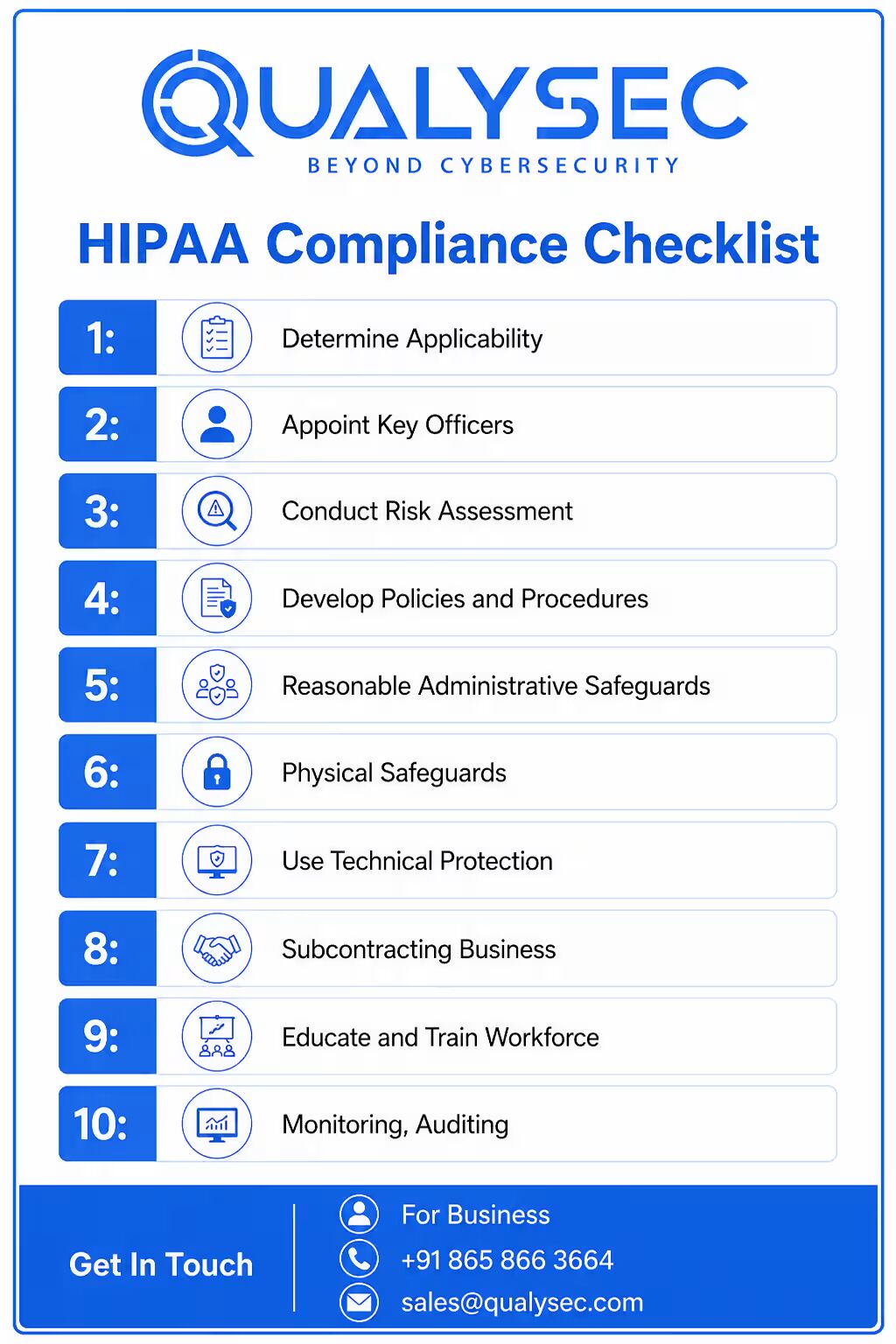
HIPAA Compliance Checklist (A Quick Overview)
| Steps | Title | Key Actions | Key Outputs / Documentation |
| 1 | Determine Applicability | Identify if you are a covered entity or business associate; map all PHI touchpoints; review electronic transactions; use self-assessment tools | Applicability report; PHI data flow map; documented scope decision |
| 2 | Appoint Key Officers | Assign Privacy Officer and Security Officer; form cross-functional team (if needed); define roles and responsibilities | Written role assignments; governance structure; compliance oversight plan |
| 3 | Conduct Risk Assessment | Identify PHI locations; map data flows; assess threats (cyber, insider, physical); prioritize risks; update regularly | Risk assessment report; risk register; remediation plan; annual updates |
| 4 | Develop Policies & Procedures | Create policies for privacy, security, access, and patient rights; draft NPP; define breach response; ensure version control | Policy documents; Notice of Privacy Practices (NPP); compliance manual |
| 5 | Implement Administrative Safeguards | Set access controls; conduct staff training; define incident response; create contingency plans (backup, disaster recovery); enforce sanctions | Training records; incident response plan; contingency plans; audit logs |
| 6 | Implement Physical Safeguards | Secure facilities (locks, badges); enforce workstation security; manage device lifecycle; protect mobile devices; audit physical access | Facility access logs; device inventory; disposal records; physical security policies |
| 7 | Implement Technical Safeguards | Enable access controls (user IDs, MFA); maintain audit logs; encrypt data; deploy firewalls, antivirus; test systems regularly | System configurations; audit logs; encryption records; security test reports |
| 8 | Manage Business Associates | Execute BAAs; perform vendor due diligence; monitor vendor compliance; track subcontractors | Signed BAAs; vendor risk assessments; vendor inventory list |
| 9 | Train & Educate Workforce | Conduct role-based training; onboard new hires; run simulations; track completion; evaluate effectiveness | Training logs, assessment results, attendance records, and feedback reports |
| 10 | Monitor, Audit & Update | Perform internal audits; review logs and policies; track regulatory updates, remediate gaps, and conduct annual reviews. | Audit reports, compliance dashboard, updated policies, and remediation records |
How to implement a HIPAA compliance checklist in 10 steps
Step 1: Determine Applicability
The first step taken by healthcare organizations is to assess whether they are covered entities or business associates under HIPAA. Providers who bill electronically, health plans, and clearinghouses that handle PHI are covered entities.
Vendors or contractors who process PHI on behalf of these entities (like IT services or billing firms) are considered business associates. Check the day-to-day operations – do you send health information to carry out transactions such as claims? Identify all PHI touchpoints, including intake to storage. This is a baseline step, which avoids scope errors.
Step 2: Appoint Key Officers
Assign special leaders to monitor compliance. The Privacy Officer is involved in the development of policies, patient rights, and alignment with the Privacy Rule. A Security Officer specializes in ePHI security, risk management, and the implementation of Security Rules – these functions may overlap in small companies.
In a bigger structure, constitute a cross-functional team including IT, legal, and clinical involvement to provide holistic management. Officers are responsible to the leadership and review regulations quarterly, as well as lead training. They make sure that policies are changed in response to changes such as new OCR guidance.
[Speak with a HIPAA compliance consultant]
Step 3: Conduct Risk Assessment
Conduct a critical examination of PHI weaknesses in systems, processes, and individuals. Locate HIPAA PHI storage locations, such as servers, devices, paper files, and trace the path of data between collection and disposal. Assess threats like data breach attacks, insider mistakes, and physical attacks.
Allocate likelihood and impact scores, and risk areas should be prioritized, such as unpatched software. Engage departments in order to have holistic perspectives. This is done to reveal vulnerabilities such as inadequate encryption, which is prevalent in OCR settlements. Frequent evaluations are in line with the requirements of the Security Rule.
Step 4: Develop Policies and Procedures
Write step-by-step, detailed guidelines addressing all aspects of HIPAA. Incorporate PHI use or disclosure policies, minimum necessary use and access, and rights of the patient, such as amendments. After you spot the risks, lock things down. Set up solid access controls and encryption. Spell out how people should act, what happens if they don’t, and share your Notice of Privacy Practices so people know how you use their info.
Make sure your HIPAA Security Rule actually fits the way you work – like making sure your telehealth crew knows the rules on remote access. Make sure there are policies on Breach Notification timelines. Keep records for 6 years after writing or the last effective date. Revise on an annual basis.
Step 5: Reasonable Administrative Safeguards
Create a set of rules to guide activities in a safe manner. Establish security management through continuous risk evaluation, responsibility, policy of sanctions, and assignment. Measures for the workforce should be done through role-based access, background checks, and termination checklists. Conduct PHI handling, phishing awareness, and incident reporting training to train staff annually.
Develop contingency plans like data backups, disaster recovery, and emergency access through drills. Define incident response for your organization by the investigation steps and mitigation. Regular assessments are done to check logs and performance. These controls decrease breaches caused by human error. Record activities to be audited.
Step 6: Physical Safeguards
Data defense starts with defending the infrastructure with the help of policies like locks, visitor logs, and maintenance records. Workstation policy outlines secure places, auto-logoff, and passwords on screensavers. Prohibit the use of PHI that is not business-related. Control devices through inventory, secure disposal-wipe/reformat media before reuse.
Organizations should use remote wiping and encryption to secure mobile devices. To work remotely, use home solutions with VPNs. These are in accordance with Security Rule standards, which avoid theft-related breaches. Digital security measures supplement physical layers to provide complete protection.
Step 7: Use Technical Protection
Automate the implementation of technology to apply data security. Access controls are based on individual user ID, emergency override, and auto-logoff after inactivity. The audit logs record the entire ePHI activity through hardware and software. Organizations use checksums to prevent unauthorized changes and implement MFA on portals for stronger security.
Transmission security implements encryption of ePHI in transit or at rest and role-based access. Test systems regularly. These are in line with the category of Security Rules, which deal with vulnerabilities of snooping. Tech safeguards automation enhances compliance, which minimizes manual errors.
Step 8: Subcontracting Business
Establish and formalize the PHI-handling vendor relationships. Sign Business Associate Agreements (BAAs) that specify authorized purposes, protection, breach notification within 60 days, and destruction of data at the end of the contract. Don’t skip your due diligence. Take a close look at each vendor’s security – review their questionnaires, check audits, dig into their practices.
Track performance through regular reviews and conduct subcontractor audits. Record all associates at the center. Flow-down requirements make sure that subs comply. For new services, update BAAs. Centralized tracking eases supervision.
Step 9: Educate and Train Workforce
Deliver role-specific training to all handling or accessing PHI. HIPAA rules, definitions of PHI, patient rights, secure handling, prevent phishing, philo. Engage in interactive modules and simulations. Organizations should train new employees immediately after onboarding and refresh the training annually or whenever major changes occur.
Add non-clinical personnel, such as receptionists. Document attendance, tests, and sanctions for failures. Customize content and track completion rates. Training matters, too. Most violations happen because employees make mistakes, and solid training helps prevent them.
Step 10: Monitoring, Auditing
Organizations generally make sure to stay updated with compliance through supervision. Carry out internal auditing periodically or every quarter, access logs, policies, and training records. Evaluate security events and changes. Track OCR updates, like the 2025 risk analysis focus. Act on findings to fill the gaps as they occur.
Organizations perform full annual reviews to address evolving threats such as ransomware. Monitor using dashboards, especially for document audits, retaining six years. The external audits provide objectivity. Automation might make it easier for you, but make sure to add manual testing too.
Pro Tip: Carry out Annual Risk Assessments
Before the year ends, do a comprehensive Security Risk Analysis to see new vulnerabilities in your digital infrastructure and revise your remediation plan.
[See the full breakdown of HIPAA compliance pricing]
How Qualysec Can Help Your Organization Achieve HIPAA Compliance
Qualysec is a Crest-accredited cybersecurity company providing complete defense systems for healthcare organizations, such as a HIPAA compliance checklist. By combining human expertise with advanced automated tools, Qualysec helps covered entities and business associates identify critical vulnerabilities before attackers can exploit them through a three-layered defense system approach.
Specialized HIPAA Penetration Testing
Qualysec offers in-depth security assessments built specifically for healthcare. They run tough tests on web apps, mobile healthcare apps, APIs, and cloud setups, looking for weaknesses like poor access controls or misconfigured storage that could leak electronic PHI.
Medical Device & IoT Security
Healthcare technology faces many security risks today, and Qualysec also addresses complex challenges like Internet of Medical Things (IoMT) devices. They don’t just run basic scans – they simulate real attacks to make sure things like MRI machines, monitors, or other connected devices can stand up to hackers and avoid disruptions.
Audit Readiness and Documentation
To support organizations during regulatory evaluations, Qualysec provides detailed, audit-ready reports. These deliverables include a systematic representation of risks, step-by-step remediation guidance, and a Letter of Attestation that serves as evidence of the organization’s commitment to security testing.
Risk Analysis and Remediation Support
Beyond simple scanning, Qualysec assists in conducting the thorough risk analyses required by the HIPAA Security Rule. Their team collaborates with internal development teams through consultancy calls to effectively implement fixes, ensure a robust security posture, and maintain continuous compliance monitoring.
Conduct a Professional HIPAA Risk Assessment with Qualysec.
Conclusion
HIPAA compliance is not a singular event but an ongoing process of ensuring patients’ trust and the integrity of the data. With the help of a detailed HIPAA compliance checklist, healthcare organizations can actively expose vulnerabilities, simplify administrative controls, and enhance technical controls. The emphasis on a culture of security will make sure that your organization will be resilient, audit-ready, and fully compliant with federal standards, which will eventually lead to a safer healthcare environment both for the providers and the patients.
Pro Tip: Encryption of Portable Devices and e-mail
Make it a rule to encrypt all portable equipment and email messages to make ePHI inaccessible and unusable in case intercepted or stolen.
FAQs
Q.What is the HIPAA compliance checklist?
A HIPAA compliance checklist is a systematic guideline that healthcare providers and business partners can apply to ensure that their business practices are in line with the national privacy and security requirements. It acts as a guide to evaluating the internal risks, providing administrative controls, and making sure technical controls exist. It also helps in identifying internal risks, offering guidance on administrative controls, and setting up basic technical safeguards. Having a structured HIPAA compliance checklist in place makes it easier for organizations to stay aligned with regulatory expectations, meet legal obligations, and be better prepared when audits come up, especially when handling sensitive patient data.
Q.What are the HIPAA compliance requirements?
The Privacy, Security, and Breach Notification Rules are some of the most important parts of a HIPAA compliance checklist. Businesses should implement security measures such as encryption, access controls, secure workstations, and protected data centers. These are all examples of administrative, physical, and technical controls. In addition, covered entities must sign Business Associate Agreements (BAAs) with outside vendors and keep detailed records of all policies. These security measures make sure that Protected Health Information (PHI) is safe, available, and private on all platforms.
Q.What are the 5 basic rules of HIPAA?
HIPAA has rules that govern it based on five pillars:
- The Privacy Rule – Governs the use and disclosure of Protected Health Information or PHI for HIPAA.
- The Security Rule – Establishes standards for protecting electronic Protected Health Information or ePHI for HIPAA.
- Breach Notification Rule – Information about reporting of a data leak.
- Omnibus Rule – Unites updates of the HITECH Act and increases the liability to business partners.
- Enforcement Rule – Explains the research and fines in case of non-compliance. All of these regulations establish an overall protection of patient rights and data safety.
Q.What are common HIPAA compliance mistakes?
The common HIPAA compliance errors are normally due to employee ignorance and technical negligence. Common mistakes include failing to conduct regular Security Risk Analysis, not signing BAAs with vendors, and unauthorized personnel snooping into patient records. Moreover, using encrypted communication channels like regular email or SMS to send Protected Health Information or PHI is a major reason for non-compliance with HIPAA.
Q.What is the most common HIPAA violation?
The most typical HIPAA violation is the unauthorized disclosure or access to Protected Health Information. This is often in the form of loss or theft of unencrypted mobile devices (laptops and smartphones) and internal snooping by employees. But on a higher level, the inability to make medical records of their patients readily available to them has recently become a high-enforcement priority of the Office for Civil Rights (OCR), punishing healthcare organizations across the country with substantial fines.