

In 2025, payment gateway security has emerged as a major concern among businesses in the US. Moreover, as cybercriminals are getting more advanced, securing customer payment information has ceased to be a choice–it is a necessity. Payment gateway security refers to the technologies, protocols, and practices which are used to protect sensitive financial information when carrying out online transactions.
The recent statistics given by Stripe show that the average cost of a data breach in the United States was as high as 9.48 million in 2023. Also, this shocking figure not only reflects short-term financial losses but also long-term reputational losses. As such, the use of strong payment gateway security is extremely essential to any business that handles online payments. Therefore, you can create a fortress that encloses your payment infrastructure by learning about the risks, compliance requirements, and best practices.
What Makes Payment Gateway Security Critical for American Businesses?
The security of the payment gateway acts as a line of defence against financial fraud and data breaches. In particular, it secures the transfer of sensitive information between customers, merchants and banks. Actually, online transactions are secured by layers of security, which are integrated to work in unison.
The Current Threat Landscape in the USA
The United States is ranked the highest in the world regarding the number of data breaches for the 13th consecutive year. In addition, cyber threats are also rapidly changing. TechnologyAdvice states that hackers currently employ interactive intrusion methods, which are simulated as normal user behaviour. So, the old security measures can no longer be considered adequate.
The challenges American businesses have been facing are sophisticated phishing attacks against API keys, malware attacks which aim at bypassing security measures, brute force attacks that overwhelm payment systems, vulnerabilities posed by vendors, and internal insider threats by employees who have access to their systems. Additionally, companies need to adopt dynamic, multi-layered security models, which are responsive to new threats and capable of responding to them in real-time.
Key Security Technologies
The knowledge of basic technologies is required to understand secure payment processing. Payments that are encrypted, such as data encryption, turn sensitive information into incomprehensible code. In particular, both SSL (Secure Sockets Layer) and TLS (Transport Layer Security) protocols provide automatic encryption of all transactions.
In tokenisation, the real credit card numbers are substituted with randomised tokens generated by random numbers. Therefore, hackers cannot get real payment information even if they intercept the transaction data. Moreover, according to NMI, tokenisation makes meeting the compliance requirements of the PCI DSS payment gateway easier.
Multi-factor authentication (MFA) involves authenticated users by using more than one method. In addition, adaptive MFA systems reveal authentication requirements according to the risk of the transaction. Thus, the security of the payment gateway provides a compromise between convenience and protection.
| Security Technology | Primary Function | Key Benefit |
| Encryption (SSL/TLS) | Scrambles data during transmission | Protects data from interception |
| Tokenization | Replaces card data with random tokens | Makes stolen data useless |
| Multi-Factor Authentication | Requires multiple identity verifications | Prevents unauthorised access |
| Fraud Detection AI | Analyses transaction patterns | Identifies suspicious activity |
| EMV Chip Technology | Creates unique transaction codes | Eliminates card cloning |
| Firewall Protection | Controls network access | Blocks unauthorised entry |
Learn more about Digital Payment Security.
What Are the Biggest Risks to Payment Gateway Security?
To have effective security in the payment gateways, it is necessary to understand the threats to institute them. In addition, DivergeIT reports that cyber threats are constantly changing, and this requires vigilance and adaptation.
Data Breaches and Information Exposure
The most dangerous risk to secure payment processing is data breaches. In particular, hackers are able to steal credit card numbers, social security numbers, and details of bank accounts when they reach payment systems. The high-profile breaches that have happened in recent years illustrate the issue, with AT&T having confirmed the breach of 73 million customers, and Ticketmaster having fallen prey to hackers who took 560 million customer records.
Moreover, the security has been weak; this provides a soft landing point to the criminals. In particular, old software, poorly set systems, and poor data encryption in payments expose businesses to risks. Thus, the use of high-quality PCI-compliant payment gateway solutions cannot be compromised.
Payment Card Fraud and Chargeback Scams
The prevention of payment fraud should deal with a variety of fraud types at the same time. Frauds are committed by criminals who utilise the stolen credit card information to purchase products. In addition, other customers knowingly make counterfeit claims on a chargeback after placing genuine orders or services. Besides, overchargeback may lead to a complete loss of the privilege to process payments.
Insecure Third-Party Payment Providers
Numerous companies use third-party payment system processors and gateways. These alliances, however, may present serious security risks in payment gateways. An example is that Bank of America suffered a ransomware attack at the hands of its service provider, which compromised 57,000 customer accounts. Consequently, companies have to carefully screen payment providers and confirm that they comply with the PCI DSS payment gateway.
Non-Compliance with PCI DSS Standards
The payment gateway model of the PCI DSS defines the minimum set of security measures against dealing with card data. Also, compliance is not a choice; it is mandatory. As a result, companies that underperform according to these criteria are sanctioned with the most harsh penalties, huge financial fines, payment processing can be denied, and their reputation can be ruined forever.
Explore our detailed guide to the Payment Card Industry Data Security Standards (PCI DSS).
Does PCI DSS Compliance Guarantee Payment Gateway Security?
The PCI compliant payment gateway offers crucial security platforms. Nevertheless, adherence does not have an absolute protection. In particular, the minimum requirements that a business should comply with are defined by the PCI DSS payment gateway standards.
Understanding PCI DSS Framework
Akurateco says that the Payment Card Industry Data Security Standard has six main objectives: construct and retain secure networks, guard cardholder information, sustain vulnerability management programs, establish robust access controls, and consistently evaluate and test networks, as well as information security policies.
Additionally, the compliance of the PCI DSS payment gateway is grouped into four levels in accordance with the yearly transaction volumes. The certification of Level 1 is necessary for businesses that handle more than 6 million transactions annually. But even small businesses of less than 20,000 transactions must comply with Level 4.
Beyond Basic Compliance
Although the use of PCI-compliant payment gateway systems is a mandatory protection, companies must adopt other security tactics. Some of the advanced security strategies are AI-based fraud detection and behavioural analytics, zero-trust security architecture, periodic penetration tests of payment gateways, and constant security monitoring.
Moreover, payment gateway penetration testing replicates the real-world attack on your systems. Furthermore, this proactive strategy detects weaknesses ahead of crimes being committed by criminals. Professional penetration testing checks authentication, data encryption in payment implementation, API, network architecture, and connectivity with third parties.
Read our guide to penetration testing services and strengthen your security.
Why is Qualysec the Best Partner for Payment Gateway Security in the USA?
The American business requires specialised skills to overcome the complicated nature of payment gateway security. Also, the selection of an appropriate security partner can spell the difference between the existence of solid protection and disastrous incidents.
Unmatched Expertise in Secure Payment Processing
Qualysec is the leading cybersecurity company in America that deals with payment gateway security solutions. In particular, their staff includes qualified security experts who have much experience in e-commerce payment security and PCI DSS payment gateway compliance.
Their full offerings are advanced penetration testing of payment gateways that help find vulnerabilities, PCI DSS compliance advisory, payment architecture design, deployment of payment fraud prevention systems, implementation of data encryption in payments, and round-the-clock security monitoring with 24/7 threat detection.
Moreover, the penetration testing methodology used by Qualysec is not limited to automated scanning. In particular, their professional analysts check the results manually and model advanced attack situations. Consequently, companies get practical insights that can help them in terms of security posture.
Proven Track Record with American Businesses
Qualysec has been able to win payment systems of hundreds of American companies in various industries. In addition, their customers include small e-commerce start-ups to big enterprise payment processors. The success stories of clients can be seen in real-world outcomes of e-commerce retailers becoming PCI-compliant payment gateways in a matter of weeks, payment processors cutting down their losses in fraud to more than 70 per cent, and financial institutions passing intense security checks.
Qualysec is based in the United States and is aware of American business laws, regulatory compliance and the market dynamics. Besides, they are well-versed with state-level data breach notification laws, federal financial regulatory laws on payment processing, and compliance laws related to the industry.
Take Action Now to Protect Your Business
Don’t wait for a security breach to compromise your business and customers. Schedule a free consultation with Qualysec now to discuss your secure payment processing needs. Additionally, download their comprehensive penetration testing report to understand current threat landscapes.
Visit Qualysec to learn more about protecting your payment infrastructure today.
Best Practices for Maintaining Payment Gateway Security
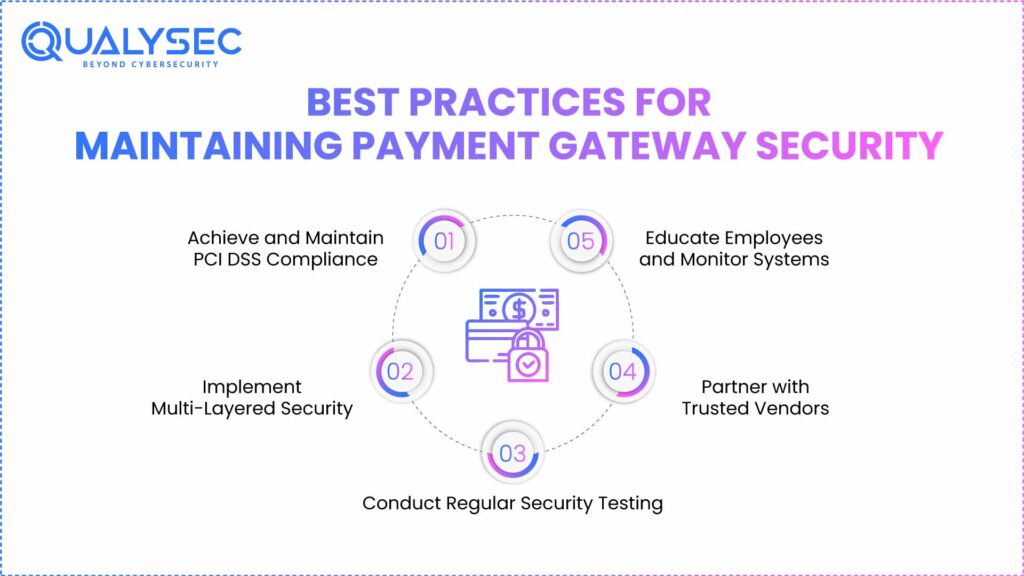
The use of holistic payment gateway security has to be guided by best practices always. In addition, security is not a one-time implementation, but is a continuous process.
Achieve and Maintain PCI DSS Compliance
The compliance of the PCI DSS payment gateway is the basis of secure payment processing. Some of the necessary actions involve regular risk assessment, installing firewall settings, strong encryption of data when making payments, limited access to cardholder data, frequent system updating, and thorough security policies.
Implement Multi-Layered Security
Defence-in-depth strategies are necessary to ensure the online transactions. Such critical security measures are network firewalls, intrusion detection systems, strong authentication mechanisms, encrypting data in payments and during transit, automated threat detection, and security awareness training among employees. Also, use network segregation to isolate payment systems.
Conduct Regular Security Testing
Penetration testing of payment gateways should be conducted on a regular basis in order to detect emerging flaws. Web application security, API authentication, implementation of data encryption during payment, effective implementation of access control, and security of third-party integration should be tested. Additionally, perform further testing once major changes have occurred to the system.
Stay PCI DSS compliant and protect payment data with expert penetration testing.
Partner with Trusted Vendors
The third-party relations are influential on the security of payment gateways. Thus, make sure that partners are PCI compliant payment gateways. In addition, it should review vendor relationships and security practices regularly.
Educate Employees and Monitor Systems
Human mistakes are one of the major sources of security breaches. The topics of training should include detection of phishing attacks, how to manage payment data, and how to report an incident. Moreover, it can be observed in real-time and therefore, security threats are detected and responded to very quickly.
Talk with Qualysec’s experts today to develop a customised security strategy for your business.
Conclusion
In 2025, American companies will prioritise payment gateway security as a business priority. Furthermore, a secure system ensures that your business and your customers are not destroyed by a catastrophic cyber threat. In this guide, we have discussed the key elements of payment gateway security, such as encrypted data in payment and payment fraud prevention software.
The nature of the threat is constantly changing, and attackers are becoming more sophisticated in their approaches to cybercrime. As a result, companies cannot risk laxness in terms of e-commerce payment security. Payment gateway solutions that are PCI compliant offer enough bases, but full protection needs to go beyond the minimum compliance. Hence, act on to ensure your payment infrastructure is secured by professional advice on the part of Qualysec.
If you have any questions, feel free to ask here.
FAQ
1. What is payment gateway security?
Payment gateway security refers to the technologies, protocols, and practices that secure sensitive payment data throughout online payments, such as payment data encryption, online authentication features, and PCI DSS payment gateway compliance. Thus, strong security of payment gateways guarantees that the credit card information and other financial data of customers are not exposed to unauthorised access and fraud.
2. Why is payment gateway security important for businesses?
Payment gateway security saves businesses an average of 9.48 million per breach and the loss of their reputation forever, since more than 60% of consumers give up on the businesses once they hear about data breaches. Furthermore, the adoption of safe payment processing can guarantee the appropriate adherence to the law and the preservation of the possibility of accepting credit cards.
3. What are the common risks in payment gateway security?
The most common risks are data breaches that provide information about customers, card fraud via stolen account credentials, unsecured third-party payment services creating vulnerabilities, and non-conformance to PCI DSS payment gateway requirements. In addition, employee insider threats and advanced phishing schemes against authentication systems are emerging issues that demand all-inclusive secure online transactions solutions.
4. Does PCI DSS compliance ensure secure payment gateways?
Although the compliance of PCI DSS payment gateway offers a fundamental security base and minimum industry requirements, it does not ensure that all threats have been mitigated. Hence, companies need to go beyond the basic PCI compliant payment gateway standards by introducing additional fraud prevention and routine payment gateway penetration testing.
5. How does penetration testing help in securing payment gateways?
The penetration testing of a payment gateway is an active way of identifying security weaknesses; it applies the simulations of attacks against payment infrastructures to test authentication processes and encryption of data used in payment implementation. Furthermore, detailed testing offers practical information on how to enhance security posture and guarantee the existence of PCI compliant payment gateways.