

By 2025, the global penetration testing market will have soared to reach 2.74 billion, almost a doubling within a few years, and on an estimated path to reach 6.25 billion by 2033. This signifies a compound annual growth rate (CAGR) of 12.5% and a security spend increase, especially in the United States, where the market provides 12.5 percent annual revenue of the US market of $543.69 million. What is so urgent about penetration testing for startups? The reply is very sharp –
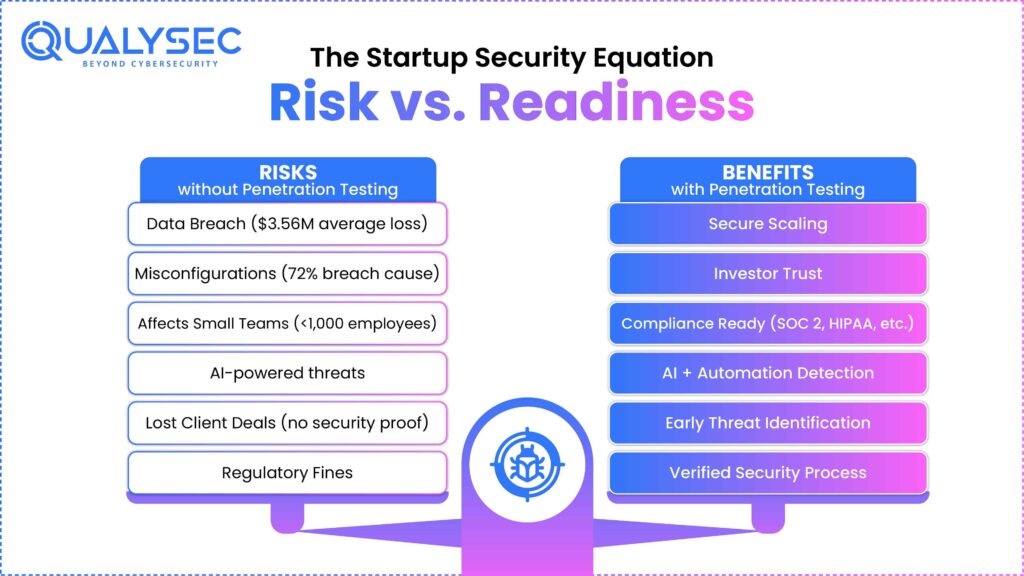
- The average cost of a data breach on startups stands at $3.56 million per breach. More importantly, 72 percent of such breaches occur due to mere misconfigurations and insecure environments that compromise fast-developing startups.
- Almost 46 percent of the total number of cyber breaches affected business upon businesses having less than 1,000 employees, with several of those representing pioneering deep tech startup ventures that intend to revolutionise their respective industries using next-generation technology.
- The cyber-surface area is expanding. As companies rush to smart AI-enabled goods, cloud-first infrastructure, and networked gear, the vulnerability of one vulnerability spreads to enormous risk.
- 57 percent of startups confirm that potential clients demand evidence of a good security position, of which a penetration test is an obvious requirement. Losing security credentials may jeopardize or disrupt multi-million-dollar transactions in early-stage and growth-stage businesses.
- There are growing compliance forces – In 2024-2025, 80 percent of organizations said regulatory and third-party compliance demands were the key triggers in requests to conduct penetration tests, and the AI-driven checks result in a 30 percent quicker turnaround time in the discovery of vulnerabilities.
That is where penetration testing for startups and founders are today. The speed and cost advantage achieved by not investing in proactive security is offset by the creation of a long-term existential threat. Unless you are starting a deep tech company and building a product or supporting a company building a product, you cannot afford to treat penetration testing as a nice-to-have. It is essential for safe scaling.
Prepared to defend the future of your deep tech startup? Understand how penetration testing startups may be used to enable secure, sustainable growth. Contact Qualysec today to get a custom threat assessment.
The Deep Tech Startups Have Unique Security Issues
1. Innovation = novel attack surfaces
Deep tech startups challenge the expectations of technology – AI, machine learning, advanced robotics, quantum computing, and IoT are some of them. Nevertheless, each new tech stack, API, and cloud integration can serve as an aggregate point of the emergence of cyber threats. As opposed to legacy companies, startups –
- Operate at an incredibly high speed, as to whether everything is covered when it comes to security is often secondary to MVPs and speed to market, especially for an MVP development company.
- Store sensitive IP and consumer information in hybrid and commonly lightly defined cloud situations.
- Trust open-source elements and third-party providers, not always thoroughly checked in terms of security.
2. Compliance and Customer Trust
In 2025, compliance ceased to be a check box. There is also another problem facing startups before they achieve significant revenue in the USA – the rules of the sector (e.g., HIPAA, PCI DSS, FinTech requirements, etc.). More to the point, more substantial B2B consumers currently insist on a startup cybersecurity testing certificate proof. What will it cost not to comply? Fine and legal suits and long-lasting reputational damage.
3. Scaling Without Guardrails
It is the largest and thickest funding round of 2025. This implies additional endpoints, additional wagering employees, and increased stakes. Following the technological forecast of McKinsey, the threat to deep tech is more critical since, as it writes, the speed and intricacies of scaling did not wait till security was achieved. Unsecured growth implies the architectures that are fragmented and access controls that are not defined, opening the doors to advanced attacks.
4. AI and Automation – A Sword that Cuts Both Ways
By 2025, cybercriminals will use AI to develop highly effective phishing, automate their offences, and develop malware that adapts during use. Deep tech startups, on the other hand, can use AI-based penetration testing to identify precisely such vulnerabilities proactively at scale and even before malicious actors have a chance to exploit them. Manual security audits can no longer keep up – this is achievable only through automation, which is no longer an option but a necessity.
The Verified Process: Why Security Test Standardization Counts
Most deep tech startups confuse a simple pen test with full coverage. However, the threats are developed much quicker. Process-based penetration testing is the most advanced form of startups in 2025, and they are verified, rather than checking the box to meet compliance requirements 2025 because security is constantly changing.
- Verification – Process-driven testing is continuously verified, which matches not only the regulatory framework but also those attack vectors used in real life.
- Process First – Consistently test automated and manual across endpoints, within the cloud infrastructure, APIs, and internal code.
- Outcome-Focused – Prioritized remediations, rather than vulnerability “lists.”
Download a sample penetration test report here!
Important Advantages to Deep Tech Startups
- Avoids Data Breaches – The early detection and patching of weak areas safeguards the data of your business and users.
- Gains Investments, Partnerships – Investors and partners require evidence of sound penetration testing before scaling, which will soon become a given.
- Establishes Customer Confidence – As customers are becoming more aware of the digital threats, they are becoming more likely to lend their trust to businesses that can be trusted.
- Makes Regulatory Compliant – Whether it is SOC 2 or HIPAA, the pen-testing proves security maturity, avoids costly penalties, and enables access to new markets.
- Adds Motivation and Competitiveness – Proactive fixing flaws promotes fortifying an adaptable, competitive technological base.
How is Qualysec Technologies Unique?
About: Qualysec Technologies is a process-based penetration testing and startup cybersecurity testing focused on confirmed, process-oriented, and custom-fit security evaluations of deep tech startups.
Location: Global
Services: End-to-end penetration testing before scaling, vulnerability fixes, compliance-based security consultancy services, and Deep tech security solutions.
Why Qualysec is Different?
Qualysec Technologies is not the only cybersecurity vendor. Our unique advantage is our Verified Process-Based Testing, a process-based proprietary approach that far exceeds industry checklists.
Our advantage –
- Process-Oriented Security – Our end-to-end approach is highly tailored to how up-and-coming deep tech companies grow and adapt to meet their changing needs. It is not just a generic scan; we automate, employ thorough manual testing, provide live attack simulations, and alignment of compliance-practice-fit every time.
- Breadth and Depth – Whether it is AI and ML pipelines, IoT data flows, blockchain integrations, or otherwise, our frameworks can handle even the most complex architectures.
- Complete visibility – All engagements conclude with actionable, prioritized, and context-rich results that not only enable technical but also executive-level teams to make security a competitive advantage and not a bottleneck.
- Qualified Experts – Qualysec only employs Startup-certified penetration testers across the US, all of whom have attained the level of international certification.
- Certified Results – Each project is issued with a Qualysec Verification Seal, which offers vetted results that are secure, auditable to potential investors, customers, and regulatory agencies.
We think deep tech security must grow with you, not drag behind you. Be one of the dozens of creative deep tech businesses that have trusted us to help keep their most sensitive assets safe before that very important growth tipping point.
Is your deep tech startup incubated to take the next funding or a big client? Make sure your product (and your future) is on the safest possible path with Security testing for deep tech startups by Qualysec. Call a security strategy session today!
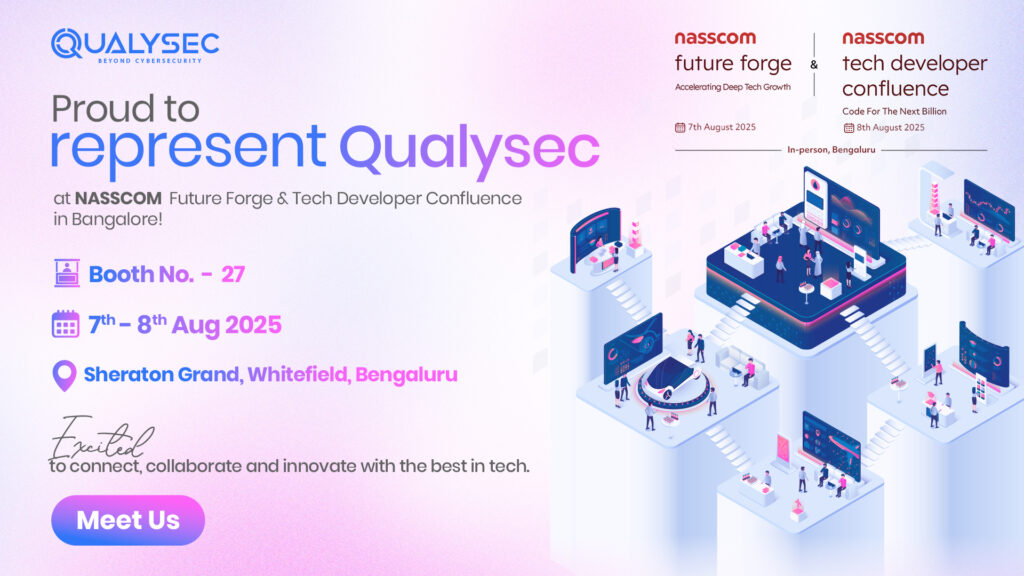
Excited to Announce!
Qualysec will be at the NASSCOM Future Forge & Tech Developer Confluence 2025!
August 7–8 at Sheraton Grand, Whitefield, Bengaluru — find us at Booth No. 27.
We’re excited to showcase our work in cybersecurity, deeptech, and innovation at the Innovator’s Hub.
If you’re planning to attend, just reach out to us — we’d love to connect and chat in person!
FAQs
1. What is start-up penetration testing? Why should it be done?
In the case of startups, penetration testing is a simulation of the startups under a cyberattack to identify the weaknesses before hackers strike. Setting the breach costs at an average of 3.56 million dollars in 2025, proactive pen-testing will prove useful to prevent financial, operational, and reputational losses.
2. At what point do we want penetration testing before scaling?
The best practice is limited to testing security any time before a major product version, fundraiser, or launch to market, particularly within a deep tech context, with code and integration being common.
3. Would penetration testing be assistive with regulatory compliance?
Absolutely. Pen-testing proves compliance against regulations such as SOC 2, HIPAA, and PCI DSS, security best practices, and is typically a requirement by B2B customers as well as investors.
4. What is the difference between the process-based version of penetration testing and regular pen-tests?
Process-tested testing is an end-to-end repeatable technique that uses automation, expert manual labor, and connects realistic attacks on your actual space alongside the particular arrangement of your tech and endeavor to achieve or amplify.
5. What is an acceptable frequency of retest?
Given the dynamic nature of the threats involved, combined with the high growth rates exhibited by startups, penetration testing ought to be done every year, at the very least, but preferably whenever a change is being made to the codebase or to the infrastructure.