

If your company uses credit card payments, you’ve likely heard of PCI Compliance. But hearing about PCI Compliance isn’t good enough. You need to understand what it means for your day-to-day, and what it means for PCI Compliance Testing.
In 2026, with really no roadmap for security, customer payment data protection isn’t up for debate – it’s what you must do. That’s where the PCI Compliance Test comes in handy.
It’s not a checkmark; it’s a way to methodically get your company on the right path to achieve certain standards in security and everything that comes with it, and it may save you from affiliates, penalties, as well as data breaches, privacy violations, credit injuries, and on and on.
It doesn’t matter if you are a startup or an expanding small business; this guide will demystify what PCI Compliance Testing is and how you can prepare to stay compliant, without feeling overwhelmed.
What Is A PCI Compliance Test?
A PCI Compliance Test is a way to determine whether your business complies with the Payment Card Industry Data Security Standard (PCI DSS). These are standards globally defined to protect cardholder data against theft or misuse. Testing involves the exploration of your systems, networks, and processes for security or compliance.
Depending on how you process payments, whether online, in-store, or a combination of both, your test requirements may look different. Additionally, there are different PCI compliance levels based on transaction volume. In general, the tests included as part of the PCI compliance process are vulnerability scans, penetration tests, self-assessment questionnaires (SAQs), and on-site audits.
Step-by-Step Guide to Prepare Your Business for a PCI Compliance Test
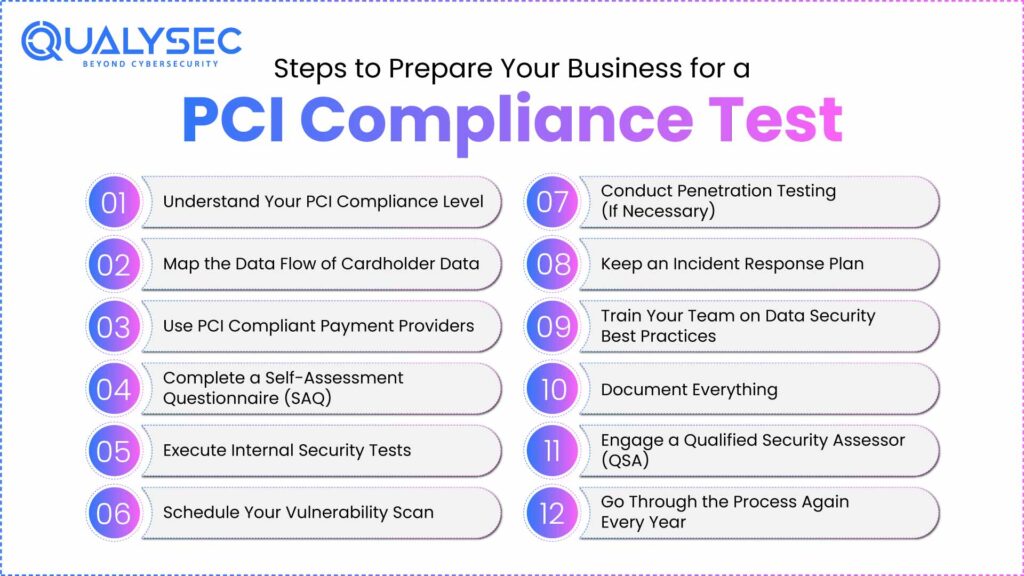
Getting ready for a PCI Compliance Test doesn’t have to be traumatic: it just takes a little planning. The following is a simplified roadmap for you and your business to successfully prepare, secure your business, and fulfil all necessary PCI Compliance matters of fact.
Qualysec will guide you every step of the way.
1. Understand Your PCI Compliance Level
To get started, figure out what your PCI level is. There are four levels, and they are based on the number of credit card transactions per year. Level 1 is for the biggest merchants, and Level 4 is for merchants with fewer than 20,000 transactions a year. Knowing what level you are determines the testing or documentation that is required.
2. Map the Data Flow of Cardholder Data
Create a data flow diagram or list that shows how payment data flows through your business. It should show where cardholder data is collected, stored, processed, or transmitted. It is helpful to write out the flow, whether you’re using a POS or an e-commerce checkout process. This helps show you where your vulnerabilities might be in the flow.
3. Use PCI-Compliant Payment Providers
If you’re not already using one, switch to a PCI-compliant payment processor (such as Stripe, Square, or PayPal, etc.). These solutions take care of a lot of heavy lifting in terms of compliance and exposure to risks, and they also reduce the risk exposure.
4. Complete a Self-Assessment Questionnaire (SAQ).
Most small businesses will be able to fill out an SAQ instead of going through a whole audit. A SAQ is a series of yes/no questions based on how you accept payments. Make sure you choose the right version of the SAQ for your business.
5. Execute Internal Security Tests.
Before you have any external testing done, do some basic security hygiene practices by updating your software, changing default passwords, running firewalls, and encrypting stored data at a minimum. If you cover the basics, you will pass the official test on your first go.
6. Schedule Your Vulnerability Scan.
If your business retains or transmits cardholder data on the internet, you will need to undergo a quarterly vulnerability scan from an Approved Scanning Vendor (ASV). A vulnerability scan looks for existing vulnerabilities within the network and applications.
7. Conduct Penetration Testing
For large organisations or those with more intricate systems, a penetration test may be necessary. Engage professionals to undertake a simulated cyberattack to uncover vulnerabilities before an actual hacker could.
8. Keep an Incident Response Plan
Even if you only draw up a simple incident response plan for your organisation, identify who to reach out to, how you will contact affected parties, and how the organisation will contain damages quickly in case of a data breach or suspected incident.
9. Train Your Team on Data Security Best Practices
Your organisation’s staff are as important to keeping data safe. Make the training classes simple by letting employees know useful things to look out for, like how to differentiate phishing emails, identify secure passwords, and securely handle customer information.
10. Document Everything
Keep clear records of everything you do in the name of compliance — your SAQ responses, scan results, policies, and employee training logs. Documentation will be key even if you are audited or if there is ever a question as to your compliance status.
11. Engage a Qualified Security Assessor (QSA)
If you are a large enough merchant or if you feel confused by the PCI rules, consider hiring a QSA. QSAs are professionals certified to work with businesses in conducting PCI testing and validation, and/or following PCI processes. They can help ensure that you are at least on the right track.
12. Go Through the Process Again Every Year.
PCI compliance is not a one-time occurrence. Compliance is ongoing. Most tests and assessments must be performed annually (and scans quarterly). Make a note of the calendar, set recurrent reminders, and integrate compliance into your annual business calendar.
How Can Qualysec Help?
Qualysec is a well-known service provider in the cybersecurity space. They provide services that help businesses comply with PCI rules and regulations. They offer various services from vulnerability assessments to penetration testing to make sure your systems, processes, and controls are supported by PCI DSS standards.
Their typical approach is simple and practical; they will work with your teams so that they can identify gaps, resolve any issues, and streamline the entire compliance process. Their primary focus is on providing customers with actionable insights, not technical terms. Qualysec serves customers of all sizes, and they tailor their services to smaller-scale budgets.
In partnership with Qualysec, you can avoid hefty fines, protect your customers’ data, and process payments to build and maintain customer trust. Obtaining PCI compliance does not have to be complicated. Qualysec can help simplify and relieve most of the stress from the process.
Conclusion
Testing your PCI Compliance Test is a critical step to protecting your business and customer data. It may be easier than you realise with the right processes and tools in place. Protect yourself from penalties and foster trust through compliance by incorporating some compliance testing into your regular operations.
Hackers don’t wait. Why should you? Let Qualysec test and secure your systems now.

FAQ’s
1. What are PCI compliance tests?
PCI compliance tests evaluate whether your business meets the Payment Card Industry Data Security Standards (PCI DSS). In other words, they are a way to ensure that customer payment data is managed safely while being transferred, processed, and stored.
2. Who needs to do a PCI compliance test?
Any business that accepts credit or debit card information must complete PCI testing, regardless of size or industry.
3. What must your business accomplish to pass the PCI compliance test?
You will need to demonstrate secure networks, updated software programs, encryption methods for card data, controls to restrict access, matching logging, monitoring with alerts, and documented security policies.
4. What is the PCI compliance test’s format?
Your test could include a self-assessment questionnaire (SAQ), vulnerability scanning (conducted by an Approved Scanning Vendor -ASV), penetration testing, and sometimes an on-site audit.
5. What happens if a business does not pass the PCI compliance test?
You may be subject to fines, an increase in processing fees, litigation costs, and, in some cases, you may lose your ability to process card payments until you become PCI compliant.