The U.S. securities industry operates within one of the most closely monitored regulatory frameworks in the world. To maintain FINRA compliance, broker-dealer firms must meet numerous regulatory expectations established by the government and industry regulators. Among other things, brokers need to uphold fair trading practices, protect investor interests, maintain accurate records, and minimize opportunities for market misconduct.
That’s why there exists an entity that oversees all those obligations – namely, the Financial Industry Regulatory Authority (FINRA audit). It’s a self-regulatory organization that works directly under the auspices of the United States’ Securities and Exchange Commission (SEC).
For broker-dealer firms, meeting all the requirements outlined by FINRA goes beyond simply passing its annual exam. Instead, they need to be continually maintaining certain kinds of written supervisory procedures, keeping proper books and records, monitoring employee activities, protecting sensitive customer information, and responding to changes made by regulators over time. If firms fail at any point, then they open themselves up to being subject to enforcement action – potentially involving large financial penalties and other forms of restriction.
Indeed, the amount of money in fines and disgorgement orders issued by the agency speaks volumes about how important compliance remains to regulators. According to the regulator’s 2025 Key Statistics, FINRA ordered $99.6 million in fines and disgorgement against member firms and individuals while filing 625 disciplinary actions during the year. The latter came as a result of various violations, including inadequate supervision and recordkeeping failures, cybersecurity and compliance issues, among others.
Learn about FINRA compliance – what it is, who has to comply, what the key regulatory requirements are for broker-dealers, how FINRA exams are performed, common compliance issues faced by firms, and much more in this guide.
What Is FINRA and Who Must Comply?
The Financial Industry Regulatory Authority (FINRA) is a self-regulatory organization (SRO), created by Congress pursuant to Section 18(a)(1) of the Securities Exchange Act of 1934. It operates under the oversight of the Securities and Exchange Commission (SEC).
FINRA’s role extends far beyond setting policy. The organization routinely examines broker-dealers for rule compliance, takes enforcement actions against firms and individuals that violate its rules, develops investor education programs, and provides resources to help investors better understand how the securities markets work.
The requirements also operate on two different levels – the firm and the individual.
Broker-Dealers (Firm-Level Compliance)
At the firm level, every broker-dealer that conducts business with the public must become a FINRA member and complete registration before engaging in securities transactions. Once registered, firms are required to make periodic disclosures demonstrating their continued compliance with applicable FINRA rules.
Registered Professionals (Individual-Level Compliance)
At the individual level, registered representatives, principals, investment bankers, and other associated persons are each responsible for meeting regulatory obligations tied to their specific roles. This creates an important distinction: a firm may be fully compliant while an individual employee is not – or the reverse.
Because of these overlapping responsibilities, FINRA compliance reaches nearly every aspect of a broker-dealer’s operations. Its requirements cover fair trading practices, market conduct, advertising and communications, registration obligations, continuing education, and recordkeeping. They also extend into areas that have become increasingly important, including anti-money laundering (AML) programs and cybersecurity risk management.
In practice, FINRA compliance is not something that can be reviewed once a year and set aside. Firms that treat compliance as an annual exercise instead of an ongoing operational responsibility are far more likely to appear in FINRA’s monthly disciplinary reports.
Finally, it’s worth noting that FINRA compliance is a bit of a misnomer – it means ensuring ongoing adherence to a large set of rules issued by the association, but also required by the SEC and based on federal securities laws.
Core Areas of FINRA Compliance
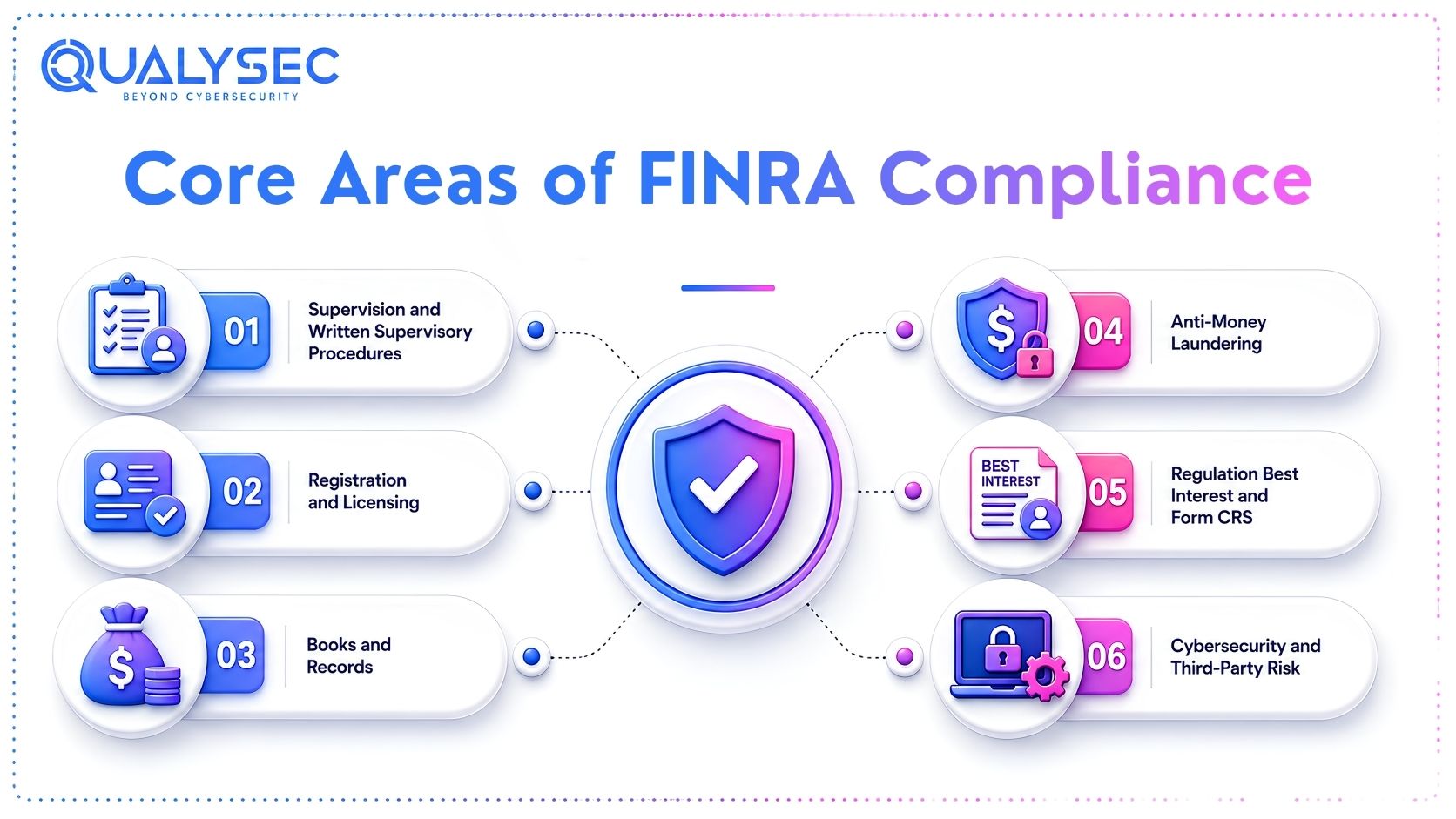
Supervision and Written Supervisory Procedures
As required by FINRA Rule 3110, all members must put into place a supervisory system reasonably designed to ensure the compliance of the firm and its associated persons with applicable federal securities laws and FINRA’s rules. This usually results in a Manual of Written Supervisory Procedures (WSP), which outlines a member firm’s supervision process for each of its business lines and its associated persons’ activities.
A number of commonly seen WSP deficiencies were recently flagged by the 2026 FINRA Annual Regulatory Oversight Report. These include those that fail to outline specific actions supervisors should undertake to satisfy their obligations. They also include those referencing the existence of regulatory mandates without providing implementing guidance. Additionally, the report identified those failing to incorporate recent rule changes, such as Regulation Best Interest. A member firm’s WSP will pose similar regulatory risks if there are procedures in place, but they aren’t enforced.
Registration and Licensing
All those who are registered should have an appropriate license issued by FINRA based on their activity as follows.
| Registration | Exam Required | Covers |
| General Securities Representative | Series 7 | Broad securities transactions |
| General Securities Principal | Series 24 | Supervision of registered reps |
| Investment Banking Representative | Series 79 | Investment banking activities |
| Operations Professional | Series 99 | Operational functions |
| Securities Industry Essentials | SIE (co-req) | Entry-level industry knowledge |
Also, firms need to keep track of the continuing education (C.E.) requirements. These consist of the Regulatory Element, which needs to be completed within 120 days of the registered second anniversary in the industry, then every 3 years after that. Not completing C.E.on time makes you inactive, making you unable to act in registered capacities until you do so.
Books and Records
Record-keeping requirements are also defined by the Securities Exchange Act of 1934 (SEC), including under Regulation 17a-3 and 17a-4. In general, members need to maintain their records in a manner that ensures accuracy and completeness. This means keeping them in whatever form meets the required retention period (typically three years) – with the first two being kept in an easily accessible location.
- Failure to capture and archive electronic correspondence of part-time Chief Compliance Officers and Financial and Operations Principals conducting firm business.
- The inadequacy of due diligence efforts on third-party vendors who provide recordkeeping services with respect to their ability to produce records during a simulation of a regulatory examination.
- The inability to detect off-channel communications from those associated persons due to failure to update keyword surveillance systems as it relates to the use of new forms of messaging.
As part of the electronic records they maintain, broker-dealers must ensure that the records comply with the Write Once, Read Many (WORM) or audit trail requirement under SEC Rule 17a-4(f). This applies even when third parties store such records. In other words, a firm may not avoid responsibility merely by outsourcing.
Anti-Money Laundering
According to FINRA Rule 3310, “Each Member Firm shall have a written AML Program which includes internal controls, an annual independent test of its effectiveness, a designated AML Officer, and training programs for persons involved in the processing of securities transactions who are responsible for identifying suspicious activity.”
A 2026 Annual Regulatory Oversight Report identified frequent failures by firms to carry out sufficient customer due diligence on low-priced securities transactions, as well as to submit timely Suspicious Activity Reports where there was evidence of attempted manipulation.
Regulation Best Interest and Form CRS
Starting back in June of last year, Regulation Best Interest, or Reg BI, now governs every single broker-dealer offering advice on securities to its retail customers. This meant those brokerages had to make sure their recommendations were in each client’s best interests at the moment they made the recommendation. Yet, according to FINRA’s 2026 examinations, many brokers were still falling short in some key categories.
For example, firms were creating Workplace Support Programs, or WSPs, that referred to the Care Obligation but failed to explain how supervisors could determine if their recommendation actually met this standard, and there were no exception reports or alerts for spotting Reg BI issues at the transactional level. And firms needed to deliver an important document called Form CRS to retail customers upon account opening, updating it whenever there are major changes.
Cybersecurity and Third-Party Risk
In this year’s report, cybersecurity & third-party risk made up one of the key topics covered. It included the most prevalent FINRA compliance requirements related to:
| Requirement | Rule / Source | Compliance Deadline |
| Multi-Factor Authentication | SEC Reg S-P (amended) | June 3, 2026 (smaller entities) |
| Incident Response Plan | FINRA Rule 4370 / Reg S-P | Ongoing |
| Third-Party Vendor Due Diligence | FINRA Rule 3110 | Ongoing |
| Off-Channel Communications Monitoring | FINRA Rule 3110 / 4511 | Ongoing |
| Business Continuity Plan | FINRA Rule 4370 | Annual review required |
As many of you will be aware by now, member firms are extremely dependent upon the services provided by their various vendors (external systems), which often facilitate the provision of compliance functions. Firms that had not implemented MFA for system access by that date violated the rule.
What Is a FINRA Audit?
To help you understand how FINRA works, we will walk you through some key terminology first.
In the world of FINRA, they swap out the word audit for the phrase examination. This process happens via FINRA’s Member Supervision programme, where the frequency and scope of an examination depend upon your firm’s risk profile, business model, and previous examination experience. In addition to these regular examinations, FINRA also performs cycle examinations (comprehensive reviews every few years) and cause examinations (triggered based on customer complaints, tips, referrals, or anomalies found during automated surveillance).
Types of FINRA Examinations
Here we find the most common gaps across all WSPs reviewed:
- Cycle Examinations: On a scheduled basis, we conduct comprehensive reviews covering all major regulatory areas applicable to the firm.
- Cause Examinations: Triggered by customer complaints, tips, referrals from other regulators, or anomalies identified through automated surveillance. These focus on the specific issue that prompted them.
- Branch Examinations: Reviews of branch office locations, assessing whether supervision at the branch level matches the WSPs in place at the home office.
What Examiners Look For
FINRA examiners typically request records and documentation across the areas relevant to the firm’s business: WSPs, trade reports, customer account records, communications, AML logs, net capital calculations, and evidence of supervisory reviews. They assess whether the firm’s written procedures match what is actually happening operationally.
The gap between policy and practice is a consistent examination finding: WSPs state that supervisors review exception reports daily, but the review logs show they did not open them for weeks. That disconnect treats supervisors as failures regardless of whether any underlying violations occurred.
Common FINRA Compliance Issues
Accordingly, FINRA’s examination and enforcement activities have identified recurring compliance concerns among broker dealers that involve more than just lack of policies, such as issues with implementation, supervision, monitoring, or documentation. These include:
The above-mentioned are some of the areas that continue to attract significant regulatory interest. The following analysis presents some of the key findings from these FINRA examinations and subsequent actions taken by them.
Conflicts of Interest Disclosure Failures
These are among the biggest compliance risk factors for brokers/firms.
Conflicts of interest violations involve situations where a broker or firm has some kind of financial incentive related to a recommendation/transaction but does not disclose this to their customers appropriately. This becomes an issue because Reg BI requires all recommendations to put clients’ interests before the firms’ financial ones. An undisclosed conflict of interest in a recommendation can undermine a firm’s entire supervisory framework and increase its risk of regulatory action.
Consolidated Audit Trail (CAT) Reporting Errors
During FINRA’s most recent examinations, we continued to find deficiencies related to the implementation of the Consolidated Audit Trail (CAT). Our regulatory review efforts have consistently revealed incomplete, inaccurate, or untimely submissions due to weaknesses in firms’ reconciliation processes, lack of adequate supervisory oversight, or failure to manage third-party reporting providers effectively.
Firms that did not synchronize their internal trading records with CAT reporting requirements experienced repeated reporting problems without addressing the root causes for those issues.
Best Execution Deficiencies
FINRA expects that firms will conduct regular, well-documented reviews of execution quality across various trading venues and order types, taking into account payment for order flow (PFOF) agreements and/or other incentive structures associated with order routing choices.
If conducted only periodically, rather than continuously, such reviews by firms that do not have continuous monitoring mechanisms in place would not necessarily enable them to uncover executional problems prior to an exam finding.
Vendor Risk Management Weaknesses
An increasing reliance by firms on external technology vendors means that oversight of these vendors should be a growing concern for regulators. FINRA notes that many firms still need work here: they lack formal vendor risk management policies; don’t assess the potential operational impact of vendor disruptions; don’t include their service providers in their incident response exercises; or fail to promptly revoke vendor access when the contractual relationship comes to an end.
AI Governance and Supervisory Gaps
Regulatory Notice 24–09 highlights the potential compliance risks arising from the application of generative artificial intelligence (AI) by broker dealers, as well as the need for firms to ensure their supervision remains effective against such technologies.
“While the Rules themselves are designed to be technology neutral… communications generated using AI applications are still subject to the same types of supervisory reviews, record keeping, and fair communication expectations applicable with respect to human-generated communications,” FINRA notes in RN 24-09.
Best Practices for Achieving FINRA Compliance
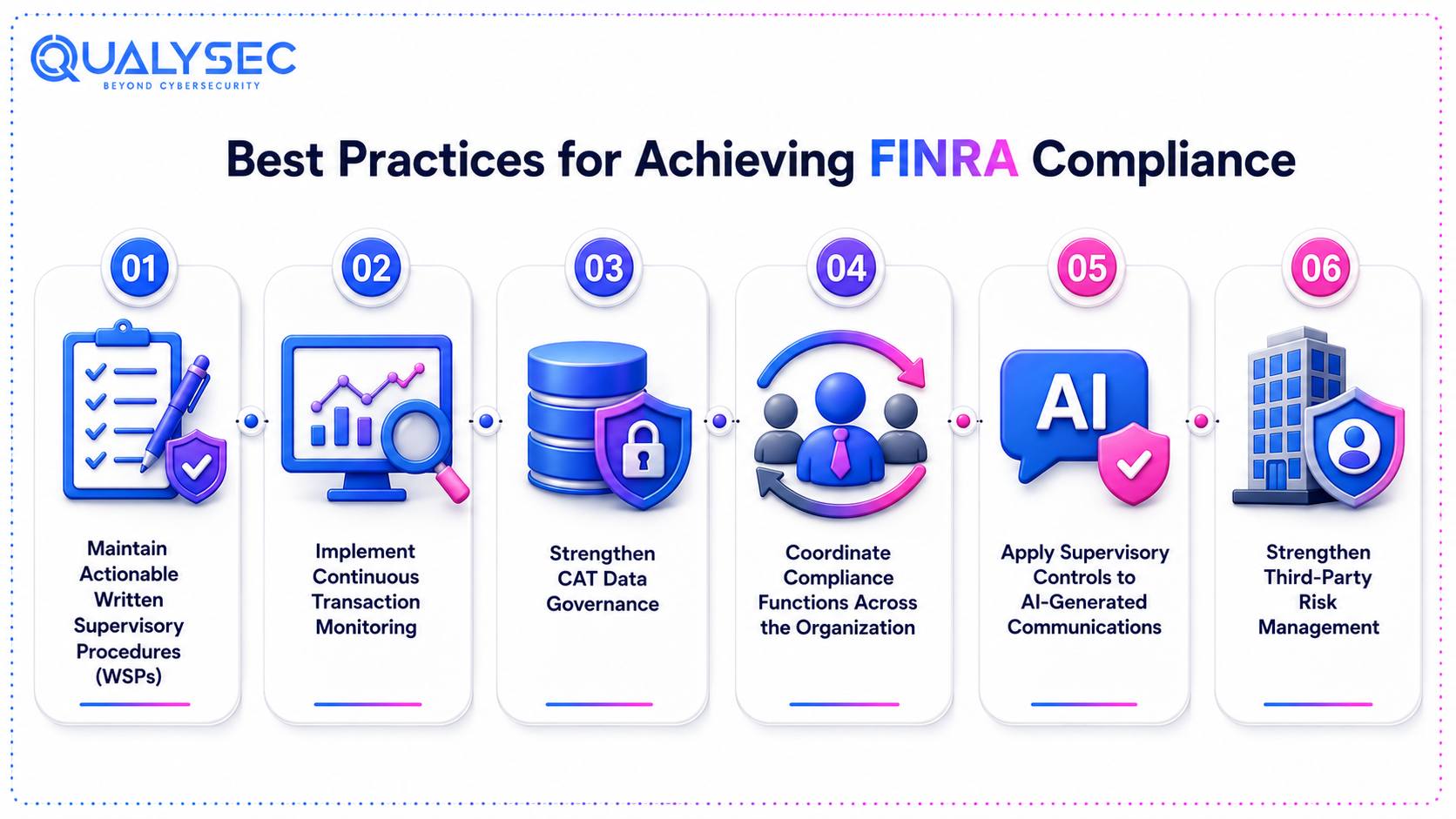
Developing an effective FINRA compliance program involves creating both governance processes and supervisory/monitoring controls to show compliance with regulations during exams. It’s not just about writing down rules and policies.
Maintain Actionable Written Supervisory Procedures (WSPs)
Describe how you will conduct supervisory activities instead of reiterating what you must do by regulation. Good written supervisory procedures specify who is responsible for each activity as well as when supervisors need to review them, what kind of reports managers need to provide, documentation standards, and other escalation procedures.
Implement Continuous Transaction Monitoring
When integrated into operational workflows, supervisory controls tend to be more effective. This could involve setting up automated exception reports and transaction monitors for identifying recommendations that run counter to a client’s stated investment objectives, risk tolerance, or suitability profiles before such recommendations escalate into compliance issues.
Strengthen CAT Data Governance
To ensure accurate CAT reporting, firms need to put effective data management mechanisms and supervision into place. This includes setting up reconciliation processes and validating data quality before submitting filings. They must also respond quickly to reporting anomalies by addressing underlying root issues, instead of merely making repeated fixes for specific filing errors.
Coordinate Compliance Functions Across the Organization
The cybersecurity team works hand-in-hand with other departments like AML, Vendor Risk Management, Legal, and Compliance to manage their respective areas of responsibility within a well-defined governance framework. This includes cross-functional oversight of various aspects to ensure consistent identification of risks, alignment of controls, etc.
Apply Supervisory Controls to AI-Generated Communications
For example, if you’re using an AI-powered tool to assist your clients with their communications or your firm’s research or marketing efforts, make sure that you cover those outputs with the supervisory review and record retention and approval processes specified by FINRA Rule 2210. In addition, firms should develop governance policies that clearly define how they will approach the appropriate use of artificial intelligence, assign responsibility for ensuring its proper application (including human supervision), and specify the types of monitoring they will perform.
Strengthen Third-Party Risk Management
Firms need to ensure vendor relationships are managed as part of their overall compliance program, rather than just an IT function. This includes effective oversight, such as performing due diligence prior to engaging a vendor. It also includes actively monitoring the performance of vendors throughout their engagement and participating in their incident response activities. In addition, firms should establish defined exit procedures for ending engagements, including ensuring access to firm systems can be revoked on time. Finally, firms should confirm via documentation that they have either returned firm data securely or destroyed it upon termination of vendor services.
How Qualysec Can Help With FINRA Compliance
The 2026 Annual Regulatory Oversight Report placed cybersecurity and third-party risk at the top of the examination focus areas, and the amended SEC Regulation S-P has added specific technical requirements that many member firms have been slow to implement. Qualification gaps in cybersecurity are now a direct FINRA examination risk, not a separate IT concern.
Cybersecurity Gap Assessment Against FINRA and SEC Requirements
Qualysec conducts cybersecurity assessments mapped to the specific controls FINRA examiners look for: MFA implementation, off-channel communications monitoring, incident response plan adequacy, third-party vendor due diligence for recordkeeping systems, and business continuity plan testing. Each gap documents the specific FINRA rule or SEC regulation it relates to, producing a remediation roadmap that speaks the language of a FINRA examination.
Penetration Testing and Vulnerability Assessment
In addition to its regular examinations, FINRA’s cybersecurity guidance encourages firms to perform regular penetration testing as part of a mature security programme. Qualysec offers Vulnerability Assessment & Penetration Testing (VAPT) engagements across all areas within broker-dealer technology environments, including trading platforms, customer portals, internal systems, and vendor interfaces. Findings are CVSS-scored and mapped to applicable regulatory requirements.
Third-Party Vendor Security Reviews
Many FINRA recordkeeping violations trace back to vendors that failed to meet WORM storage requirements or could not produce records during a simulated examination. Qualysec reviews the security and compliance posture of third-party vendors used for recordkeeping, communications archiving, and AML systems, providing firms with documented evidence of due diligence that satisfies the FINRA Rule 3110 vendor oversight requirement.
Talk to Qualysec about closing your firm’s cybersecurity compliance gaps before your next FINRA examination!
Conclusion
FINRA compliance is not a status a firm achieves and then retains passively. The rulebook gets updated via annual regulatory oversight reports, new rule filings, and regulatory notices. Topics such as 2026 examination focus areas, cybersecurity, third-party risks, GenAI governance, and Reg BI supervision show current areas of the biggest discrepancies between what existing rules require and what firms implement.
Fines levied against securities industry professionals in 2025 totaled an eye-popping $99.6M, with firms spanning all size categories (not just large, established broker-dealers) impacted by these orders. Common threads among many of these actions included weak supervisory systems and/or a lack of adequate recordkeeping and cybersecurity infrastructure.
Schedule a consultation with Qualysec today to help you build a better cybersecurity foundation for your FINRA compliance programme!

FAQs
Q. What Is FINRA Compliance?
FINRA compliance refers to the rules, regulations, and obligations that are enforced by the Financial Industry Regulatory Authority (FINRA) on behalf of the securities industry, as well as other federal securities laws. These include things such as supervision, registration, recordkeeping, customer communications, AML controls, net capital, and cybersecurity. FINRA’s Member Supervision programme must examine every FINRA member firm for conformity with its own written policies as well as its obligations under regulation, according to FINRA.
Q. What Is FINRA Compliance Management?
FINRA compliance management builds and maintains the firm’s compliance programme. That involves everything from writing/writing up-to-date WSPs and training registered persons, through to monitoring for potential violations, answering queries from regulators, running internal audits, and keeping abreast of new rules/guidance issued by FINRA. The Chief Compliance Officer (CCO) typically does this within the firm, reporting directly to senior management, although they may also be answerable to the Board.
Q. What is a FINRA audit?
FINRA calls its reviews examinations rather than audits. To ensure compliance with SEC regulations, FINRA also performs what it calls cycle examinations based upon a risk-based schedule, as well as examinations prompted by specific concerns (“cause examinations”) and examinations of particular office locations (“branch examinations”). For these examinations, examiners inspect records and interview relevant personnel to determine if an organisation’s supervisory system and written procedures are adequate and enforced. Subject matter experts will convey the results of the examination via a letter, and organisations will have to provide steps they will take to address findings from the examination.
Q. How long does FDA approval usually take?
This question does not apply to FINRA compliance. For questions about FINRA examination timelines: cycle examination frequency depends on the firm’s risk profile and can range from annual reviews for higher-risk firms to less frequent reviews for lower-risk operations. Cause examinations are initiated when a specific concern is identified and move along the timeline that the concern requires. There is no fixed calendar for how long an examination takes once begun.