The major difference between CREST vs CHECK Penetration Testing is that CREST is an international accreditation body that is trusted throughout Europe and beyond. CHECK is a scheme operated by the National Cyber Security Centre, which is available in the UK only for the testing of government and critical infrastructure systems. It depends on your customers and which regulations apply to you.
Main points
- CREST is an international organization, while CHECK penetration testing comes from the National Cyber Security Centre and is used for public sector purposes.
- Companies aiming to be certified with CHECK status must be accredited by CREST.
- CHECK testers differ from CREST testers in that CHECK professionals must have security clearance in the UK.
- There is international recognition of CREST by the DORA and TIBER-EU frameworks in terms of its EU recognition.
- CREST remains the standard for most European private companies.
Introduction
When you’re looking for a penetration testing vendor in Europe, you repeatedly hear the terms CREST and CHECK. They sound like alternatives to each other. They are not. Knowing the true story between the two is a time, money, and risk-saving thing to do.
It’s easy to see why there’s confusion. Both signal quality. Both are mentioned in tenders and procurement requirements. They are, however, different from each other; they operate on different systems, and they have different masters. It’s a matter of getting CREST vs CHECK Penetration Testing correct. It’s the distinction between fulfilling commitments and losing money on the incorrect evaluation.
This guide is designed to clarify the situation for Europeans on both schemes. It outlines what each one is, sheds light on the unique differences, and assesses the advantages and disadvantages of each. It then provides you with an applicable model for selecting between them. In the process, it explains how European requirements such as DORA affect your organization’s accreditation.
What Is CREST Penetration Testing?
CREST (Council for Registered Ethical Security Testers) is an international, not-for-profit accreditation organization. It certifies both companies and individuals who provide penetration testing, incident response, threat intelligence and security operations services (Precursor Security). It is accepted throughout Europe, the UK and the world.
A CREST pen test is conducted by a provider who CREST accredits. For that accreditation, a company will have to be able to demonstrate a lot. It has to have qualified staff with CREST certification throughout its workforce. This must be quality-driven, including the ISO 27000 family. It must be covered by significant liability insurance and have documented processes for scope, test, and report.
There are four levels of individual certification, ranging from Practitioner to Certified level, at which CREST can be achieved. This arrangement enables buyers to check the accreditation of a firm, as well as other details. They can also verify that the particular testers on their engagement are qualified. For European organizations, CREST penetration testing is the standard for credible, independent security testing.
Key to this is the fact that most organizations are not required to complete a CREST pen test. It’s not a legal requirement but a sign of confidence. Those who need it include enterprise customers, auditors, procurement teams, and financial services and regulated companies, who are in need of taking out the guesswork. It ensures that the provider has been independently evaluated against a recognized international standard.
What Is CHECK Penetration Testing?
CHECK is a scheme run by the UK government’s National Cyber Security Center (NCSC). It includes a framework for the NCSC to approve companies to carry out authorized penetration tests on UK public sector and critical national infrastructure systems (Pen Test Partners). It can be referred to as the IT Health Check service. The keyword is UK – not a European-based scheme; it is a national scheme.
The mission of CHECK is to defend vulnerable government systems. It includes government departments, public sector organizations dealing with data at OFFICIAL or above, and critical national infrastructure. These assessments are only carried out by companies approved by the NCSC. The scheme assures government buyers that professionals who undergo rigorous vetting are doing testing to a defined national standard.
It is a very demanding and specific requirement. Review penetration testing requirements: testers need to be qualified to hold UK security clearance, which is usually at least a Security Check (SC) clearance. The Principal level or above of the Cyber Security Council’s Security Testing title is required for CHECK Team Leaders. Team Members shall be of the Practitioner level. There is a specific report format required for reports, and a copy is provided to the NCSC for review and archiving.
This is where the two schemes are joined. You can only apply to be a CHECK company if it is CREST-accredited. CHECK builds on CREST accreditation by adding UK government requirements for tester qualifications, security clearance, and operational procedures. That is, the CHECK Penetration Testing layer is a layer added to the CREST foundation by the UK government.
CREST vs CHECK Penetration Testing: The Core Differences
Scope and authority are the driving factors behind CREST vs CHECK Penetration Testing. The advantages of CREST are that it is international and applicable to a wide range of activities. CHECK is national, government-based, and only applicable to certain UK work. The table below spells out the differences that are most important for a European buyer.
| Dimension |
CREST |
CHECK |
| Managed by |
CREST, an international not-for-profit body |
The UK NCSC, a government authority |
| Geographic scope |
International, recognised across Europe |
UK only |
| Covers |
Private and public sector, any industry |
UK government, public sector, and CNI |
| Mandatory? |
No; a mark of assurance |
Yes, for in-scope UK government work |
| Security clearance |
Not required |
SC clearance minimum for testers |
| Reporting |
Provider’s own accredited format |
Specific NCSC format, copied to NCSC |
| Relationship |
The foundation accreditation |
Builds on top of CREST accreditation |
| Best for |
European enterprises and regulated firms |
UK public sector and infrastructure |
It is easier to understand with an analogy. Imagine a fully regulated, nationally recognized professional driving qualification, accepted all over the world – that is what CREST is. CHECK is more akin to a specialized police-pursuit qualification: it is the standard license with added, rigorous clearances for high-risk situations involving government. The base qualification needs to be achieved first. If you don’t do that specific work, the specialized one doesn’t matter.
Why This Matters for the European Market
This is where many of the comparisons go awry. As CHECK is a UK-only initiative, it is not significant for organizations with EU-wide operations. Most European businesses do not have to decide between CREST and CHECK at all. It is the regulatory conformity of their CREST pen test that is in question, one that is applicable all over the EU.
Among these is DORA (Digital Operational Resilience Act), which entered into force on 17 January 2025. DORA is applicable to the EU financial sector and requires threat-led penetration testing by big financial institutions (financialregulations.eu). The world’s most prescriptive penetration testing regulation.
DORA’s threat-led testing is based on the TIBER-EU framework, created by the European Central Bank. The key thing about our comparison is that TIBER-EU acknowledges the suitability of CREST accreditation in testing providers (Fortbridge). For a European financial institution that is regulated by DORA, one of the easiest methods to prove provider competence is to utilize a firm that CREST accredits. This is the European version of the CHECK system for assurance that we have in the UK.
CREST’s Role in EU and UK Compliance
The trend is not limited to the financial arena. Under GDPR Article 32, there are appropriate technical measures that must be implemented to ensure the security of personal data. The regulators in EU member states increasingly refer to the lack of adequate security testing in their investigations of breaches. Periodic CREST pen testing will provide evidence of reasonable measures taken. For European organizations, CREST is the accreditation that travels – CHECK doesn’t exist.
For organizations operating in both the UK and the EU, the UK Procurement Policy Note (PPN) requires government suppliers providing cyber security services to hold CREST accreditation from February 2025. Even in the UK, CREST is the minimum requirement – CHECK is added on for the most sensitive government systems. If any organization is considering CREST vs CHECK Penetration Testing, both markets share CREST as their common denominator.
Need a penetration test that satisfies European regulators and enterprise buyers? Qualysec offers comprehensive and independent penetration testing, and reports clearly with evidence to map your auditors’ and customers’ requirements. Talk to Qualysec about your security assessment.
Get CREST-Accredited Penetration Testing Services
Qualysec delivers CREST-accredited VAPT services with real-world attack simulations, validated findings, and actionable remediation reports.
Request a Quote
→
The Benefits of CREST Pen Testing
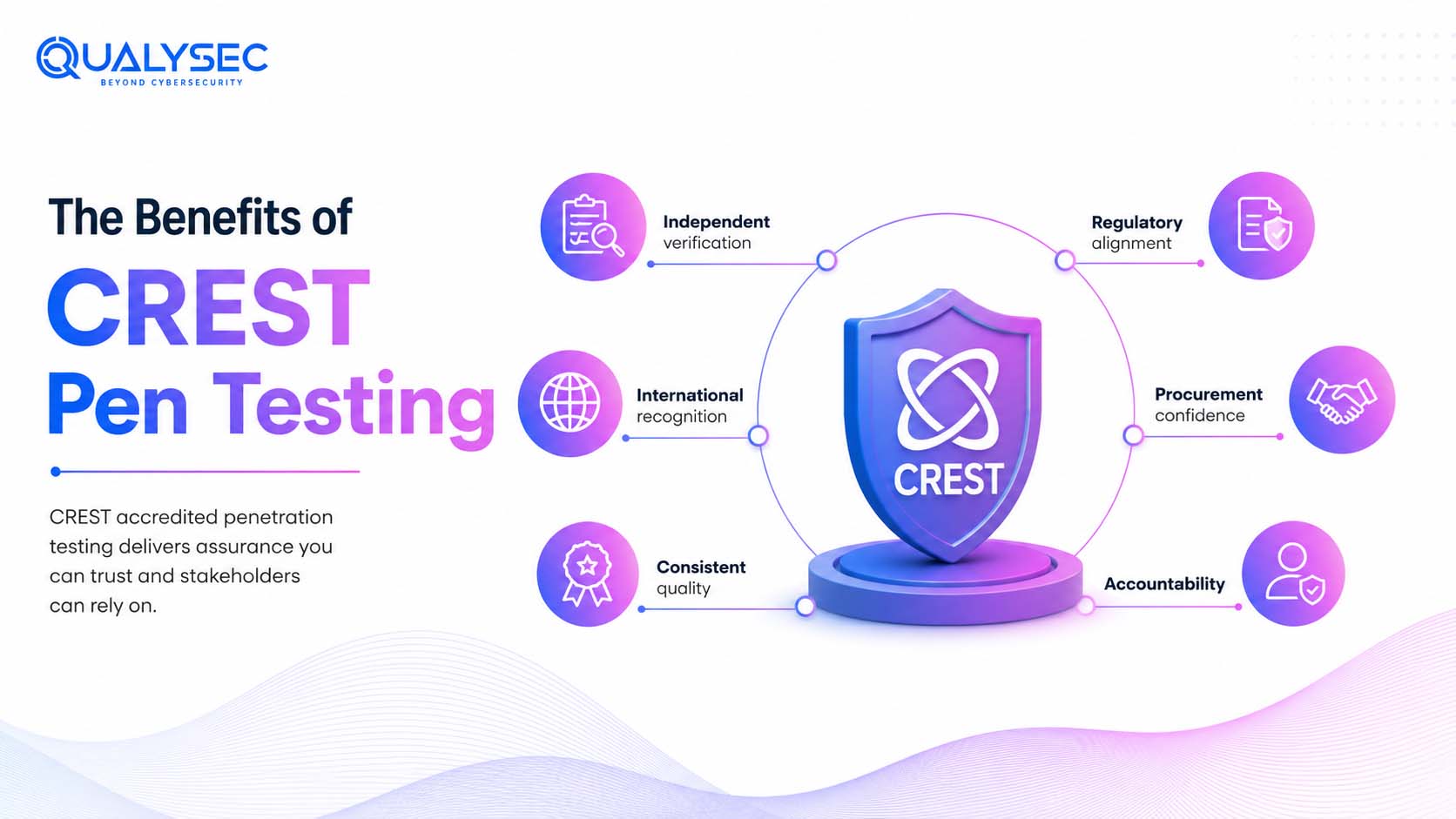
European organizations can benefit from CREST pen testing in more than just a certificate hanging on their wall. All the benefits below are the reason it is becoming the default expectation in enterprise and regulated contexts.
- Independent verification. It is not marketing claims; it’s verified expertise from CREST.
- Regulatory alignment. A CREST pen test should help European organizations meet the following regulatory obligations: DORA, GDPR, ISO 27001, SOC 2, PCI DSS, and others.
- International recognition. The CREST qualification recognizes procurement needs in many markets throughout Europe and worldwide.
- Procurement confidence. Enterprise buyers and public bodies often set CREST accreditation as a minimum requirement and use it to help reduce sales and vendor-assessment times.
- Consistent quality. CREST Accredited providers have repeatable processes, so that you are not getting hit with inconsistent results.
- Accountability. Any complaints that arise during an engagement must be able to escalate, and members of CREST must have access to a complaints procedure.
The Benefits of CHECK Penetration Testing
CHECK penetration testing provides benefits to the specific organizations that it applies to, which CREST does not. These are particularly relevant for organizations dealing with public and sensitive information, as well as those that report to the UK government.
- Government-grade assurance. The NCSC evaluates CHECK companies directly, ensuring that public sector buyers have confidence, reinforced by the NCSC.
- Vetted, cleared testers. As a minimum, SC clearance involves stringently vetted individuals performing sensitive government functions.
- Standardized reporting. Due to the set structure of the NCSC report, the government gets exactly the data it requires to manage the national risk consistently.
- Current threat alignment. CHECK methodologies are based on NCSC threat intelligence; therefore, assessments reflect current threats to the UK’s infrastructure.
- Regulatory necessity. For in-scope UK government and CNI work, CHECK requires action and hence directly opens up contracts that require it.
The important thing is still the same. The benefits apply only to work for the UK government or critical infrastructure. They increase the costs and clearances of a purely European private-sector organization without providing any added value. That’s why the importance of the CREST & CHECK Accredited status for a provider varies by market.
Providers That Are CREST & CHECK Accredited
Some will have both accreditations. A CREST & CHECK Accredited firm has completed CREST’s assessment and received NCSC approval on top. It can be very helpful for organizations that are on both sides. However, it is important to understand its implications and meanings for you.
Your engagements benefit from a provider’s CHECK status if your organization works only in EU countries. It’s their CREST accreditation and the nature of your test team that is important. A frequent procurement error is the premium paid for CREST & CHECK Accredited status that isn’t used. The process of clearance and government form reporting is not going to apply to your work.
For organizations that operate in the UK public sector and within the EU, a CREST & CHECK Accredited provider may provide the ultimate in convenience. You can have your UK government-related assessments done under CHECK and your European commercial and regulatory testing requirements under CREST all from one firm. This helps you avoid having to deal with different vendors, and maintain the uniformity of your security assessment strategy in both markets.
The hands-on advice is straightforward. Don’t assume that CREST & CHECK Accredited is automatically better. If you really need both, then you can consider it to be better. For most European organizations, high levels of CREST accreditation with individuals who have the appropriate test certificates make perfect sense for the situation.
How to Choose Between CREST and CHECK
The choice between CREST and CHECK Penetration Testing is primarily about answering a few simple questions. Solve them sequentially, and the correct route will generally be apparent.
Question 1: Who Are Your Customers?
The key question is this one. For UK government departments, public sector organizations, and critical national infrastructure, you probably must have CHECK. When you cater to private-sector clients, financial institutions, or European enterprises, they will expect CREST pen testing. Your customers are the key to the solution.
Question 2: Which Regulations Apply to You?
Identify and map your regulatory duties. If you are a financial institution (FI) in Europe, DORA would apply to you, and you will need to be tested through the CREST-aligned pathway, TIBER-EU, which is threat-led testing. In the case of handling UK OFFICIAL data, CHECK applies. For most European policies, the direction of travel is towards CREST, whereas CHECK is only applicable in government situations in the UK.
Question 3: What Data and Systems Are in Scope?
Think about what you need to defend. Sensitive UK government systems require the clearance and controls that only CHECK penetration testing can offer. A CREST pen test is suitable for commercial applications, customer data, cloud environments and corporate networks. The requirement depends upon the sensitivity and ownership of your systems.
Question 4: Where Do You Operate?
Geography frames everything. A business solely active in the EU will typically have little need to think about CHECK. If the business is operating in both the UK and Europe, it may be advantageous for it to have a provider that is accredited for both areas. It is a public-sector supplier that will simply be a UK supplier, it would require an additional check over its CREST foundation.
If you are one of the majority of European organizations reading this, then the result is the same. It’s the accreditation that counts – CREST. It meets European standards, enterprise procurement requirements, and is measured and proven to be competent. Once UK government or infrastructure work comes into the picture, then CHECK becomes relevant.
Are you preparing for a penetration test?
Choose a partner that helps you identify and fix real security risks before attackers do. We are here to help.
Talk to an Expert→
How the Two Schemes Compare on Testing Standards
In addition to location, another often asked question is, “How do CREST vs CHECK Penetration Testing compare in terms of quality of the work? The truth is that both require strict, manual, and experienced testing. Both are not an easy automated scan. The differences are in what each verifies and how it’s reported.
The emphasis on CREST is on competence and consistency of the provider. It ensures the firm adheres to documented methodologies, uses certified testers, and publishes results to a professional standard. A CREST pen test identifies weaknesses, offers a clear, in-depth business risk assessment, and offers practical remediation advice. The focus is on self-evident performance in any industry or systems.
CHECK is an additional layer for national-security-sensitive systems; organizations must obtain CREST accreditation to use CHECK penetration testing, and hence it follows the same methodology. Testers must then report it in NCSC format and provide clear documentation. The outcome is a test tailored to national-security sensitive systems where the government designs the reports to manage risk across a myriad of suppliers.
A European buyer can take heart in the fact that the takeaway is reassuring. The quality of the testing in CREST cybersecurity is the same as that of the work carried out by the UK government. It is not a lesser assessment if you use CREST rather than CHECK. You’re obtaining the same core standard, but without the government-specific overhead that would not be relevant to your systems in any case.
Conclusion
The CREST vs CHECK Penetration Testing question is not as it sounds, but rather it is a competition. The two aren’t competing for the same position. CREST is the global provider of credible security testing. It’s underpinned by a specialized layer of the UK government, called CHECK. Knowing which you need is simply a matter of knowing your customers, your regulations, and your systems.
The guidance is clear and consistent for European organizations. CREST is the accreditation that crosses borders, aligns with DORA and GDPR, and answers questions enterprise buyers and auditors ask. Most businesses on the continent benefit from a CREST pen test conducted by a well-accredited provider. The final piece to the puzzle is the right individual tester certifications.
So it is with CHECK: It matters but in a very specific way. It is a must-have for organizations that work closely with the UK government or critical infrastructure, and is unhelpful for most other organizations. Don’t ask what’s better in theory, ask what’s better in practice. Answer it straight, select an accredited provider similar, and your penetration testing will provide compliance along with real security worth.
Ready to book a penetration test that fits your market and your regulators? Qualysec offers end-to-end penetration testing in the standards based approach with clear reporting, severity rating of results and retesting after remediation of the results for European enterprises. Contact Qualysec to request a penetration testing quote today.
Frequently Asked Questions
1. What is the difference between CREST and CHECK penetration testing?
The main difference between CREST and CHECK Penetration Testing is scope and authority. CREST is an international accreditation organization for private and public work throughout Europe and the world. CHECK is an NCSC scheme for testing government and critical infrastructure systems only and is a UK NCSC scheme. CHECK also builds on top of CREST accreditation.
2. Which organizations should choose CREST penetration testing?
Any private sector organization, regulated company, financial institution or enterprise in Europe should opt for CREST pen testing. It complies with DORA, GDPR, ISO 27001 and company procurement needs. A CREST pen test is the relevant and expected standard of assurance for almost all organizations in the EU.
3. When is CHECK penetration testing required?
CHECK penetration testing is mandatory in the UK government for departments and critical national infrastructure. This also includes public sector organizations with data classified as OFFICIAL or above. The requirement is only for this particular type of work targeting the UK government. Organizations that only offer EU services do not require CHECK.
4. Is CREST certification recognized internationally?
Yes. CREST operates as an international not-for-profit organization recognized throughout Europe, the UK and much of the world. One benefit of CREST pen testing is that an accreditation can relate to procurement and regulatory questions in a number of markets. Furthermore, the EU recognizes CREST for testing under the DORA and TIBER-EU framework.
5. How do CREST and CHECK differ in terms of accreditation and testing standards?
CREST accredits businesses and certifies people to international standards, such as ISO 27000 and levels of defined competence. CHECK brings UK government requirements: SC security clearance, NCSC-format reporting, and NCSC approval. The CREST & CHECK Accredited combination indicates a government layer on top of CREST’s base accreditation, as a firm needs to be CREST-accredited first.
6. How can organizations choose between CREST and CHECK for their security assessment?
Know what your customers are, what regulations you comply with, where you are within the systems, and where you are based. Infrastructure and government work in the UK; UK government and infrastructure point to CHECK. European and commercial work indicate CREST pen testing. In Europe, most organizations see CREST as the accreditation for their needs.

About Pabitra Kumar Sahoo
Pabitra Kumar Sahoo is the Co-Founder and Chief Operating Officer (COO) at Qualysec. With a deep commitment to elevating global cybersecurity standards, he directs corporate operations and service strategy, helping enterprises mitigate compliance debt and defend their digital infrastructure through elite, human-led penetration testing.
Leave a Comment.
Your email address will not be published. Required fields are marked *