






Penetration testing framework, or “ethical hacking”, is an essential process where information security professionals simulate cyber attacks to find vulnerabilities in systems, networks, or applications. By 2025, with growing sophistication in cyber threats, organisations must take a proactive approach in assessing their security and making improvements.
Use of measures that are structured and repeatable to organise penetration tests can maximise stakeholders’ confidence by assuring that the penetration tests are thorough and organised, in line with industry standards, and provide a manageable roadmap to protect digital assets.
Understanding Penetration Testing Frameworks
A penetration testing framework is a structured method that enables ethical hackers to identify and exploit vulnerabilities. Penetration testing frameworks, such as the Penetration Testing Execution Standard (PTES) and NIST SP 800-115, provide standardized methods, which can improve the conduct and consistency in penetration tests. When organisations align with a framework, they can demonstrate full coverage and compliance with risk avoidance to a certain extent, and in turn improve their overall security posture.
Steps in a Penetration Testing Framework
Penetration testing is not merely an attempt to hack a system — it is a formalised approach to identify and remediate vulnerabilities before an actual attacker acts. Adhering to an established framework ensures that the penetration tests are as safe, complete, and repeatable as circumstances allow. The structure of the methodology enables penetration testers to analyse systems systematically while providing organisations with actionable remediation and recommendations to improve their security posture.
1. Planning and Scoping
During this stage, the objectives and scope of the test are well articulated. Testers determine which systems, networks, or applications will be surveyed. Engagement rules are established so that testing remains ethical and legal. Tools, timelines, and reports are also determined. They’ll follow up with stakeholders and gain approvals before beginning. This phase is meant to lay down expectations of those involved so physical damage isn’t done inadvertently.
2. Information Gathering (Reconnaissance)
In this phase, the tester collects data on their target system to identify entry points of attack. Information such as network addresses, types of servers, and any publicly facing applications is useful. An assortment of tools and techniques, such as WHOIS lookups, DNS queries, and open source intelligence, may be utilised to gather valuable data about the targeted environment. In this phase, the tester establishes a topology of the network and what services are exposed. The information collected is thoroughly documented for a seamless transition to the next phase.
3. Vulnerability Assessment
In the Vulnerability Assessment phase, testers begin scanning systems for known vulnerabilities, out-of-date software, or missing patches. They will use a combination of automated tools to find vulnerabilities quickly, and then some testers will manually verify the accuracy of some of their findings, and some will combine the tools and manual testing. The tester assesses the level of risk and exploitability for every vulnerability. Misconfigurations that could be exploited are also thoroughly documented. The result will be a prioritised list of vulnerabilities to exploit in the next phase.
4. Exploitation
At this stage, ethical hackers will conduct a safe attempt at exploiting vulnerabilities discovered in phase two. The reasons for this phase are to see if the vulnerabilities can be exploited to gain access. Ethical hackers typically leverage tools such as Metasploit to simulate a real attack while maintaining control of the testing environment. Throughout the exercise, the tester will need to document anything done during the testing, while never causing actual damage to any system, and testing only within scope.
5. Post-Exploitation
After successfully exploiting a vulnerability during the testing period, the tester will usually assess what the impact of a breach would actually be, what data or systems could be compromised, and how an attacker could move laterally throughout the network. This stage highlights the potential real-world impact on an organisation associated with the vulnerabilities identified in phase two. Ethical hackers will usually revert any changes made during testing to ensure their systems are stable and intact. Any notes taken during this exercise will reference points that will feed directly into the final report.
6. Reporting
All (Phase 1, Phase 2, Phase 3, & Post-Exploitation) findings will be compiled into a report that can be read in full, or portions can be quickly referenced depending on the audience. All vulnerabilities, exploited paths, and risks will clearly be noted and include actionable responses to remediate the issues, respectively. Visual representations, such as charts and/or diagrams, may be included for clarity in some spots. The report will be written so that both technical teams and management can understand and follow along.
7. Remediation support
Lastly, the testers help the organisation in remediating the vulnerabilities. This might include patching specific software, updating software configurations, or even a revision of security-dependent policy. A retest of any critical issues will occur to confirm that the fixes were correctly applied. In addition, the testers may provide suggestions for preventive actions that could help eliminate potential future vulnerabilities. The overall purpose is to assist the organisation in maturing its security culture.
Discover expert-approved steps, tools, and a real-world penetration testing framework used by top cybersecurity teams

Tools Used in Penetration Testing
To find weaknesses and assess security, penetration testers need specialised tools. Penetration testing tools assist with automating scans, simulating attacks, and evaluating results to save time and increase accuracy. Appropriately utilising the tools selected will help processes function seamlessly and ensure that no areas of the system are being left vulnerable. Penetration testing in 2025 has adopted both modern and manual testing tools to assess networks, applications, and systems effectively.
1. Nmap
Nmap is a well-known network scanning tool used by testers to discover active devices and the ports that are open on a network. Additionally, Nmap provides information such as system configurations and any services that are running. By scanning the network, testers can identify possible points of entry for continued testing as well as identify required systems. Nmap is both fast and reliable while being beneficial to both large and small organisations.
2. Nessus
It is a vulnerability scanning tool that allows testers to review the systems for known vulnerabilities. This provides the ability to identify outdated software, missing software updates, and any misconfiguration issues in the specified systems. Nessus also provides a way to prioritise vulnerabilities based on applicable risk levels, allowing the tester to focus on further investigating relevant matters. Nessus produces reports that are easy to read for both technical teams and upper management.
3. Metasploit
Metasploit is a framework that can be utilised to exploit vulnerabilities in systems and applications safely. The tester can simulate real-world attacks to understand how vulnerabilities could be abused. Metasploit provides code as a readiness to exploit and gives options to build custom attacks. The test or exploitation will help the organisation understand the possibilities that could arise in response to vulnerabilities.
4. Burp Suite
Burp Suite is a tool particularly used for web application security testing. Its purpose is to intercept, analyse, and modify web traffic to identify vulnerabilities such as SQL injection or cross-site scripting. Testers may automate certain scans or do manual testing for deeper investigations. Burp Suite is the user’s choice for verifying that web applications are secure.
5. Wireshark
Wireshark is a network protocol analyzer. It captures and analyzes the data packets as they flow through a network. Testers will use it to determine suspicious traffic or possible vulnerabilities in applications. It is beneficial while analysing communications between systems, and to examine weaknesses in protocols. Wireshark is valuable for understanding the flow of data through a network.
6. OpenVAS
The OpenVAS is yet another vulnerability scanner that assists in identifying possible security weaknesses in networks and systems. OpenVAS is a free, open-source scanner with frequent updates implemented into its system and vulnerability scans. Testers will use OpenVAS as an additional scanner, combined with others, to verify that the systems are secure. OpenVAS also generates detailed reports that summarise the findings and help with the remediation process.
7. Aircrack-ng
Aircrack-ng is a tool for testing the security of wireless networks. It has the capability of assisting testers in the discovery of weak Wi-Fi passwords, compromised levels of encryption, and rogue access points on wireless networks. When using Aircrack-ng, the tester can simulate actual attacks on Wi-Fi networks to harden their wireless systems against hackers. Aircrack-ng is imperative for organisations that utilise wireless connectivity as a significant and core business function.

Best Practices for Penetration Testing
To maximise the value of penetration testing, organisations should consider using a proven penetration testing framework and best practices. Best practices provide a level of assurance that will enable the testing to be effective, safe, and actionable. Best practices will allow teams to find actual vulnerabilities while limiting risk to systems and data. In 2025, combining various structured approaches with the proper tools in an open and transparent communication environment will create meaningful and efficient penetration tests.
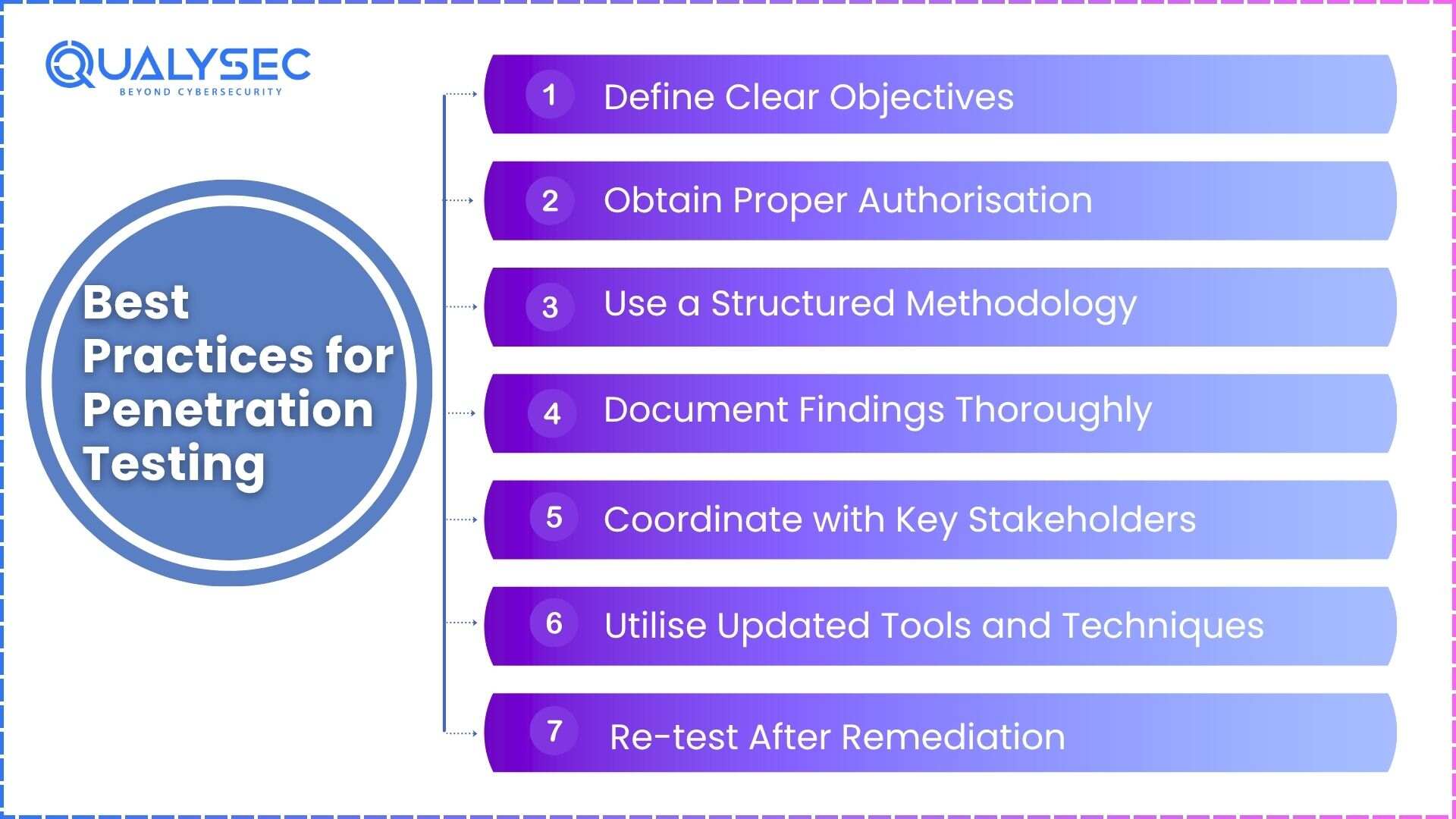
1. Define Clear Objectives
Before proceeding with a penetration test, you should have a clear understanding of what the penetration test should accomplish. This means defining the specific systems, applications, or networks that you want tested. If the objectives are clearly defined, the test will remain on point and have meaning. Objectives also prevent wasting limited time on items that are not prioritised. Clear goals will allow testers to measure success and report effectively.
2. Obtain Proper Authorisation
It is critical to obtain written consent from management before initiating any testing. Testing without authorisation can lead to litigation or damaging operational continuity. Written authorisation documents the scope of assessment, limitations, and rules of engagement. As a matter of practice, authorisation establishes that testing is both ethical and safe, while ensuring that the organisation and testers are protected. Obtaining consent is the first and most crucial step of professional penetration testing.
3. Use a Structured Methodology
The recommendation is to use established frameworks, such as PTES, NIST, or OWASP, to guide the testing. A properly structured logistical approach to testing allows for all test approach structural components without any step omitted. Repeatable test coverage is constantly developed when formal logistical processes are defined. The same can be said for repeatability of methodology. Methodologies create a clear path from planning to reporting, while providing consistency to ANY testing framework. Methodologies create reliable results and are bias or prejudice-free.
Dive deeper into how penetration testing works in our recent article.
4. Document Findings Thoroughly
It is important to document every step, finding, and observation from the testing. Good documentation helps technical personnel understand the vulnerability and guides remediation. Documentation is also helpful for compliance requirements and audits. Reporting the testing accurately allows key stakeholders to prepare and take action based on the results.
5. Coordinate with Key Stakeholders
It is also important to work closely with the IT, security, and management teams throughout the process. Coordination not only ensures vulnerabilities are well understood for remediation, but can also keep the testing aligned with Business priorities. Effective communication prevents misunderstandings and creates a more proactive culture of security.
6. Utilise Updated Tools and Techniques
In summary, stakeholders should maintain that all tools and techniques used in testing are current and represent the latest in security trends. Older tools may miss an entirely new vulnerability and, likely, will not give accurate results. Continued updates will lead to better accuracy and timeliness. Keeping tools and techniques current will also allow testers to emulate modernised cyber threats.
7. Re-test After Remediation
After remediating vulnerabilities, one should re-test to ensure these issues are remediated successfully. Re-testing confirms the fix and that modifications to the system work as intended. Additionally, re-testing ensures that remediation efforts did not introduce additional vulnerabilities. Re-testing closes the remediation loop and strengthens the overall system security.
Conclusion
The penetration testing framework remains a key component of any cybersecurity plan in 2025. By following a structured framework, using the right tools, and applying best practices, organisations can identify and even remediate vulnerabilities before they can be exploited against the organisation.
Regular penetration testing does not just improve security defences; it also creates a culture of proactive risk management to safeguard critical digital assets in an increasingly complex environment of cyber threats.
Have questions? Need instant answers from security experts?

FAQ’s
Q1: What are the stages in a framework for penetration testing?
The stages are planning, recon (gathering information), vulnerability discovery, exploitation (safely exploiting the vulnerabilities), impact assessment (determining the impact), and reporting. Each of the stages helps testers approach a pentest in an organised way.
Q2: Why is it necessary to work within a structured framework during testing?
Having a structured framework makes it easier to approach a pentest in an organised, thorough, and repeatable manner to ensure that no steps in the pentest will be missed, at the same time making it easier to present findings.
Q3: How is an overall framework different from a methodology?
A framework is a process and a list of defined steps to follow. A methodology is an overarching view of the approach or philosophy to assess a particular situation. In other words, a framework documents the methodology.
Q4: Can the same framework be applied to other types of systems?
Yes, most frameworks are flexible and can be applied to networks/applications/systems. The steps of a framework are similar, although some of the tools and techniques may differ.
Q5: What are the common tools within the pentesting framework?
The standard tools would be Nmap for scanning, Nessus for discovery, Metasploit for testing exploits, Burp Suite for web apps, and Wireshark for network analysis.