

Cyberattacks in 2026 are not limited to exploiting a single software or vulnerability, making red team companies more important than ever. Modern cyberattackers combine identity compromise, cloud misconfigurations, AI-powered attack techniques, phishing, and lateral movement to reach an organisation’s most critical assets. As a result, many businesses are turning to Red Team assessments to validate whether their security controls, detection systems, and incident response teams can withstand a realistic cyberattack.
However, choosing the right red team provider is not simple. Almost every vendor out there claims to offer real-world adversary simulation, elite operators, or threat intelligence-led testing. In reality, these providers’ expertise, attack methodologies, reporting quality, industry focus, and pricing can differ significantly. A provider that excels at cloud and identity security may not be the best choice for AI security, regulatory assessments, or large-scale enterprise red teaming.
This guide compares the top red team companies in 2026 based on their technical capabilities, core services, pricing, industry expertise, and ideal use cases.
Key Takeaways
- Not every red team company provides the same level of adversary simulation. Some specialise in threat intelligence-led operations, while others focus on cloud, identity, AI, or regulatory assessments.
- A Red Team assessment is different from a penetration test. Rather than simply finding vulnerabilities, it evaluates whether an attacker can achieve real business objectives and whether your security team can detect and respond in time.
- The right security provider depends on your organisation’s security maturity, attack surface, and business goals.
- Enterprise Red Team engagements typically range from $20,000 to over $150,000; prices are highly influenced by scope, duration, cloud complexity, AI systems, social engineering, and physical testing requirements.
- This guide compares seven leading Red Team companies in 2026, including their expertise, specialities, best-fit use cases, and pricing.
What Is Red Teaming?
Red Teaming is a cybersecurity practice where ethical hackers simulate adversarial attacks on an organisation, system, or AI model to detect vulnerabilities. The main goal behind Red Teaming is to test how well an organisation’s technology, defence systems, and security infrastructure perform.
Terms that you should know:
- Adversary simulation – Security professionals test specific attacker TTPs against the detection system of your organisation.
- Purple Teaming – Cyberattackers and security professionals work together in real time to detect vulnerabilities.
- Breach and attack simulation (BAS) – Automated, repeatable control checks for continuous validation.
Benefits of Red Teaming
What if you could find your biggest security gaps before hackers do? That’s exactly what Red Teaming does:
1. Validates real-world detection
Having advanced security tools does not guarantee that your Security Operations Center (SOC) will detect an active cyber breach. Red Teaming detects how long a cyberattacker can move silently inside your network before being detected. It helps security teams to eliminate blind spots, refine alert thresholds, and reduce response times to stop actual attack intrusions.
2. Detects multi-vector attack chain
Real cyberattacks do not stick to single isolated systems. They travel in chains across different layers to compromise the entire security environment. Red Teaming demonstrates how minor misconfigurations in Active Directory or Entra ID can enable attackers to escalate privileges from a basic user account to control of cloud infrastructure (AWS/Azure). It also evaluates modern surfaces like internal AI agents, LLMs, and RAG systems to check for any sensitive data leakage or unauthorised automated actions.
3. Simulates high-impact outcomes
Instead of producing a lengthy list of technical vulnerabilities, Red Teaming is goal-oriented. It tests whether an attacker can safely execute simulated ransomware, access core financial databases, exfiltrate IP, or manipulate critical operations such as making online payments on its own or accessing sensitive information.
4. Evaluate human and physical attack surface
In 2026, technology is not the sole entry point of cyberattack. Attackers are exploiting human psychology or physical premises to gain initial access. Red Teaming evaluates how much employees and other staff members are vulnerable to spear-phishing, vishing (phone scams), executive impersonation, and badge cloning.
Do you know?
Red Teaming didn’t originate in cybersecurity! The concept comes from military war games, where a “Red Team” played the role of the enemy to challenge strategies of the opposite team to expose its weaknesses before the real battle. Today, the same idea helps organisations and AI systems to detect vulnerabilities before attackers do.
What is Red Team Assessment?
A Red Team Assessment is a goal-based, realistic cybersecurity test where the Red Team imitate the tactics of real attackers to test an organisation’s people, processes, and technology. It measures an organisation’s ability to detect and respond to cyber threats.
Red team assessment vs. penetration testing vs. purple teaming vs. BAS
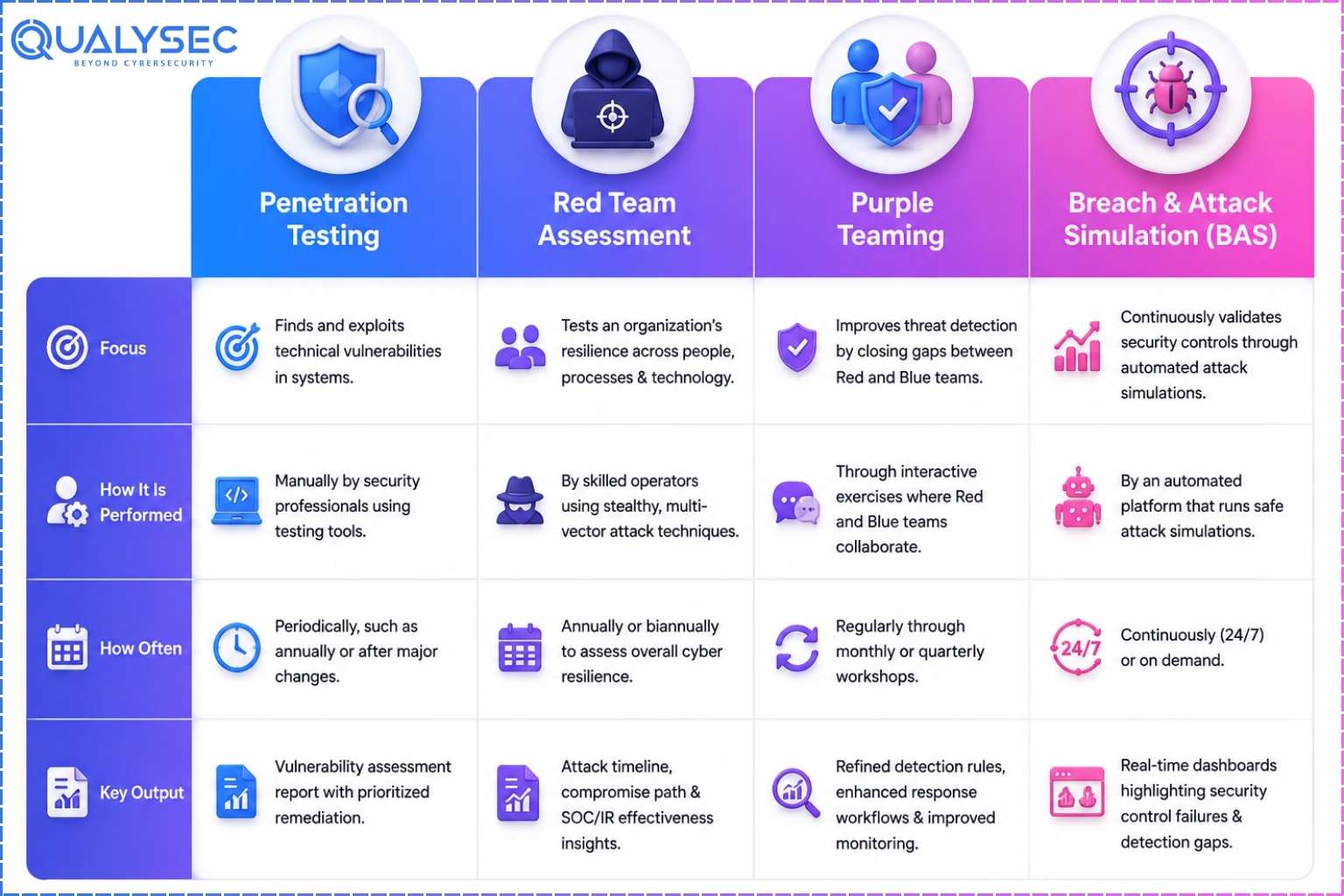
| Penetration Testing | Red Team Assessment | Purple Teaming | Breach & Attack Simulation (BAS) |
| It discovers and exploits technical vulnerabilities in systems, applications, and networks. | It tests an organisation’s resilience and its ability to detect and respond to attacks across people, processes, and technology. | It improves threat detection by enabling collaboration between Red and Blue teams to identify and close security gaps. | It continuously validates the effectiveness of security controls across the environment through automated attack simulations. |
| It is performed manually by security professionals using penetration testing tools and techniques. | It is conducted by skilled human operators who use stealthy, multi-vector attack techniques to simulate real-world adversaries. | It is carried out through interactive exercises in which Red and Blue teams work together in real time. | It is performed by a fully automated software platform that continuously executes safe attack simulations. |
| It is typically performed periodically, such as annually or after major application or infrastructure changes. | It is typically conducted annually or biannually to assess the organisation’s overall cyber resilience. | It is conducted regularly through monthly or quarterly workshops to improve detection capabilities. | It runs continuously (24/7) or on demand to ensure security controls remain effective over time. |
| It produces a vulnerability assessment report with prioritised remediation recommendations. | It provides an attack timeline, compromise path, and insights into the effectiveness of the Security Operations Center (SOC) and incident response processes of the organisation. | It provides refined detection rules, enhanced response workflows, and immediate improvements to security monitoring. | It provides real-time dashboards that highlight security control failures, configuration drift, and detection gaps. |
Get more details about Red Team, Blue Team, and Purple Team. Discover the Best Security Approach for Your Business.
How We Evaluated Top Red Team Companies
To help organisations make informed decisions, we evaluated Red Team providers on the basis of their technical capabilities and service quality. Each company in this list was assessed based on the following criteria:
1. Cloud, Identity, and AI Security Expertise:
We assessed each provider’s experience in testing hybrid and cloud-native environments, identity platforms such as Microsoft Entra ID, AWS, Azure, and Google Cloud, as well as AI applications and large language models (LLMs) for emerging cyberattacks.
2. Attack simulation capabilities:
We evaluated how companies tackle phishing, vishing, physical security assessments, web and network attacks, and other human-focused or technical attack simulations.
3. Report quality:
We have reviewed the assessment quality of each company, specifically technical findings, executive summaries, risk prioritisation, remediation guidance, and recommendations.
4. Response validation:
We have evaluated how each company measures an organisation’s ability to detect, investigate, and respond to attacks by testing Security Operations Center (SOC) monitoring, incident response processes, and their overall defensive capabilities.
Note:
This ranking is independently researched. Companies are listed on the basis of publicly available information, published methodologies, customer feedback, industry reputation, and technical capabilities. No company has paid for inclusion, placement, or ranking in this list.
Top Red Team Companies in 2026
1. Mandiant
Mandiant is a part of Google Cloud Consulting that provides realistic attack simulations using real-world threat intelligence. It is a great choice for large enterprises and mature SOCs that want red teaming tied to threat intelligence, purple-team collaboration, and executive-level reporting.
Speciality: It leverages frontline Incident Response (IR) telemetry and global threat intelligence from thousands of annual breach investigations, mimicking nation-state (APT) and cybercrime tradecraft against high-value target assets.
Best for: Large organisations, government entities, and highly regulated institutions.
2. Qualysec
Qualysec is a comprehensive cybersecurity company that provides Vulnerability Assessment and Penetration Testing (VAPT) alongside advanced AI Red Team Services.
Best for: Mid-to-large market organisations, Tech, FinTech, and Healthcare companies
Speciality: Human-led adversary simulation, Diverse asset and broad attack surface coverage, and detailed remediation-focused reporting
3. Bishop Fox
Bishop Fox is a private security firm that provides adversary emulation, continuous threat exposure management, and comprehensive red teaming.
Best for: IT companies that are scaling fast in cloud/SaaS environments
Speciality: High-touch manual exploitation integrated with their proprietary Cosmos technology platform for Continuous Threat Exposure Management (CTEM) and automated target discovery.
4. NCC Group
NCC Group is a global cybersecurity company that provides offensive Attack Simulation services.
Speciality: It provides regulatory services, including CBEST, TIBER-EU, iCAST-driven red teaming, physical security, hardware/IoT exploitation, and full-spectrum adversary simulation for organisations.
Best for: Tier-1 financial institutions, Global companies having strict regulatory framework compliance, and companies having critical European infrastructure operators.
5. IBM X-Force Red
IBM X-Force Red is a global team of over 200 ethical hackers and cybersecurity professionals working with IBM X-Force that helps organisations identify, prioritise, and remediate security vulnerabilities through penetration testing, adversary simulation, and red teaming services.
Best for: Large organisations and Fortune 500 companies that need Red Team assessments across multiple locations.
Speciality: End-to-end vulnerability management, specialised industrial control systems (ICS)/SCADA testing, ATM/IoT hardware testing, and cyber breach stimulation at a massive level.
6. CrowdStrike
CrowdStrike is a global cybersecurity company that provides CrowdStrike Red Teaming and CrowdStrike AI Red Team Services to simulate real-world cyberattacks and test the security defence of an organisation.
Speciality: Large enterprises and organisations with mature security teams seeking advanced adversary emulation and SOC validation.
Best for: Organisations that are looking to validate their Endpoint Detection and Response (EDR)/SOC investments and improve their Mean Time to Detect (MTTD) and Respond (MTTR).
7. NetSPI
NetSPI is a proactive cybersecurity company specialising in NetSPI Red Team Operations, penetration testing as a service (PTaaS), and attack surface management.
Best for: Large enterprises requiring continuous Red Team assessments and advanced threat-led security validation.
Specialisation: Tech-enabled red teaming combining human expertise with the NetSPI Platform for real-time tracking, continuous testing, and asset discovery.
Services, Expertise, and Pricing Comparison
| Company | Core Services Offered | Technical Expertise & Specialities | Estimated Cost
(Taken from official website of company) |
| Mandiant (Google Cloud) | Red Team Assessments, Security Operations Red Teaming, Cyber Threat Intelligence (CTI), Incident Response & Retainers | Advanced adversary emulation based on real-world threat intelligence, multi-cloud and OT/ICS security testing, custom payload development, and EDR/AV evasion techniques | Project-based / Enterprise Retainer at $25,000 to over $150,000+ per engagement depending on scope and complexity |
| Qualysec | Red Team Simulation, VAPT, Web, Mobile, API & Cloud Security Testing, Compliance Audits | Human-led adversary emulation, comprehensive attack surface testing, AI-assisted testing, and remediation-focused reporting | Starts at $30,000–$15,00,000+ |
| Bishop Fox | Red Teaming, Adversary Emulation, Cosmos CTEM Platform, AI & Cloud Security, Hardware Security Testing | Continuous attack surface management, cloud-native security testing, manual exploitation, and AI-driven exposure validation | Subscription + Project-based, starts from $25,000 to over $350,000, depending on the project scope, complexity, and enterprise size |
| NCC Group | Red, Purple, Black & Gold Teaming, Regulatory Attack Simulations, IoT & Hardware Testing, AI Security | Expertise in CBEST, TIBER-EU, physical security, social engineering, hardware reverse engineering, and cryptographic security | Time & Materials / Fixed Scope at $100,000–$300,000+ for regulatory engagements |
| IBM X-Force Red | Adversary Simulation, Red Teaming, Penetration Testing, ICS/SCADA & ATM Testing, Vulnerability Management | Enterprise-scale Red Teaming, OT/ICS security, hardware testing, and integration with IBM Threat Intelligence and Managed Security Services | Enterprise Contract / Annual Retainer at $100,000–$500,000+ for enterprise programs |
| CrowdStrike | Adversary Emulation, AI Red Team Services, Purple Teaming, SOC Validation, Incident Response | Threat intelligence-led adversary emulation, SOC validation, AI/LLM security testing, and detection engineering | Retainer / Scope-based ag $50,000–$150,000+ per engagement |
| NetSPI | Red Team Operations, PTaaS, Attack Surface Management, AI/LLM Security Testing | Continuous human-led testing through PTaaS, cloud security, attack surface management, mainframe security, and AI security validation | Annual Subscription / Credit-based at $30,000–$150,000+/year based on service tier |
Note:
Services and pricing are based on publicly available information and may change without notice. Actual offerings and costs may vary by project scope.
Red Team Pricing in 2026
Red team engagement asks for premium pricing in 2026 because they require highly skilled security professionals, realistic adversary simulation, and weeks or months of planning. The total fee will be determined by the nature, goals and operating complexity of the engagement.
In 2026, prices will range from:
- Limited attack surface, targeted/boutique engagements with a shorter duration of $20,000-$40,000.
- For the Standard enterprise red team engagements: $20,000 to $150,000+
- When the social engineering, physical intrusion, and multi-region operations are mixed in, large-scope, multi-month, or physical-inclusive engagements can surpass $150,000.
- Most often, and with an AI/LLM red teaming add-on, one-time audits cost between $8,000 and $25,000.
Note:
The total price of a red team engagement is dependent on several factors such as:
- No. of testing objectives
- The scope of social engineering and physical scope.
- The complexity of systems, cloud infrastructure and identity environments.
- How long the fight lasted.How long the battle went on.
- Reporting requirements, executive presentations and post-engagement validation or follow-up testing.
How to Choose the Right Red Team Company
The answer to this is truthfully that there is no ‘best’ red team company for all organisations. Numerous companies offer organisations red team assessment services. The choice of provider will be based on your organisation’s risk profile, security maturity, business goals and budget. When choosing a red team company, take into account the following:
- The intent behind the red team assessment, discovery of validation, executive assurance, compliance evidence, and identity attack-path discovery are all different providers.
- How mature is your system’s security program? Red team engagements are most helpful for organisations with a mature security program. A red team engagement may be too early if it has not been done already in the past few years for penetration testing or vulnerability remediation. Conduct that first.
- What are your organisation’s biggest attack surfaces? Choose a vendor based on its specialisation in your organisation’s biggest attack surfaces. For instance, enterprises that have a lot of identity and privilege management problems can profit from an identity specialist.
- Evaluate the team’s threat intelligence: Before choosing any read team company, make sure that it bases its methodology on current, real-world threat actor tactics, techniques, and procedures (TTPs), such as those documented in the MITRE ATT&CK framework.
- Gain access to their technical capabilities, such as EDR: See if the provider builds custom payloads, implements realistic adversarial techniques and can test modern defensive technology in a safe environment.
- Request a sample report – If they can, share a sample report; get a feel for it.
- What do they do with the report? Retesting, purple team workshops and detection engineering are available from the red team company.
- Confirm regulatory assessments: For financial institutions, you may need expertise in TIBER-EU or CBEST; for healthcare, HIPAA or FDA assessments, and for specific jurisdiction, the provider should be knowledgeable of relevant regional regulations (e.g., evaluating red team providers in Singapore for regional compliance).
- How much budget and time are you willing to spend: The price and time of a red team engagement can widely range depending on the scope, objectives and complexity.
Why Choose Qualysec for Red Team Engagements?
Red teaming is only as effective as the team conducting it. Engaging a team of experienced security professionals who are attuned to the mindset and capabilities of the attack team can uncover attack paths that you never considered and make actionable recommendations that enhance the security of your environment.
Qualysec combines deep technical expertise with proven adversarial testing methodologies to deliver realistic Red Team Services that help organisations prepare for sophisticated cyber threats.
What makes Qualysec different from others?
- Certified Security Professionals: Red team engagements are conducted by security experts holding globally recognised certifications such as CREST, OSCP, CEH, and CART to ensure that assessments are performed using industry-recognised methodologies.
- Customised Red Team Engagements: Each assessment is designed in alignment with the goals, attack surface, infrastructure complexity and compliance needs of the organisation, and will include realistic simulations that are in line with the actual risks faced by these businesses rather than generic testing methodologies.
- End-to-End Attack Simulation: Engagements can be run across external or internal networks, cloud environments, Active Directory, identity systems, social engineering, phishing campaigns and physical security testing, and can be a complete evaluation of an organisation’s cyber resilience.
- Actionable Reporting: Every engagement concludes with executive and technical reports that prioritise risks, explain attack paths, and provide clear remediation recommendations.
- Trusted Across Industries: Companies in regulated, government, tech, healthcare and finance sectors rely on Qualysec for realistic adversarial simulation to validate security controls and enhance incident response.

Conclusion
There isn’t a single best red team company because “the best” entirely depends on your attack surface, maturity and budget, not the brand names. A successful Red Team engagement can answer a simple question that is often hard to answer in a standard security engagement:
- Will an attacker be able to damage your critical assets?
- Will your SOC detect the attack?
- Will your incident response team be able to tame it before the damage is done?
Those answers, in fact, can assist organisations in confirming security investments, enhancing their detection capabilities, and prioritising remediation efforts based on genuine business threats.
When choosing a provider, consider their experience with cloud, identity, AI security, social engineering, reporting standards, pricing, and post-engagement remediation assistance.
Use this guide as a starting point to evaluate providers based on your organisation’s security maturity, objectives, and budget.
Frequently Asked Questions (FAQs)
What is a Red Team assessment?
A Red Team assessment is a comprehensive simulation of a cyber attack where a team of ethical hackers acts like real hackers to test whether they can break into an organisation’s systems, steal sensitive information, or achieve specific goals without being detected.
How is Red Teaming different from penetration testing?
| Penetration Testing | Red Teaming |
| Focuses on identifying and exploiting technical vulnerabilities in systems, networks, or applications. | Simulates a real-world attacker attempting to achieve specific business objectives. |
| Primarily evaluates the security of technology and infrastructure. | Tests people, processes, and technology together. |
| Produces a list of vulnerabilities with remediation recommendations. | Provides attack timelines, compromise paths, SOC performance, and incident response effectiveness. |
How do I choose the best Red Team company?
The best Red Team company for each organisation is not one-size-fits-all. Before choosing any Red Team Company, check:
- Security maturity: Make sure your organisation has already done penetration testing and remediation of vulnerabilities before you start Red Teaming.
- Technical Skills: Seek someone with experience in cloud, identity, AI/LLM security, Active Directory and hybrid environments.
- Attack simulation capabilities: Select a provider that can simulate attacks like phishing, social engineering, identity attacks and multi-vector adversary simulations.
- Threat Intelligence-Informed Methodology: The assessment should mimic an attacker’s methodology and tactics, techniques and procedures (TTPs), including those that have been identified and mapped to MITRE ATT&CK.
- Review sample reports to assess technical depth, executive summaries, risk prioritisation, and remediation guidance.
- Post-engagement support: Make sure to look for a provider that provides retesting, purple team workshops and detection engineering following the assessment.
- Industry knowledge/expertise: Ensure that the provider knows compliance and threats within your industry.
- Pricing & engagement scope: Review pricing in relation to goals, time, complexity & scope of deliverables.
How much does a Red Team assessment cost?
The price for a Red Team engagement is in the range of $20,000 to $150,000+, depending on the extent and nature of the assessment.
- $20,000-$40,000 for specific or focused engagements, small attack surface.
- Standard enterprise Red Team assessments cost $20,000 to $150,000+ USD.
- $150,000+ for large-scale engagements, multi-region, social engineering or physical security testing.
- One-time AI/LLM Red Team assessments typically cost anywhere from $8,000 to $25,000.
How often should organisations conduct Red Team exercises?
Most organisations carry out a Red Team assessment once a year or on a 12- to 24-month cycle, depending on their level of risk and security maturity. Frequent assessments might also be warranted following large-scale cloud migrations, mergers or acquisitions, deployment of critical applications, major infrastructure changes, or the deployment of AI systems.
What are the benefits of Red Teaming?
The benefits of Red Teaming are:
-
- Tests the detection capabilities of a real-world environment to see if the Security Operations Center (SOC) is able to detect active threats.
- Defines attack surfaces in complex cloud environments and identity systems, networks, and AI applications.
- Assesses the effectiveness of measures through the detection, investigation, and containment of attacks in a short time.
- Evaluates human security awareness by phishing, vishing, executive impersonation and other social engineering techniques.
- Focuses on the investments that will be made in security, determining the most dangerous vulnerabilities to the business.
- Enhances cyber resilience by identifying gaps in people, processes and technology that can be exploited by real-world attackers.