

“
Qualysec did a great job identifying vulnerabilities in our web and cloud applications and gave us clear steps to fix them. They stuck to deadlines, handled re-tests, and supported well.
Kenny Kim
Product Manager

Qualysec's LLM penetration testing services help you identify and exploit vulnerabilities specific to language models, including prompt injection, jailbreaking, insecure output handling, and sensitive data leakage. We also provide actionable remediation guidance to ensure your LLM-powered products are secure, compliant, and trustworthy.















DEFINITION
Secure your AI systems today! Choose Qualysec to uncover LLM vulnerabilities before attackers exploit them.
LLM penetration testing is a specialized security assessment that simulates real-world adversarial attacks against large language model applications to identify exploitable vulnerabilities before hackers can exploit them. It follows methodologies such as the OWASP Top 10 for LLM Applications to ensure comprehensive coverage.
Vulnerabilities
Testing AI models, agents, and LLM applications to uncover vulnerabilities before attackers do.

Process
At Qualysec, we tailor every LLM penetration testing engagement to match your specific threat model, organizational maturity, and the level of access available to our team. Each approach uncovers a distinct layer of risk in your LLM applications and AI models

We define the scope based on your LLM models, data flows, integrations, and real usage scenarios to ensure complete coverage of critical components.
"Don't compromise between depth and speed. Own both. Connect with Swagat, Your trusted penetration testing advisor."

Head Of Business Development
Testimonials
Read what our clients say about our services. See how Qualysec has helped several businesses to keep their digital assets safe!
Qualysec did a great job identifying vulnerabilities in our web and cloud applications and gave us clear steps to fix them. They stuck to deadlines, handled re-tests, and supported well.
Product Manager
Key Benefits
Regular LLM penetration testing gives your organization a clear, evidence-based understanding of your language model's security weaknesses to ship safer AI products, protect user data, and meet the growing compliance demands of the AI era.
Discover how susceptible your LLM application is to prompt injection, indirect prompt injection, and jailbreaking.
Prevent attackers from extracting confidential system prompts, user data, proprietary knowledge base content.
Validate the security of every external tool, API, and plugin connected to your LLM to close the insecure integration gaps that attackers can exploit.
Receive a pentest report mapped to OWASP Top 10 for LLMs, NIST AI RMF, and EU AI Act obligations.
A verified LLM penetration testing report and letter of attestation removes a key blocker in enterprise security reviews.
Go to market knowing your LLM-powered product has been rigorously tested against real-world attack scenarios for reducing the risk of post-launch security incidents.
Other Types
At Qualysec, we offer a range of LLM penetration testing approaches to suit your specific security needs, risk profile, and the level of access available for testing. Each method surfaces a different layer of vulnerability in your language model application.

Our testers interact with your LLM application exactly as an external attacker would with no access to system prompts, model configurations, or backend architecture. This approach evaluates your real-world defenses against prompt injection, jailbreaking, and data extraction attacks from unknown threats.

With full visibility into your system prompts, model integrations, RAG pipeline, plugin configurations, and API design, our team conducts an in-depth assessment that uncovers hidden vulnerabilities, logic flaws, and insecure design patterns that black box testing cannot reach.

Our testers work with partial knowledge of your LLM environment, such as the model family or general tool integrations while simulating a semi-informed attacker. This balanced approach provides thorough security coverage while mirroring realistic threat scenarios such as compromised users or third-party supplier attacks.
Free Downloads
Access our free LLM security resource library to give your team the practical tools, proven methodologies, and real-world testing insights needed to secure your llm applications.
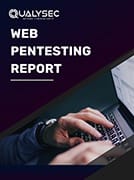
A detailed sample report from a real LLM penetration testing engagement different vulnerabilities and risks with severity ratings and developer-ready remediation steps. Includes an executive summary and full technical findings mapped to OWASP Top 10 for LLMs.
A step-by-step guide to Qualysec's LLM pentesting methodology covers scoping, threat modeling, manual exploitation, safety evaluation, and compliance reporting phases. Learn how we systematically probe LLM applications for different vulnerabilities.
A comprehensive LLM security checklist covering all OWASP Top 10 for LLM Application vulnerability categories, from prompt injection and insecure output handling to excessive agency and training data poisoning.




PRICING
Our Penetration Testing Service Pricing Could Save You Millions!
Process To Start Assessment
Key steps to start protecting your LLM application from cyber threats.
Reach out to us and our friendly team will listen to your concerns and understand your unique security needs. Whether you prefer a call, email, or chat, we're ready to start your journey towards a more secure llm app.
We send you a simple pre-assessment form to fill up with the appropriate information. This helps us understand your app's architecture, current security measures, and specific concerns.
After we review our findings from the pre-assessment and outline our proposed approach, we discuss security strategy and answer any questions you may have through either online or face-to-face meetings.
We sign an NDA to protect your sensitive information and finalize the service agreement. This ensures clear expectations and a smooth partnership from the start.
We provide our clients with a checklist of everything we need to begin testing, such as access credentials and documentation. Our team assists and ensures a smooth start to your app's security enhancement journey.
Get a Quote
Request a tailored quote from Qualysec and understand how advanced security testing can help protect your GenAI applications from prompt injections and evolving attack techniques.

Total No. Of Vulnerabilities

Years in Business

Assessment Completed

Trusted Clients

Countries Served
FAQ
Get quick answers to common questions about LLM security testing, its benefits, frequency, costs, and more.
A large language model (LLM) is an advanced AI system trained on vast amounts of text data to understand, generate, and reason with human language. LLMs such as GPT, Claude, Gemini, and Llama power a wide range of modern applications, from AI chatbots and virtual assistants to code generators, document analyzers, and autonomous AI agents. As organizations integrate LLMs into their products and workflows, these models become high-value targets that introduce a new class of security risks distinct from traditional software vulnerabilities.
LLMs introduce a fundamentally new attack surface that traditional application security tools are not equipped to test. Vulnerabilities like prompt injection and indirect prompt injection can allow attackers to bypass safety controls, extract sensitive data, manipulate outputs, or take over agentic workflows.
The OWASP Top 10 for LLM Applications is the industry-standard framework for LLM security risks. It covers prompt injection, insecure output handling, training data poisoning, model denial of service, supply chain vulnerabilities, sensitive information disclosure, insecure plugin design, excessive agency, overreliance, and model theft. Qualysec's LLM pentesting methodology is fully aligned with this framework.
Qualysec can test any LLM-powered application regardless of the underlying model. These include those built on GPT-4, Claude, Gemini, Llama, Mistral, or custom fine-tuned models. We test chatbots, copilots, RAG-based document systems, AI agents, code assistants, and multi-model pipelines across industries including fintech, healthcare, SaaS, legal, and enterprise software.
Prompt injection is an attack where a malicious actor crafts inputs that override or manipulate an LLM's system instructions, causing it to behave in unintended ways, such as revealing confidential system prompts, bypassing safety filters, executing unauthorized actions, or leaking user data. It is one of the most critical LLM vulnerabilities and is ranked first in the OWASP Top 10 for LLM Applications.
Yes, increasingly so. The EU AI Act requires conformity assessments and risk management for high-risk AI systems, NIST AI RMF recommends adversarial testing as a core risk governance practice, and enterprise procurement teams routinely request evidence of AI security testing. Qualysec's reports are structured to support all of these compliance and due diligence requirements.
A standard LLM penetration testing engagement typically takes 1–3 weeks depending on the complexity of your application, the number of integrations in scope, and the depth of testing required. RAG systems, multi-agent pipelines, and applications with extensive plugin ecosystems may require additional time. Qualysec defines a clear timeline during the scoping call.
You receive a comprehensive LLM penetration testing report covering all findings with severity ratings, proof-of-concept demonstrations, business impact analysis, and prioritized remediation recommendations mapped to OWASP LLM Top 10. You also receive a letter of attestation confirming the assessment was conducted, suitable for enterprise clients, compliance audits, and regulatory submissions.