

Modern medical devices are becoming more connected, software-driven, and dependent on digital technologies. This has extended the scope of regulatory expectations from product safety to cybersecurity, software integrity, data privacy, and supply chain security. As a result, medical device compliance is crucial throughout the product lifecycle, from design and development to post-market monitoring.
According to the survey conducted by Medical Device and Diagnostic Industry in 2025, 73% of health care organizations work with connected devices. Many of them don’t have modern security measures. Complying with regulations for medical devices involves a combined approach to the management of the software supply chain and clinical safety risks. This helps to meet current regulatory requirements.
This compliance guide covers global regulatory requirements, cybersecurity expectations of the FDA in the premarket stage, international standards, and submission paths. We will also discuss the security checklists you can follow before medical device submission.
Key Takeaways
- The FDA’s QMSR is effective from February 2, 2026, and harmonizes US device quality standards with ISO 13485:2016.
- Cybersecurity is mandated for qualifying cyber devices under FDA Section 524B.
- Submission of SBOMs for qualifying cyber devices is mandatory under Section 524B.
- The new FDA guidance on medical-device cybersecurity is dated February 2026.
- Annex I of EU MDR contains cybersecurity-related safety and performance requirements.
- Medical device compliance covers the entire life cycle of the device.
What Is Medical Device Compliance?
Medical device compliance proves that the medical device follows the requirements of safety, quality, and performance. These are set by the relevant authorities in the market where it is sold. This involves complying with the laws and standards and maintaining proper documentation. It indicates that the medical device is safe, reliable, and performs the way it is supposed to.
Core Purpose of Compliance
As you construct a compliance program, there are three core performance purposes that you have to consider:
- Safety: Making sure that the medical device does not expose the patient or the operators to unacceptable hazards.
- Quality: Creating quality management and manufacturing processes that ensure that all production units are made according to the specific design specifications.
- Performance: Demonstrating through rigorous testing, software, and clinical use that the device performs the way it was expected.
Essential Documentation
Achieving medical device cybersecurity compliance requires backing your claims with explicit, auditable documentation. It includes:
- Design History File (DHF): Proves that the device was created in compliance with the design control documents approved for use.
- Medical Device File (MDF): Consists of all the exact specifications, manufacturing process, quality management activities, and installation procedures needed to manufacture the device. It is in accordance with the FDA’s QMSR and ISO 13485:2016.
- Software Documentation: Includes documentation from the software development life cycle mandated by IEC 62304, including software architecture and software requirements specification (SRS). Static analysis report and unit or integration test results are also included.
- Cybersecurity Management File: Includes threat model, Software Bill of Materials (SBOM), Vulnerability Exploitability eXchange (VEX) file. It also includes a security risk assessment (ANSI/AAMI SW96) and penetration testing report.
What Is The Importance of Medical Device Compliance?
Medical device cybersecurity compliance is crucial because it guarantees that the devices comply with the safety and quality standards. It also has so many other benefits, which include:
- Patient Safety: Ensures prevention of device failure, unauthorised access, and mismanagement of patients’ data.
- Market Access: Ensures prevention of lost documentation and regulatory concerns that lead to delays in the approval process.
- Lower Risk of Recalls: Detects hardware, software, and design issues early on when the fixes are simpler and cheaper to implement.
- Brand Trust: Proves to hospitals and healthcare facilities that your medical devices comply with certain safety and security requirements.
- Cyber Resilience: Provides protection of the connected devices against ransomware attacks, denial-of-service, and other unauthorised remote access.
- Insurance & Reimbursement: Helps prove mandatory requirements of safety, quality, and performance of the devices.
- Global Growth: Utilization of internationally recognized medical device compliance standards ensures reusability of compliance documentation globally.
What Are The Key Stages Of Medical Device Compliance Throughout the Product Life Cycle?

Compliance is not a one-time activity performed before product launch. It involves the following five stages in the TPLC (Total Product Lifecycle).
1. Design Phase
- Risk Analysis: Conducting hazard analysis according to ISO 14971, along with threat modeling initially, such as STRIDE. It defines the system’s trust boundaries.
- Usability Engineering: Performing formative usability assessments as per IEC 62366-1 to prevent user error hazards and clinical misinterpretations.
- Design Controls: Defining design inputs, outputs, and traceability from the clinical requirements to the technical specifications.
2. Development Phase
- Software Lifecycle Validation: Following the IEC 62304 architectural controls in accordance with the safety level of the software (Classes A, B, and C).
- Coding Security Standards: Mandating the use of static application security testing (SAST), software composition analysis (SCA), and MISRA C/C++ and CERT C rulesets.
- Documentation Compilation: Construction of the design history file (DHF) and dynamic software architecture diagram with interface information.
3. Testing Phase
- Verification & Validation (V&V): Performing bench testing, environmental stress testing, and automated regression testing to prove that the design outputs match the inputs.
- Biocompatibility: Determining tissue, blood, and cell interactions according to the ISO 10993 series.
- Cybersecurity Testing: Performing interactive dynamic application security testing (DAST), API security testing, and fuzzing. Also conducting authenticated hybrid penetration testing to identify any exploitable vulnerabilities before code freeze.
4. Manufacturing Phase
- Quality Management System (QMS): Running on FDA 21 CFR Part 820 (QMSR) and ISO 13485:2016 standards for monitoring manufacturing environments and material traceability.
- Supplier Management: Conducting audits of qualified third parties of hardware, Commercial Off-The-Shelf Software (COTS), and contract manufacturers.
- CAPA Systems: Developing effective Corrective and Preventive Actions (CAPA) processes to examine the vulnerabilities in manufacturing and to avoid systematic problems.
5. Post-Market Phase
- Complaint Handling: Monitoring, filtering, and documenting real-life performance issues of the device and customer safety information.
- Adverse Event Reporting: Following rigorous reporting schedules such as FDA MDR and the EU Vigilance System for adverse events.
- Patch Management: Providing cryptographically signed Over-The-Air (OTA) updates for firmware/software to patch zero-day vulnerabilities without compromising on safety.
- Continuous Monitoring: Collecting real-time feeds for vulnerability information (CVE/NVD) and correlating it with the SBOM of the product.
How Are Medical Devices Regulated Around the World?
Dealing with international commercialization requires maintaining compliance with the important regulatory standards in your chosen markets. The major medical device regulations around the world include:
|
Region/Market |
Regulatory Body |
Core Regulations/Frameworks |
Applies To |
Key Compliance Emphasis |
|
USA |
US FDA |
21 CFR Part 820 (QMSR) |
All Medical Devices |
ISO 13485:2016 harmonization, QMS records transparency, risk management integration. |
|
USA |
US FDA |
FD&C Act Section 524B |
Cyber Devices |
Mandatory SBOM, SPDF, threat modeling, security patching, and vulnerability disclosure. |
|
Europe |
EU Authorities/NBs |
EU MDR (2017/745) |
General Medical Devices |
GSPR 14.2/17 compliance, stringent clinical evaluation, EUDAMED registration, post-market surveillance. |
|
Europe |
EU Authorities/NBs |
EU IVDR (2017/746) |
In Vitro Diagnostics |
Performance evaluation, risk classification rules, companion diagnostic validation. |
|
United Kingdom |
UK MDR 2002 (as amended) |
UK Market Devices |
UKCA marking, UK Responsible Person representation, software safety alignment. |
|
|
Kanada |
Health Canada |
CMDR (SOR/98-282) |
Class II, III, IV Devices |
Medical Device Single Audit Program (MDSAP) mandatory certification, clinical evidence. |
|
Australia |
TGA |
ARGMD / Therapeutic Goods Regulations |
All Medical Devices |
Essential Principles conformity, software classification, global evidence leveraging. |
|
Japan |
PDMA/MHLW |
PMD Act |
All Medical Devices |
Japanese QMS Ordinance (MHLW Ord. 139), strict local MAH representation, technical standards. |
|
South Arabia |
SFDA |
Medical Devices Law & Regulations |
All Medical Devices |
SFDA registration, cybersecurity controls, localized technical file submissions. |
|
India |
CDSCO |
Medical Devices Rules (MDR 2017) |
All Medical Devices |
Device risk classification (Class A-D), local testing/clinical requirements, registration. |
What Essential Standards Should Every Manufacturer Know?
Medical device manufacturers have to incorporate the basic international standards into their engineering processes. It proves your device meets relevant requirements before submission. The compliance standards include:
Quality & General Safety
- ISO 13485:2016: This is the basic global standard for quality management systems within the field of medical device production, from design to suppliers.
- ISO 14971:2019: This is the global standard for risk management of medical devices that provides guidelines for the assessment, evaluation, control, and monitoring of hazards.
Software & Usability
- IEC 62304:2006/Amd 1:2015: Specifies lifecycle considerations for software in medical devices. Provides guidelines for activities such as development, maintenance, risk management, and configuration management. Works on activities based on the Software Safety Classes, which are Class A, Class B, and Class C.
- IEC 62366-1:2015: Establishes a process for usability engineering to assess and mitigate usability risks. It addresses human factors usability risks linked with normal use and use error.
- IEC 60601-1: Basic safety standard for medical electrical equipment, covering electrical safety, mechanical hazards, and general safety performance.
Cybersecurity & Systems Engineering
- IEC 81001-5-1:2021: Describes processes for lifecycle management of health software with particular emphasis on health software security and integration with IEC 62304.
- AAMI TIR57: It provides a risk management guidance document for medical device security. It works by extending the traditional ISO 14971 safety risk management framework to analyze threat vectors and security assets.
- NIST CSF 2.0: Provides a holistic architectural framework such as Govern, Identify, Protect, Detect, Respond, and Recover. This helps to protect devices, enterprise ecosystems, and cloud backend services.
- NIST SP 800-218 (SSDF): Secure Software Development Framework that defines practices for developers to prevent vulnerabilities in source code.
- OWASP MASVS/ASVS: It is called the Mobile Application and Application Security Verification Standard. This provides benchmark checklists for the verification of companion healthcare applications and backend API’s.
How Can Manufacturers Strengthen Medical Device Security?
Medical device manufacturers can strengthen security by transitioning from static evaluations to continuous, proactive risk management across the device lifecycle.
Core Cybersecurity Execution Domains
Critical technical capabilities are required to secure medical device architecture. These include:
- Secure Software Development Lifecycle (SDLC): Integrating security measures at every sprint. It includes threat modeling, static application security testing (SAST), software composition analysis (SCA), code review, and dynamic testing before deployment.
- Threat Modeling: A systematic way to document trust boundaries within devices. Information flow through devices, entry points into systems, and threat vectors using a framework such as STRIDE.
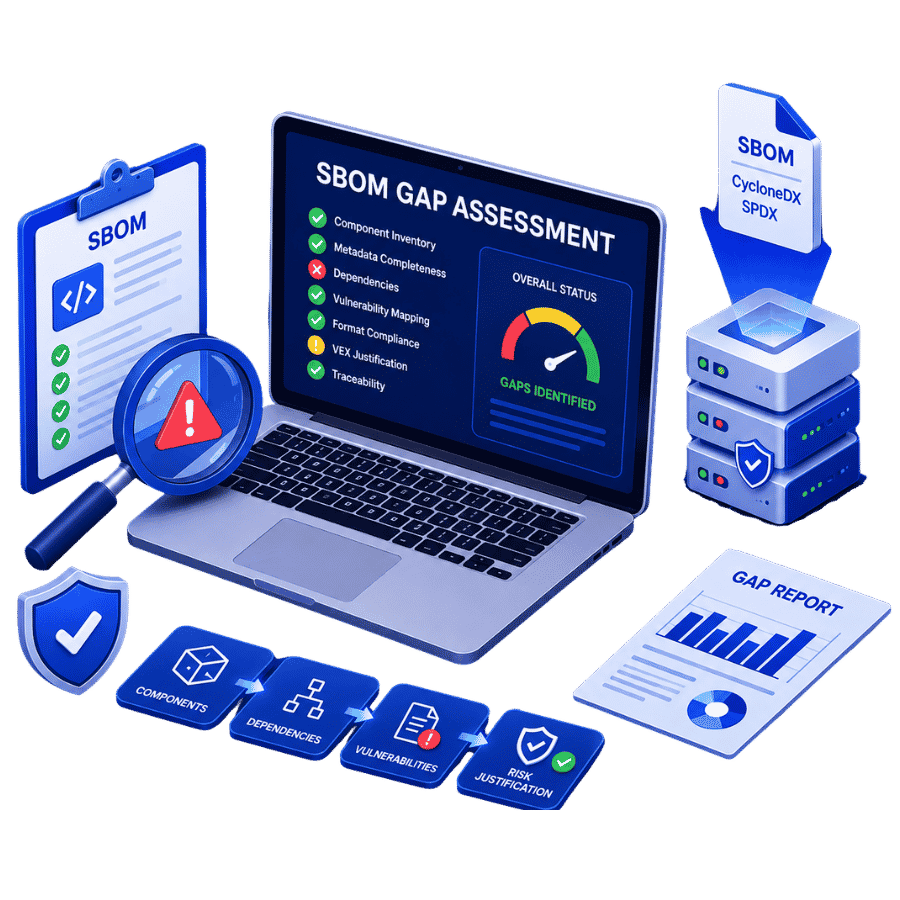
- Software Bill of Materials (SBOM): Creation of a complete and machine-readable inventory in SPDX/CycloneDX format. It is required for all commercial off-the-shelf (COTS), open-source, and proprietary components and libraries used in the devices.
- Authentication & Access Control: Ensuring strong identity verification, role-based access control, minimum necessary privileges for administrators, and multi-factor authentication for services.
- Cryptographic Protections: Protection of sensitive information at rest and in transit using standard cryptography such as AES-256, TLS 1.3, and mTLS. Cryptographic keys stored in Hardware Security Modules or Secure Elements.
- Logging, Auditability & Monitoring: Utilizing tamper-proof security logging for authentication activity, privilege escalation, network traffic, and changes in the system configuration.
- Incident Response & Patch Management: Providing a documented Coordinated Vulnerability Disclosure process and capability for timely creation, testing, signing, and delivery of OTA updates.
- Zero Trust Architecture (ZTA): Building networks of connected devices on the premise that local networks are compromised, thus ensuring verification of each session and API request.
What Are The FDA Cybersecurity Requirements?
The U.S. Food and Drug Administration imposes strict cybersecurity standards on all medical devices. It incorporates software requirements pursuant to Section 524B of the FD&C Act and the FDA Cybersecurity Guidance.
Scope of FDA “Cyber Devices”
According to Section 524B, a Cyber Device can be defined based on three factors:
- It contains software that is tested, created, or executed by the device.
- The device has the capability to access the internet and other networks, including wired, wireless, Bluetooth, cellular, and cloud networks.
- Presence of software or firmware that is capable of being attacked through cybersecurity.
Mandatory Premarket Cybersecurity Deliverables
Key FDA requirements for medical device cyber risk management include the following.
- Section 524B Plan: Legally binding agreement to monitor, detect, and manage postmarket cybersecurity threats and vulnerabilities within acceptable timelines.
- Secure Product Development Framework (SPDF): Documentation demonstrating that security controls were built directly into the Quality Management System (QMSR) 21 CFR Part 820 in design, code, test, and distribution.
- Machine-readable SBOM & VEX: Submission of dynamic SPDX or CycloneDX software bill of materials (SBOM) in addition to Vulnerability Exploitability eXchange (VEX). Documentation stating whether known CVEs in library dependencies are exploitable.
- Threat Modeling Documents: System boundaries, attack surfaces, threat tree analysis, and risk management strategies for each threat mapping to safety consequences.
- Security Risk Assessment (ISO 14971 to ANSI/AAMI SW96): Security risk quantification based on the measurement of exploitability and consequence rather than the probability scale of ISO 14971 alone.
- Penetration Testing and Verification Report: Independently verified security evaluation report describing methodology, dynamic application security testing (DAST), vulnerability scans, interface fuzzing, and proof of remediation.
- Coordinated Vulnerability Disclosure (CVD): Defined CVD process and policies explaining how to access the company’s vulnerability reporting processes for third-party vulnerability reports.
What Are The EU MDR Cybersecurity Requirements?
According to European standards, meeting MDR compliance entails ensuring that cybersecurity is integrated into medical devices’ safety and performance. They should as per EU Medical Devices Regulation (MDR 2017/745) and the EU In Vitro Diagnostic Regulations (IVDR 2017/746).
General Safety and Performance Requirements (GSPR)
European Notified Bodies assess cybersecurity according to the Annex I GSPRs, which are also called General Safety and Performance Requirements.
The requirements include:
- GSPR 14.2: Mandates that the devices intended to operate with other devices or networks must be designed with proper security. So that any system risk will be either eliminated or reduced to an acceptable level.
- GSPR 17.1 & 17.2: Focuses on verification, validation, and cybersecurity for software. Specifies that software must be developed with the latest technological principles which are considering lifecycle management, risk assessment, verification, and validation. Also provides IT network security and protection from unauthorized access.
Key Focus Areas for Notified Bodies
Alignment with MDCG 2019-16 Guidelines: European Coordination Group guidance demanding manufacturers show their security risk management end-to-end with integration of ISO 14971 and TR 60601-4-5.
Overlapping European Cybersecurity Legislation:
- EU NIS2 Directive: Mandates compliance and breach notification requirements for cybersecurity for health care providers and critical digital supply chains.
- EU Cyber Resilience Act (CRA): Covers digital products, companion apps, and cloud computing infrastructure used within the European marketplace. Mandates security patches and automatic reporting of vulnerabilities.
Post-Market Clinical Follow-up (PMCF) & Vigilance: Any cybersecurity events affecting clinical performance or safety must be communicated via the EUDAMED vigilance portal.
Compliance Framework Comparison
Here is the way that important standards and regulations correlate to make it easier for you.
|
Framework / Standard |
Core Focus |
Statutory / Mandatory Status |
Primary Target Audience |
Interoperable Alignment |
|
ISO 13485:2016 |
Quality Management System (QMS) |
Mandatory in EU/MDSAP; incorporated into FDA QMSR |
QA/RA, Operations, Executive Leadership |
ISO 9001, FDA QMSR (21 CFR Part 820) |
|
ISO 14971:2019 |
Application of Risk Management |
Mandatory across all global markets |
Risk Managers, System Engineers |
AAMI TIR57, IEC 62304 |
|
IEC 62304 |
Software Lifecycle Processes |
Mandatory for all software-containing devices |
Software Engineers, Architects |
IEC 81001-5-1, FDA Guidance |
|
IEC 81001-5-1 |
Health Software Cybersecurity Lifecycle |
Rapidly becoming mandatory baseline |
Security Engineers, Software Team |
NIST SSDF, AAMI TIR57 |
|
FDA Section 524B |
US Statutory Cyber Device Mandates |
Legally Mandatory in the US (Refuse to Accept threshold) |
CTOs, CISOs, Regulatory Affairs |
FDA Guidance, ISO 13485 (QMSR) |
|
EU MDR (GSPR 14.2/17) |
European Market Device Safety & Software |
Legally Mandatory for CE Marking |
Regulatory Affairs, Notified Bodies |
MDCG 2019-16, ISO 14971 |
Step-by-Step Medical Device Compliance For Medical Device Manufacturers
Global regulatory approval is attained through a defined twelve-step lifecycle process that includes:
1. Regulatory Requirements Identification:
Identify geographic regions targeted by the product and identify statutory requirements such as FDA 510(k)/PMA, MDR CE Mark, Health Canada MDL.
2. Classify Device
Classify the device risk level based on the requirements of the target market. For example, US FDA Class I, II, III; EU MDR Class I, IIa, IIb, III; EU MDR Rule 11 software.
3. Comprehensive Risk Assessment
Begin ISO 14971 safety risk assessments together with AAMI TIR57 / ANSI/AAMI SW96 security hazard analysis to set the initial risk acceptance threshold.
4. Implement Quality Management System (QMS)
Implement organization-wide SOPs according to ISO 13485:2016/FDA QMSR (21 CFR Part 820). It includes design controls, documentation control, and supplier evaluation.
5. Generate Technical Documentation
Develop Design History File (DHF), Technical File, and Software Lifecycle Documentation (IEC 62304) documenting device architecture, requirements, and trace matrices.
6. Verification
Perform bench tests, electrical safety tests per IEC 60601-1, automation of software unit/Integration testing, and Static Analysis showing the output design meets input specifications.
7. Design Validation
Ensure validation of the device meeting user requirements and clinical purpose in real-world operating conditions, with human factors usability evaluation per IEC 62366-1.
8. Clinical Evaluation & Performance Evaluation
Prepare a Clinical Evaluation Report (CER) for EU MDR or conduct clinical trials to prove clinical safety, effectiveness, and state-of-the-art equivalence.
9. Independent Cybersecurity Validation
Conduct automated scanning, Dynamic Application Security Testing (DAST), Software Composition Analysis (SCA), Dynamic Threat Modeling, and Authenticated Hybrid Penetration Testing.
10. Technical Submissions to Regulatory Bodies
Prepare technical documentation in specific formats and submit to regulatory authorities via specialized portals. For example, US FDA eSTAR v6.1, EUDAMED Registration, Health Canada review.
11. Regulatory Approval & Clearance
Obtain clearance through the substantive review process, respond to additional information (AI) queries, pass pre-clearance QMS audits, and get clearance certificates.
12. Post-Market Surveillance (PMS) & Continuous Monitoring
Implement automated CVE monitoring, complaint trend tracking, post-market clinical follow-up (PMCF), CVD tracking, and signed OTA software updates.

Medical Device Documentation Checklist Every Manufacturer Should Follow
Before sending technical files for review, make sure that the following fundamental documentation is prepared.
Quality & Engineering Files
- Design History File (DHF): Design Documentation, user requirements, design inputs/outputs, design review minutes, verification and validation reports.
- Medical Device File (MDF): Device specifications, manufacturing process, labeling artwork, installation instructions and service instructions.
- Risk Management File (RMF): Risk management plan, hazard analysis, benefit-risk analysis, risk control verification, residual risk analysis.
Software & Usability Files
- Software Development File (SDF): Software architecture, Software Requirements Specification (SRS), Software Design Specification (SDS), test records for unit and integration testing, and release notes.
- Usability Engineering File (UEF): Usability evaluations, use-safety analysis, and human factors validation study results.
- Clinical Evaluation File: Clinical Evaluation Plan (CEP), Clinical Evaluation Report (CER), and Post-Market Clinical Follow-up Plans.
Cybersecurity & Security Evidence
- Software Bill of Materials (SBOM): Machine-readable document listing all Commercial off-the-shelf, third-party, and open-source libraries.
- Vulnerability Exploitability eXchange (VEX): Document that analyzes the identified vulnerabilities in the components to determine if they affect device safety or not.
- Vulnerability Exploitability eXchange Trust boundary documentation, data flow diagrams, threat trees, and mitigation matrix.
- Penetration Testing Report: Independent and authenticated penetration testing report for network, local interfaces, APIs, cloud, and reverse engineering testing.
- Coordinated Vulnerability Disclosure (CVD) Plan: Document outlining the policy and procedure for intake of vulnerabilities and customer communication.
What Are The Common Medical Device Compliance Challenges?
- Legacy Device Management: Adaptation of legacy devices into cybersecurity compliance without making the existing market clearance void.
- Evolving Global Timeline: Keeping up with new region-specific transition timelines, such as additional EU MDR transition timelines and EUDAMED module rollouts.
- Third Party and Software Supply Chain Risks: Potential risks introduced by open-source library unknown vulnerabilities and unmanaged software component updates.
- Incompleteness in Traceability: Inconsistency between clinical user needs, design inputs, software requirements, test cases, and threat mitigations.
- Uncontrolled Software and Over-the-air Upgrades: Introduction of software patches without doing delta risk assessment and regression testing, making unauthorized changes on the device.
- Audit Preparedness & Evidence Management: Lack of compliance artifacts kept in different locations, such as spreadsheets, development tools, and quality management systems, leading to major audit failures.
- Medical product compliance: Ensuring seamless alignment of compliance within a cross-border healthcare framework without redundant engineering efforts.
- SaMD Compliance Challenges: Managing cloud-based updates, third party API, and mobile operating system changes for standalone software applications.
Best Practices for Medical Device Manufacturers
Security and compliance considerations cannot be postponed until after medical devices are launched on the market. Proactive measures such as proper planning, continuous testing, thorough documentation, and adherence to regulations will help identify risks earlier.
- Incorporate quality engineering, threat modeling, and regulatory analysis in the early phases of architectural design rather than at the pre-launch testing stage.
- Include static application security testing (SAST), software composition analysis (SCA), and dependency scanning in the CI/CD pipeline.
- Update the threat model as the architecture changes or as new interfaces or new CVEs appear.
- Perform automated scanning alongside manual testing by cybersecurity experts specializing in the healthcare sector to minimize false positives.
- Engage specialists to fill in the gap between software engineering, quality systems, and regulations.
- Generate and validate SBOMs continuously to ensure software component visibility.
- Maintain centralized QMS documentation, Design History File, and cybersecurity risk-related documentation.
What Are The Consequences of Non-Compliance
The consequences of not being able to comply with regulatory standards or maintain proper medical device compliance processes can be large. It can cause:
- Refuse-to-Accept (RTA) & Warning Letters from FDA: Failure to include cybersecurity or quality documentation can cause the submission to be refused. It can also cause failure to maintain proper QMS and public Warning Letters to be issued.
- Class I Device Recalls: A critical issue with the software and potential vulnerability that puts patients at risk can cause mandatory product recalls.
- Penalties and Consent Decrees: Violation of regulatory standards can cause financial penalties, civil fines, and Consent Decrees.
- Market Suspension and Import Bans: Not being able to comply with MDR from the EU or international QMS requirements can cause suspension from the market and import bans.
- Injury to Patients & Civil Lawsuits: Software defects and security vulnerabilities can cause clinical errors and patient injuries, privacy issues, and lawsuits.
How Will Medical Device Compliance Evolve In The Future?
Medical device cybersecurity compliance is becoming increasingly continuous, automated, and technology-dependent. Device manufacturers will have to adjust to new compliance trends related to AI, post-market security, SaMD, and digital compliance evidence.
- AI-Driven & Machine Learning Medical Devices: Regulatory authorities are using GMLP and PCCPs for managing continuously learning devices without making new premarket submissions.
- Automated Post-Market Security: Automated platforms will be used to correlate real-time NVD/CVE alerts with device SBOMs for discovering vulnerabilities.
- SaMD Governance & Compliance Focus: SaMD compliance will be increasingly concentrated on cloud security, multi-tenant isolation, zero-trust APIs, and mobile OS patches.
- Machine-Generated Compliance Evidence & Automated Tools: Regulators are more likely to accept machine-generated evidence produced by means of DevOps, automated testing, and digital QMS platforms.
Medical Device Cybersecurity Compliance Readiness Checklist
Here is the checklist that will help you to check whether your company is ready for global submission of regulatory compliance medical devices.
- Have a Quality Management System (QMS) in place with FDA QMSR (21 CFR Part 820) and ISO 13485:2016.
- Perform Device Classification for each target global regulatory compliance medical device.
- Finalize the Risk Management File, including hazard analysis and risk controls according to ISO 14971.
- Have Design Controls & Documentation in place with updated DHF and completed traceability.
- Document the Software Development Life Cycle in line with IEC 62304, including architecture, software safety classes, and testing.
- Complete Usability Engineering in line with IEC 62366-1, including formative and summative evaluations.
- Prepare a Clinical Evaluation with a CER showing the safety and performance of the device.
- Develop a Threat Model that covers trust boundaries, attack vectors, and security controls.
- Perform a Cybersecurity Risk Assessment in line with ANSI/AAMI SW96 and AAMI TIR57.
- Maintain a machine-readable Software Bill of Materials (SBOM) in place using SPDX or CycloneDX format.
- Perform a VEX Assessment to measure the effect and exploitability of the CVEs found.
- Perform Penetration Testing for network, API, and firmware security independently.
- Conduct GSPR 14.2 and 17 Mappings for EU MDR/IVDR relevant to Annex I.
- Adopt a CVD policy with SLAs for intake and response.
- Create the necessary regulatory submission for each target country, like eSTAR for FDA or EUDAMED for Europe.
- Create a Post-Market Surveillance Plan for CVE monitoring, incident management, and secure OTA updates.
How Qualysec Helps You Pass Global Compliance Reviews
Qualysec works as your technology partner to make sure you comply with all these global standards flawlessly in order to make your market entry. Instead of dealing separately with security testers, software teams, and compliance consultants, you deal with only one team that takes care of all the heavy lifting for all these global markets:
- FDA (US): Qualysec designs your full cybersecurity solution for FDA Section 524B. We develop your dynamic SBOMs, create threat models, and perform penetration tests that seamlessly integrate with your 21 CFR Part 820 quality system.
- EU MDR & IVDR (Europe): We perform security testing according to EU safety standards (GSPR 14.2 & 17), giving Notified Bodies evidence of your compliance with IEC 62304 and ISO 14971.
- UK, Canada, Australia, and Japan: We design your technical report according to global standards such as ISO 13485 and IEC 81001-5-1 in order to reuse your security findings for MHRA, Health Canada, TGA, and PMDA submissions.
- India and Saudi Arabia: We conduct security testing of your device firmware, mobile apps, and cloud API against local criteria for CDSCO and SFDA submissions.
Conclusion
Medical device compliance is not something that happens at the end, just before entering the market. It is the process that runs through the entire life cycle of the medical device. This will help manufacturers to minimize any sort of regulatory delays, enhance patient safety, and secure access to the market. With the ongoing development of devices and software, companies should stay prepared for any changes in their compliance.
FAQs
1. What is the difference between FDA 510k and PMA?
The 510(k) involves a manufacturer showing that their device is substantially similar to a predicate legally marketed device. PMA process is more rigorous and applies to the majority of Class III devices.
2. What are the medical device rules in 2026?
The most significant regulation of 2026 is the FDA’s Quality Management System Regulation (QMSR), which is now effective as of February 2, 2026. It is intended to replace the earlier QS system, 21 CFR Part 820, and adopt ISO 13485:2016.
3. Is ISO 13485 only for medical devices?
ISO 13485 is developed exclusively for the Quality Management System of medical devices. It covers organizations that are engaged in the design, manufacture, servicing, installation, and other processes associated with medical devices.
4. What is the difference between 21 CFR 820 and 13485?
ISO 13485 is an international quality management system standard, whereas 21 CFR Part 820 is the FDA regulation for the United States. FDA’s Quality System Regulation will include ISO 13485:2016, including any FDA-specific additions.
5. What are the medical device amendment regulations for 2026?
The major US regulatory change that is expected for 2026 includes the revision to 21 CFR Part 820 referred to as the QMSR. It brings quality requirements closer to ISO 13485:2016.
6. What is the new MDR regulation?
The European Medical Device Regulation is the framework for regulating medical devices in Europe. This framework sets out requirements related to safety, performance, clinical evaluation, technical documentation, conformity assessment, and post-market surveillance.
7. How are medical devices regulated in the US?
FDA regulates medical devices in the USA based on a risk-based approach. It checks for classification, pre-market submission, quality system, manufacturing, labeling, and post-market control. The appropriate regulatory path depends largely on the device classification and use.
8. What are the three main medical device classifications in the US?
The Food and Drug Administration classifies devices as Class I, Class II, or Class III, depending largely on risk and the degree of control necessary. Class I is usually considered to have the least risk, whereas Class III has the greatest risk.
9. What is regulatory compliance in the medical device industry?
Regulatory compliance consists of complying with the relevant laws, regulations, standards, safety guidelines, quality control mechanisms, and documentation requirements that apply to the medical device. This ensures that the medical device can prove to be safe and effective in doing what it was designed to do.