






A regulatory compliance audit has never been more significant than in 2025, since regulations are becoming increasingly difficult and governments are scrutinizing more. According to a recent survey, 93 percent of compliance officers said they believed their priority in the 12-18 months is to keep up with the new rules. The use of AI tools will likely internalize the audits by 48 percent faster and assist companies in managing audits more efficiently with increased regulation.
Regulatory fines now run into billions annually across the globe, and three out of five leaders of audits claim cybersecurity is the largest area of threat. Alternatively, 76 percent of businesses have an intention to conduct at least one AI-driven compliance audit within two years to examine things more quickly and provide a superior guarantee. These facts demonstrate why it is important to ensure potent compliance audit plans to reduce the risk and to avoid expensive fines in the present day.
Regulatory Compliance Audit – An Overview
By 2027, AI and automation will be used in regulatory compliance audit testing to enhance speed and precision. To identify gaps that may hinder the audit process, mitigate risk, and equip teams with all the information necessary to perform the actual audit, companies conduct preparedness tests in advance. Compared to paper-based checklists, digital ones are more convenient in terms of the ability to collect evidence and examine documents to please auditors within a short time. Current risk management is based on the continuous monitoring and forecasting of possible breaches in order to recognize them at the very beginning and implement preventive measures.
Basic Essentials of Compliance Audit Checklist
With a comprehensive compliance audit checklist, you are good to go in terms of preparing to be audited. The checklist covers –
- Gathering and arranging documents (policies, procedures, previous audit reports).
- Discussion with stakeholders and explanation of the scope of the audit.
- Determining and assessing the compliance risks.
- Surveillance of controls and verification of evidence.
- Checking training records and use of policies.
- Assessing the compliance of vendors and third parties.
It lowers the possibility of missing important items and ensures the weak areas are corrected prior to the audit using this checklist. Revise the checklist frequently since the laws evolve to keep hackers on their toes. Learn more about data security compliance.
Layers to Plan on a Regulatory Compliance Audit
All teams need to plan well to pass the regulatory compliance audit. Key steps are –
- Assign a Leader – Select a compliance officer or team that has the responsibility of leading the audit.
- Know the Rules – Familiarize yourself with the regulations that impact your industry and formulate them into your own compliance system and framework.
- Conduct Internal Tests – Conduct mock audits and pre-audit tests that simulate the actual audit.
- Check Documents – Ensure all compliance materials are right, are easy to locate, and are as per the prevailing rules.
- Detect and Take Action – Pay attention to risk tools and identify and correct issues at the beginning stages.
- Pitch Early – Introduce the auditors early to understand what they will want and change your audit strategy.
- Train and Culture – To create a culture of compliance, it is necessary to engage in frequent training and awareness.
- Use Technology – Introduce AI and automation into the compliance audit process, which will accelerate the control checks and reporting.
Compliance Risk Management Beyond 2025
Compliance risk management in the year 2025 became predictive instead of reactive to issues due to live data and AI. Enterprises consider all risks- cyber, data privacy, third-party, and regulatory changes from an entire system perspective. Approximately 61 percent of those experts who have continuous risk monitoring claim to have a continuous risk watch in their procedures; hence, threats are identified and prevented within a short time.
Any compliance program, particularly in both IT security and vendor control, is subject to stricter scrutiny by the government. There is a tendency to unify standards globally, and this puts pressure on more companies to comply with stringent audit procedures. Companies that implement the use of sophisticated compliance tools can reduce the time spent on audit preparation by 30 percent and the chances of massive fines.
Innovations in Regulatory Compliance Testing
Regulatory compliance testing is no longer limited to manual checks. It has machine learning that identifies irregularities, AI-based reviews, and automatic validation of controls. These developments ensure more in-depth, quick, and accurate audits.
Not only are policies checked, but rules themselves in cybersecurity and privacy, which are particularly frequently tested. It is simple to collect evidence, monitor work, and report, connecting compliance platforms with audit systems. Such tools will provide the possibility of continuous compliance audits and detect issues before the real audit process, and ensure that the company gets stronger.
The Compliance Audit Process
The regulatory compliance testing includes some steps that are clear to the companies in order to have a complete assessment and correct any lapses. These measures assist in maintaining compliance and remaining within the law. Effective interaction with all people will result in an improved audit report. The main steps are –
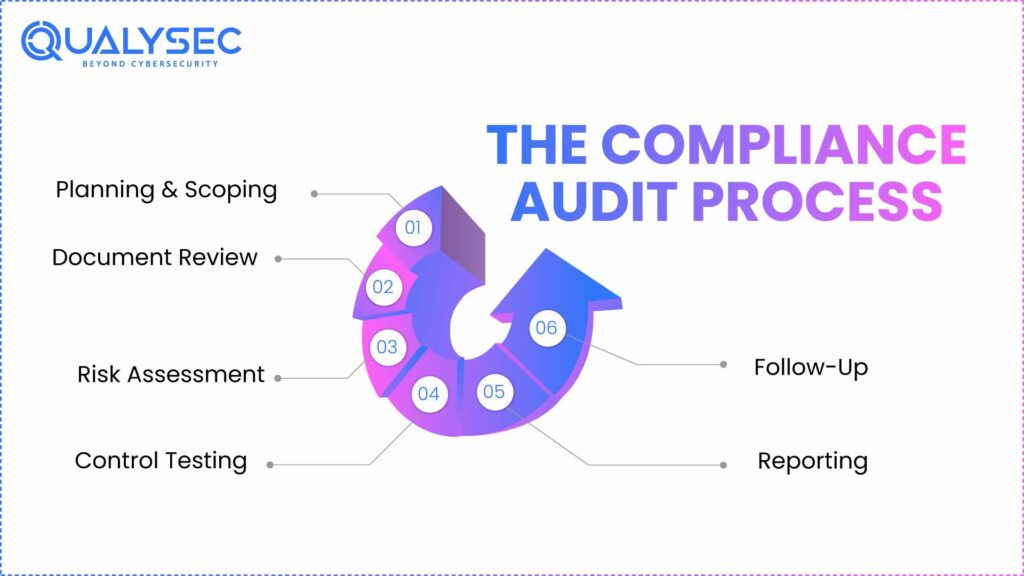
1. Planning & Scoping
Determine what to audit, what is to be covered, and identify the important rules. This will inform everybody of what the audit will examine.
2. Document Review
Using the relevant policies, procedures, work records, and previous audit reports, collect and research the documents. The auditors read them so that they can get a good understanding of the compliance structure and identify gaps.
3. Risk Assessment
Identify and analyse spots where the company may not comply with rules, and the controls may not work. This assists in prioritizing the most probable and the most effective risks.
4. Control Testing
These are real-life tests of internal controls, in terms of sampling, interviews, and observations. This is to determine whether controls are effective in deterring or preventing violations of rules.
5. Reporting
Prepare an audit report, risks, and recommendations on how to resolve issues. The report should be effective and understandable, and distributed promptly to the appropriate individuals.
6. Follow-Up
Monitor the process of fixes and re-testing controls to ensure that problems are closed. This cycle continues to make compliance better as time goes by.
How Qualysec Technologies Can Help You
Qualysec Technologies specializes in clarity and dependable compliance audit services, which are intended to help firms feel prepared and prosper in stringent regulatory conditions. Having a good understanding of numerous industries, we provide high-quality compliance audits and audit readiness assessments.
We primarily do compliance audits, compliance testing, compliance risk management, and audit readiness assessment consultations. We demonstrate that clients adhere to the rules with the help of test-proven procedures, which makes us special in this sphere.
What’s So Special About Us?
The test-based approach of Qualysec ensures that all the audits are constructed on established procedures with greater confidence as compared to the more common methods.
- Process-based Approach – We are unparalleled in terms of compliance, with a test-based, proven framework. As opposed to so many others, we do not use checklists and automated scans. Rather, we have our layers of validation, which assure precision and thoroughness, where each stage of the audit is strictly checked.
- Dedicated Experts – Our personnel includes numerous seasoned professionals who are well-versed in regulatory requirements and practical skills in audit preparation and risk management, and are prepared to international standards. This competency will allow us to develop tailor-made solutions that precisely respond to industry and regulatory demands.
- Beneficial Communication – Another transparency and quality promise that we make is to keep clients in constant communication with us by updating them in real-time and providing practical advice. This minimizes audit disruptions and enhances performance, keeping clients running well and preserving their reputations.
- All-encompassing Tests – Qualysec has test plans that have been tested effectively over time, and in a dynamic world where rules are complicated and keep evolving, Qualysec can assure its clients that they can sustainably pass audits.
Conclusion
Regulatory fines now run into billions annually across the globe, and three out of five leaders of audits claim cybersecurity is the largest area of threat. Alternatively, 76 percent of businesses have an intention to conduct at least one AI-driven compliance audit within two years to examine things more quickly and provide a superior guarantee.
Trust your path to audit success with Qualysec Technologies – Get in touch with us today to have data-driven and trusted compliance audit solutions!

FAQs
1. What is a regulatory compliance audit?
A regulatory compliance audit is a definite audit of the existence of a company that is in compliance with the laws, rules, and internal policies. It verifies controls and procedures to identify issues and recommends remedies to ensure the firm complies with the regulatory requirements.
2. How can businesses prepare for a compliance audit?
Preparation includes business people assigning a compliance head, understanding rules, conducting in-house audits, documenting, risk identification, staff training, engaging auditors before the audit, and technology to aid in the process.
3. What are the main stages of a regulatory compliance audit?
These broad steps include: planning, document review, risk assessment, control testing, reporting, and finalizing on corrections to seal any loopholes.
4. How often should a regulatory compliance audit be conducted?
Audits are performed either annually or as regulations dictate. There might be additional rules with higher risks or rapidly evolving areas that might incur increased checks.
5. What are the penalties for failing a compliance audit?
Punishments may be huge fines, lawsuits, suspension of licenses, damaged reputation, and the restriction of the business. Data breaches and other rule violations will also be a threat due to non-compliance, which will result in severe financial loss.