

The HIPAA compliance cost in 2026 is a main operational line of healthcare organizations in the U.S, be it small clinics, group practices, or an enterprise-level healthcare provider. A typical cost of HIPAA-related controls in a small to mid-sized healthcare organization is estimated to be around $30,000–$120,000 per year. Weighed against the possible punishments, possible civil fines in 2026 can be approximately $2.07 million per category of violation annually, and proactive planning regarding HIPAA compliance becomes an apparent risk-reduction measure, rather than a regulatory box.
Cost of Compliance with HIPAA in 2026
| HIPAA Cost Component | Estimated Cost Range (2026) | Cost Type | Why It’s Required |
|---|---|---|---|
| Security Risk Analysis (SRA) | $5,000 – $15,000 (small-mid) Up to $85,000+ (enterprise) | Initial + periodic | Required under the HIPAA Security Rule to identify risks to PHI |
| Policy & Procedure Development | $3,000 – $12,000 initial $2,000 – $8,000 annually | Initial + ongoing | Required for Privacy, Security, and Breach Notification compliance |
| Staff Training & Awareness | $20–$50 per employee annually, $500–$3,000 (small practices) | Annual recurring | Mandatory workforce HIPAA training |
| Technical Safeguards Implementation | $15,000 – $40,000 initial | Initial setup | Encryption, access controls, logging, endpoint protection |
| Security Monitoring & Incident Response | $1,500 – $6,000 per month | Ongoing | Continuous threat detection & audit readiness |
| Compliance Tools & Software | $499 – $4,000 (small orgs) $3,000 – $8,000 (mid-size) | Annual | Risk tracking, audit readiness, compliance automation |
| Vendor Risk Management / BAAs | $1,000 – $3,000 initial $1,000 – $2,000 annually | Initial + ongoing | Required for third-party PHI access |
| Remediation & Security Improvements | $5,000 – $50,000+ | Variable | Fix vulnerabilities discovered in the risk assessment |
Practically speaking, HIPAA compliance cost is the amount of investment required to:
- Meet the Privacy, Security, and Breach Notification Rules.
- Take technical, administrative, and physical measures.
- Conduct train personnel, document management, vendor management, and incident response.
These are not a one-time setup cost, as they recur every year since HHS and OCR consider HIPAA as a long-term program, rather than a project with a deadline. In 2026, two definite figures can be used to put the argument in context:
- Small clinics (5–15 employees) commonly budget $5,000–$15,000
- Mid-size organizations (50–200 employees) often allocate $60,000–$180,000 upfront, with recurring budgets in the $40,000–$120,000 range.
Pro Tip:
Cross-map the capital you are spending on a particular HIPAA requirement (e.g., Security Risk Analysis, workforce training, BAAs)
HIPAA Compliance Cost (2026) – Core Components
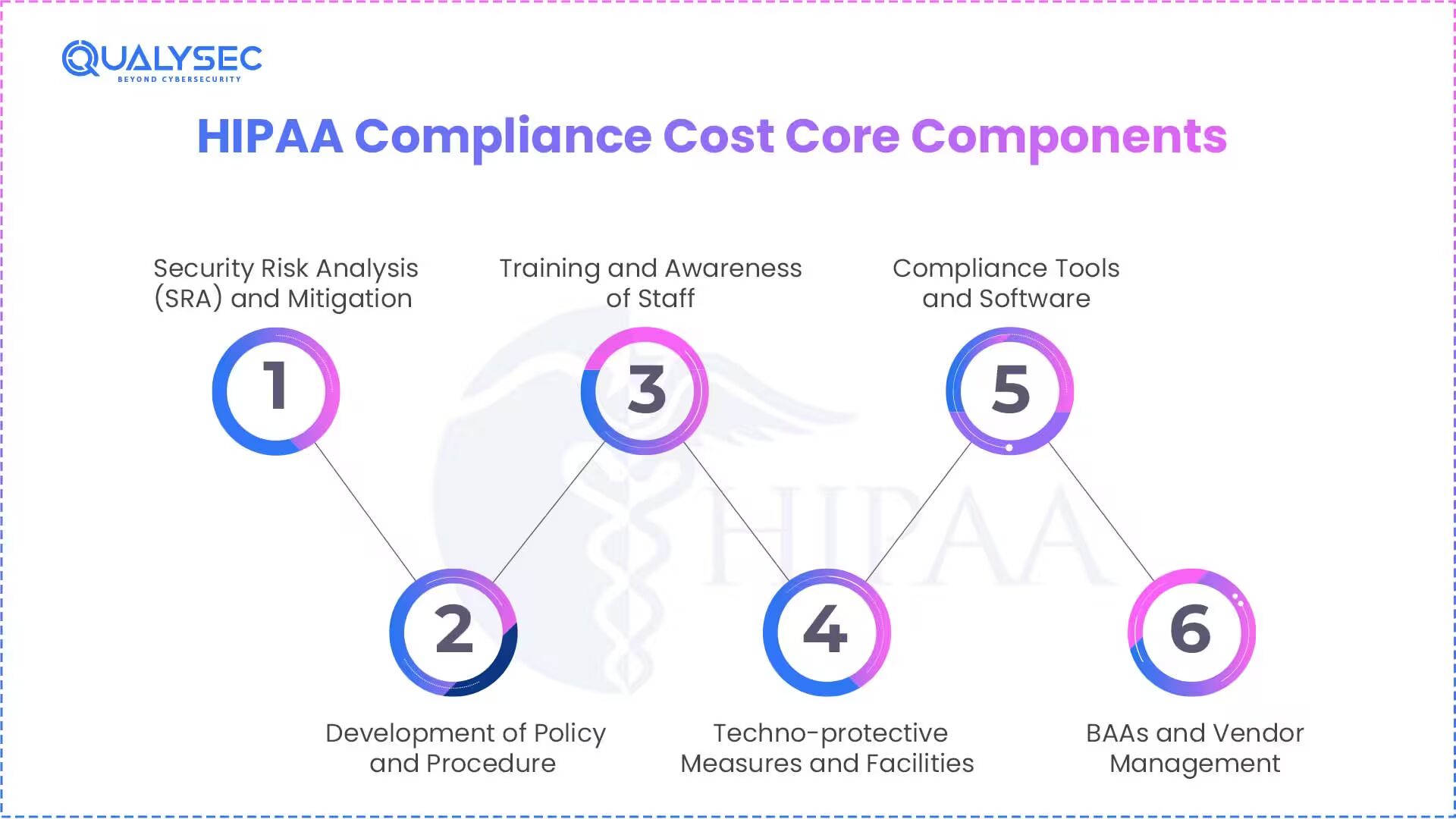
1. Security Risk Analysis (SRA) and Mitigation
Approximate cost – $5,000-$15,000 for small-to-mid organizations, and up to $85,000+ for complex environments, depending on system complexity and remediation scope.
Why it is important: SRA is the basis of the HIPAA Security Rule. Incomplete or superficial SRAs are popular causes of OCR. Remediation (sealing holes discovered in the SRA) may cost thousands up to tens of thousands, particularly when there are legacy systems, EHRs hosted in the cloud, or third-party applications.
2. Development of Policy and Procedure
Average cost: $3,000-$12,000 initial development, with $2,000–$8,000 annually for updates and compliance maintenance.
What this means: Policies, SOPs, forms, and workflows that are congruent with OCR expectations and state-specific privacy laws.
3. Training and Awareness of Staff
Average cost: $20-$50 per employee annually, typically $500–$3,000/year for small practices, depending on workforce size.
Emphasis areas in 2026: phishing, mobile-device usage, cloud applications (e.g., ChatGPT-like applications), and BYOD policies.
Pro Tip 2:
Document all training sessions (date, topics, attendees) and archive them in a central, versioned repository.
4. Techno-protective Measures and Facilities
These are encryption, access controls, network segmentation, logging and endpoint protection. Examples of line-items in 2026 include:
- Encryption (data at rest / in transit): $2,000–$15,000 implementation cost, depending on EHR integration and cloud hosting.
- Access controls/MFA: $1,000–$8,000 annually for identity-management tools and configuration.
- Security monitoring and incident response: 24/7 log review and SOC-like support costs between $1,500 and $6,000 per month, depending on monitoring scope.
5. Compliance Tools and Software
Independent DIY tools: Around $499–$4,000 per year for small practices, with $3,000–$8,000 annually for mid-size healthcare organizations.
6. BAAs and Vendor Management
Average cost: $500-2000 a month to track and manage Business Associate Agreements and vendor-risk assessments.
2026 focus: OCR is taking a closer look at third-party information access to PHI, such as cloud storage, email, and AI-based applications.
Enhance the Security Value using Compliance Support by Qualysec Technologies
The financial landscape of HIPAA compliance in 2026 implies that it is no longer possible to go through checkbox exercises but rather implement a risk management strategy. In an attempt to control these dynamic costs, Qualysec Technologies provides three-layered defense services that aim at technical security by providing a highly focused and human-centred approach.
Human-Led, AI-Powered Approach
The reduction of the long-term costs of compliance can be achieved by minimizing security noise, one way. Qualysec uses a hybrid human-led, AI-powered testing model. This approach goes beyond automated scanners that often generate false positives and consume valuable internal resources.
2026 Standards
With the increase in the complexity of reporting requirements, Qualysec recommends that you consider incorporating more developed technical documentation in your annual audit process. Their methodology can give:
- Threat Modelling – A best practice that can be proposed to detect certain points of entry into healthcare networks before they are attacked.
- Vulnerability Exploitability eXchange (VEX) – This may assist in understanding which vulnerabilities are really a risk in the real world, and more resources can be allocated more efficiently.
- Detailed Pentest Reports – Detailed documentation that can be taken as a strong piece of evidence in the case of internal and external reviews.
Download a Sample Pentest Report for Free.
Digital Health Scalable Security.
In the case of organizations overseeing telehealth platforms or cloud-based EHRs, Qualysec is scalable for testing solutions. Their services adapt to the complexity of your digital infrastructure. This proactive approach helps healthcare providers reduce reactive spending and build a stronger, validated security posture.
Reduce Compliance Costs with Qualysec.
Conclusion
HIPAA compliance cost is a required, quantifiable aspect of operating a healthcare organization in the U.S., with typical ranges of approximately $25,000 to more than $250,000 annually, representing size, complexity, and the extent to which a practice is investing in preventive measures, as opposed to merely responding to incidents.
Organizations can convert HIPAA compliance costs into a strategic investment that reduces the risk of breach, eliminates the high OCR fines, and enhances trust in patients by breaking down the expenses into SRA, policies, training, tools, and special testing providers like Qualysec Technologies.
To enhance your HIPAA compliance cost roadmap in 2026, reach out to Qualysec Technologies and discover how validated, procedure-based testing can optimize your compliance program and keep your long-term expenses in check.
FAQs
Q.Are you required to pay HIPAA?
No, the HIPAA itself does not imply that organizations pay a fee to the government, as there is no formal HIPAA certification provided by regulators. However, medical facilities generally invest in compliance measures, including risk assessment, employee education, policy formulation, security measures, and continuous monitoring.
Q.How much money can a HIPAA fine cost?
Penalties may be hefty based on negligence and the severity of the HIPAA violation. The U.S. Department of Health and Human Services imposes fines of a maximum of hundreds to tens of thousands of dollars per violation and the maximum annual fines of about 2.07 million dollars per violation classification (adjusted up or down annually due to inflation). Organizations may also face corrective action plans, audits, and reputation damage in addition to fines, making proactive HIPAA compliance more cost-effective.
Q.What are the 5 main HIPAA rules?
The 5 major HIPAA regulations are –
- Privacy Rule, which safeguards patient data
- Security Rule, which encompasses technical and administrative controls
- Breach Notification Rule, which compels the reporting of data breaches
- Enforcement Rule, which defines investigations and punishments
- Omnibus Rule, which extends compliance to business partners.
The U.S. Department of Health and Human Services states that the combination of these rules regulates the protection and management of the protected health information.
information by healthcare organizations.
Q.How much does a HIPAA certificate cost?
Businesses often include HIPAA certification in compliance programs that cover audits, remediation planning, and workforce training, with costs varying by scope and organization size. Thus, the HIPAA certification of organizations usually costs tens of thousands up to more than $120,000 based on the complexity of the infrastructure, the depth of the audit, and the need to maintain compliance.
Q.How long is a HIPAA valid for?
HIPAA compliance is not out of date since it is an ongoing regulation. Companies need to have protective measures in place, renew policies, conduct regular risk analysis, and offer continuous workforce education. U.S. Department of Health and Human Services suggests that reviews and updates should be consistent as technology, workflow, and cybersecurity threats change over time. This leads to a situation where healthcare organizations usually regard HIPAA compliance as a program and not a certification.