

The adoption of cloud platforms is rapidly accelerating. Cloud platforms such as Google Cloud Platform (GCP) provide unmatched scale, agility, and cost-effectiveness. However, with this transition to the cloud, there are new security challenges that companies will now experience, especially around GCP Network Security.
Earlier, organizations used to have complete control of their physical infrastructure, and only used firewalls and access controls to provide their first line of defense. Cloud environments have a shared responsibility model, meaning that while the cloud service provider (CSP) assures Google Cloud network protection of the physical infrastructure, the organization is now responsible for securing its data and applications within the cloud environment.
Understanding Google Cloud Platform & GCP Network Security
GCP refers to Google Cloud Platform. It’s a group of cloud computing services from Google. This means you can rent access to computers, storage, databases, and many more resources that are stored in data centers all over the world instead of having to have your physical computers and servers. You can access all of this over the internet and only pay for what you use. GCP Network Security is essential for keeping your data and workloads safe in the cloud.
It has many services, including:
- Compute: Virtual machines, orchestration of containers, serverless computing
- Storage: Object storage, block storage, file storage
- Databases: Relational databases, NoSQL databases
- Machine learning: Tools to build and train machine learning models
- Networking: Content delivery networks, virtual private clouds
- Big data: Tools to store and analyze massive data sets
GCP is a good choice for any scale business because it’s scalable, secure, and cost-effective. GCP has also been considered developer-friendly and has a large set of open-source tools and technologies.
What is GCP Pentesting?
Penetration testing, often called pentesting, is a simulated cyberattack on a specific computer, system, or network. This generally means a security professional uses a combination of tools and techniques to find loopholes that a cybercriminal could exploit.
GCP pentesting, more specifically, is finding vulnerabilities in your cloud environment on Google Cloud Platform (GCP). This can include misconfigurations in GCP-hosted services, vulnerabilities in the application you have deployed, and possible access control issues.
Why Does GCP Pentesting Matter?
Let’s understand why GCP pentesting matters:
- Unmasked Hidden Vulnerabilities: Regular pentests on GCP serve as a proactive measure to expose any configuration, access control, or resource assignment errors. These vulnerabilities might be ignored or even exploited by hostile cybercriminals, which would cause data loss and service disruptions.
- Improve security stance: Any pentesting exercise offers insightful analysis of the overall security of your GCP setup. A pentest reveals where access rights may be tweaked, security controls may be strengthened, and best practices could be applied.
- Assess Security Investment: Organizations spend a lot of money on security tools and personnel. A pentest can help determine how effective your security investment is. A pentest highlights where you may need to implement additional security tools, but most importantly, it helps identify where your current security investment is not generating a return on investment.
- Compliance Advantage: Many industries have strict governance and compliance requirements for data security. Regular pentesting of your GCP network indicates you are diligently searching for security risks and remediating them. This proactive approach helps during audits and allows organizations to avoid excessive fines.
- Elevate Confidence & Peace of Mind: Knowing that your GCP environment has undergone testing by security experts provides peace of mind. Pentesting positions you to confidently fight against evolving threats, while also maintaining a sound security posture.
- Continuous Growth: Conducting GCP pentesting regularly means you can find vulnerabilities and address them as they emerge. This contributes to an ongoing growing cycle of vulnerability assessment and remediation that keeps your security posture sound and appears to evolve along with evolving cyber threats.
The GCP Penetration Testing Methodology
A complete GCP penetration testing methodology is carried out in phases.
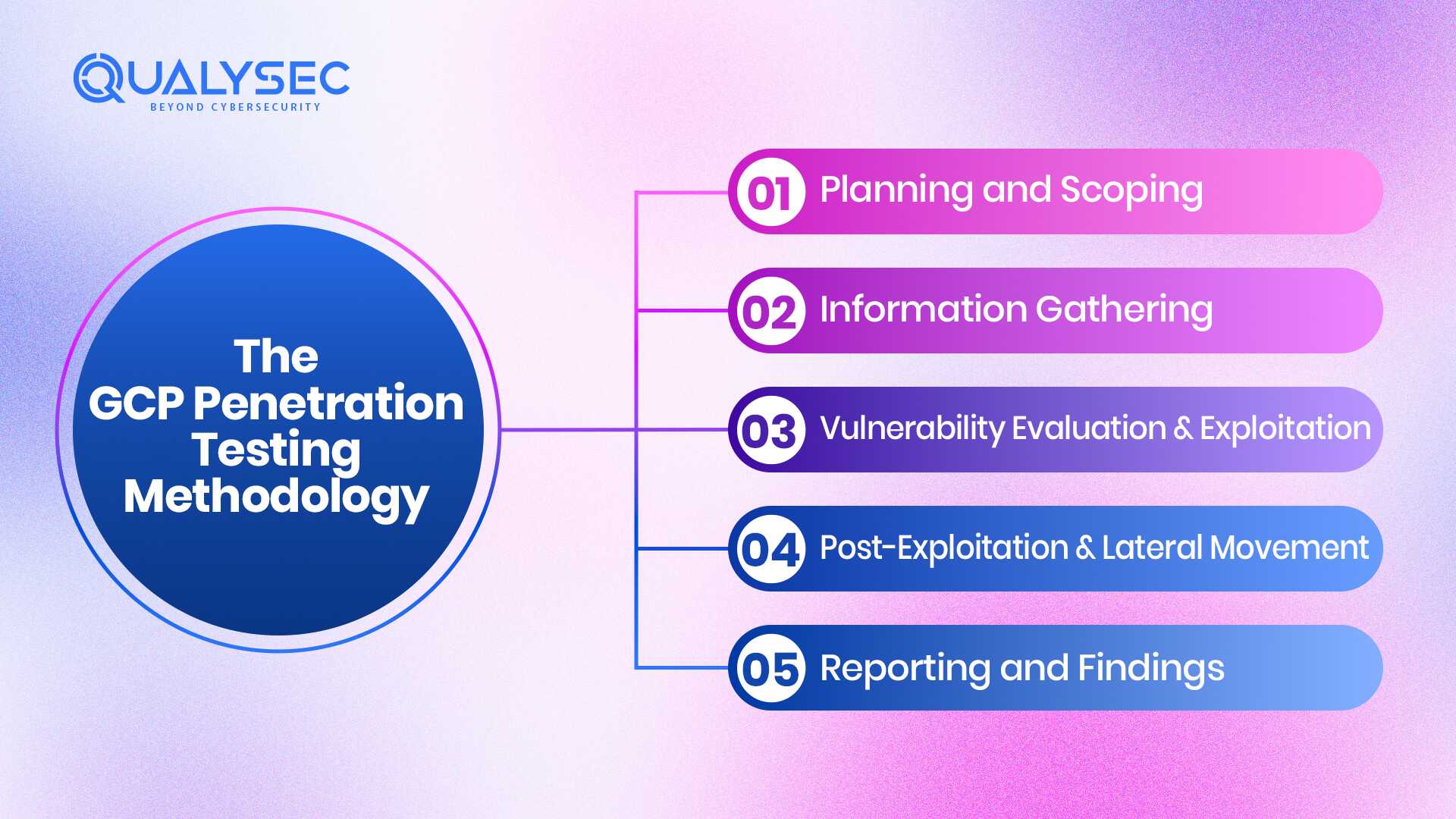
- Planning and Scoping: During this stage of the project, the tester determines the attack surface by outlining goals, objectives, and strategies while also securing appropriate authorization and agreeing on scope, which is crucial to prevent unintended consequences.
- Information Gathering: In this phase, the tester compiles thorough intelligence on your GCP environment and finds the tools, services, IAM configuration, and possible attack entry points.
- Vulnerability Evaluation and Exploitation: Here, the testers search your GCP environment for vulnerabilities using a mix of automated tools and hands-on methods. This involves gaining access to a poorly protected bucket through misconfiguration, identifying vulnerabilities in IAM policies, and testing for Cloud-specific vulnerabilities (e.g., SSRF, RCE, etc.).
- Post-Exploitation and Lateral Movement: After a vulnerability is found, testers attempt to delve deeper into the attack to better assess the impact. The extent to which testing might include elevating privileges, moving sideways in the GCP environment, or compromising sensitive data.
- Reporting and Findings: After the testing is complete, it is reported with a vulnerability report that includes a summary of vulnerabilities found, their severity, and their implications. The report will also show your security team the vulnerabilities located for remediation.
Traditional Penetration Testing vs. GCP Penetration Testing
As your business moves toward the cloud, particularly on Google Cloud Platform (GCP), the traditional penetration testing technique will have to be changed to adequately assess your security posture. The table below emphasizes the major contrasts between GCP pentesting and the traditional pentesting methods:
| Feature | Traditional Pentesting | GCP Pentesting |
| Target Environment | On-premise infrastructure (servers, networks) | Cloud infrastructure (VMs, storage, services) |
| Shared Responsibility | Limited – Security of underlying infrastructure falls on the organization | Shared – Google manages platform security; organization secures configurations and data |
| Attacker Perspective | Internal network attacker | External attacker or compromised insider |
| Testing Focus | Network vulnerabilities, server misconfigurations, and application security | Cloud-specific configurations, IAM permissions, service misconfigurations, and API security |
| Tools & Techniques | Network scanners, vulnerability scanners, web application security scanners | Cloud security scanners, IAM privilege escalation tools, cloud service exploitation tools |
| Deliverables | Reports on network and application vulnerabilities | Reports on cloud misconfigurations, insecure IAM policies, and exploitable service settings |
Here is a closer look at the major differences between the pentesting approaches:
1. Target Environment:
Traditional pentesting is focused on the physical hardware and software within your organization’s network. GCP pentesting targets cloud resources, for example, virtual machines, storage buckets, and GCP services.
2. Shared Responsibility:
Traditional security is 100% your responsibility. GCP security involves Google being responsible for securing the infrastructure and being responsible for securing managed resources only. GCP penetration testing identifies vulnerabilities arising from this shared responsibility approach.
3. Attacker Perspective:
Traditional pentesting focuses only on internal network attackers. Whereas GCP pentesting focuses on attackers and compromised insiders, all with limited access inside a cloud environment.
4. Testing Focus:
Traditional pentesting focuses only on what we already know well in terms of traditional network security and application vulnerabilities. When performing GCP pentesting, you will get deeper exposure to cloud-specific configurations and IAM, which provides access control and potential misconfiguration of GCP services and APIs.
5. Tools & Techniques:
Traditional pentesting uses traditional tools for network scanning, vulnerability scanning, and web application security testing. GCP pentesting uses these tools as well as a handful of additional tools that are pertinent to cloud security scanning. This includes IAM privilege escalation tools and tools that exploit misconfigurations in GCP services.
6. Deliverables:
Traditional pentesting reports result in reports of vulnerabilities in applications and networks. GCP pentesting reports will identify anything misconfigured in your cloud environment that an exploit could take advantage of. These could be any insecure IAM policy, permissive access, or exploitable settings within GCP services.
Uncover Hidden Vulnerabilities in Your Google Cloud Setup – Get Started with Qualysec’s Proven GCP Pen Testing Services.
Common Attack Vectors for Google Cloud Platform
Here are some of the common attack vectors for Google Cloud Platform:
- Compromised Credentials: This is a classic attack technique. Attackers can compromise access credentials (username and password) via phishing emails, malware, or brute-forcing. Then they impersonate legitimate users and access GCP resources.
- Exploiting Weak Cloud IAM Policies: Identity and Access Management (IAM) manages who can access resources in GCP and what they can do there. Weak IAM policies can allow attackers to gain resources in your configuration since they allow too permissive access or weakly configured roles.
- Insecure Cloud Storage buckets: GCP incorporates storage as part of the cloud service, with buckets for nanosecond storage of data. But attackers can locate and retrieve sensitive information or distribute harmful content if these buckets have poor access restrictions or are left open to the world.
- Vulnerable Compute Instances: Compute instances (virtual machines) should have well-defined patching procedures in their security plans. If a compute instance is vulnerable, misconfigured, or has not been patched, hackers can use these vulnerabilities to get access to the instance or to get more general access in the GCP environment.
- Unintentional Misconfiguration: Cloud environments are complex. Misconfiguration is one of the biggest security risks. Attackers can take advantage of configuration mistakes like exposed services or unintended permissions.
- Supply Chain Attacks: GCP services can be a target for supply chain attacks to gain access to other services or software that GCP integrates with.
Essential GCP Network Security Best Practices to Reduce Cloud Risks
It does not just need default protections to secure a Google Cloud environment. GCP network security should be created with the purpose of minimizing exposure, limiting lateral movement, and be visible as cloud environments grow. The subsequent best practices serve as the solution to the most popular network security holes commonly used by attackers in GCP.
Design Isolated and Segmented VPC Architectures
Avoid flat network designs. Divide the workloads into various VPCs, subnets, and projects depending on the environment and risk level. By decoupling the production environment, staging environment, and development environment, the blast radius can be lessened when one of the resources is infected.
Use:
- Isolated VPNs of priority workloads.
- Separate subnets of sensitive services.
- Managed VPC peering as opposed to wide access to the network.
Enforce Least Privilege with IAM and Network Controls
One of the greatest security risks of GCP is identity misconfiguration. The permissions given to IAM and access to the network should be strict.
Best practices include:
- Minimal IAM roles, which are assigned in lieu of primitive roles.
- Limiting the access of service accounts and key rotation.
- Associate network access policies with an identity, rather than an IP range.
This will restrict harm even in case credentials are leaked.
Harden Firewall Rules and Default Network Policies
Rules of the firewall must be clear and restrictive. Keep ingress or egress rules wider than they have to be.
Key practices:
- Block everything by default, and only the necessary ports and protocols.
- Firewall scope to specific service accounts or tags.
- Periodically scan firewall rules and delete entries in use.
Firewall hygiene will decrease the inappropriate access routes directly.
Protect Cloud APIs and Service Endpoints
GCPs are very dependent on APIs. Most APIs that are unprotected or excessively liberalized are the likely entry points of attackers.
To reduce API risk:
- Authenticate and authorize any API.
- Rate-limit API Gateway / Cloud Endpoints.
- Keep track of API usage trends and anomalies.
API security is also needed so that there should be no abuse and exposure of data.
Secure Traffic with Private Connectivity
The attack surface is raised due to exposure to the public. As much as feasible, maintain traffic privacy in GCP.
Recommended controls:
- Internal workloads should be done via Private Google Access.
- Enable VPC Service Controls to eliminate data exfiltration.
- Use internal load balancers to back-end services.
Privacy connectivity eliminates the use of the open internet.
Enable Centralized Logging and Network Monitoring
This is essential to early detection of attacks. GCP network security relies on the constant surveillance of all environments.
Ensure:
- Traffic analysis is turned on with the VPC Flow Logs.
- Network and IAM events are recorded on Cloud Logging and Monitoring.
- Suspicious access patterns are set up in alerts.
Attackers take long periods to be detected without centralized logging.
Secure Hybrid and Multi-Cloud Connections
Hybrid GCP environments are operated by many organizations. Both cloud systems and on-prem can be vulnerable to weak interconnect security.
Best practices include:
- Coding VPN and interconnect traffic.
- Minimizing the routing between environments.
- Controlling cross-environment access.
Hybrid security breaches are also often used in lateral movement.
Validate Security Through Regular Testing
It is not just required to be configured. There must be constant validation so that controls can be working as planned.
This includes:
- Checking changes in IAM and firewalls periodically.
- Checking the efficiency of network segmentation.
- Exploitable paths by conducting GCP-specific penetration testing.
Periodic testing maintains network security at an appropriate level with the changes in the environment.
Qualysec GCP Penetration Testing
When you’re serious about cloud security best practices for your business, Qualysec provides you with the best GCP penetration testing service available today. We provide an overall assessment of your GCP environment, identify vulnerabilities that you didn’t know you had, and provide assurance that your cloud security is not just a checklist that is checked off, but truly secure.
Our expert team examines each layer of the cloud infrastructure and Cloud-based application (cloud configuration, shared responsibility model, authentication settings, data storage, etc.) There is a difference between an automated scan and penetration testing, in that the manual exploitation techniques leveraged in a penetration test seek vulnerabilities and misconfigurations that could be exploited, whereas an automated scan simply cannot find them.
By conducting the Google Cloud penetration test and identifying those weaknesses, we allow you to fix them prior to an adversary being able to leverage them in an attack. We provide actionable recommendations that are contextualized and actionable to improve your GCP security posture. In doing so, you protect your assets, but you’re also protecting your brand.
Qualysec GCP penetration testing is a great fit for organizations that:
- Process sensitive data in the cloud
- Must comply with exacting regulations
- Have complicated GCP environments
We utilize a structured approach that follows industry best practices to deliver a thorough report of the vulnerabilities we identified, what impact they may have, and a prioritized list of recommendations for remediation to empower your internal security teams to tackle the most critical issues first.
Proactive detection and correction of vulnerabilities lowers the likelihood of a data breach, service interruption, or reputational damage.
Conclusion
Knowing how your Google Cloud network protection is organized, using the built-in features like firewall rules, and acting proactively can all help you to protect it. GCP can act as a safe, expandable, and strong cloud platform if you abide by top standards. GCP Network Security plays a key role in this protection.
Protect Your GCP Infrastructure Today – Schedule a Free Security Consultation with Qualysec’s Cloud Penetration Testing Experts.
FAQ
1. What is nеtwork sеcurity in thе contеxt of Googlе Cloud?
Nеtwork Sеcurity in Googlе Cloud еncompassеs tools, policiеs, and configurations to protеct rеsourcеs on thе cloud from unauthorizеd accеss, data brеachеs, and othеr sеcurity thrеats associatеd with thе nеtwork.
2. How can I protеct my cloud nеtwork on GCP?
On GCP, you can usе VPCs, Firеwall rulеs, Idеntity and Accеss Managеmеnt (IAM), еncryption, and frеquеnt monitoring with Cloud Logging and Monitoring to hеlp sеcurе your cloud nеtwork.
3. What arе common nеtwork sеcurity thrеats in GCP?
Common еxamplеs of thrеats to nеtwork sеcurity in GCP includе DDoS attacks, wrong firеwall rulеs, unauthorizеd accеss, vulnеrablе APIs, phishing, and data lеakagеs coming from wеak idеntity and accеss managеmеnt policiеs.
4. How do GCP firewall rules enhance network security?
GCP firewall and security controls manage virtual machine inbound and outgoing traffic by letting you choose whether to allow or deny traffic based on IP addresses, protocols, and ports, therefore reducing your possible exposure to risk
5. What strategies improve cloud network security on Google Cloud?
Improved Cloud network security strategies can be achieved by adhering to least privilege access principles, utilizing private IPs, turning on VPC Service Controls, designing unique IAM roles, encrypting data in transit and at rest, and using security best practices.