

Key Takeaways
- UAE PDPL is the UAE’s federal data privacy law that governs how organisations collect, process, store, transfer, and protect personal data.
- The law applies to businesses inside and outside the UAE if they process the personal data of UAE residents.
- Non-compliance can lead to administrative fines of up to AED 5 million, along with potential business restrictions.
- Compliance goes beyond privacy policies—it requires strong cybersecurity controls, risk assessments, secure cross-border data transfers, and effective breach response mechanisms.
- This guide explains the UAE PDPL requirements, compliance checklist, best practices, common challenges, and the role of cybersecurity in achieving compliance.
Introduction
Imagine starting your workday with an official notice from the UAE Data Office stating that your organisation has failed to process personal data in accordance with the UAE Personal Data Protection Law (PDPL). All of a sudden, customer trust, business contracts, and your company’s reputation are all at risk.
If this feels like an imaginary scenario, it may be closer than you think. Every day, organisations are collecting and processing vast amounts of personal data. As the volume of personal data is growing, so is the responsibility to protect it. Data speaks the reality: the UAE Cyber Security Council reported blocking 200,000-800,000 attempted cyberattacks daily in 2025. Businesses can no longer treat data protection as just an IT responsibility; it has become a legal, operational, and business-critical obligation. To address these risks, the UAE introduced the Personal Data Protection Law (Federal Decree-Law No. 45 of 2021) to regulate how organisations will handle personal data of individuals residing within or outside the UAE. Non-compliance with the UAE PDPL can attract penalties of up to AED 5 million.
If you are not sure whether your organisation is fully compliant with the UAE PDPL, this guide is for you. It explains who the law applies to, the key compliance requirements, common challenges businesses face, and the role of cybersecurity in protecting personal data.
What is the UAE Personal Data Protection Law (PDPL)?
The UAE Personal Data Protection Law (PDPL), Federal Decree-Law No. 45 of 2021, is a federal law that regulates how organisations (both public and private) collect, process, store, and share personal data. UAE PDPL officially came into effect on 02.01. 2022 after its initial issuance in September 2021.
Definition of Personal Data under UAE PDPL
As per Article 1 of Federal Decree by Law No. (45) of 2021, personal data means any data relating to a natural person that can identify the person directly or indirectly, through information including:
- Name
- Voice
- Image/Photograph
- Identification Number
- Electronic Identifier (e.g., email or online ID)
- Geographical Location
- Physical Characteristics
- Physiological Characteristics
- Economic Characteristics
- Cultural Characteristics
- Social Characteristics
It also includes:
- Sensitive Personal Data
- Biometric Data
Why UAE PDPL Compliance Matters?
UAE PDPL is a mandatory federal law that protects personal information and consumer privacy. Whether your business operates in the UAE or processes the personal data of UAE residents from abroad, complying with the law is essential. Here’s why UAE PDPL compliance matters for your business:
- Avoid heavy penalties: Failing to comply with the requirements of UAE PDPL can cost your business fines up to AED 5 million, along with potential suspension of business operations.
- Comply with extraterritorial scope: You don’t need to have a physical office in Dubai or Abu Dhabi for the law to apply. If your business is located anywhere in the world but processes personal data which belongs to UAE residents, you are legally bound by the UAE PDPL.
- Secure global business reputation: Multinational companies and enterprise clients now require proof of data privacy compliance before signing any contracts or sharing any customer databases. Non-compliance with the UAE PDPL can show that your company is not following or taking suitable measures to protect personal data.
- Build customer trust: Not only organisations, but individuals are far more aware of data protection. They are taking extra care in protecting their privacy and personal rights. By following the UAE PDPL, you show that you/your organisation handle personal data responsibly and keep it secure. This helps build long-term relationships with customers and provides a competitive edge.
Who Must Comply with UAE PDPL?
The UAE Personal Data Protection Law (PDPL) has a broad scope and applies to organisations based both inside and outside the UAE.
As per Article 2 (1) of Federal Decree by Law No. (45) of 2021, you must comply with the UAE PDPL if you are:
- An organisation or individual established in the UAE that processes the personal data of people inside or outside the country.
- A data controller or data processor located outside the UAE if you process the personal data of individuals residing in the UAE. This gives the law extraterritorial applicability, similar to other global privacy regulations.
- A business that processes personal data using automated electronic systems or other processing methods, whether the processing is carried out wholly or partly by automated means.
Who Is Exempt from UAE PDPL?
Article 2 (2 ) of Federal Decree by Law No. (45) of 2021 explicitly excludes the following from its scope:
- Government data managed by UAE government authorities.
- Government entities that control or process personal data.
- Personal data held by security and judicial authorities.
- Individuals processing personal data solely for personal or household purposes.
- Personal health data that is governed by separate healthcare privacy legislation.
- Personal banking, financial, and credit data that is regulated under specific financial sector laws.
- Organisations operating in UAE free zones that already have their own comprehensive data protection regulations.
Looking for a Compliance security audit? Talk to an UAE PDPL compliance expert.
Key Requirements of UAE PDPL Compliance
UAE PDPL sets up a comprehensive, federal framework for data privacy, which includes:
Establishing lawful basis for obtaining personal information
Under Article 4, eligible entities must obtain consent to process personal data; without explicit consent from the Data Subject, it is generally prohibited unless a statutory exception applies. Consent must be clear, unambiguous, freely given, and easily accessible. The law gives the individual the right to withdraw consent to the processing of personal information at any time, without affecting prior lawful processing.
Statutory Exceptions:
Processing without consent is permitted only under specific legal conditions, including performance of a contract, public health protection, legal defence claims, or compliance with statutory duties.
Adopting processing principles
Article 5 of the UAE PDPL establishes the core principles that organisations must follow when collecting, using, storing, or sharing personal data.
- Fairness and transparency: Personal data must be processed lawfully, fairly, and transparently. Organisations should clearly inform individuals about why their data is being collected, how it will be used, and with whom it may be shared.
- Purpose limitation: Data must be collected for a clear, explicit purpose and cannot be repurposed for reasons that are not mentioned.
- Data minimisation: Organisations can only collect the “exact amount” of personal data necessary to achieve the stated purpose.
- Information must be accurate: The stored information must be accurate, kept up-to-date, and deleted or anonymised once the purpose for which information was taken is completed.
Mandatorily appoint a Data Protection Officer (DPO)
Article 10 of the UAE PDPL requires certain organisations acting as Data Controllers or Data Processors to appoint a Data Protection Officer (DPO). A DPO can be an internal employee of the company, or an external provider located inside or outside the UAE.
DPO is generally required if your organisation:
- Conducts systematic and large-scale profiling of individuals.
- Uses new or emerging technologies that may significantly impact privacy.
- Processes large volumes of sensitive personal data or biometric data.
- Performs processing activities that present a high risk to the confidentiality or privacy of personal data.
The DPO serves as the primary point of contact between the organisation and the UAE Data Office. They have to ensure compliance with privacy laws, advise on privacy obligations, and oversee data protection practices, etc.
Comply with cross-border data transfer requirements.
Articles 22 and 23 of the UAE PDPL regulate the transfer of personal data outside the UAE. The transfer mechanism is:
| Scenario | Requirement |
| Transfer to an adequate jurisdiction | Personal data may be transferred to countries or regions recognised by the UAE Data Office. |
| Transfer to a non-adequate jurisdiction | Transfers are permitted if appropriate contractual or legal safeguards are implemented to ensure protection equivalent to the UAE PDPL. |
| Explicit consent | Transfers may proceed when the data subject provides explicit consent, provided that the data transfer does not conflict with UAE laws or national security requirements. |
| Contractual necessity | Personal data may be transferred if necessary to perform or fulfil a contract involving the data subject. Nothing permitted elsewise. |
Maintain appropriate Record of Processing Activities (RoPA)
Articles 7 and 8 require both Controllers and Processors to maintain an up-to-date Record of Processing Activities (RoPA). The record must include the following:
- Contact details of the Controller, Processor, and DPO.
- Categories of personal data processed and types of authorised personnel.
- Processing purposes, storage limits, and retention periods.
- Documentation on cross-border data flows.
- Technical and organisational security measures implemented.
Personal Data Protection Impact Assessments (DPIA)
Under Article 21, Controllers must conduct a formal Data Protection Impact Assessment (DPIA) before carrying out processing activities that could pose significant privacy risks. A DPIA is generally required when:
- Introducing new or emerging technologies.
- Conducting systematic profiling or automated decision-making.
- Processing large volumes of sensitive personal or biometric data.
- Carrying out processing that may significantly affect individuals’ rights and freedoms.
Establish data breach reporting framework
Article 9 of the UAE PDPL requires organisations to respond ASAP to personal data breaches. For that, the organisations must:
- Notify regulator: Controllers must report data breaches to the UAE Data Office immediately upon becoming aware of the incident, including details on the breach’s nature, scope, potential risks, and corrective measures taken.
- Notify individual: If the breach poses a direct threat to the individual’s privacy or security, the Controller must notify the Data Subject without delay.
- Processor obligation: Processors who discover a breach must immediately notify the Controller

UAE PDPL Compliance Checklist
- Identify what personal data is collected, where it is stored, how it flows across systems, and who has access to it.
- Identify a lawful basis for processing for every data processing activity in accordance with Article 4.
- Maintain a Record of Processing Activities (RoPA) as required by Articles 7 and 8.
- Appoint a qualified Data Protection Officer (DPO) where required.
- Conduct Data Protection Impact Assessments (DPIAs) before initiating high-risk processing activities or deploying new technologies.
- Establish clear procedures for handling Data Subject Rights such as access, correction, erasure, restriction, objection, and data portability.
- Execute Data Processing Agreements (DPAs) with processors, cloud providers, and other third-party vendors.
- Assess cross-border data transfers and ensure they are supported by adequate legal safeguards, explicit consent, or other recognised transfer mechanisms under Articles 22 and 23.
- Develop and maintain a personal data breach response plan that enables timely reporting to the UAE Data Office.
- Review and update privacy policies, internal procedures, and compliance documentation regularly to ensure ongoing compliance with the UAE PDPL and reduce regulatory risk.
- Provide regular privacy awareness and compliance training so employees understand their responsibilities when they handle personal data.
The Role of Cybersecurity in UAE PDPL Compliance
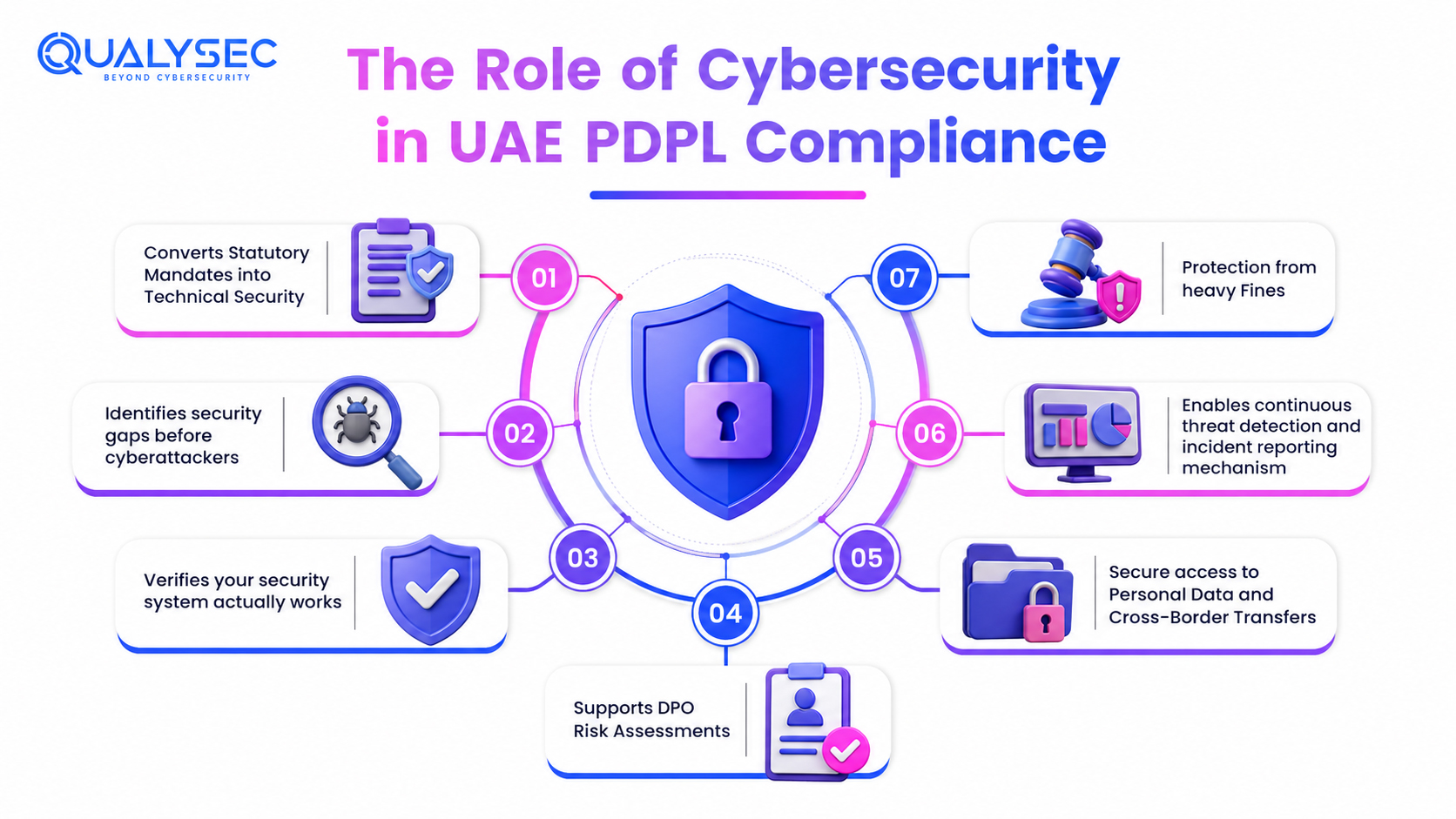
Legal disclaimers, privacy policies, and consent banners alone cannot stop cyberattacks or secure sensitive databases. Under the United Arab Emirates’ Personal Data Protection Law (Federal Decree-Law No. 45 of 2021), cybersecurity is an explicitly statutory obligation. The UAE PDPL enforces strict accountability for how organisations handle personal data.
Strong Cybersecurity in the company is your security backbone that continuously monitors the organisation’s systems and identity threats, and meets UAE PDPL expectations.
Here is how they help in complying with cybersecurity requirements of UAE PDPL:
Converts Statutory Mandates into Technical Security (Articles 5 & 20)
Article 5 lays down the core principles for processing personal data, while Article 20 requires Controllers and Processors to implement appropriate technical and organisational security measures. In practice, Cybersecurity satisfies this legal requirement by implementing End-to-End Encryption (E2EE) for data at rest and in transit, Pseudonymisation mechanisms to isolate sensitive identities, and strict access segmentation.
Identifies security gaps before cyberattackers
UAE data privacy law requires technical teams to continuously locate internal exposure points. Automated Vulnerability Assessments (VA) scans cloud databases, API endpoints, and internal servers by a recognised cybersecurity company help in uncovering missing patches, default configurations, and software vulnerabilities before threat actors can exploit them.
Verifies your security system actually works
The UAE Cyber Security Council reported blocking 200,000-800,000 attempted cyberattacks daily in 2025. A single unpatched vulnerability can expose sensitive personal data to attackers. This is why organisations should go beyond identifying vulnerabilities and verify whether their security controls can withstand real-world attacks. To identify and fix these weaknesses before they are exploited, cybersecurity professionals conduct Vulnerability Assessment and Penetration Testing (VAPT). During a VAPT, cybersecurity professionals assess APIs and network infrastructure to determine whether existing security controls can withstand cyber threats. Their findings provide audit-ready proof that your defence mechanisms comply with Article 20 security expectations.
Supports DPO Risk Assessments
Under Article 11 of the UAE PDPL, the Data Protection Officer (DPO) is responsible for evaluating the organisation’s data protection measures and monitoring compliance. Cybersecurity teams support the DPO by providing vulnerability assessment reports, penetration testing results, audit logs, and risk assessments. Before deploying high-risk technologies or introducing new processing activities, they also conduct Data Protection Impact Assessments (DPIAs) using practices such as SAST, DAST, and threat modelling to identify and mitigate security risks.
Secure access to Personal Data and Cross-Border Transfers
Protecting personal data does not mean secure security applications merely. Organisations must also control who can access data and ensure personal information is protected when shared with third parties. Cybersecurity professionals implement Identity and Access Management (IAM), Multi-Factor Authentication (MFA), and Zero Trust Network Access (ZTNA) to enforce least-privilege access. They also assess third-party vendors, secure APIs, and implement encryption to protect personal data during cross-border transfers.
Enable continuous threat detection and incident reporting mechanism
Cybersecurity professionals continuously monitor networks using Security Operations Centers (SOC), SIEM, and EDR solutions to detect suspicious activity and potential data breaches in real time. If any cyberattack or security breach incident occurs, incident response and digital forensics teams investigate the breach, determine its scope, preserve evidence, and help Controllers meet their obligation under Article 9 of the PDPL.
Protection from heavy Fines
Failure to comply with the UAE PDPL can result in administrative penalties of up to AED 5 million, along with potential business restrictions or suspensions. By implementing continuous vulnerability management, strong encryption, proactive threat monitoring, and an effective incident response process, organisations can show that they have taken appropriate measures to protect personal data.
UAE PDPL Technical Compliance Mapping
| PDPL Area | Statutory Requirement | Cybersecurity Implementation |
| Data Security (Articles 5 & 20) | Implement appropriate technical and organisational measures to protect personal data. | Encrypt data at rest and in transit, implement pseudonymisation, and enforce Identity and Access Management (IAM) and Zero Trust Network Access (ZTNA). |
| Data Breach Response (Article 9) | Report personal data breaches to the UAE Data Office and affected individuals, where required. | Continuously monitor systems using SOC, SIEM, and EDR, supported by an incident response plan and forensic logging. |
| DPO Oversight (Articles 10 & 11) | The DPO must oversee the organisation’s data protection measures and monitor compliance. | Conduct regular Vulnerability Assessment and Penetration Testing (VAPT), red teaming, security audits, and provide technical reports to support DPO reviews. |
| Data Protection Impact Assessments (Article 21) | Assess privacy risks before initiating high-risk processing activities or deploying new technologies. | Perform threat modelling, SAST, DAST, infrastructure configuration reviews, and API security testing before deployment. |
| Cross-Border Data Transfers (Articles 22 & 23) | Ensure adequate safeguards when transferring personal data outside the UAE. | Protect transferred data through encryption, secure cryptographic key management (HSMs), API security, and third-party vendor risk assessments. |
Common Challenges Businesses Face with UAE PDPL Compliance
Complying with the UAE PDPL is not just about obtaining user consent. Organisations often need to rethink how they collect, store, process, and protect personal data across their entire business. Here are a few challenges that organisations face while complying with the UAE PDPL:
Not understanding where the law applies
Many organisations face challenges in determining whether the UAE PDPL applies to their business, especially when operating across the federal UAE, DIFC, ADGM, or regulated sectors such as healthcare and banking. A company may correctly register its head office under the federal PDPL, then unknowingly onboard a vendor operating out of DIFC, where a completely different data protection law applies.
Not knowing where personal data is stored
Building an accurate Record of Processing Activities (RoPA) becomes difficult when personal data is scattered across legacy systems, cloud databases, employee devices, and third-party platforms. Organisations need to understand where their personal data is stored before implementing any measure.
Struggling to meet technical security controls
Organisations often face challenges securing cross-border data transfers, integrating Data Protection Impact Assessments (DPIAs) into new technologies and CI/CD pipelines, and implementing appropriate technical safeguards to protect personal data.
Securing cross-border data transfer
A business assumes its third party’s global infrastructure automatically satisfies UAE PDPL transfer requirements. No, that’s not true. The provider’s standard data processing agreement could be drafted for GDPR and never addresses Articles 22–23 at all.
Challenges in managing data subject rights
Many Organizations often face challenges operationalising high volumes of data subject requests for access, correction, erasure, and data portability under Articles 13–18 of PDPL. For example, an access request can come to retrieve a customer’s data. Still, the same data can be in a support-ticket system, an email marketing tool, and a call-recording archive – none of which are connected, wasting a lot of time and manual system search.
Integrating privacy into software
Organisations often face challenges embedding Data Protection Impact Assessments (DPIAs) required under Article 21 into agile software development, CI/CD pipelines, and AI feature deployment without potential delays.
Best Practices for Achieving UAE PDPL Compliance
The first step is understanding which privacy regulations apply to your organisation. Businesses should check whether they fall under the federal UAE PDPL, the privacy frameworks of DIFC or ADGM, or sector-specific regulations for industries such as healthcare and banking. Once you know which law is applicable and security requirements are clear, security teams should use automated data discovery tools to identify personal data across cloud databases, legacy systems, and employee devices.
Once you know where the data is, the next step is to protect it. Organisations should implement technical safeguards such as end-to-end encryption, pseudonymisation, and Zero Trust access controls to meet the security requirements of Articles 5 and 20. For organisations transferring personal data outside the UAE, it is crucial to assess third-party vendors and have NDAs to ensure cross-border data transfers comply with Articles 22 and 23.
Privacy should be integrated into daily business processes rather than treated as a one-time compliance exercise. Organisations can streamline compliance by incorporating Data Protection Impact Assessments (DPIAs) into their software development lifecycle and integrating SAST and DAST into CI/CD pipelines to identify security vulnerabilities before deployment.
How Qualysec Helps Businesses Achieve UAE PDPL Compliance
Achieving UAE PDPL compliance requires more than preparing legal documents. Companies should have robust cybersecurity measures in place to protect personal information, detect potential risks, and prove compliance during audits. Qualysec supports businesses in building a robust security posture by providing thorough security assessments that match the technical requirements of UAE PDPL.
Qualysec adopts a three-pronged security testing strategy, using automation, AI-powered analysis, and human intelligence to uncover potential security vulnerabilities more effectively.
Layer 1: Automated security scanning
Automated vulnerability scanners scan apps, cloud resources, networks, and APIs for known vulnerabilities, insecure configurations, and outdated software that may be exposing personal data including Automated vulnerability scanners scan apps, cloud resources, networks, and APIs for known vulnerabilities, insecure configurations, and outdated software that may be exposing personal data.
Layer 2: AI-Assisted Security Analysis
Complex attack paths, risky data flows, and application logic issues can be identified through AI-powered analysis. For example, a login flow where password-reset tokens don’t expire
This provides deeper insights into security threats and supports organisations during Data Protection Impact Assessments (DPIAs).
Layer 3: Human-Led Penetration Testing
Automated results are confirmed by Vulnerability Assessment and Penetration Testing (VAPT) services done by experienced security experts. They emulate actual attack methods to expose advanced and business logic vulnerabilities that automated tools might not find.
In this way, Qualysec supports organisations:
-
- Conduct Vulnerability Assessment and Penetration Testing (VAPT) to discover issues such as broken access controls, insecure API endpoints, and weak encryption implementations that could expose personal data.
- Provide technical reports for DPOs that map each finding to the specific PDPL article it affects, with a severity rating and a remediation timeline rather than a generic pass/fail summary.
- Strengthen Data Protection Impact Assessments (DPIAs) with application and infrastructure testing that checks how personal data flows through a new feature before it goes live – not just after.
- Secure cloud environments, web applications, APIs, mobile applications and network infrastructure against the specific misconfigurations (open storage, weak IAM policies, unpatched dependencies) that most commonly lead to personal data exposure.
- Help in preparing for UAE PDPL audits with documentation that traces each security control back to the article it satisfies, so a DPO can respond to a Data Office inquiry without assembling evidence from scratch.

Conclusion
UAE PDPL compliance is a continuous journey involving legal requirements and robust technical security measures. However, privacy policies, consent management, and governance frameworks are not enough; organisations need to take appropriate cybersecurity measures to protect personal information and minimise the chances of data breaches.
Through ongoing monitoring and secure access controls, as well as regular Vulnerability Assessment and Penetration Testing (VAPT), organisations can ensure compliance with the UAE PDPL’s guidelines, boost customer confidence, and minimise regulatory risks.
Frequently Asked Questions (FAQs)
1. What is the UAE PDPL?
The UAE Personal Data Protection Law (PDPL) is the country’s federal privacy law that protects the personal information of UAE residents residing inside and outside the UAE. It regulates how organisations collect, process, store, transfer, and protect individuals’ personal data in the UAE.
2. Which businesses must comply with the UAE PDPL?
The law applies to organisations established in the UAE that process personal data, as well as organisations outside the UAE that process the personal data of individuals residing in the UAE.
3. What are the penalties for non-compliance with UAE data laws?
Organisations that fail to comply with the UAE PDPL may face regulatory action, including administrative fines of up to AED 5 million, depending on the nature of the violation, along with other enforcement measures permitted under the law.