

In today’s rapidly evolving software world, you cannot put off security checks until the last minute. Your software is updated and released too quickly to rely on manual testing. DAST scanning Automation allows you to find and fix security vulnerabilities in your applications before hackers get a chance to exploit them. It provides a reasonable strategy for maintaining security in modern development without slowing down your release pace.
What is DAST scanning automation?
DAST scanning automation is the process of automating scan running and dynamic application security tests in your software development lifecycle. Rather than launching scans manually and relying on a human to remember, this process involves embedding the scanning into pipelines, so that you run scans in a coordinated manner automatically based on timing– such as when a new build is released to a test environment. Automating the process will ensure security consistently occurs when the scan is scheduled without relying on people to remember.
How does Dynamic Application Security Testing (DAST) work?
DAST tools evaluate an application from the outside in a way that closely resembles how an actual attacker would use the application, as there is access to the running application itself and possibly API endpoints. DAST tools run against the running application without the need for the source code in order to find gaps in security.
The tool works by giving the app various types of fake, bad input and observing how the app responds to the input. If the app acts in an unsafe manner, a vulnerability is present, and they need to fix it. The way the tool works is that it tests the app in a live, operational state, meaning it will also find issues that only arise in the context of the app’s use.
“Read our recent article on- difference between SAST & DAST“
How To Conduct DAST Scanning Automation?
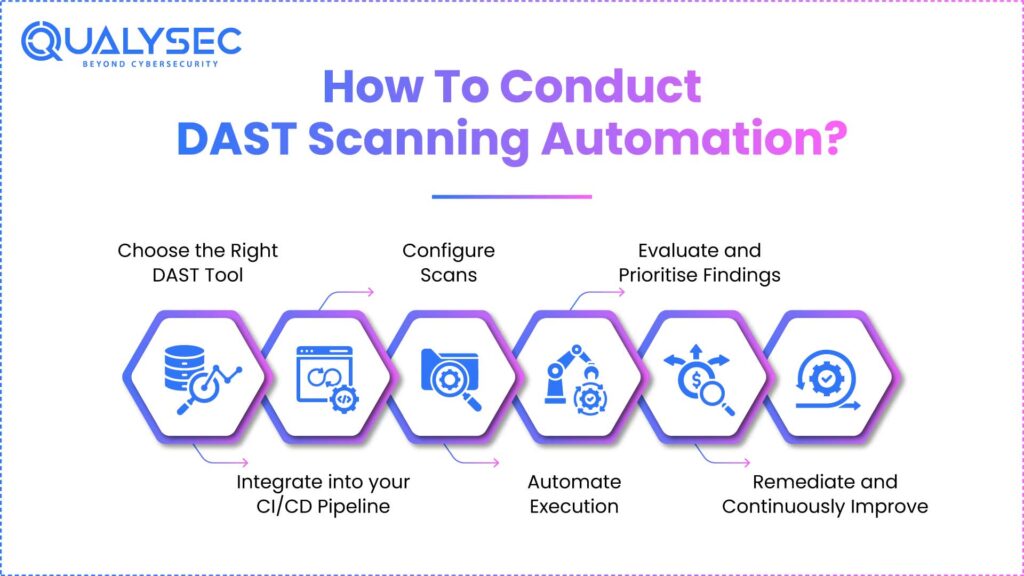
When DAST scanning is automated, security checks can automatically run as part of your development process without anyone needing to kick them off. This allows you to detect problems with your app earlier, fix them prior to release, and mitigate the risk of security problems. It allows teams to maintain strong protection with good speed for upcoming releases.
1. Choose the Right DAST Tool
Pick a solution that fits your technology stack and your security objectives (i.e. are you measuring security risk?). Commercial solutions like Invicti or Acunetix provide comprehensive features and great integrations, and open-source solutions like OWASP ZAP are free to acquire.
2. Integrate into your CI/CD Pipeline.
Integrate the DAST tool into your build and deployment pipeline. Configure the scan settings, authentication, target URLs, etc., so that the scans are triggered automatically after every build or staging deployment.
3. Configure Scans
Clearly define what you are scanning (specific endpoints and areas requiring authentication). Configure scan policies to only scan for vulnerabilities that are most important to you, such as injection flaws or misconfigurations.
4. Automate Execution
Utilise scripts or pipeline features to start scans in response to a triggering event such as code commit, nightly build, deployment event, etc. This ensures you maintain consistent security risk assessment without requiring additional effort.
5. Evaluate and Prioritise Findings
Integrate your DAST tool with a project management tool like Jira so that it can automatically log any issues. Prioritise vulnerabilities based on severity so your team resolves the most serious issues first.
6. Remediate and Continuously Improve
Remediate findings as soon as possible. After addressing findings, review the scans and adjust to improve. Keep your DAST tool updated and your DAST findings as a reference for your developer training and moving towards secure coding.
“Discover more in our article on DAST Application Security.“
Where Does Penetration Testing Fit in with DAST Automation?
Automated DAST scans are helpful in terms of speed and repeatability, but penetration tests add human interpretation into the process. Penetration testing capture complex business logic vulnerabilities that DAST tools may miss.
The best practice is to utilise automated DAST for continual testing as an ongoing approach, integrating periodic penetration tests for thorough analysis.
How can Qualysec help in DAST Automation?
Qualysec assists organisations in automating DAST by selecting the appropriate tools, setting the configuration, and providing a subject matter expert (SME) to help. Their team works with you to incorporate the DAST scans into your development process so that they run automatically when needed and do not impede work.
The Qualysec team sets the scan settings, authentication workflows, and scope to align with your application, to provide quality results without unnecessary false positives. All vulnerabilities discovered are prioritised and pushed directly into your issue ticketing systems to provide speed and a higher level of organisation for remediation.
As a bonus to simply running the scans, the Qualysec team readily provides remediation advice to provide developers with clear, actionable options. Additionally, the Qualysec team continuously monitors and optimises the automation irrespective of the event of a changing threat landscape.
Secure your apps before hackers find a way in — partner with Qualysec today.
Conclusion
DAST scanning automation allows you to keep your security testing at pace with modern development. Select an appropriate tool for your context, integrate automating scanning into your pipelines, and wrap it with solid remediation processes to identify, manage, and remediate any vulnerabilities earlier in the software development lifecycle while also decreasing risk.” Adding pentesting to the process will give you an overall, proactive security approach.
Don’t just test your apps, protect them — Qualysec makes it simple. Book a call today

FAQ’s
1. What is DAST scanning automation?
DAST scanning automation is the process of automatically executing dynamic application security tests in automated pipelines in order to find security vulnerabilities in running applications.
2. What tools support the automation of DAST scanning?
There are several popular tools available, like Invicti, Acunetix, and OWASP ZAP, among others.
3. How does automated DAST integrate into CI/CD pipelines?
Automated DAST tools are typically integrated into the pipeline scripts, allowing the scans to run automatically after builds or deployments are made.
4. What are the advantages of DAST scan automation?
Automation provides consistent testing, speed in the detection of vulnerabilities, and speed in remediation without impacting release velocity.