

Companies in India are realising that keeping secret information is not a choice or a luxury, but it is a survival issue. The ISO 27001 security audit is a review process that is conducted methodically to make sure that your information security management system (ISMS) is in line with international standards and best practices. Further, the ISO 27001 security audit assists in exposing vulnerabilities to allow the control of security to be enhanced and in an attempt to prove that compliance is being observed by the relevant stakeholders. Moreover, this detailed guide will take you through all elements of the ISO 27001 security audit process, which will help Indian organisations see the importance of such audits and how they can prepare properly by 2025.
Recent statistics have found that half of the organisations that have suffered a breach raise their security budgets. Hence, it is much cheaper to run an ISO 27001 security audit regularly, before a breach, than to manage it after it has taken place.
What is an ISO 27001 Security Audit and Why Should Indian Organizations Care?
The basis of an ISO 27001 security audit is the independent audit of information security compliance and practices of your organization. Moreover, it is a validation of your ISMS in line with ISO/IEC 27001: 2022 guidelines and global best practices. Also, this kind of audit evaluates whether your security controls, policies, and procedures are effective or not. As a result, these audits become very beneficial to Indian organizations, particularly those that are involved in finance, health care, information technologies, and manufacturing.
The ISO 27001 audit process evaluates several critical areas:
- Security Control Implementation: Enforcement of the security measures being in place.
- Policy Compliance: Assurance that employees adhere to the laid-down security policies.
- Risk Management: Evaluation of the effectiveness of your organization in identifying and reducing threats.
- Data Protection: Checking the security of sensitive customer and business data.
- Incident Response: Test of your preparedness to cope with security attacks.
- Continuous Improvement: Assessment of the ongoing attempts to enhance security.
Moreover, India is changing rapidly through the digital transformation process; hence, cyber threats are developing at a rapid rate. In this way, ISO/ IEC 27001 is the protection your organization needs in the constantly expanding, dangerous digital world.
What Do the Various ISO 27001 Audits entail?
The distinction between the types of audits should be known to prepare the compliance plan for Indian organisations. In particular, there are two large groups, i.e., ISO 27001 internal audit and ISO 27001 external audit. In fact, the two are mandatory in the acquisition and retention of certification.
ISO 27001 Internal Audit: Your First Line of Defence
An ISO 27001 internal audit is a self-audit that can be carried out by your internal team or an external consultant that you have employed. However, this audit is not similar to an external certification that is undertaken through official certification. It is also worth mentioning that internal auditing must be conducted by unbiased individuals who have received training based on the ISO 27001 standards.
Key characteristics of ISO 27001 internal audit requirements:
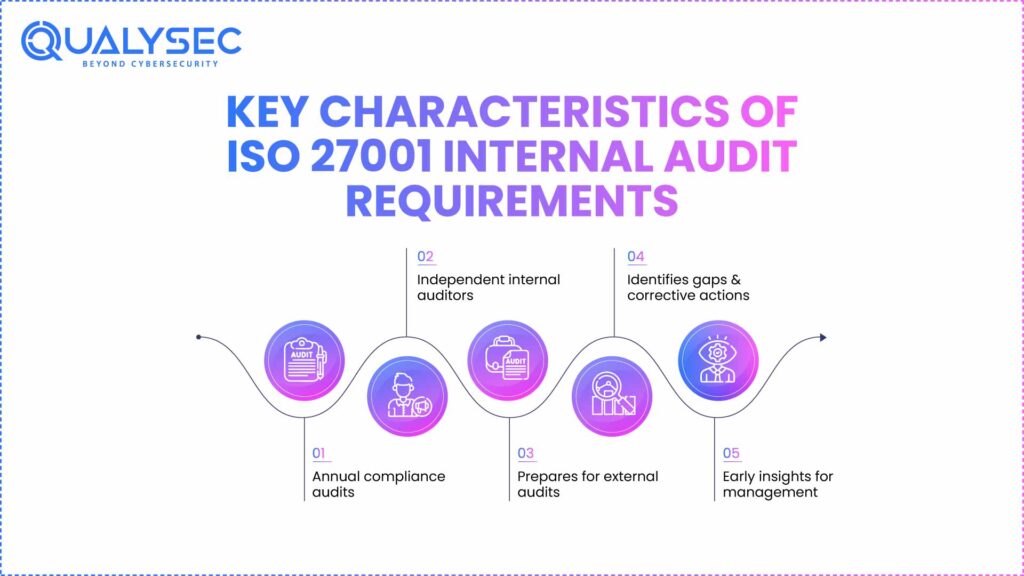
- Compliance should be checked at least once a year.
- Carried out by employees who are not involved in the management of the ISMS.
- Concentrates on the pre-arrival of external auditors to find gaps.
- Produces results that lead to corrective measures.
- Provides management with early-warning insights about security weaknesses
As such, you can schedule your internal audit of ISO 27001 at least 2-3 months before your external audit, where you will be allowed to correct any of the non-conformities that will be detected.
ISO 27001 External Audit: Your Path to Certification
The accredited independent certification bodies conduct an ISO 27001 external audit. Also, this formal assessment measures your ISMS against international standards. In addition, the external audit verifies the ISO 27001 standards by conducting a full field inspection.
Types of ISO 27001 external audit:
| Audit Type | Purpose | Frequency | Duration |
| ISMS Design Review (Stage 1) | Evaluate documentation and design | Once (initial) | 3-5 days |
| Certification Audit (Stage 2) | Verify operational effectiveness | Once (initial) | 5-10 days |
| Surveillance Audits | Monitor ongoing compliance | Annually | 2-3 days |
| Recertification Audit | Full system review | Every 3 years | 5-10 days |
Therefore, organizations will be required to go through Stage 1 and Stage 2 to get first certified. Subsequently, certification is done through an annual surveillance audit.
What is in an audit of ISO 27001 Compliance?
It is a full audit of your entire information security framework to determine its conformity to ISO 27001. Specifically, auditors test a number of factors within your security posture. In addition, it is also compensating to understand what is being audited to enable organisations to be more prepared.
Read our Security Compliance guide and secure your business future.
Documentation Review Phase
Auditors begin by examining all ISMS documentation, including:
- Security procedures and policies.
- Risk evaluation reports and treatment plans.
- Applicability Statement (SOA)
- Access control procedures
- Incident response plans
- Documentation on business continuity.
Operational Verification Phase
The auditors later provide field reviews to ensure that recorded procedures are indeed being adhered to. In particular, they examine:
- Actual security control implementation
- Employee training records and awareness programs
- Access logs and authentication records
- Backup and recovery procedures
- Physical security measures
- Vendor and third-party management contracts
Evidence Collection
Notably, auditors need physical evidence of conformity. Thus, they gather such evidence as:
- In action, system logs of security controls.
- Photographs of security settings.
- Completion certificates of training of employees.
- Documentation of incident response.
- Record and approval access.
- Patch management deployment history.
Auditors determine based on live evidence acquired in the course of documentation analysis, personal observations, and interviews with employees. Thus, well-organised, searchable records facilitate the process of audit process greatly.
Ensure regulatory compliance with a professional Security Audit.
How Often Should Your Organization Conduct ISO 27001 Audits?
The aspect of frequency of ISO 27001 audit requirements is based on the status of your organisation and the expectations of the certification body. Nevertheless, there are also some minimums which are universal.
Audit Schedule for Compliance:
In the case of new certified organizations, the audit plan schedule is as follows:
- Pre-certification phase: ISO 27001 internal audit must be conducted at least once (ideally, 2-3 months before external certification).
- Year 1 after certification: Final first surveillance audit.
- Year 2 after certification: Full second surveillance audit.
- Year 3: Entire recertification audit (compulsory)
- Ongoing: Ensure that ISO 27001 internal audit requirements are carried out annually as required by Clause 9.2.
Further, ISO 27001 does not specify the frequency of internal audits that an organisation should undertake. Nonetheless, annual internal audits are considered a best practice in most Indian organizations. As such, a regular audit calendar will be set to ensure a high level of compliance.
Talk with our experts today to understand your ISO 27001 certification cost and timeline. Schedule your consultation at Qualysec.

Why Is Qualysec the Best Company for ISO 27001 Audit in India?
Qualysec is the best CREST-accredited company in terms of offering audit and compliance services related to ISO 27001, which is the best company in India because it provides solutions that enable organisations to go through the certification process confidently and efficiently. In particular, Qualysec integrates profound technical expertise with industry-specific understanding to help Indian businesses solve the problematic issues that are specific to the finance, healthcare, IT services, and manufacturing sectors.
What makes Qualysec exceptional:
Qualysec will provide full-cycle ISO 27001 auditing services, including the gap analysis at the start and certification audit at the end as well as the subsequent surveillance audit. Also, they have a team of qualified ISO 27001 auditors who offer practical experience in dealing with organizations of both small and large scale, including start-up companies and established businesses. Moreover, Qualysec’s own compliance automation platform allows smoothing out the overall audit-readiness cycle, thereby saving on certification time and resource consumption.
Key strengths include:
- Expert Auditors: Experienced and qualified Lead Auditors for ISO 27001.
- India-Focused Solutions: Managing evidence collection and documentation through technology.
- Technology-Driven Approach: Open, with no secret charges to ISO 27001 auditor certification cost requirements.
- Transparent Pricing: Preparation of the audit, but development of a compliance roadmap.
- Strategic Guidance: Not only the preparation of audits, but also the development of a compliance roadmap in the long term.
- Multi-sector Experience: History of achievements in the field of finance, healthcare, IT, and e-commerce.
Moreover, the combined nature of Qualysec will ensure that you are not dealing with a number of vendors. Instead, you are provided with comprehensive assistance in all your ISO 27001 requirements. Also, they are more keen on continuous enhancement; hence, your organization will be in compliance long after the first certification.
Contact Qualysec today to discuss your specific audit requirements and timeline. Their experts can provide a customised roadmap for your organisation’s ISO 27001 journey.
Conclusion
The high-cost relocation to the ISO 27001 certification is a cost on the security picture and stance of your company. Moreover, in order to demonstrate good intentions, Indian organisations can make sure that confidential information is secure by undertaking internal and external audits of ISO 27001 security regularly, along with ISO 27001 Penetration Testing, which will help Indian organisations safeguard their critical information. In addition, the familiarity with the audit process, intensive training, and work with a team of highly qualified specialists, including Qualysec, will be a promising chance to achieve successful certification and the following compliance.
The time to begin is now. Start with a free ISO 27001 audit consultation with Qualysec to review your current security position and create your unique audit roadmap to 2025.
Frequently Asked Questions
1. What is an ISO 27001 security audit?
Consider an ISO 27001 security audit as a complete health check of your data protection systems in the company. An auditor is invited and inspects your security infrastructure, examines your policies and procedures, and finds out whether all that you are asserting to be in practice is actually happening. They are just confirming whether your information security management system is internationally fit and whether it manages your data reasonably.
2. Why is an ISO 27001 audit important?
The majority of firms learn the bitter lesson that it is such an expensive exercise to wait until an intrusion occurs. An IT audit based on ISO 27001 makes you stop issues before they turn out to be disasters. Besides, when dealing with large clients, or in finance or healthcare, they will usually demand this certification, and they are not even ready to enter into a contract with you. It is a form of a security badge that informs its customers that it cares about their data.
3. What are the types of ISO 27001 audits?
You have an ISO 27001 internal audit, which is simply you auditing yourself prior to any other person auditing you. Then there is the external audit offered by the ISO 27001 that is presented by the certified third-party organizations and that results in certification. The outer exterior is subdivided into some flavors, which include, in the first instance, the design review, which is the same as the certification audit; the annual surveillance audit; and lastly there is the massive recertification after every three years.
4. What does an ISO 27001 security audit include?
When an ISO 27001 compliance audit occurs, they will first look into the documentation that you have, and after that they will demand evidence that you are actually doing what you have written in the documentation. They will look at logs of access, training records, backup policies, physical security controls, vendor contracts- technically anything that has to do with information security. These are not boxes they are filling; they are seeking evidence.
5. How often should an ISO 27001 audit be conducted?
After certification, one of the ISO 27001 internal audit requirements is that you must meet its requirements at least once a year. On the outside, you will have to contend with the external audit needs of ISO 27001 external audit per year to monitor, and at the end of every three years, you undergo an entire recertification audit to renew your certificate. It is a lifetime thing and not a one-time event.