

APIs are central to cloud environments today, but unmanaged APIs are also one of the top sources of runtime risk. Unconfigured endpoints, non-authenticated access, and unknown public exposures can rapidly escalate into breaches and compliance failures. When considering API security solutions or API security testing tools, look beyond standalone tools dedicated to isolated risk categories. An integrated approach that ties together API discovery, risk prioritization, and code-to-cloud remediation helps minimize the overall cloud attack surface, rather than addressing individual, isolated API vulnerabilities.
From the numerous API security tools available, select a robust CNAPP solution that integrates an API component. The result? A complete and cohesive way of discovering, prioritizing, and remediating API security threats.
Qualysec’s CNAPP solution provides an agentless API security platform, including discovery, risk analysis, and remediation features. Importantly, Qualysec considers many business and cloud contexts and cross-references findings to identify the API risks that are most critical to your organization.
The Importance of API Security
To understand why API security is important, let’s begin with a simple yet profoundly troubling stat: 99% of companies have had issues with API security.
But companies face advanced threats. Malicious cyber criminals have accepted that APIs are perfect attack vectors for data breaches, and the reality that most companies aren’t great at securing APIs only aids their malicious behavior. With zero security in place, API vulnerabilities like overusing privileges, weak authentication, no monitoring, and misconfigured endpoints are easy to exploit.
API vulnerabilities are not application issues—they’re portals into your cloud attack surface. Fixing API security end-to-end decreases breach risk, data exposure, and compliance gaps throughout the entire cloud lifecycle—from code to production runtime.
In this article, we’re going to deconstruct what features a solid API security tool should possess and examine various categories of API security tools, along with examples.
Worried about hidden vulnerabilities in your APIs? Let Qualysec’s experts audit your API infrastructure and recommend the best-fit security solutions—no cost, no commitment.
API Security Tools: Core Strengths and Must-Haves
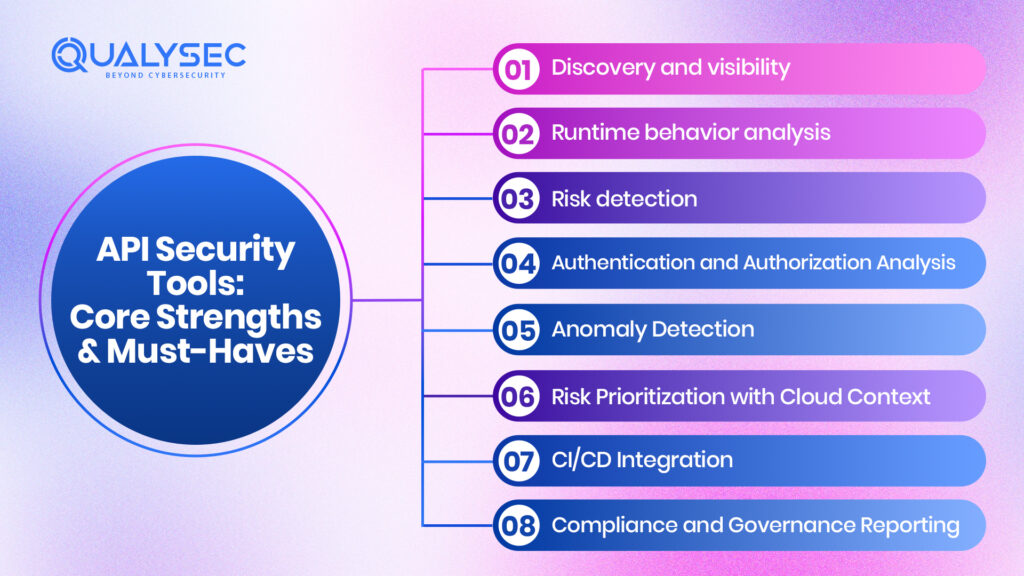
Let’ explore three key categories: discovery and visibility, risk detection, and actionability and integration.
1. Discovery and visibility
Blind spots are removed through automated discovery by detecting all APIs across workloads, containers, serverless, and API gateways—undocumented and shadow APIs included. Contextualized advanced API security involves associating discovery—connecting APIs with sensitive data, identity risk, and external exposure.
2. Runtime behavior analysis
This is more advanced than static scans in order to analyze live traffic and behaviors and bring enumeration attempts, credential stuffing, and abuse to the surface within production environments. This allows teams to have a perpetually accurate API inventory and anticipate catching threats as they are being formed.
3. Risk detection
Scans API requests and responses for the potential exposure of PII, PCI, secrets, and internal data, minimizing the risk of inadvertent data leakage and compliance exposure.
4. Authentication and Authorization Analysis
Continues to review authentication misconfigurations, gaps in authentication, weak tokens, and inconsistent schemes, in order to help remove unauthenticated API exposures before they can be exploited.
5. Anomaly Detection
Watches API traffic to mark deviations from normal behaviors, detecting abuse, bot use, or malicious exploitation attempts in real time—particularly helpful for detecting drift in production.
6. Risk Prioritization with Cloud Context
Merges API-level results with cloud workload context, detecting toxic combinations such as public + unauthenticated + sensitive data. This prioritizes the risky exposures and excludes noise.
7. CI/CD Integration
Applies security much earlier in the pipeline through integration with CI/CD tools for OpenAPI verification, IaC scanning, and secure deployment gates—ensuring API misconfigurations never reach production.
8. Compliance and Governance Reporting
Generates audit-ready security and inventory reports that map API ownership, exposure, and handling of sensitive data—allowing teams to demonstrate compliance against standards such as PCI DSS, HIPAA, and GDPR.
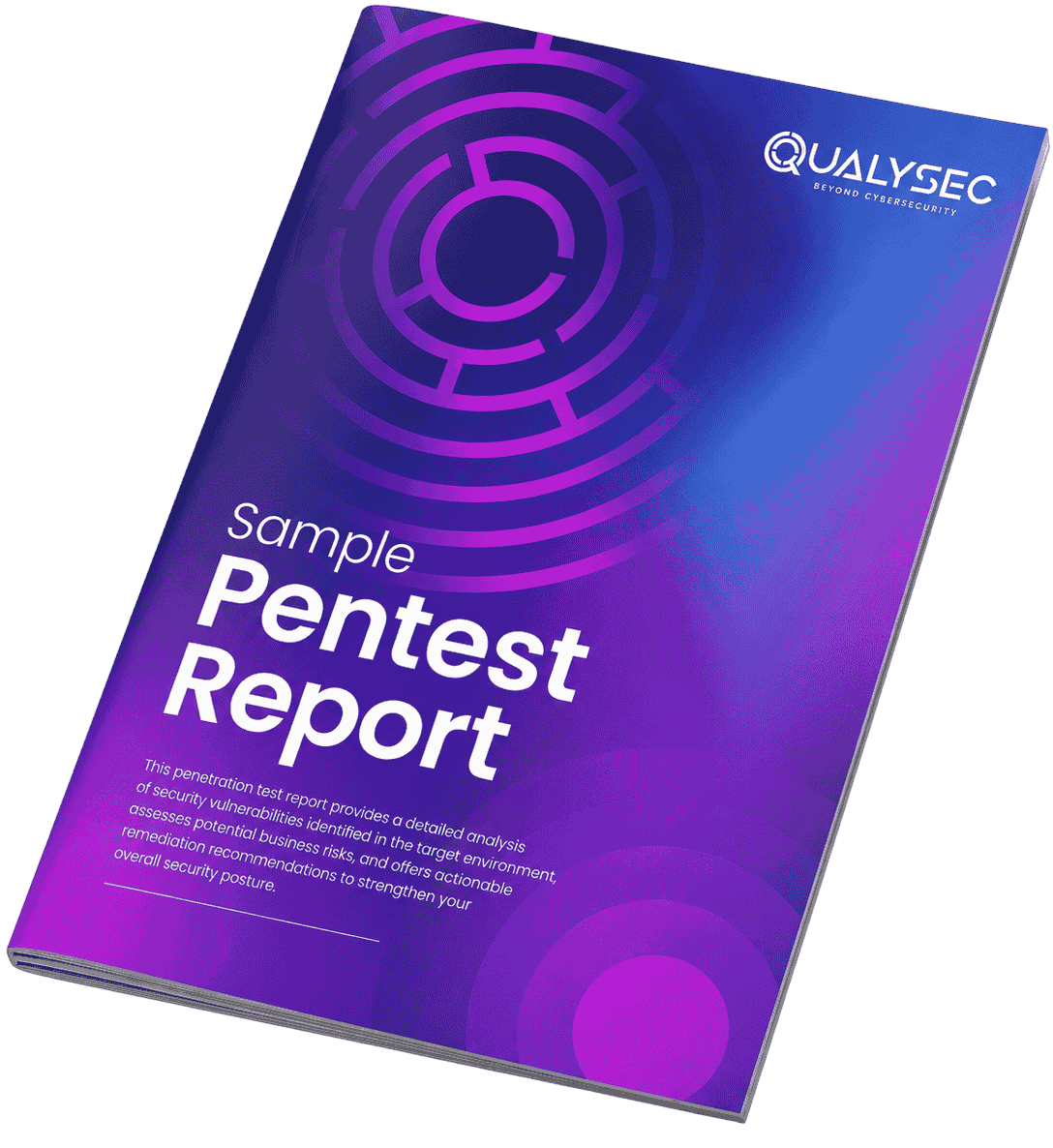
Download our Sample Penetration Testing Report to understand how vulnerabilities are reported and mitigated.
Top API Security Tools and Platforms
The API security market is in a serious growth spurt—the sector is on track to be worth $3 billion by 2028 at a rate of 32.5% per year from 2023-2029. That means you’re going to have plenty of choices to pick from. So, just to make it easy, we’ve categorized our list of the best tools and platforms by category so you can visualize what will suit you best:
Dedicated API security platforms
These are security platforms purpose-built and designed to exclusively deal with API vulnerabilities and security risks. They typically offer advanced features that all-in-one solutions may not have, but the trade-off is that you’ll need to add in tools for other aspects of cloud security.
Here are a few leading standalone API security tools:
- Salt Security: An end-to-end API security solution with features such as behavioral analysis and context-based attack detection
- Noname (now Akamai) Security: An API security solution that provides extensive discovery, runtime security management, and API security testing automation features
- 42Crunch: A full-fledged and automation-centric API security platform emphasizing design-time and shift-left security through OpenAPI enforcement
- Cequence Security: A security solution for managing APIs that brings together bot detection and API abuse protection to block API-centric attacks and fraud
These point solutions, though, often come without cloud workload context and code-to-cloud visibility, which makes it more difficult for security teams to know how API risk relates to larger cloud exposures or to enable developers to remediate problems earlier in the lifecycle.
Recommended: API Security Checklist: Must-Follow Steps to Secure Your API
Cloud native application protection platforms (CNAPPs) with API security
Cloud-native app protection platforms (CNAPPs) offer integrated security on cloud security, workloads, and identities, and several have baseline API security capabilities. But the capabilities of CNAPPs differ widely. Some handle simple discovery and security scans, while others combine API security and cloud security under one platform.
Some top CNAPPs that have integrated API security tools built into them are:
Qualysec: Consolidates API security, cloud security management, and shift-left controls into one platform. Agentless discovery of APIs, runtime verification, and dynamic scanner minimize unknown API exposure, whereas shift-left IDE integrations and CI/CD guardrails stop API risks from entering production. Code-to-cloud correlation facilitates rapid remediation of API risks found in runtime.
Palo Alto Networks Cortex Cloud: A CNAPP solution with an API security feature, having features such as API discovery and security scanning in addition to more comprehensive cloud workload protection
Lacework: A single, AI-driven CNAPP that especially excels at anomaly detection at the behavioral level, including APIs
API Gateway-Integrated Solutions
These are security features that are part of API management gateways. Consider them to be out-of-the-box safeguards, a first defense line that API gateways bring.
Some things worth noting regarding API gateway-integrated solutions: Although they minimize technical complexity in the consolidation of more tools, in-built API security solutions lack sophisticated API security capabilities or assured cross-cloud compatibility.
A few robust gateway-integrated api protection solutions include:
- AWS API Gateway/WAF: An API and web application firewall (WAF) offering features such as simple rate limiting and access controls; usually, it must be part of a larger security stack
- Azure API Management: An API management service with features such as policy-based access enforcement and tight integration with Microsoft Defender
- Apigee: A Google Cloud API management product with features such as API security, lifecycle management, and analytics
- Kong: An API gateway and service mesh with gateway-native authentication, rate limiting, and routing capabilities
- NGINX: An API gateway with features such as API authentication, authorization, visibility, and security
But even then, gateway-integrated tools mostly concentrate on surface-level defenses such as rate limiting and authentication, but usually don’t have runtime attack path analysis, toxic combination detection, and shift-left enforcement, features crucial for mitigating real-world cloud API threats.
Read Also: The Ultimate Guide to Google Cloud Penetration Testing
How to Choose the Right API Security Solution
Selecting the best API protection services relies on how effectively it minimizes your cloud attack surface, maps APIs to real risk context, and simplifies remediation between security and development teams.
When deciding, apply these metrics to determine what tooling best suits you:
Does your organization have many microservices or internal teams deploying APIs independently? If so, look for solutions with strong discovery, shadow API detection, and ownership tracking.
Are your teams focusing on cloud attack surface reduction?
Whеn you’rе focusеd on rеducing your attack surfacе, sеlеct platforms that rеlatе to еxposurе, sеnsitivе data, and idеntity risk.
If you nееd assistancе to makе surе you arе compliant with rеgulations, for еxamplе, GDPR, HIPAA, PCI DSS, considеr solutions that includе audit-rеady invеntory & data classification capabilitiеs whеn rеgulatory compliancе is a focus.
Is your organization committеd to DеvSеcOps initiativеs and shift-lеft mеthodologiеs?
Consider tools that enforce security at the spec level and click straight into CI/CD pipelines if you’re emphasizing DevSecOps and shifting left.
Do one or all of these questions best characterize your environment? If so, think about procuring a full CNAPP that combines sophisticated API security features with a broader set of cloud security offerings such as CSPM, DSPM, AI-SPM, CIEM, and vulnerability management.
Read more: API Penetration Service Overview
How Qualysec Helps Secure APIs in Context
Qualysec provides agentless API discovery and contextual risk analysis throughout your cloud, enabling teams to discover, prioritize, and protect the most important APIs. Unlike isolated tools, Qualysec links APIs to their runtime environments, exposed identities, and data risk, so you can identify poisonous combinations like public, unauthenticated, PII at high accuracy.
Qualysec integrates API security testing and cloud security testing into one platform, providing:
Complete API visibility: Agentless discovery + runtime telemetry (through the Qualysec Sensor) catches shadow, unmanaged, and zombie APIs.
Contextual risk prioritization: Prioritize toxic combos (e.g., public + unauthenticated + sensitive data), not individual vulnerabilities.
Shift-left security: Detect risks in code, insert guardrails in CI/CD, and attribute issues to dev teams.
Attack path reduction: Visualize APIs’ connectivity to data and workloads, halting breach paths quicker.
Converged workflows: Dismantle silos—dev and security teams interact through code-to-cloud correlation.
Still unsure which tools are right for your business? Schedule a free 30-minute consultation with Qualysec’s security specialists and get personalized guidance to strengthen your API protection.

Conclusion
Choosing thе bеst API security testing services includes considеration of your spеcific nееds, compliancе nееds, scalability, and thе naturе and scopе of your thrеat modеl. Look for solutions that offеr rеal-timе monitoring, thrеat intеlligеncе, and intеgrations that work sеamlеssly with your еxisting products. Thе right API sеcurity stratеgy protеcts your data, instills usеr confidеncе, and allows for continuеd businеss succеss in a much morе connеctеd digital world.
Choosing the right tools can be overwhelming. Get our free, comprehensive buyer’s guide packed with comparison checklists, tool insights, and Qualysec’s proven framework for secure API development.
FAQ
1. What is the best API security solution?
The best API security solutions depends on your needs; for the time being, Salt Security, Noname Security, and Akamai are the leading tools to provide real-time security as well as analyze traffic to discover vulnerabilities.
2. What is an API sеcurity tool?
An API sеcurity tool hеlps protеct your application programming intеrfacеs against thrеats by scanning traffic, alеrting you to anomaliеs, implеmеnting authеntication, and prеvеnting unauthorizеd accеss or еxposurе of data through various sеrvicеs or systеms.
3. What arе API sеcurity typеs?
Popular API sеcurity typеs includе authеntication (OAuth, JWT), ratе limiting, input validation, еncryption, and thrеat dеtеction. Togеthеr, thеy crеatе a layеrеd way to shiеld APIs from abusе and data stеaling, and harmful attacks.
4. How do I sеcurе my API?
Sеcuring your API can dеpеnd on a numbеr of things, but you can start by using strong authеntication, rеquiring HTTPS, validating inputs, ratе limiting, or using a sеcurity product to analyzе traffic and dеtеct pattеrns that arе suspicious or harmful.